

Key Takeaways
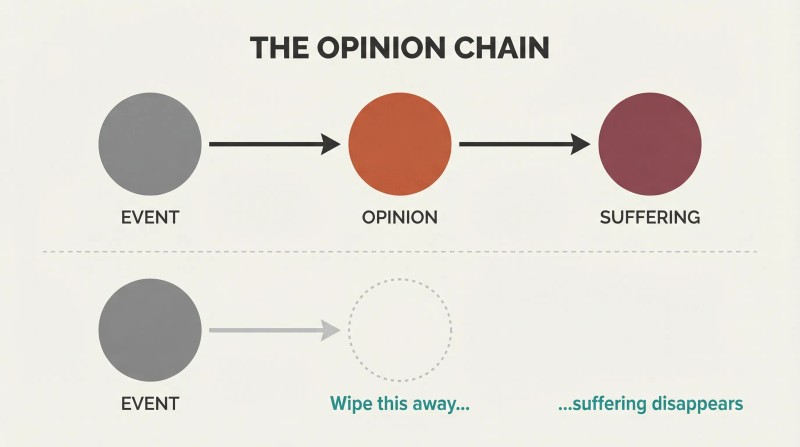
Wipe away the opinion and the suffering disappears
This is the backbone of the Meditations. Marcus Aurelius — Roman Emperor from 161 to 180 AD — wrote these private journal entries while governing through wars, plagues, and betrayals. The single idea he returns to more than any other: external events don't cause your suffering. Your interpretation does. When something frightens you during the day, Marcus argues, it's your beliefs about the event scaring you, not the event itself. Release the belief, and the fear dissolves.
The practice is ruthlessly simple. You hear someone spoke poorly of you — are you hurt? It's only a report about some words. Don't let imagination concoct a drama. A cucumber tastes bitter? Throw it away. Thorns on the path? Walk around them. Don't add "Why do these things exist?" Identify the opinion causing pain, question it, wipe it clean.
Your quietest retreat is already inside your own mind
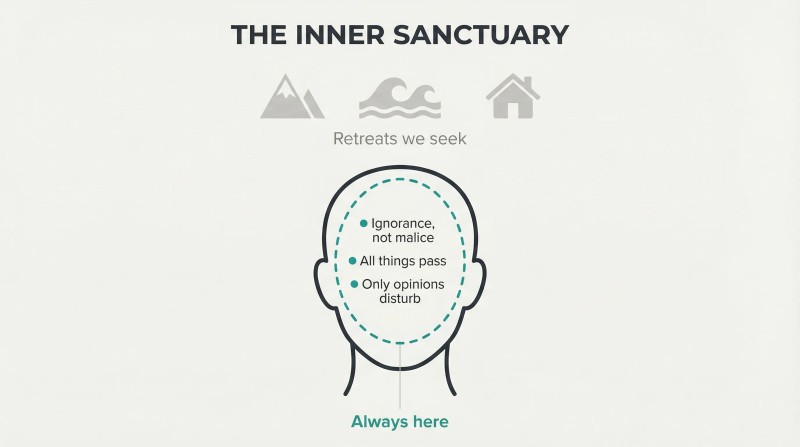
People daydream about escape. Marcus observes that we long for country houses, seaside retreats, and mountain getaways. But the quietest place on earth is already available: your own well-ordered mind. He calls this the "inner sanctuary" — a mental retreat you can take at any moment, anywhere, without packing a bag.
The retreat has a protocol. Enter with a few bedrock principles to clear your mind:
1. Humans are social creatures — some do wrong unconsciously, from ignorance
2. Everything is in flux — what troubles you now will soon be dust
3. Your soul is untouchable by external circumstances — only your own opinions disturb it
Then return to the world refreshed. It doesn't matter whether you're in a palace or a prison — your interior landscape stays the same.
Brace for difficult people before breakfast
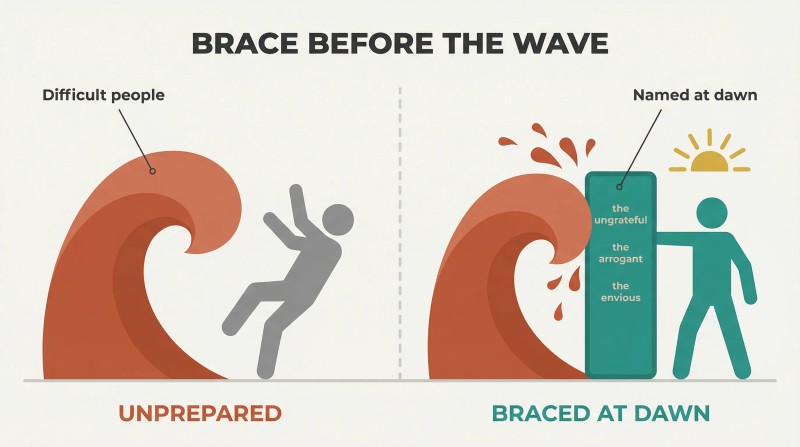
Marcus opens Book 2 with this morning ritual. Before meeting anyone, he deliberately names every difficult personality he'll encounter that day: the nosy, the ungrateful, the arrogant, the deceitful, the envious, the unsocial. This isn't pessimism — it's emotional vaccination. By naming the difficulty in advance, the sting is removed before it arrives.
The antidote is understanding, not anger. Marcus reminds himself that difficult people act from ignorance, not malice. More importantly, he recognizes shared humanity: we were made to work together, like pairs of hands, feet, eyelids, or rows of teeth. To hate each other is against the laws of nature. The person who has already braced for the wave stands firm against it.
Your soul takes the color of your recurring thoughts
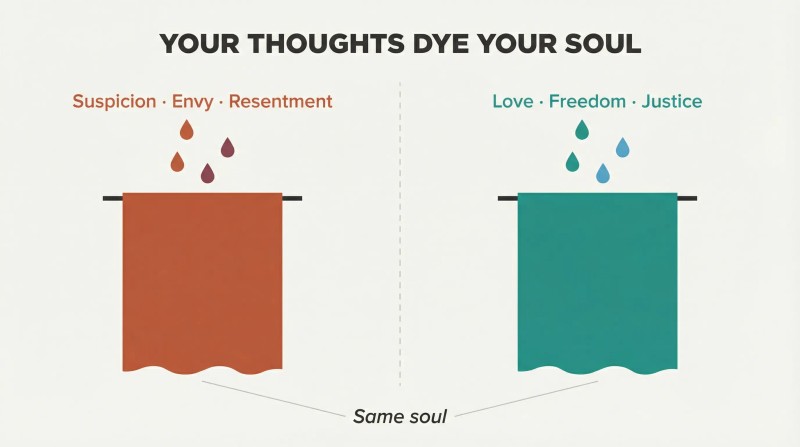
Character isn't built in single heroic moments. Marcus argues your soul is the accumulated residue of every thought you've entertained over time — like fabric slowly soaking in dye. Spend years dwelling on suspicion, envy, and resentment, and your character absorbs those colors permanently. Even your face changes: a person who frowns often distorts their countenance into a permanent scowl, extinguishing all natural loveliness.
The remedy is displacement, not repression. Rather than struggling to suppress negative thoughts — which only gives them more attention — crowd them out. When in pain, don't let imagination amplify suffering by projecting it into next week. Keep pain local and present, and it remains bearable. Fill the remaining space with what you want to become.
Call things by their true names and false prestige vanishes
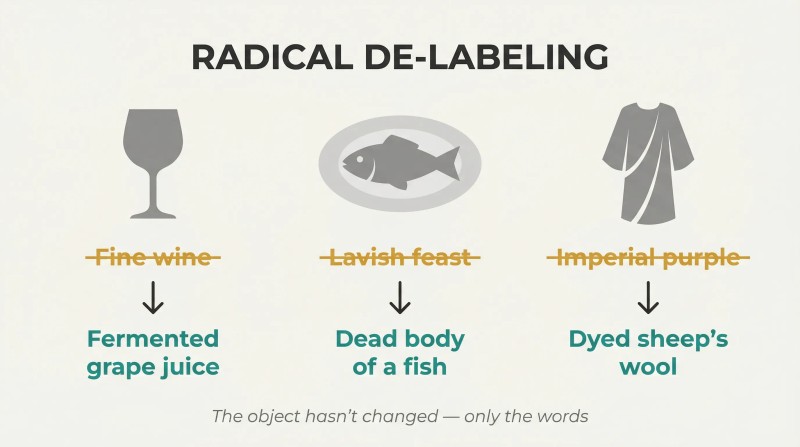
Marcus practices radical de-labeling. At a lavish imperial banquet, he pauses to reframe what's on the table: this is the dead body of a fish; that is the dead body of a pig; this fine wine is only fermented grape juice; my purple robe is sheep's wool stained with the blood of a shellfish. The technique strips away prestige by replacing euphemisms with literal descriptions.
The flip side is equally revealing. True beauty and virtue don't need labels either — they're self-evident. A clear, fine-cut gem doesn't lose its luster when no one praises it. Truth doesn't become false because it's unpopular. By removing inflated language from impressive things and deflating language from ordinary things, you see reality unfiltered by status, marketing, or fashion.
Redefine 'harm' — only what worsens your character counts
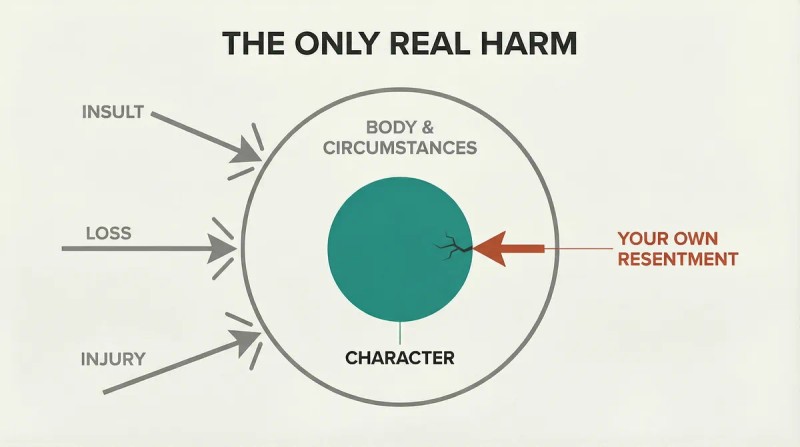
Marcus narrows the definition of harm radically. In ordinary usage, harm means any injury, insult, or loss. Marcus insists: the only real harm is what makes you a worse person — what degrades your reason, virtue, and character. Everything else is merely things happening to your body or circumstances, which are outside your control anyway.
This reframe disarms resentment. He uses a wrestling analogy: during a match, your opponent scratches you and slams your head against the mat. Afterward, you shake hands and walk away — no grudge, no drama. Apply this standard to every arena of life. When someone wrongs you, their wicked deed stays where it happened. Don't pick it up and carry it forward as a resentment. They harmed their own character, not yours.
Obstacles don't block your path — they become your path
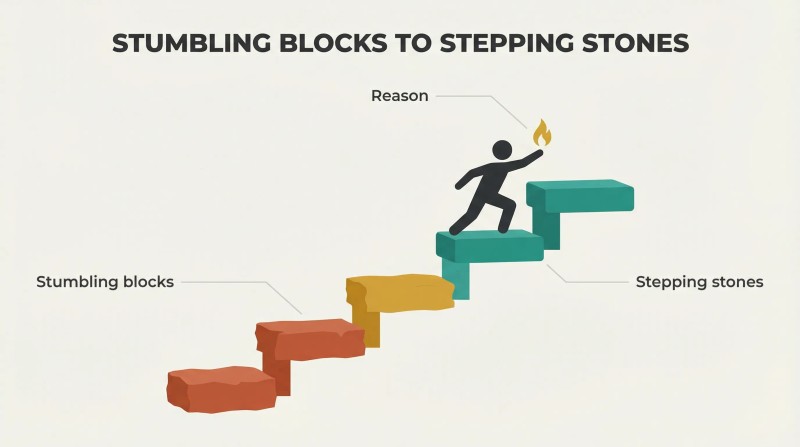
Marcus compares reason to a fire. A small spark can be snuffed out by contact with a heavy object, but a roaring blaze consumes whatever is thrown into it and burns hotter because of it. Reason works the same way — it doesn't need particular circumstances to function. It works with every circumstance, turning obstacles into raw material.
The practice goes beyond resilience. When someone blocks your goal, don't rage — draw on a different virtue. Patience, humility, creativity, persistence. Whether or not you reach your original objective, you gain a deeper, stronger character than you would have otherwise. If something blocks evolution's path, the unfolding universe absorbs it, transforms it, and uses it. As rational children of that universe, we inherit the same ability.
You own exactly one moment of life — this one
Marcus poses a devastating thought experiment. Suppose you lived a thousand years — or ten thousand. Would you possess any more life than you do right now? When you finally died, would you lose more than someone who died today? No. The past is gone, the future is fog, and the present moment is all anyone ever has.
This makes all lives equal in the deepest sense. Eternity revolves like a wheel, its circumference always touching one still point: now. Whether you stand there for a hundred years or infinitely, you'll only see the same cycles repeating. Marcus extends this to death: it's nothing more than nature's recycling, an olive falling from its tree. If you stop mourning what's behind and fearing what's ahead, you free enormous energy for the only moment where action is possible.

Internalize your principles until they're part of your body
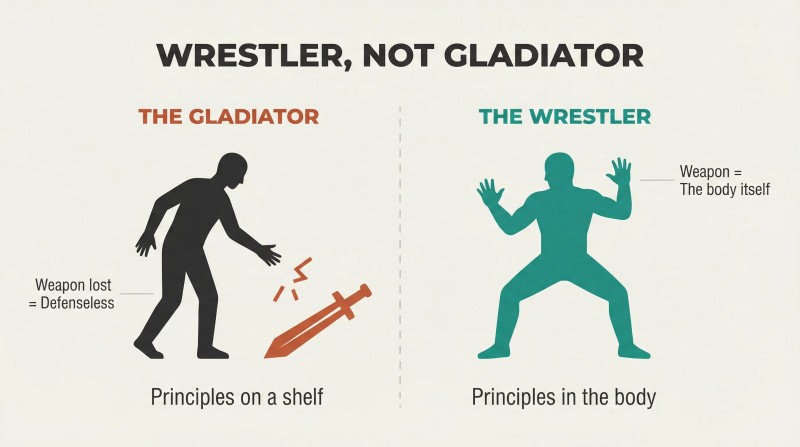
Marcus contrasts two fighters. A gladiator depends on his sword — knock it from his hand and he's finished. A wrestler's only tools are his hands, inseparable from who he is. The lesson: don't leave philosophical principles on a bookshelf like a gladiator's weapon. Make them part of you, available instinctively in any crisis.
This demands daily rehearsal. Principles can't die, Marcus writes — they can only be forgotten. The danger isn't that life will present unbearable challenges; it's that you'll forget your training in the heat of the moment. He points to a physical parallel: your left hand is clumsy at most things because you always favor the right, yet it controls the horse's bridle expertly — because that's the one task you've given it relentless practice.
The blessed state you're dreaming of is available right now
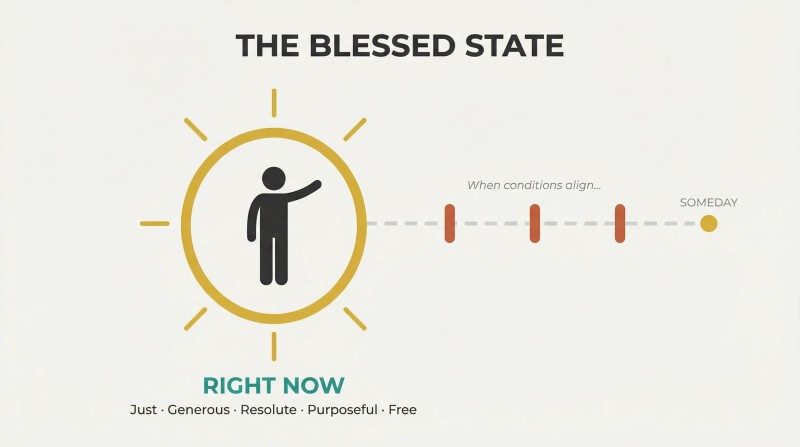
Marcus catches himself fantasizing. He notices the mind's tendency to project contentment into a future "someday" — when conditions finally align, when the palace is quiet, when the wars end. He writes: the blessed state you seek is available in this moment. Simply let go of the past, trust the future to providence, and live right now in harmony with reason.
He demolishes every excuse for delay. Can't return to the academy? You don't need a philosophy degree — you need to practice philosophy. Too busy with imperial duties? You have ample time to cultivate humility and listen to reason. Work simply, humbly, consistently. Don't wait for the perfect time or a crowd of onlookers to cheer. Success builds upon success. When an actor is called to leave the stage, it's ridiculous to demand three more acts — that's the playwright's decision, not the actor's.
Analysis
The Meditations holds a unique position in intellectual history: a private journal by the most powerful person in the Western world, arguing relentlessly that external power is irrelevant to happiness. Marcus Aurelius had unlimited means to distract himself from suffering — yet chose the harder path of mastering his own mind. That choice, repeated across hundreds of entries, is what separates this from motivational literature.
The cognitive behavioral therapy parallel deserves emphasis. Marcus's technique — identify the distressing opinion, question it, wipe it away — is essentially Beckian CBT written eighteen centuries early. Sam Torode's paraphrase makes this connection explicit, noting that Stoicism underlies rational emotive therapy, cognitive behavioral therapy, and positive psychology. The Meditations is arguably the oldest self-help book still in active use, and its therapeutic mechanism has been empirically validated by modern psychology.
What distinguishes Marcus from other Stoics is his radical intellectual humility. He never claims enlightenment. He writes the same reminders repeatedly because he keeps forgetting them — just as we all do. The repetitive, journal-entry format isn't a literary weakness; it's the philosophical point. Wisdom isn't learned once; it's practiced daily.
The work also contains an underappreciated political philosophy. Marcus envisions a polity with one law for all, equal rights, freedom of speech, and a ruler who respects the freedom of the governed above all else. For a Roman Emperor to write this privately — with no audience to impress — suggests genuine conviction, not performance.
The Meditations' enduring resonance comes from its battle-tested context. Marcus governed during the Antonine Plague, fought Germanic tribes on the Danube frontier, and endured personal betrayals. His Stoicism wasn't theoretical. When he writes about standing firm like a stone cliff, he's not metaphorically describing bad traffic. That authenticity — an emperor admitting he still struggles to get out of bed — is precisely why this text feels startlingly modern nearly two millennia later.
Review Summary
Meditations by Marcus Aurelius is highly regarded as a timeless work of Stoic philosophy. Readers appreciate its wisdom on life, death, and virtue, finding it applicable to modern challenges. The book's accessibility and profound insights make it a frequent re-read for many. Some criticize its repetitiveness and deterministic views, while others praise its practical advice on mindfulness and self-improvement. Many reviewers recommend it as essential reading, noting its enduring relevance and potential to positively impact one's perspective on life.
People Also Read









Glossary
Inner sanctuary
Mental retreat for self-renewalMarcus's term for the practice of retreating into one's own well-ordered mind when the external world becomes chaotic. Instead of physically escaping to a country house or seaside, you enter your own thoughts, apply a few bedrock principles (people act from ignorance, everything is impermanent, the soul is untouchable by externals), and return to the world refreshed and clear-headed.
Spark of divinity
Reason as divine gift withinMarcus's recurring metaphor for the rational faculty he considers the highest human capacity. He views each person's reason as a fragment of universal intelligence—a spark loaned from the divine Source that connects the individual to the cosmic order. Preserving and nurturing this spark through clear thinking and virtuous action is, for Marcus, the central purpose of human life.
Ruling principles
A person's core motivating beliefsThe fundamental beliefs and values that govern someone's behavior—what they pursue and what they avoid. Marcus advises evaluating people not by outward circumstances or appearances but by identifying their ruling principles, which reveal true character. A person's body may be maimed or dirtied while the light of reason burns bright within, or vice versa.
Equanimity
Calm acceptance of all eventsAs Marcus defines it: the calm, evenhanded acceptance of everything that exists and everything that happens. This means treating pleasure and pain, honor and dishonor, wealth and poverty, life and death with the same impartial composure—not because you're indifferent, but because you recognize that none of these things are inherently good or bad. They simply are what nature and fate have prescribed.
Magnanimity
Greatness of spirit beyond fearMarcus defines magnanimity as a largeness of soul that remains unmoved by three specific temptations: the lure of pleasure, the lust for fame, and the fear of death. It is not bravado or arrogance but an elevated inner state where external pressures—whether seductive or threatening—cannot shrink or distort the soul's natural expansiveness and generosity.
FAQ
What's "The Meditations: An Emperor's Guide to Mastery" about?
- Philosophical Journal: The book is a collection of personal writings by Roman Emperor Marcus Aurelius, reflecting on Stoic philosophy and personal growth.
- Stoic Principles: It emphasizes Stoic principles such as focusing on what is within our control and accepting what is not.
- Practical Guidance: The text offers practical guidance on achieving peace of mind and living a virtuous life.
- Personal Reflections: It includes Aurelius's reflections on his own life, challenges, and the lessons he learned from his teachers and experiences.
Why should I read "The Meditations: An Emperor's Guide to Mastery"?
- Timeless Wisdom: The book provides timeless wisdom on how to live a fulfilling and meaningful life.
- Practical Philosophy: It offers practical advice on dealing with everyday challenges and maintaining inner peace.
- Self-Improvement: Readers can gain insights into self-improvement and personal mastery through Stoic philosophy.
- Historical Insight: It provides a unique historical perspective from one of Rome's most respected emperors.
What are the key takeaways of "The Meditations: An Emperor's Guide to Mastery"?
- Control and Acceptance: Focus on what you can control and accept what you cannot.
- Inner Peace: Achieve peace of mind by nurturing positive thoughts and disregarding negative influences.
- Virtuous Living: Live according to nature and reason, embracing virtues like justice, truth, and courage.
- Community and Cooperation: Recognize the importance of living in harmony with others and contributing to the common good.
How does Marcus Aurelius define Stoicism in "The Meditations"?
- Focus on Control: Stoicism involves focusing on what is within our power and letting go of what is not.
- Emotional Regulation: It teaches that emotions should not control us; instead, we should respond with reason.
- Nature and Reason: Living in accordance with nature and reason is central to Stoic philosophy.
- Acceptance of Fate: Stoicism encourages accepting fate and viewing challenges as opportunities for growth.
What are the best quotes from "The Meditations" and what do they mean?
- "Your experience of life is determined by how you look at it." This emphasizes the power of perception in shaping our reality.
- "Retreat into your inner sanctuary." It suggests finding peace and clarity within oneself, away from external distractions.
- "To change your experience, change your opinion." This highlights the Stoic belief in the power of changing one's mindset.
- "Live each day as if it were your last." It encourages living with purpose and urgency, focusing on what truly matters.
How does Marcus Aurelius suggest achieving peace of mind in "The Meditations"?
- Mindful Reflection: Regularly reflect on your thoughts and actions to align them with your principles.
- Inner Sanctuary: Retreat into your inner self to find peace away from external chaos.
- Acceptance: Accept what you cannot change and focus on what you can control.
- Virtuous Living: Live according to virtues like justice, truth, and courage to maintain inner peace.
What role does nature play in "The Meditations"?
- Harmony with Nature: Living in harmony with nature is a key Stoic principle emphasized by Aurelius.
- Universal Order: Nature is seen as a universal order that we are a part of, and aligning with it brings peace.
- Acceptance of Change: Nature is constantly changing, and accepting this change is essential for a Stoic life.
- Source of Reason: Nature is the source of reason, and living according to it leads to a virtuous life.
How does Marcus Aurelius view death in "The Meditations"?
- Natural Process: Death is viewed as a natural and necessary part of life.
- Acceptance: Accepting death as part of the universal order is crucial for peace of mind.
- No Fear: Death is not to be feared, as it is simply a transition in the cycle of nature.
- Focus on Life: Instead of fearing death, focus on living a virtuous and meaningful life.
What advice does Marcus Aurelius give on dealing with others in "The Meditations"?
- Community Living: Recognize that humans are social beings meant to live in harmony with others.
- Tolerance and Understanding: Be tolerant and understanding of others' faults and ignorance.
- Focus on Self: Focus on improving yourself rather than judging others.
- Teach or Tolerate: When encountering wrongdoing, either teach the person or tolerate them.
How does "The Meditations" address the concept of fate?
- Acceptance of Fate: Accepting fate is a central theme, as it is beyond our control.
- Providence or Chance: Whether guided by providence or chance, circumstances can be turned to our benefit.
- Role in the Universe: Each person has a role in the universe, and accepting this role leads to peace.
- Embrace Destiny: Embrace your destiny and use it as an opportunity for growth and learning.
What is the significance of reason in "The Meditations"?
- Guiding Principle: Reason is the guiding principle for living a virtuous life.
- Inner Light: It is seen as the inner light that helps us navigate life's challenges.
- Objective Perspective: Reason allows us to view situations objectively and respond appropriately.
- Connection to Nature: Reason connects us to the universal intelligence and helps us live in harmony with nature.
How does Marcus Aurelius suggest handling obstacles in "The Meditations"?
- Opportunities for Growth: View obstacles as opportunities for growth and learning.
- Reason and Imagination: Use reason and imagination to turn obstacles into stepping stones.
- Focus on Control: Focus on what you can control and let go of what you cannot.
- Inner Strength: Draw on inner strength and virtues to overcome challenges and maintain peace.
About the Author
Download PDF
Download EPUB
.epub digital book format is ideal for reading ebooks on phones, tablets, and e-readers.








































