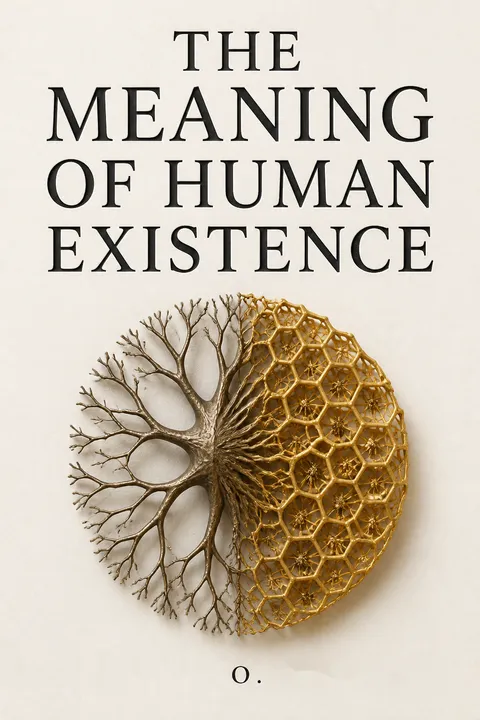

Key Takeaways
1. Humanity's Accidental Origin and Inherent Conflict
Humanity, I argue, arose entirely on its own through an accumulated series of events during evolution.
Meaning's dual nature. The concept of "meaning" can be understood in two ways: intentional design by a designer, or as the result of historical accidents and physical cause-and-effect. While organized religions favor the former, science embraces the latter, viewing human existence as an unfolding reality shaped by evolution, not predestination. This scientific worldview suggests we are not here for a purpose, but rather our capacity for purpose emerged from evolutionary processes.
Proximate vs. ultimate. To truly understand the human condition, both proximate (how we are) and ultimate (why we are this way) explanations are needed. Our anatomy and emotions are hardwired for certain activities (proximate), but the ultimate explanation reveals why this specific hardwiring evolved. This dual perspective is crucial for self-understanding and navigating future choices, such as the profound moral dilemma of directing our own evolution through volitional selection.
Self-made and fragile. We are a self-made, independent, and fragile biological species adapted to a biological world. Our existence is not a divine test or machination, but simply "the way things worked out." This inherent conflict, born from our evolutionary path, might be the only way human-level intelligence and social organization can evolve, serving as a primary source of our creativity.
2. The Imperative for Unified Knowledge: Science and Humanities
The time has come, I believe, to make a proposal about the possibility of unification of the two great branches of learning.
Enlightenment's stalled dream. The original Enlightenment sought to unify all knowledge through science and reason, but it faltered due to unmet expectations and the rise of Romanticism, which emphasized the humanities' unique domain of human feeling. For two centuries, science and humanities diverged, becoming "two cultures" separated by a perceived chasm.
Resuming the quest. Today, enough is known to resume this quest for unification, which is vital for solving modern problems like religious conflict, moral ambiguities, and environmentalism. This convergence should be central to liberal education, fostering a holistic understanding of humanity's place in the cosmos. The most successful scientists, like poets, think wide-ranging and sometimes fantastically, but work with rigorous, fact-based discipline.
Anthropocentric addiction. Both science and humanities stem from the same creative wellspring, yet the humanities often remain anthropocentric, endlessly exploring human experience. This fascination with ourselves, rooted in our primate evolution, sharpens social intelligence and fuels our love for stories. However, a full understanding requires science to reveal the origins of our traits and place us within the vast continua of the real world.
3. Eusociality and the Evolution of Human Intelligence
The key to the great riddle lies in the circumstance and process that created our species.
Rarity of advanced sociality. The most complex societies, including humans, arose through eusociality—cooperative rearing of young across generations and division of labor where some members sacrifice personal reproduction. This condition is extremely rare, having evolved only about twenty times in Earth's history, mostly in insects, marine crustaceans, and subterranean rodents, and very late in life's timeline.
The nest as a catalyst. The crucial preliminary step to eusociality is the construction of a protected nest or campsite. For early Homo species in Africa, around two million years ago, a shift to a meat-inclusive diet made campsites efficient for sharing food and protecting young. This anchored existence fostered intense social interaction, demanding advanced social intelligence, memory, and the ability to predict future interactions.
Multilevel selection. The expansion of the human brain, one of the fastest evolutionary episodes, was driven by multilevel selection:
- Individual selection: Competition and cooperation within groups.
- Group selection: Competition and cooperation between groups, favoring altruism and cooperation.
This dual pressure created our inherent inner conflict: selfish individuals win within groups, but groups of altruists beat groups of selfish individuals.
4. Our Sensory Blindness to Earth's True Biodiversity
More than 99 percent of the species of animals, plants, fungi, and microbes rely exclusively or almost exclusively on a selection of chemicals (pheromones) to communicate with members of the same species.
Sensory cripples. Despite our perceived brilliance, humans are "chemosensory idiots" compared to most other organisms. Our reliance on sight and sound, while enabling civilization, has left us largely oblivious to the pheromone-saturated world that constitutes the majority of Earth's biosphere. We perceive only minute slivers of the electromagnetic spectrum and sound frequencies.
A hidden world. Imagine seeing chemicals as vividly as other life forms smell them:
- Billowing clouds of odorants from ground and vegetation.
- Ellipsoidal streams and hemispherical bubbles of chemical messages.
- Pheromones aimed with precision, conveying sex, alarm, and territory.
- Examples: Moth sex pheromones attracting males from kilometers away, ants distinguishing nestmates, plants signaling distress to neighbors.
Evolutionary trade-offs. Our large size, bipedalism, and audiovisual communication, while crucial for human dominance, separated us from the minute, pheromone-driven lives of most species. This sensory limitation means we are largely unaware of the vast life we are heedlessly destroying, highlighting the urgent need to understand these other communication systems to better conserve the environment.
5. Superorganisms: A Stark Contrast to Human Societies
The driver ant colony is one of the most extreme superorganisms ever evolved.
Organized chaos. Superorganisms, like driver ant colonies with millions of sterile females, function as a single, coordinated entity without leaders. Individual ants are "robot flying sexual missiles" or specialized workers, totally altruistic to the colony, resembling cells in an organism. Their collective behavior, from foraging to defense, is driven by instinct.
No moral lessons. While fascinating, ant societies offer no moral lessons for humans. Their practices, such as all workers being female, males dying after mating, and eating the injured, are extreme and incompatible with human values. Ants even send their older, less valuable members to the front lines of war, a stark contrast to human societies.
Instinct vs. culture. Social insects achieve complex "civilizations" with brains one-millionth the size of human brains, relying almost purely on a small number of instincts. Human societies, while also cooperative and specialized, base labor division on culture and individual destiny. We are too selfish to behave like cells; humans seek personal reproduction and revolt against slavery, unlike worker ants.
6. Microbes: The Universal Blueprint for Life
One prediction seems unavoidable: whatever the condition of alien life, and whether it flourishes on land and sea or barely hangs on in tiny oases, it will consist largely or entirely of microbes.
Life's rapid emergence. Life on Earth arose quickly, within 100-200 million years of the planet becoming habitable. This suggests that if conditions are favorable (water, "Goldilocks" orbit), life is likely to emerge elsewhere in the galaxy. Astrobiologists are actively searching for "biosignature" gases in exoplanet atmospheres as evidence.
Extremophile resilience. Earth's microbes are incredibly resilient, thriving in extreme environments:
- Volcanic deep-sea vents (above boiling point).
- Mine outflows (sulfuric acid pH).
- Antarctica's McMurdo Dry Valleys (Mars-like conditions).
- Deinococcus radiodurans (radiation-resistant bacterium).
This suggests alien life, if found, will likely be microbial extremophiles, potentially in subterranean oceans on icy moons like Europa or Enceladus.
Interplanetary travel. The possibility of "pangenesis"—microbes drifting through space in cryogenic dormancy—is a remote but intriguing idea. Earth bacteria have been found in the upper atmosphere, poised for space travel. Exploring space for microbes, even Earth-born ones, could reveal the limits of life's adaptation and the potential for life in other severe conditions.
7. Instinct and Prepared Learning: The Deep Roots of Human Behavior
Humans and other large-brained mammals are also guided by inherited key stimuli and instincts, but they are not nearly so rigid or simpleminded as those of lower animals.
Beyond simple reflexes. Unlike the rigid, simple instincts of lower animals (e.g., stickleback fish attacking red bellies, sea turtles crawling towards brighter light), human instinct is characterized by "prepared learning." We inherit a likelihood to learn specific behaviors quickly and intensely, especially those related to ancient perils.
Adaptive phobias. Phobias, like arachnophobia or ophidiophobia, are extreme examples of prepared learning. They can be acquired from a single traumatic experience because the objects of these fears (spiders, snakes, wolves, closed spaces) were ancient threats to our ancestors. This rapid, intense learning was a survival advantage, unlike modern dangers like cars or guns, for which we haven't had enough evolutionary time to hardwire avoidance.
Human nature's blueprint. Human nature is the ensemble of hereditary regularities in mental development that bias cultural evolution. It's not just genes or cultural universals, but the process connecting them in the brain. This includes:
- Gossip: A deep-seated fascination with others' lives, crucial for social networking.
- Music: An innate love, serving to integrate societies and heighten emotions since Paleolithic times.
- Habitat preference: An instinctive draw to savanna-like environments (parkland, water, on a rise), a residue of our ancestral African origins.
8. Religion: A Tribal Instinct, Not Just Spirituality
The brain was made for religion and religion for the human brain.
Biological roots of faith. Evidence from neuroscience suggests a religious instinct exists, mediated by neural and biochemical reward systems similar to those for music. Religion offers profound psychological benefits: unifying followers into an extended family, providing explanations for existence, and promising immortality. The deity serves as the ultimate alpha figure, offering comfort and meaning.
Tribalism's dark side. While religion provides invaluable services to civilization (rites, moral law, charity), its "exquisitely human flaw" is tribalism. The instinctual force of tribalism is stronger than the yearning for spirituality. Religious groups define themselves by unique creation stories, fostering an "us vs. them" mentality that leads to cruel discrimination and conflict, making "good people do bad things."
The Absolute Paradox. Religious faith, a Darwinian device for tribal survival, demands unquestioning belief in often absurd creation myths. This creates an "Absolute Paradox" for honest seekers: how to reconcile an all-knowing God who created billions of galaxies with human-like emotions and a puzzling lack of concern for earthly suffering. This paradox, the author argues, is not about God's nature, but about the biological origins of the human mind.
9. Free Will: An Adaptive Illusion for Sanity
So, does free will exist? Yes, if not in ultimate reality, then at least in the operational sense necessary for sanity and thereby for the perpetuation of the human species.
Consciousness: The ultimate quest. Neuroscientists are tackling the physical basis of consciousness, viewing it as the "guarantor of all we hold to be human and precious." The human brain, the most complex system known, involves billions of neurons and half of our genes, having evolved rapidly over millions of years. Philosophers, often innocent of biology, have largely failed to explain it.
Bottom-up approach. Neuroscientists are pursuing a "bottom-up" approach, including projects like the Brain Activity Map (BAM), to map every neuron's activity in real time. Optimism stems from:
- Gradual evolution: Consciousness evolved in steps, traceable through animal species.
- Emergent phenomena: Consciousness arises from the synchronized activity of linked brain parts.
- Sensory limitations: Our conscious mind is a narrow map of awareness, focused on survival-relevant information.
Confabulation and the self. The conscious mind is built on "confabulation"—a constant storytelling process reviewing past experiences and inventing future scenarios. Decisions are made unconsciously seconds before conscious awareness. The "self" is the central character in these scenarios, an illusion of independence that is, in reality, part of the body's neurobiological system. Confidence in free will is biologically adaptive, preventing fatalism and preserving the mind's creativity.
10. The Paleolithic Curse: Our Dysfunctional Evolutionary Legacy
We are hampered by the Paleolithic Curse: genetic adaptations that worked very well for millions of years of hunter-gatherer existence but are increasingly a hindrance in a globally urban and technoscientific society.
Dysfunctional species. Humanity, despite its potential, is an "innately dysfunctional species." Our Paleolithic Curse refers to genetic adaptations that, while beneficial for hunter-gatherer life, now hinder us in a global, technoscientific world. This includes an inability to stabilize governance beyond village level and addiction to tribal conflict.
Hereditary myopia. This dysfunction manifests as hereditary myopia:
- Difficulty caring for others beyond our tribe or country, or past one or two generations.
- Lack of concern for most animal species, except domesticated companions.
- Taboo against population policies.
- Destruction of the natural environment, our "irreplaceable and most precious heritage."
Sin and virtue. Our internal conflict stems from opposing forces of natural selection:
- Individual selection: Favors selfish behavior ("sin"), providing competitive advantage within groups.
- Group selection: Favors cooperation and altruism ("virtue"), increasing group survival.
This creates an unstable mix of emotions—proud, aggressive, vengeful, yet also empathetic and loving—which is the essence of human character and creativity.
11. Alone and Free: Humanity's Moral Imperative for a Sustainable Future
We are, it seems, completely alone. And that in my opinion is a very good thing. It means we are completely free.
No external grace. Science reveals humanity as an accident of evolution, one species among millions, with no evidence of supernatural intelligence, destiny, or purpose. This realization, while humbling, grants us complete freedom to choose our future and unite the human race. Our self-understanding must be accurate, based on science, not archaic religious narratives.
The Eremocene threat. Our species' dysfunction, fueled by the Paleolithic Curse, drives us towards the "Eremocene," an Age of Loneliness, where we recklessly extinguish biodiversity. The HIPPO acronym summarizes the agents of destruction:
- Habitat loss
- Invasive species
- Pollution
- Population growth
- Overharvesting
Despite conservation efforts, extinction rates remain alarmingly high, threatening the very biosphere that birthed us.
A moral choice. We bear the responsibility to guide ourselves and the rest of life through this environmental bottleneck. This requires knowledge, common decency, and extending our concern for individual human dignity to the living world. We must understand our evolutionary and psychological makeup to plan a rational, catastrophe-proof future, embracing our unstable, creative human nature rather than domesticating it.
Review Summary
The Meaning of Human Existence by Edward O. Wilson receives mixed reviews averaging 3.85/5 stars. Readers appreciate Wilson's insights on evolutionary biology, particularly his multilevel selection theory explaining human nature's conflict between selfishness and altruism. Many praise his accessible writing and integration of science and humanities. However, critics note the book doesn't fully address its titular question, repeats content from Wilson's previous works, and displays condescension toward religion. Some find it enlightening and thought-provoking, while others consider it predictable or lacking depth for those familiar with evolutionary science.
People Also Read

The Anthropocene Epoch Series
About the Author

Download PDF
Download EPUB
.epub digital book format is ideal for reading ebooks on phones, tablets, and e-readers.








































