
Plot Summary
Operation Brainwash Unfolds
An elite U.S. Army patrol is captured during the Korean War and brought deep into Manchuria. Under the hands of Dr. Yen Lo, a legendary Chinese brainwasher, the patrol—led by Captain Ben Marco and sergeant Raymond Shaw—are subjected to advanced hypnotic programming. The process is overseen by Soviet and Chinese officials. Raymond, already withdrawn and embittered by his domineering, power-hungry mother, proves to be the ideal subject for deeper manipulation. Upon return, Raymond is celebrated as a Medal of Honor hero, having "saved" his unit, but the true events are buried within layers of false memory and amnesia, while the men begin to experience disturbing dreams that hint at a deeper, darker manipulation at play.
The Queen of Diamonds
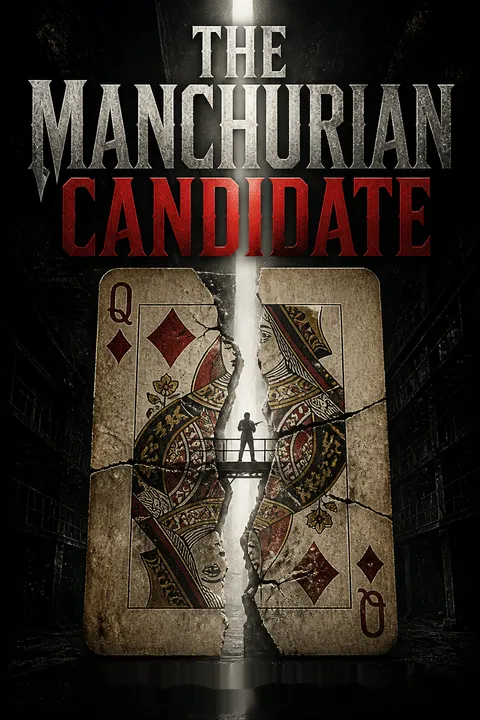
To assure absolute post-hypnotic control over Raymond, his conditioning is tied to a symbol: the queen of diamonds from a deck of cards. Repeatedly exposed to the queen during the brainwashing process, Raymond is trained to fall into a robotic, amnesiac state upon seeing the card, at which point he will unthinkingly obey commands, including murder. All traces of guilt and memory are erased by clever psychological design. The queen—chosen for its resemblance to Raymond's mother—ensures his entire willpower is enslaved to his handler's commands. The targets and tasks are not yet revealed, but a perfect, undetectable political assassin has been constructed for a chilling future purpose.
Hero's Welcome, Hollow Victory
Returned from Korea, Raymond is paraded as a hero, manipulated by his mother and stepfather, Senator Johnny Iselin, for political advantage. His Medal of Honor is used as a campaign tool, while his own emotional detachment and buried conditioning leave him isolated. He moves through ceremonies and photo ops like an automaton, while Marco, haunted by night terrors of the capture and brainwashing, tries unsuccessfully to embrace normal life. Both men drift, the trauma of unseen manipulation seeping poison into their personal and public lives, as the machinery of power grinds forward.
Origins of a Manipulator
The narrative delves into the upbringing of Raymond Shaw, charting the lifelong domination he suffered at the hands of his brilliant but monstrous mother, Eleanor Shaw Iselin. Through political maneuvering, moral bankruptcy, and emotional abuse, she grooms both Raymond and her second husband Johnny into instruments of her ambitions. Her own past—marked by incest, betrayal, and voracious thirst for power—has twisted her affections into weapons. Her stewardship ensures Raymond is a man fundamentally incapable of real connection, except perhaps for a fleeting summer of love, easily sundered by her will.
Love and Betrayal
During a rare period of happiness, Raymond falls in love with Jocelyn "Jocie" Jordan, the daughter of a political adversary of his mother. Their innocent, healing love is soon shattered when Eleanor, seeing a threat to her ambitions and enraged at the alliance with her rival, orchestrates their separation through psychological warfare and lies. Jocie is sent away, Raymond left in despair and emotional shut-down—a critical blow that leaves him vulnerable to exploitation by those who have conditioned him. Love is not just lost, but weaponized as another tool of betrayal.
The Columns Are Laid
As Iselin's McCarthy-esque rise is engineered by Eleanor, Raymond's life grows more regimented—his very identity now embedded with key triggers. Political speeches, numbers games, and the spectacle of false patriotism become daily rituals. Marco's nightmares intensify. The two men are trapped in the machinery of political ambition and psychological control. The seeds of a grand plot begin to germinate, aimed at steering the U.S. towards chaos and authoritarianism. Eleanor's hand is everywhere, directing the ascension of her husband and the further isolation of her son.
Marco's Nightmares Begin
Marco—now back in the States—suffers from recurring, vivid nightmares in which he watches Raymond, uncannily calm, murder two members of their Korean patrol at the command of their captors. The dreams are matched exactly by the nightmares of another survivor. Marco's attempts to recover sanity fail, leading him to obsessively document every detail, from setting to sound and even irrelevant symbolism such as the presence of playing cards. He recognizes the horror: something within them is programmed, and he cannot trust what happened or his own mind anymore.
Iselin Rises—Waves of Accusation
Johnny Iselin, under Eleanor's iron grip, becomes a mouthpiece for a new wave of anti-Communist hysteria. He makes wild accusations against the government, changing numbers to suit the headlines, destroying reputations heedlessly. The McCarthy-esque spectacle wins him notoriety and fear. The political climate grows feverish; Americans are conditioned to suspicion, distraction, and blind following of charlatans. This "conditioning" mirrors the literal brainwashing suffered by Raymond and his unit; the personal and political blend, threatening democracy itself.
The Test and the Killing
Years after the initial brainwashing, Soviet handlers test Raymond's programming in New York. Using the queen of diamonds, they instruct him to kill his employer—the kindly columnist Holborn Gaines. Raymond obeys, dispatching the man with cold efficiency and without memory, then resumes his life as if nothing happened. His handlers conduct elaborate cover-ups and medical excuses for his sudden absences. The test is a complete success: Raymond is proven a sleeper assassin, perfectly obedient and perfectly blank, for use in political assassinations to come.
The Love of Jocie
Against the tide of manipulation, Raymond finds brief relief when he and Jocie are reunited by chance at a long political party. Jocie, newly widowed, and Raymond quickly elope, marrying and taking solace in Caribbean exile. For a fleeting moment, they are happy, eluding the machinations of their families and the surveillance of Soviet and American intelligence alike. Marco and his task force, searching desperately for Raymond to deprogram him, stand aside out of respect for this fragile sanctuary—the only light in Raymond's otherwise mechanized life.
Marco Reaches Breaking Point
As the convention approaches, Marco and his intelligence unit race against time. Their investigation uncovers the reality of Raymond's programming and the queen of diamonds' power, and through hypnotic sessions, Marco triggers Raymond to reveal the entire plot: not just his own role but the master plan for an assassination at the national political convention. The tragic irony is unavoidable: only through Marco conjuring the mechanisms of mind control can Raymond's full memory and narrative be retrieved, and with it, the path to disaster—and perhaps redemption—becomes clear.
Chunjin's Return, Marco's Assault
Chunjin, the Korean interpreter and secret Soviet agent, reappears as Raymond's new cook and valet. Marco, hyper-aware of his own paranoia, attacks Chunjin on sight, leading to a hospital stay and official investigation—a physical echo of psychological violence. Simultaneously, Army and FBI investigations ramp up, trying to pull together the fragments of clues from multiple continents, murders, and minds. Everyone knows a plot is afoot but, desperately, cannot seem to quite make out the final, devastating shape.
Fragments of Memory
Marco creates decks entirely composed of queens of diamonds, deploying them to finally override Raymond's previous indoctrination and unlock his full memory of what was done to him. Through traumatic hypnotic sessions, the truth spills out: he has been ordered to kill a presidential nominee onstage at the convention, then shoot Johnny Iselin, who will—thanks to a bulletproof vest and prepared theatrics—rise as a martyr and hero, swept by national hysteria into the presidency with the promise of authoritarian rule. The Soviet/Eleanor master plan will be complete, with Raymond as its tragic instrument.
Marriage in Exile
Raymond and Jocie's marriage in secret brings both relief and greater dread. Marco's investigative unit stands aside while agents from all sides stalk the couple. For a paradisiacal month, they live as man and wife, rediscovering the hope and gentleness denied by years of familial manipulation and trauma. But fate is closing in. The machine of history, politics, and spycraft grows ever more relentless, and the joy the pair find is shaded by the knowledge that something monstrous—and irrevocable—waits in Raymond's psyche, planted by those who should have protected him.
The Convention Converges
The national convention begins, and all the historical machinations, lies, and betrayals point toward this moment. Eleanor executes her final moves: ordering Raymond's reconfirmed programming as an assassin, staging Johnny Iselin's rise to the vice presidential slot, and preparing the convention—and the watching nation—for spectacular violence. The queen of diamonds card, always at Raymond's call, is the final, damning key. Neither Marco nor the intelligence services, despite their vigilance, are able to prevent Raymond from making his way to the convention hall, rifle in hand, enacting the last command.
Orders From the Mother
Alone, Eleanor confesses to Raymond all: she knowingly sacrificed his mind to the Communists for power, never expecting they would so utterly destroy her son as an individual. Her rage, grief, and monstrous mother-love culminate in one last, incestuous embrace—she demands from him both passion and murder. In this ultimate act of control, she steers him irrevocably toward the assassination, unaware that the seed of her undoing has also been planted by her actions.
The Final Mission
The final act unfolds. Dressed as a priest, Raymond ascends to a spotlight booth high above Madison Square Garden with his sniper rifle. On the convention floor, Johnny and Eleanor await the chosen moment when the soon-to-be President will be shot, Johnny wounded spectacularly, and the country stampeded into martial law. Marco, bandaged and battered but desperate, rushes to avert the horror. Through force of will and the legacy of their strange, broken friendship, Marco reaches Raymond in time for one last act—Raymond, at the height of his trance, finds an inner command stronger than anything his mother, the Soviets, or fate itself had written.
Catwalk of Destiny
In the booth, triggered by Marco and driven by his own emerging autonomy, Raymond turns his gun away from the candidate and, instead, shoots and kills Johnny Iselin and Eleanor—dismembering the master plan and, finally, avenging his own ruined self. Afterward, Raymond turns the gun on himself, ending his cycle of exploitation, manipulation, and too brief love. Marco, left below in the darkness of the fallen regime, is both America's witness and its mourner as he cradles the hero's memory. Justice is purchased, not by law or government, but by trauma, suffering, and the red queen's final dissolution.
Analysis
The Manchurian Candidate endures as a razor-sharp dissection of power, manipulation, and the ease with which personal and national identities can be engineered by those who understand—and ruthlessly exploit—psychological, familial, and social vulnerabilities. Written against the backdrop of Cold War anxiety and McCarthyist hysteria, the novel both satirizes and actualizes the fear that America could be undone not only by foreign ideologies, but by its own willingness to suspend skepticism, to cede autonomy for spectacle, and to turn over the unconscious (be it mind or public opinion) to demagogues and manipulators. The psychoanalytic undertones—of control, incest, and Oedipal cycles—merge seamlessly with political allegory: Eleanor and Iselin are both literal and symbolic parents, nurturing not growth but dependence and violence. The tragic arc of Raymond—engineered as assassin, denied love, redeemed only through defiance and death—forces the reader to confront the ultimate cost of building systems (be they familial, governmental, or ideological) that prize loyalty over autonomy, obedience over conscience. Condon's lesson endures: democracies, like individuals, must fiercely guard against the seductions of easy answers, the coercions of power, and the fatal comfort of forgetting. The Manchurian Candidate, compressed to its essence, haunts us as a warning—of what we might become if we permit others to shuffle the deck, lay the cards, and tell us who to be.
Review Summary
People Also Read




Characters
Raymond Shaw
Raymond is the product of ruthless parental ambition and experimental psychological engineering. Raised by a cold, power-mad mother, he is emotionally stunted, withdrawn, and resentful—though beneath the armor, a devastating need for love lingers, realized only in his brief connection with Jocie. As the Manchurian Candidate, he is a programmed instrument of assassination, controlled by the queen of diamonds. His journey is one of fragmented identity: a "hero" honored for a fake deed, a victim molded to become the perfect weapon. His tragedy is both personal—love lost, autonomy stripped—and national, as his fate becomes a dark satire of the American dream.
Ben Marco
Marco is the captain who led the ill-fated patrol in Korea and the only friend Raymond ever truly knows. Suffering both psychological torment and social alienation due to recurring nightmares, Marco becomes obsessed with uncovering the truth about their capture and Raymond's condition. His persistence draws together threads across government and continents; he risks career and sanity to save Raymond and, by extension, the nation. Psychology frames Marco's journey as one of awakening: overcoming trauma, assembling fragmented memory, and showing profound—even sacrificial—loyalty, ultimately guiding Raymond to escape his programming.
Eleanor Shaw Iselin
Raymond's mother is the book's central villain—a force of ambition so overwhelming it warps the lives and minds around her. Incapable of empathy, fixated only on power, she manipulates her son as an object from childhood onward. Her complex pathology encompasses emotional incest, political Machiavellianism, obsession with "purity" and nationalist rhetoric—all underlaid by unspeakable trauma and inherited trauma. She is at once victim and perpetrator, feeding the machinery of Cold War hysteria through personal grievance and monstrous love. Her ultimate undoing stems from overreaching: by using Raymond as her instrument, she seals her own fate.
Johnny Iselin
Iselin, Raymond's stepfather, is a vulgar, intellectually shallow man whose every public gesture is engineered by Eleanor. Climbing from minor judge to Senator through scandal, demagogy, and faux patriotism, he becomes the vessel for America's Red Scare hysteria. Iselin's inner hollowness—his impotence, dependence, and lack of principle—make him both a figure of ridicule and the perfect mask for the true operators behind him. Psychoanalytically, he is the archetype of the empty suit whose self-image is constructed entirely by others and who, when called to real action, collapses.
Jocelyn "Jocie" Jordan
Jocie enters as a healing, redemptive force in Raymond's life—his only hope for genuine connection and joy. Her warmth, intelligence, and independence stand in stark contrast to Eleanor's machinations. Despite her love and willingness to span the gap between their families, she falls victim twice: first to Eleanor's sabotage, then to Raymond's own conditioned hands as an unintended casualty. The loss of Jocie is the fatal wound that dooms Raymond, crushing hope in favor of programming. In a psychoanalytic sense, she embodies the ideal of love that the traumatized subject cannot access.
Dr. Yen Lo
The head Chinese interrogator who orchestrates the brainwashing in Manchuria, Yen Lo is a master of Pavlovian and hypnotic techniques. Cold, witty, and confident, he not only breaks the men but lectures his Soviet and Chinese colleagues on the future of psychological warfare. His role as godlike manipulator reflects postwar anxiety about the dissolution of self under political pressure. He is not just an antagonist but a satiric projection of 20th-century "science" unmoored from empathy—a creator whose "success" comes at the annihilation of the subject's humanity.
Chunjin
Introduced in Korea as Marco's orderly and later reappearing as Raymond's valet in New York, Chunjin is an understated but significant presence. Secretly an agent of the Soviets, he serves to shepherd Raymond in both literal and psychological journeys, always maintaining plausible deniability. His function is to ensure continuity of surveillance and manipulation, even after repatriation. On a psychological level, Chunjin mirrors the way "familiar" figures can be vehicles for continued trauma and surveillance.
Holborn Gaines
As Raymond's boss at The Daily Press, Gaines represents stability and mentorship—something good in the otherwise transactional world of politics and media. His murder, at Raymond's programmed hands, is a powerful demonstration of the ultimate reach and ruthlessness of the brainwashing: even kindness and routine matter for nothing against the machine. Psychoanalytically, Gaines's death signals the death of postwar optimism or the old stability, swept away by new forms of unfiltered power.
Lou Amjac
FBI agent and once-fiancé of Marco's lover Rosie, Amjac becomes a trusted investigator partnering with Marco during the urgent last phase of the Manchurian plot. His keen sense of danger, bureaucratic realism, and underlying resourcefulness provide the tools needed to decode the psychological puzzle of Raymond's programming, furthering the possibility (but not the guarantee) of justice.
Eugénie "Rosie" Cheyney
Rosie, Marco's lover, is a stabilizing and nurturing force; unlike Eleanor, her love is generous, healing rather than devouring. She supports Marco through his breakdowns and collaborates in his desperate investigation. Symbolically, she represents the potential for positive intimacy and connection, in contrast to the cycles of control and trauma—her presence is both balm and anchor as Marco confronts psychological apocalypse.
Plot Devices
Hypnotic Programming & Symbolic Triggers
The key device animating the entire plot is the intricate brainwashing of Raymond and, by extension, his patrol. Hypnosis, combined with Pavlovian conditioning, installs unbreakable "triggers" (the queen of diamonds, key sentences) so that Raymond can be controlled from afar without memory, agency, or guilt. This device literalizes the Cold War fear that ideology could erase or reprogram identity, creating weapons hidden in plain sight. The deck of cards itself is a perfect symbol of both chance and fate, as well as the shallow rituals beneath political theatrics.
False Memories & Amnesia
The conversion of unthinkable trauma (witnessing and performing murder) into fake heroism, through expertly planted false memories, underlines the novel's satirical take on spin, myth-making, and personal narrative. Raymond's Medal of Honor is a fraudulent product; national recognition is given, but to a man who has had his consciousness entirely emptied. The absence of guilt—engineered into Raymond's psyche—makes him the "ideal" assassin, but also mirrors the guiltlessness of mass political movements and demagoguery.
Parental Control as Political Metaphor
Eleanor's relationship to Raymond is not just pathological; it is the psychoanalytic engine of the plot, fusing family and state, love and treason, the personal and the political. The ultimate plot device is the use of familial love gone awry—infused with abuse, emotional incest, and instrumentalization—as the foundation for global violence. The parallel between the "manipulated" public, rendered unconscious by political spectacle, and Raymond's unconscious obedience to the queen of diamonds is explicit.
McCarthyism and Hysteria as Narrative Engine
The ascendance of Johnny Iselin—built through numbers games, innuendo, and endless spectacle—is itself a plot device, intended to stir the American public to a fever pitch, to create an "emergency" into which authoritarian rule can step. The entire plot pivots not only on the manipulated mind of the assassin, but on the manipulated mind of the crowd—a nation brainwashed through media, repetition, and fear, ready to accept a Manchurian Candidate and his handlers.
Investigative Structure & Foreshadowing
The investigation, primarily led by Marco and Amjac, is constructed as a slow-mounting race against fate. The recurring nightmares, repetition of detail, and seemingly random symbols all serve as both clues and psychological ballast, creating an atmosphere of dread and a sense that the past is permanently returning. The chessboard-like movement of characters—Raymond as piece, Marco as player, Eleanor as shadowy manipulator—enriches the plot.
Political Spectacle as Theater
The final act takes place at the national convention—an enormous public stage, crowded, ritualized, and saturated with empty patriotism. Here, the machinery of manipulation is made manifest; the public, media, and all levels of government become unwitting actors in a domestic coup, until the final bloody reversal. The convergence of individual destiny and mass manipulation here is the book's signature plot device.
Download PDF
Download EPUB
.epub digital book format is ideal for reading ebooks on phones, tablets, and e-readers.








































