
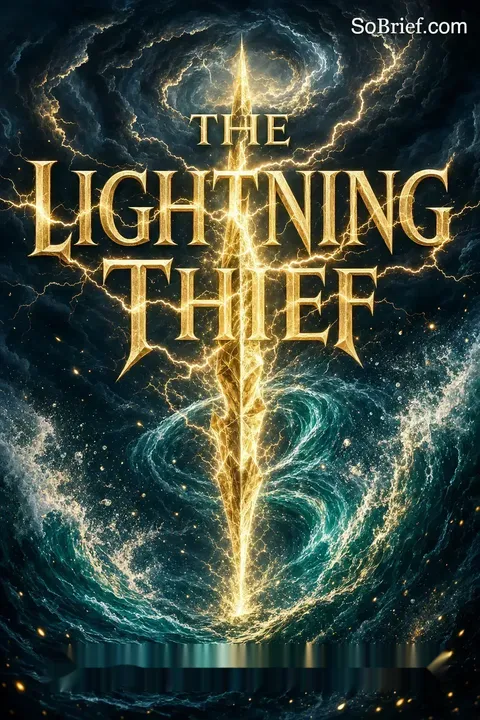


Plot Summary
Mrs. Dodds Never Existed
Percy Jackson1 is twelve, dyslexic, ADHD, and attending his sixth school in six years. On a field trip to the Metropolitan Museum of Art, his pre-algebra teacher Mrs. Dodds14 corners him in an empty gallery, demanding he confess to something he doesn't understand.
Then her fingers stretch into talons, her jacket melts into leathery wings, and she lunges for his throat. His Latin teacher Mr. Brunner5 — a wheelchair-bound man who always seemed to know more than he let on — throws Percy1 a pen that becomes a bronze sword.
Percy1 swings. Mrs. Dodds14 explodes into yellow dust. But when Percy1 stumbles outside, every student and teacher insists Mrs. Dodds14 never existed. Only his friend Grover3 hesitates before lying, and that hesitation becomes the first crack in Percy's1 ordinary world.
The Bull-Man Takes Sally
Percy's1 friend Grover3 arrives at Montauk in a hurricane — without pants, his legs shaggy and hooved. He's a satyr, and something monstrous is behind him. Percy's mother Sally6 drives them through the storm toward a summer camp on Long Island that Percy's1 absent father once wanted him to attend.
Lightning flips the car. A seven-foot creature with an enormous bull's head lumbers toward them through the rain. Sally6 tells Percy1 the monster wants him, not her — and she cannot cross the camp's property line. They haul unconscious Grover3 uphill, but the Minotaur catches Sally.6
She dissolves into shimmering golden light. Rage ignites something new in Percy.1 He vaults onto the creature's back, snaps off a horn, and drives the jagged bone into its ribs. The monster crumbles. Percy1 drags Grover3 to the farmhouse and collapses.
Chiron Rises from the Wheelchair
Percy1 wakes at Camp Half-Blood, a hidden training ground for children of the Greek gods. A blond girl named Annabeth2 nursed him with ambrosia; she asks urgently about the summer solstice and something stolen — answers Percy1 doesn't have.
The camp director is Dionysus,10 the actual god of wine, banished here by Zeus13 as punishment. Then Percy's1 old Latin teacher reveals himself: Mr. Brunner5 stands from his wheelchair and keeps rising, his lower body unfolding into a white stallion's flanks. He is Chiron,5 the immortal centaur who has trained heroes since Hercules.
The gods are real, he explains — they've migrated with Western civilization and now reside above the Empire State Building. Percy's1 dyslexia means his brain is wired for Ancient Greek. His ADHD is battle instinct. He's a demigod, but whose child remains unknown.
Son of the Sea God
At camp, Percy1 discovers water responds to him — toilets erupt to defend him from a bully named Clarisse,11 daughter of Ares,8 leaving Percy1 perfectly dry in the wreckage. During capture the flag in the forest, Clarisse's11 squad ambushes Percy1 at a creek.
They beat him down, but when he falls into the water, strength floods back. He breaks Clarisse's11 electric spear and defeats her entire squad. Then a hellhound — summoned from within camp by an unknown traitor — tears through his armor. Chiron's5 arrows kill it, and Percy1 stumbles into the creek to heal.
The campers gasp: a holographic green trident glows above his head. Poseidon,7 god of the sea, has claimed Percy1 as his son — breaking a sacred oath the Big Three gods made after World War II never to sire more children. Every camper kneels, their expressions a mix of awe and dread.
Ten Days to Stop a War
Chiron5 explains the crisis: Zeus's master bolt was stolen during the winter solstice. Zeus13 accuses Poseidon.7 Unless the bolt returns in ten days, divine war will shatter civilization. Chiron5 suspects Hades9 hid it in the Underworld — Percy1 must travel to Los Angeles and retrieve it.
A mummified Oracle breathes green mist and delivers a prophecy: go west, face a god who has turned, find what was stolen, be betrayed by a friend, and fail to save what matters most. Percy1 tells no one the final two lines. Annabeth,2 who has waited years for a quest, volunteers. Grover3 joins — his career depends on protecting Percy.1
Chiron5 gives Percy1 Riptide, a celestial bronze sword disguised as a pen that always returns to his pocket. Luke,4 the skilled older camper who trained Percy1 in swordfighting, offers a parting gift: winged sneakers. Percy,1 forbidden from Zeus's13 sky, gives them to Grover.3
Medusa's Head by Mail
On a Greyhound bus, three Furies — including the returned Mrs. Dodds14 — corner the trio. Percy1 crashes the bus during the fight; lightning destroys it as they escape into New Jersey. Broke and starving, they stumble into a roadside shop run by a veiled woman who feeds them burgers.
Annabeth2 recognizes the danger: the lifelike statues, the hissing overhead. The hostess is Medusa. Percy1 fights her without looking — guided by her reflection in a gazing ball — while Grover3 dive-bombs her with a tree branch and his flying sneakers.
Percy's1 sword takes her head. Furious at the gods for filling his path with monsters, he packages the trophy and ships it to Mount Olympus via Hermes Overnight Express — a twelve-year-old's defiant message to the divine establishment.
Six Hundred Feet Down
At the Gateway Arch in St. Louis, a woman's tiny Chihuahua swells into the Chimera — a lion-headed, goat-bodied, snake-tailed monstrosity that breathes fire. Its serpent tail sinks venom into Percy's1 leg.
Cornered on the observation deck with a hole melted through the wall and his sword lost to the river below, Percy1 makes a desperate calculation: he is the son of the Sea God. He leaps. Six hundred thirty feet of free fall end not in death but in discovery — the Mississippi doesn't crush him. He breathes underwater. The poison fades.
His clothes stay dry. A shimmering water spirit, a Nereid sent by Poseidon,7 tells Percy1 his father believes in him and to visit Santa Monica beach before entering the Underworld. She warns him not to trust the gifts — a cryptic caution he files away without understanding.
The War God's Errand
In a Denver diner, the war god Ares8 materializes — leather duster, sunglasses over sockets of fire, radiating aggression that makes Percy1 itch to punch walls. Ares8 demands Percy1 retrieve his shield from an abandoned water park where he'd been on a date with Aphrodite.
At the park's Tunnel of Love, Percy1 and Annabeth2 trigger a trap built by the jealous blacksmith god Hephaestus: Cupid statues broadcast them live to Olympus while millions of mechanical spiders swarm the ride. Percy1 summons water to blast them free.
Ares,8 satisfied, drops two revelations: Percy's mother6 isn't dead — she was taken as a hostage, kept to control someone. Then he tosses Percy1 a blue nylon backpack and arranges transport west in a zoo truck. The backpack seems ordinary. It is not.
The Casino That Eats Time
The zoo truck deposits them in Las Vegas, where they free mistreated animals into the streets. Seeking shelter, they enter the Lotus Casino — a glittering palace of infinite games, free food, and bottomless credit cards. The place is intoxicating. Percy1 bungee-jumps the lobby. Annabeth2 builds holographic cities. Grover3 hunts virtual deer.
Only when Percy1 talks to a kid in bell-bottoms who thinks it's 1977 does the spell crack. He shakes Annabeth2 free of her sim game and physically drags a protesting Grover3 past the bellhop offering platinum upgrades. Outside, they discover five days have evaporated. The summer solstice is tomorrow. Their margin for the quest has collapsed from manageable to nearly impossible.
The Bolt Was Always There
A sea spirit gives Percy1 three pearls at Santa Monica — each returns one person to the ocean. Then they enter the Underworld: bribe Charon across the Styx, slip past Cerberus when Annabeth2 tames the three-headed dog with a red rubber ball.
Near Hades's9 palace, Grover's3 flying sneakers — Luke's4 parting gift — drag him toward a vast pit radiating ancient evil: the entrance to Tartarus. The shoes were cursed. They save Grover3 barely in time. In the throne room, Hades9 reveals his helm of darkness was also stolen. Percy1 unzips his backpack and the master bolt gleams inside — the bag was the bolt's enchanted sheath, planted by Ares,8 designed to produce the weapon near the Underworld.
He's been framed. Hades9 offers Percy's captive mother6 in exchange, but three pearls means three escapes. Percy1 makes the wrenching choice to leave Sally6 behind and stop the war. They crush the pearls and rocket to the surface.
Heel-Deep in the Surf
Ares8 waits on Santa Monica beach. He admits to intercepting the stolen items and planting the bolt in Percy's backpack to trigger a three-way divine war. Percy1 challenges him to single combat. They duel in the surf — Ares8 with a skull-hilted blade, Percy1 with Riptide and the ocean at his back.
The war god is stronger, faster, centuries more experienced. Percy1 absorbs a beating until he pulls the tide itself into the fight — holding back a wave, then releasing six feet of seawater into Ares's8 face. In the blind moment, Percy1 drives his blade through the god's heel.
Golden ichor flows. A suffocating darkness sweeps the beach, halting Ares8 from retaliating — something from Tartarus intervened, something protecting its pawn. Ares8 curses Percy1 and vanishes. The Furies arrive, take Hades's9 helm, and acknowledge Percy's1 innocence.
The 600th Floor
Percy1 flies to New York and enters the Empire State Building. A special elevator opens onto a cloud-borne stairway leading to Mount Olympus — a gleaming Greek city anchored above Manhattan. In the throne room, Zeus13 and Poseidon7 sit on towering thrones.
Percy1 lays the bolt at Zeus's13 feet and explains that Ares8 was manipulated by something stirring in Tartarus. Zeus13 accepts the weapon but forbids further discussion of Kronos — a name that darkens the room even here. Poseidon7 is guarded, neither warm nor cold — like the sea on an unreadable day.
He tells Percy1 he did well, that he is a true son of the Sea God, but that a hero's fate is never happy. Then he delivers the gift that outweighs all others: Hades9 released Sally6 when his helm was returned. Percy's mother6 is alive.
Luke's Scorpion Farewell
The summer winds down with celebrations, but Luke4 — the scarred, trusted Hermes counselor — lures Percy1 into the woods. He confesses everything: during the winter solstice field trip, he stole both the master bolt and Hades's9 helm on orders from Kronos, the Titan king awakening in Tartarus.
Ares8 caught him, but Luke4 planted the idea of a war in the war god's easily inflamed mind. He despises the Olympians — Hermes abandoned him, his quest left him scarred — and serves Kronos willingly. The cursed flying sneakers were meant to drag Percy1 into the pit.
The backpack delivered the bolt to the Underworld. His confession finished, Luke4 summons a pit scorpion that stings Percy's1 palm before he can kill it, then vanishes into shadow. Percy1 stumbles back to camp barely alive, carrying the Oracle's fulfilled promise: betrayed by one who calls you a friend.
Home Before Next Summer
Percy1 recovers to find the world rearranged. At home, he discovers his mother6 alive — and a package: Medusa's head, returned to sender from Olympus. He could use it to petrify his abusive stepfather Gabe,12 but his mother6 insists on handling her own life. Percy1 leaves the box with her.
Annabeth,2 taking his earlier advice, writes to her estranged father and goes home to try again. Grover3 earns his searcher's license and departs to find Pan, the lost god of the wild, though no searcher has ever returned alive.
Percy's mother6 later writes that Gabe12 vanished mysteriously and she sold a life-size sculpture called 'The Poker Player' for enough money to start college. Percy1 decides to go home, attend seventh grade, and return to camp next summer. The quest is finished, but Kronos is stirring and the real war hasn't begun.
Analysis
The Lightning Thief performs a deceptively sophisticated act of cultural translation: it takes the Greek mythological tradition — stories about divine negligence, inherited trauma, and the expendability of children — and filters them through the experience of a modern twelve-year-old labeled deficient by every institution meant to nurture him. Percy's1 ADHD and dyslexia, pathologized by schools, become evidence of divine heritage — his restless mind is a warrior's instinct, his scrambled reading a brain built for an older language. Riordan isn't merely making mythology accessible; he's arguing that the kids society discards might be the ones most equipped for extraordinary purpose.
The novel's deepest current is its interrogation of absent fatherhood. Every major character navigates a broken parental bond: Percy1 resents a father who never visited; Annabeth2 ran from one who didn't want her; Luke4 was scarred and abandoned after his quest. The Olympians' refusal to directly help their children — framed as cosmic law — mirrors the excuses of real absent parents. Poseidon's7 eventual acknowledgment of Percy1 is deliberately incomplete: he calls his son a wrongdoing, expresses regret at his birth, then offers pride that feels conditional. The novel refuses to let divine parentage function as simple wish fulfillment.
Luke's4 villainy emerges from the same system that produces Percy's1 heroism. Both are abandoned sons of negligent gods; the difference is that Percy1 channels resentment into loyalty while Luke4 converts it to nihilism. Kronos — the original devouring father — recruits Luke4 by exploiting exactly the wound the gods inflicted. The story suggests that institutions create their own destroyers when they fail the young people they exist to protect.
The quest structure, borrowed from Homer and Campbell, is complicated by the Oracle's prophecy of inevitable failure. Percy1 cannot succeed completely — he saves the world but not his mother6 through his own power. Heroism here is defined not by triumph but by choosing to act despite foreknowledge of loss, and by the maturity to let others — even his mother6 — fight their own battles.
Review Summary
The Lightning Thief receives mostly positive reviews, with readers praising its blend of Greek mythology and modern settings. Many appreciate the humor, fast-paced plot, and relatable characters, particularly Percy Jackson. The book appeals to both young and adult readers, with some wishing they had discovered it earlier. Critics note similarities to Harry Potter but generally find the story unique and engaging. A few reviewers express disappointment, citing unoriginality or juvenile writing, but these are in the minority.
People Also Read




Characters
Percy Jackson
Demigod son of PoseidonA twelve-year-old with ADHD, dyslexia, and a history of expulsion from every school he's attended. Percy's impulsiveness masks deep loyalty—he fights not for glory but for the people he loves. Raised by a devoted single mother6 and tormented by an abusive stepfather12, he carries the wound of abandonment by a father he's never met. His discovery that he's a son of Poseidon7 reframes every deficiency as a hidden strength: his restless mind is a warrior's instinct, his reading difficulty a brain wired for Ancient Greek. Percy's central tension is between resentment toward the divine father who ignored him and a primal need for that father's approval. He leads with his heart, acts before strategizing, and treats loyalty as non-negotiable currency.
Annabeth Chase
Daughter of AthenaDaughter of Athena, the goddess of wisdom and battle strategy. Annabeth arrived at Camp Half-Blood at age seven after running away from a father who resented her and a stepmother who treated her as a threat. She compensates for that rejection through relentless competence—she reads architecture books in Ancient Greek, devises flawless battle plans, and wears her mother's legacy like armor. Her deepest desire is to build something permanent, a monument that outlasts the gods. Beneath her confidence lives a child starved for belonging. She develops a grudging respect for Percy1 that evolves into genuine friendship, their partnership mirroring the mythological cooperation between Athena and Poseidon7. Her admiration for Luke4 reveals her vulnerability to charisma and her need to believe the best in those she cares for.
Grover Underwood
Satyr protector and loyal friendA satyr who poses as a middle-school student to protect Percy1, Grover is twenty-eight years old but emotionally equivalent to a nervous teenager. His hooves hide in fake sneakers; his anxiety manifests in bleating and compulsive tin-can eating. Grover carries the guilt of a previous failed assignment—he was the keeper who couldn't save Thalia, daughter of Zeus13, five years earlier. That failure haunts every decision and fuels both his self-doubt and his determination. His life's dream is to earn a searcher's license and find Pan, the lost god of wild places, though no searcher has ever returned. Grover's emotional intelligence is his greatest gift: he reads feelings instinctively, calls out Percy's1 buried need for paternal approval, and offers steadfast loyalty without demanding heroics in return.
Luke Castellan
Camp's best swordsmanSon of Hermes and the camp's most skilled swordsman, Luke carries a scar from his failed quest to the Garden of the Hesperides—a wound deeper than skin. Handsome, welcoming, and generous with younger campers, he fills the older-brother role Percy1 never had. Yet beneath his easy charm lies a furnace of resentment: abandoned by his father Hermes, scarred by a quest that earned only pity, and disillusioned with gods who treat their children as expendable tools. His bitterness emerges in unguarded moments—a twist of the mouth, a sharp remark about divine negligence. Luke represents the gifted child failed by the institution meant to serve him, someone talented enough to see the system's flaws and wounded enough to take them personally. He is the camp's most admired figure and its most psychologically complex.
Chiron
Immortal centaur hero-trainerThe immortal centaur who has trained heroes since the age of Hercules. Disguised as a wheelchair-bound Latin teacher named Mr. Brunner, Chiron watches over Percy1 at boarding school before revealing himself at camp. Patient and kind but bound by divine restrictions on what he may share, he provides wisdom without answers and guidance without control. His millennia of experience make his rare expressions of genuine worry deeply alarming.
Sally Jackson
Percy's devoted, resilient motherPercy's1 mother—warm, selfless, and quietly fierce. She married the repulsive Gabe Ugliano12 because his overwhelming human stench masked Percy's1 demigod scent from monsters. She works at a candy store, dreams of writing novels, and endures abuse to protect her son. Her strength isn't supernatural; it's the stubborn, grinding resilience of a woman who refuses to surrender her child's safety or her own identity—she kept her maiden name and wages small rebellions with blue food.
Poseidon
Percy's distant sea-god fatherGod of the sea and Percy's1 absent father. He broke a sacred post-war oath by siring Percy1, then stayed distant to avoid drawing Zeus's13 wrath. Poseidon communicates through indirect gifts—a sword, a water spirit's message—rather than direct presence. When father and son finally meet, Poseidon is neither warm nor cold: unreadable as the ocean, proud of his son yet burdened by the knowledge that fathering a hero means fathering tragedy.
Ares
Manipulative god of warGod of war, who radiates aggression that makes everyone nearby itch for violence. Leather-clad and brutal, Ares plays the role of a bullying roadside encounter—buying the kids cheeseburgers while executing a scheme far more sophisticated than his personality suggests. His love of conflict makes him easy to manipulate, and his role in the quest reveals him as simultaneously an obstacle, a deceiver, and an unwitting pawn of forces even he doesn't fully comprehend.
Hades
Aggrieved Lord of the DeadLord of the Dead, ruling a crumbling bureaucracy of overworked ghouls and ever-expanding real estate. Far from the mastermind everyone suspects, Hades is a victim—his helm was stolen too, and he wants only to recover his property and be left alone. His menace is real but his grievances are surprisingly legitimate. He holds Sally Jackson6 hostage as leverage, motivated by desperation rather than cruelty.
Dionysus
Grumpy camp director godGod of wine sentenced to run Camp Half-Blood for a century as Zeus's13 punishment. Petulant, dismissive, and deliberately mangling campers' names, his Diet Coke addiction replaces the wine he's forbidden from drinking. Despite his contempt for mortals, Dionysus serves as an accidental protector—his divine presence helps shield the camp, even if his attitude makes everyone wish it didn't.
Clarisse
Ares's daughter, camp bullyDaughter of Ares8 and cabin five's aggressive leader. She initiates Percy1 by trying to dunk his head in a toilet—an attempt thwarted when the plumbing rebels on his behalf. Proud and combative, she embodies her father's love of dominance.
Gabe Ugliano
Percy's abusive stepfatherA beer-swilling, cigar-reeking poker addict whose overwhelming human stench unknowingly masks Percy's1 demigod aura. Abusive toward Sally6, he represents the mundane cruelty Percy1 must navigate alongside mythological horrors.
Zeus
Paranoid king of the godsKing of the Olympians—paranoid, proud, and quick to assign blame. He accuses Poseidon7 of stealing his master bolt and threatens war, refusing to consider alternatives even when presented with evidence of a deeper conspiracy.
Mrs. Dodds
Fury disguised as a teacherPercy's1 pre-algebra teacher at Yancy Academy, secretly a Fury—one of Hades's9 winged torture spirits. She is the first monster Percy1 kills and the first proof that his world conceals something ancient and hungry.
Plot Devices
Riptide (Anaklusmos)
Percy's ever-returning swordA celestial bronze sword disguised as a disposable ballpoint pen—a gift from Poseidon7, delivered through Chiron5. The blade harms monsters and immortals but passes through mortals like an illusion. It cannot be lost: no matter where Percy1 drops or throws it, the pen reappears in his pocket within moments. Riptide functions as Percy's1 inheritance—the one tangible proof that his absent father prepared for his existence. Its dual nature (mundane pen and lethal weapon) mirrors Percy1 himself: an ordinary-seeming kid harboring extraordinary capability. From vaporizing Mrs. Dodds14 in the museum to wounding Ares8 on the beach, it serves as his constant companion. The sword's enchantment—always returning—subtly reinforces the story's theme that identity, once claimed, cannot be discarded.
Zeus's Master Bolt
Stolen weapon driving the questA two-foot cylinder of celestial bronze capped with divine explosives—Zeus's13 symbol of power and the weapon that won the war against the Titans. Its theft triggers the entire plot: Zeus13 blames Poseidon7, war looms, and Percy1 is accused of being the thief. The bolt is concealed within the enchanted backpack Ares8 gives Percy1 in Denver, designed to materialize only when Percy1 approaches the Underworld—framing him at the worst possible moment. The bolt represents the gods' vulnerability to manipulation: the most powerful weapon in existence, stolen by a teenager and passed through multiple hands in a scheme orchestrated from Tartarus. Its recovery and return to Olympus resolves the surface conflict while leaving the deeper conspiracy intact.
The Oracle's Prophecy
Foreshadows and structures the questDelivered by a mummified corpse in the Big House attic, the prophecy contains four lines that map Percy's1 journey with disturbing accuracy. The first two—go west, face a turned god, retrieve the stolen item—provide direction. The last two—betrayal by a friend and failure to save what matters most—provide dread. Percy1 hides these final lines from his companions, carrying their weight alone. The prophecy operates on double meanings: the 'turned god' initially seems to indicate Hades9 but actually describes Ares's8 role; the 'friend's betrayal' seems to fit Ares8 but ultimately identifies the true thief4. It serves as both narrative scaffolding and psychological weapon, fueling Percy's1 anxiety and shaping his decisions throughout the quest.
The Mist
Conceals the divine from mortalsA supernatural veil that obscures mythological events from human perception. When Percy1 vaporizes Mrs. Dodds14, the Mist rewrites every student's memory. When Percy1 fights monsters in public, mortals see a delinquent with a baseball bat, not a demigod with a celestial sword. The Mist explains how gods, monsters, and heroes operate in modern America without exposure: humans rationalize the impossible into familiar frameworks. It also creates Percy's1 initial isolation—he alone perceives the truth while everyone insists on a sanitized version of reality. The Mist functions as a metaphor for the way consensus reality suppresses uncomfortable truths, forcing those who see clearly to doubt their own perceptions until the evidence becomes undeniable.
Ares's Backpack
Hidden delivery for the boltA blue nylon backpack given to Percy1 by Ares8 in Denver, ostensibly containing supplies—clothes, cash, golden drachmas, and Oreos. In reality, the backpack is the master bolt's enchanted sheath, magically rigged to produce the weapon once Percy1 reaches the Underworld. This transforms apparent generosity into the quest's most devastating trap: Percy1 carries the evidence of his own guilt without knowing it. The backpack's delayed activation means the bolt materializes in Hades's9 throne room—making Percy1 appear to be threatening the Lord of the Dead with a weapon he didn't know he possessed. The device reveals the quest's true architecture: Percy1 was never hunting the bolt. He was unwittingly delivering it.
FAQ
Synopsis & Basic Details
What is The Lightning Thief about?
- Demigod's Quest Begins: Twelve-year-old Percy Jackson discovers he's a demigod, son of Poseidon, and is thrust into a world of Greek gods and monsters.
- Stolen Lightning Bolt: Percy is accused of stealing Zeus's master lightning bolt, and must embark on a quest to retrieve it and prevent a war among the gods.
- Journey to the Underworld: Accompanied by his friends, Annabeth and Grover, Percy travels across the United States, facing mythical creatures and ultimately venturing into the Underworld.
Why should I read The Lightning Thief?
- Mythology Meets Modernity: The book seamlessly blends Greek mythology with a contemporary setting, making ancient stories accessible and exciting for modern readers.
- Relatable Characters: Percy's struggles with ADHD and dyslexia, along with his friendships with Annabeth and Grover, create relatable and engaging characters.
- Action-Packed Adventure: The story is filled with thrilling battles, suspenseful moments, and a fast-paced plot that keeps readers hooked from beginning to end.
What is the background of The Lightning Thief?
- Greek Mythology Foundation: The story is deeply rooted in Greek mythology, drawing on the stories of gods, monsters, and heroes, and reinterpreting them for a modern audience.
- Contemporary American Setting: The narrative is set in present-day America, with locations like New York City, St. Louis, and Los Angeles serving as backdrops for the mythological events.
- Social Commentary: The book subtly touches on themes of social injustice, such as the treatment of those who are different, and the abuse of power, as seen in the actions of the gods.
What are the most memorable quotes in The Lightning Thief?
- "Look, I didn't want to be a half-blood.": This opening line immediately establishes Percy's reluctant hero status and sets the tone for the entire series.
- "With great power comes the great need to take a nap.": This quote, attributed to Chiron, highlights the humorous and relatable aspects of the demigod experience.
- "You are a pawn of the gods, Percy Jackson. You would be better off as a statue. Less pain. Less pain.": Medusa's words reveal the manipulative nature of the gods and foreshadow the challenges Percy will face.
What writing style, narrative choices, and literary techniques does Rick Riordan use?
- First-Person Perspective: The story is told from Percy's point of view, allowing readers to experience his thoughts, emotions, and reactions firsthand, creating a strong sense of intimacy.
- Humorous Tone: Riordan uses a lighthearted and humorous tone, even in the face of danger, making the story engaging and entertaining for a younger audience.
- Foreshadowing and Symbolism: The narrative is rich with foreshadowing, subtle clues, and recurring symbols, such as the color blue, that add depth and complexity to the story.
Hidden Details & Subtle Connections
What are some minor details that add significant meaning?
- Blue Food Obsession: Sally Jackson's love for blue food, stemming from a fight with Gabe, symbolizes her quiet rebellion and her determination to maintain her identity.
- Grover's Fake Feet: Grover's use of fake feet to appear human highlights his struggle to fit into the mortal world and foreshadows his true nature as a satyr.
- The Red Umbrella: Mr. Brunner's red umbrella, which appears at the museum and later at the bus stop, is a subtle hint at his true identity as Chiron, a protector figure.
What are some subtle foreshadowing and callbacks?
- Mrs. Dodds's "Honey": Mrs. Dodds's use of "honey" as a term of endearment is a subtle foreshadowing of her true nature as a Fury, a creature of the Underworld.
- The Fruit Stand Ladies: The old ladies knitting socks at the fruit stand foreshadow the Fates and their role in determining the course of Percy's life.
- Luke's Scar: Luke's scar, initially presented as a battle wound, foreshadows his later betrayal and his connection to the darker forces at play.
What are some unexpected character connections?
- Ares and Aphrodite: The revelation of Ares and Aphrodite's affair adds a layer of complexity to the gods' relationships and foreshadows the chaos that will ensue.
- Chiron and Mr. Brunner: The reveal that Mr. Brunner is actually Chiron, a centaur and mentor to heroes, connects the mortal and mythological worlds in an unexpected way.
- Grover and Thalia: The connection between Grover and Thalia, a daughter of Zeus, reveals Grover's past failures and his desire to prove himself as a protector.
Who are the most significant supporting characters?
- Annabeth Chase: As a daughter of Athena, Annabeth provides strategic guidance and intellectual support to Percy, becoming a crucial ally in his quest.
- Grover Underwood: Grover's loyalty and empathy make him a valuable companion, and his satyr abilities often prove essential in navigating the mythological world.
- Luke Castellan: Luke's role as a mentor and friend to Percy makes his eventual betrayal all the more impactful, highlighting the theme of deception.
Psychological, Emotional, & Relational Analysis
What are some unspoken motivations of the characters?
- Poseidon's Pride: Poseidon's reluctance to directly help Percy stems from his pride and his desire to avoid further conflict with Zeus, but also a genuine care for his son.
- Annabeth's Yearning: Annabeth's eagerness for a quest is driven by her desire to prove herself and escape the confines of Camp Half-Blood, seeking recognition for her abilities.
- Luke's Resentment: Luke's bitterness towards the gods and his desire for a new order are fueled by his own perceived failures and the lack of recognition he received.
What psychological complexities do the characters exhibit?
- Percy's Impulsivity: Percy's ADHD manifests as impulsivity and a tendency to act before thinking, which often leads him into trouble but also makes him a formidable opponent.
- Annabeth's Fear of Spiders: Annabeth's intense fear of spiders, stemming from her mother's curse on Arachne, reveals a vulnerability beneath her confident exterior.
- Grover's Insecurity: Grover's self-doubt and fear of failure, stemming from his past mistakes, highlight his emotional depth and his desire to prove his worth.
What are the major emotional turning points?
- Percy's Mother's Disappearance: The loss of Percy's mother fuels his desire for revenge and drives his decision to go to the Underworld, marking a shift in his motivations.
- Luke's Betrayal: Luke's revelation as the true antagonist shatters Percy's trust and forces him to confront the darker side of the demigod world.
- Poseidon's Claim: Poseidon's acknowledgment of Percy as his son, though distant, provides Percy with a sense of belonging and purpose, despite the challenges he faces.
How do relationship dynamics evolve?
- Percy and Annabeth: Their relationship evolves from initial skepticism to mutual respect and a deep bond of friendship, as they learn to rely on each other's strengths.
- Percy and Grover: Their friendship is tested by the dangers of the quest, but their loyalty and shared experiences solidify their bond.
- Percy and Luke: The mentor-mentee relationship between Percy and Luke is shattered by Luke's betrayal, highlighting the theme of deception and the complexities of trust.
Interpretation & Debate
Which parts of the story remain ambiguous or open-ended?
- The Voice in the Pit: The identity and motives of the voice in the pit remain ambiguous, leaving readers to speculate about the true nature of the evil force at play.
- The Nature of the Prophecy: The Oracle's prophecy is open to interpretation, leaving readers to wonder about the true meaning of betrayal and failure.
- The Future of the Gods: The book leaves the future of the gods uncertain, hinting at a larger conflict to come and the potential for a new world order.
What are some debatable, controversial scenes or moments in The Lightning Thief?
- Percy's Treatment of Gabe: Percy's desire for revenge against his abusive stepfather, while understandable, raises questions about the morality of violence and the nature of justice.
- Annabeth's Fear of Spiders: Annabeth's intense fear of spiders, while a character flaw, can be seen as a limiting factor for a hero, sparking debate about the nature of courage.
- The Gods' Actions: The gods' manipulation of demigods and their tendency to use them as pawns raises questions about their morality and their responsibility towards their children.
The Lightning Thief Ending Explained: How It Ends & What It Means
- Percy's Choice: Percy chooses to return to the mortal world, demonstrating his desire for a normal life while acknowledging his responsibilities as a demigod.
- The Looming Threat: The ending reveals that Kronos is the true enemy, setting the stage for future conflicts and highlighting the ongoing battle between good and evil.
- Uncertain Future: The book concludes with a sense of uncertainty, as Percy's future is left open-ended, leaving readers to wonder about the challenges he will face and the choices he will make.
Camp Half-Blood Chronicles Series
About the Author
Download PDF
Download EPUB
.epub digital book format is ideal for reading ebooks on phones, tablets, and e-readers.








































