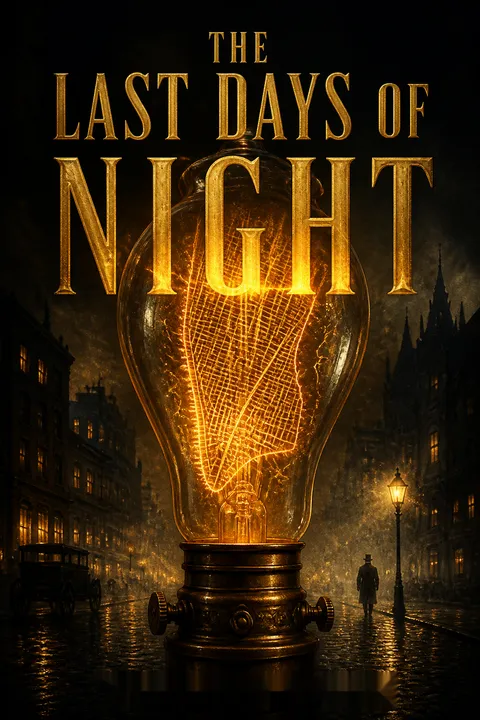

Plot Summary
Flames Over Broadway
On a bustling New York morning in 1888, young attorney Paul Cravath witnesses a lineman's horrific electrocution above Broadway—a public tragedy that crystallizes the dangers and promise of electricity. This event thrusts Paul into the heart of a technological revolution, as he is soon summoned by Thomas Edison, the era's most celebrated inventor. Their tense meeting reveals the stakes: Edison and his rival, George Westinghouse, are locked in a legal and commercial war over the future of electric light. Paul, ambitious and untested, is hired by Westinghouse to defend against Edison's billion-dollar lawsuit, setting the stage for a battle that will shape the modern world. The flames over Broadway become a symbol of both innovation's peril and the irresistible drive toward progress.
The Wizard's Challenge
Paul's first encounter with Edison is a masterclass in intimidation. Edison, the "Wizard of Menlo Park," boasts of his inventions and legal might, warning Paul of the futility of resistance. Yet Paul, driven by both pride and a sense of justice, counters with a surprise: Westinghouse has acquired key patents that threaten Edison's monopoly. The meeting is a psychological duel, revealing Edison's need for control and Paul's determination to prove himself. The city's electrified skyline becomes a metaphor for the power struggle, as both men realize that the winner will not only control a technology, but the very rhythm of modern life. Paul leaves, shaken but resolute, aware that he faces a genius who will stop at nothing to win.
A Prodigy's Gamble
Paul's journey from law school prodigy to partner at a struggling firm is marked by insecurity and ambition. When a family connection lands him a dinner with Westinghouse, Paul seizes the opportunity, despite feeling out of place among industrial titans. His honesty and conviction impress Westinghouse, who offers him the case of a lifetime: defending against Edison's claim to have invented the light bulb. The lawsuit's scale is staggering, but Paul's hunger for recognition outweighs his fear. He becomes the unlikely champion of innovation, betting his career on the hope that justice—and superior technology—will prevail. The gamble is not just legal, but existential, as Paul seeks to define his own legacy in a world remade by electricity.
War of the Currents
The conflict between Edison's direct current (D/C) and Westinghouse's alternating current (A/C) escalates into a nationwide war, fought in courtrooms and newspapers. Paul, overwhelmed by hundreds of lawsuits, realizes that the battle is as much about public perception as legal precedent. Edison's team sues relentlessly, aiming to bankrupt Westinghouse through attrition. Meanwhile, Paul searches for weaknesses in Edison's patent, questioning who truly invented the light bulb and what constitutes an "invention." The war becomes a test of endurance, strategy, and narrative control, with each side seeking to define the future of power. The stakes are nothing less than the electrification of America—and the soul of modern progress.
The Ghost in the Lab
As Paul seeks an edge, he hears rumors of Nikola Tesla, a brilliant but eccentric former Edison employee who vanished after a mysterious falling out. Tesla's absence becomes legendary among engineers, his name whispered as both a cautionary tale and a lost hope. Paul's investigation leads him through a web of scientific gossip and dead ends, until a chance encounter reveals Tesla's revolutionary ideas. Tesla's ghostly presence haunts the narrative, embodying both the promise and peril of genius unmoored from society. His eventual reemergence will change the course of the current war, but for now, he remains an enigma—an inventor lost in the shadows of his own mind.
Tesla's Dazzling Revelation
Tesla's public demonstration of alternating current at Columbia College electrifies the scientific community. His machines, powered by A/C, solve the "distance problem" that has plagued both Edison and Westinghouse, allowing electricity to travel far beyond city blocks. The event is both spectacle and revelation, as Tesla's mathematical brilliance and showmanship captivate the audience. Westinghouse recognizes the potential immediately, moving to secure Tesla's patents and expertise. For Paul, Tesla's arrival is a turning point—a chance to outflank Edison with superior technology. Yet Tesla's otherworldly detachment and erratic behavior foreshadow the challenges ahead, as genius proves both a blessing and a curse.
Alliances and Betrayals
The struggle for dominance intensifies as Paul navigates a labyrinth of negotiations, betrayals, and corporate espionage. Tesla's partnership with Westinghouse is fraught, as the inventor's brilliance is matched only by his instability. Paul's own firm becomes a battleground, with partners jockeying for credit and control. Meanwhile, Edison's camp plants spies and manipulates the press, turning public opinion against A/C by branding it dangerous. The introduction of the electric chair—a device powered by Westinghouse's current—marks a new low in the propaganda war. Alliances shift, trust erodes, and the line between right and wrong blurs, as each player sacrifices ideals for survival.
The Price of Progress
The race to electrify America exacts a heavy toll on all involved. Tesla's mental health deteriorates under pressure, leading to breakdowns and hallucinations that both inspire and torment him. Paul, consumed by the demands of the case, alienates friends and loses sight of his own values. The legal and financial stakes escalate, with Westinghouse's company teetering on the brink of bankruptcy. The relentless pursuit of progress leaves casualties—burned workers, ruined reputations, and shattered relationships. The narrative interrogates the true cost of invention, asking whether the ends justify the means, and what is lost when ambition eclipses empathy.
The Chair of Death
Edison's campaign to discredit A/C culminates in the invention of the electric chair, used for the first time in a gruesome public execution. The spectacle is intended to prove the deadly danger of Westinghouse's current, but the botched procedure horrifies witnesses and backfires in the press. Paul, present at the execution, is shaken by the moral implications of technological progress wielded as a weapon. The event becomes a turning point in the current war, exposing the lengths to which Edison will go to win—and the vulnerability of truth in the face of fear-mongering. The chair becomes a symbol of both the promise and peril of modernity.
The Power of Perception
As the war drags on, Paul realizes that victory depends as much on storytelling as on science or law. Edison's mastery of the media allows him to shape public opinion, turning technical debates into moral crusades. Paul counters with his own campaigns, leveraging the press and forging alliances with influential figures. The battle for hearts and minds becomes as fierce as the courtroom drama, with each side spinning facts to fit their agenda. The power of perception emerges as the true currency of the age, determining not only who wins the current war, but how history will remember its combatants.
Collapse and Conspiracy
The collapse of major banks triggers a financial panic, threatening to destroy Westinghouse's company. Paul and his allies scramble to secure funding, only to find themselves outmaneuvered by J.P. Morgan, who manipulates the market to favor Edison. Desperation breeds conspiracy, as Paul uncovers a spy within Westinghouse's ranks and orchestrates a secret coup to depose Edison from his own company. The machinations behind the scenes reveal the ruthless logic of capitalism, where loyalty is fleeting and survival demands compromise. The crisis forces Paul to confront his own limits, as he risks everything to save his client—and himself.
The Reverse Salient
Drawing on lessons from military strategy and the advice of Alexander Graham Bell, Paul identifies Edison's obsession with the lawsuit as a "reverse salient"—a vulnerability that can be exploited. By orchestrating a series of feints and leaks, Paul distracts Edison and his allies, buying time for Westinghouse to regroup. The narrative explores the interplay between innovation and strategy, as technical brilliance alone proves insufficient without cunning and adaptability. The reverse salient becomes a metaphor for the hidden flaws in even the most formidable systems, and the possibility of turning defeat into victory through insight and audacity.
The Art of Negotiation
The final phase of the current war is marked by high-stakes negotiation and personal sacrifice. Paul convinces Tesla to relinquish his lucrative royalties for the greater good, ensuring the survival of A/C and Westinghouse's company. The deal is both heroic and tragic, as Tesla's selflessness is contrasted with the manipulations of those around him. Paul's own relationships suffer, particularly with Agnes Huntington, whose trust he betrays in pursuit of victory. The art of negotiation is revealed as a double-edged sword, capable of achieving great things but also inflicting deep wounds. The cost of winning becomes painfully clear.
The Cost of Victory
With Edison deposed and a new era of cooperation dawning, Paul and his allies achieve the seemingly impossible: the electrification of America under a unified system. Yet the victory is bittersweet, as the personal and ethical compromises required leave lasting scars. Paul's relationship with Agnes is strained, Tesla is left penniless, and the giants of industry are haunted by the consequences of their actions. The narrative reflects on the paradox of progress—that every triumph carries a hidden cost, and that the pursuit of greatness often demands the sacrifice of innocence. The end of the current war is not a celebration, but a reckoning.
The Triumph of Networks
The merger of Edison's and Westinghouse's companies into General Electric marks the birth of a new industrial order. The triumph is not of any one man, but of networks—of people, ideas, and technologies woven together into a system greater than the sum of its parts. Paul's "Cravath system" revolutionizes the practice of law, mirroring the collaborative spirit of the age. The narrative celebrates the collective achievement of the era, while acknowledging the tensions and contradictions that remain. The triumph of networks is both a culmination and a beginning, as the world is forever changed by the power of connection.
The Last Invention
As the dust settles, the protagonists gather at Niagara Falls to witness the opening of the world's largest power plant—a symbol of the age's achievements and its passing. Edison, Westinghouse, and Tesla reflect on the nature of invention, lamenting the end of an era when miracles seemed possible. The narrative contemplates the future, where innovation becomes incremental and wonder is harder to find. Yet the legacy of the current war endures, in the lights that shine across the continent and the systems that shape modern life. The last invention is not a device, but a way of seeing the world—one that balances awe with understanding.
The Architects of Wonder
In the aftermath, Paul and Agnes find a measure of peace, dedicating themselves to philanthropy and the nurturing of future innovators. Tesla, though impoverished, remains a figure of fascination and inspiration. The story closes with a meditation on the nature of greatness, the interplay of genius and ambition, and the enduring power of wonder. The architects of the modern world are revealed to be flawed, complex, and deeply human—driven by love, rivalry, and the unquenchable desire to create. Their legacy is not just in the machines they built, but in the possibilities they opened for generations to come.
Analysis
A meditation on progress, power, and the human cost of innovationThe Last Days of Night is more than a historical thriller; it is a profound exploration of the forces that shape the modern world. Through its vivid characters and intricate plot, the novel interrogates the nature of genius, the ethics of ambition, and the price of technological advancement. It reveals that progress is never the work of a single individual, but the product of networks—of collaboration, competition, and compromise. The story warns that every triumph carries hidden costs, and that the pursuit of greatness can lead to both wonder and tragedy. In an age obsessed with disruption and innovation, the novel offers a timely reminder that the true legacy of invention lies not in machines, but in the possibilities they create—and the responsibilities they entail. The architects of wonder are, above all, human: flawed, striving, and forever reaching for the light.
Review Summary
The Last Days of Night by Graham Moore chronicles the late 1880s legal battle between Thomas Edison and George Westinghouse over light bulb patents and electrical current systems, told through young attorney Paul Cravath's perspective. Reviewers praise the compelling blend of historical fact and fiction, noting Moore's meticulous research and entertaining narrative style. The book vividly portrays Edison, Westinghouse, and the eccentric Nikola Tesla, alongside figures like J.P. Morgan and Alexander Graham Bell. Readers appreciated learning about this transformative period in American history through engaging storytelling that reads like a thriller, though some found pacing issues and excessive technical detail.
People Also Read





Characters
Paul Cravath
Paul is a young, brilliant attorney thrust into the epicenter of the current war. His outsider status—Southern roots, modest means, and lack of connections—fuels both his insecurity and his drive. Paul's journey is one of self-discovery, as he navigates the treacherous waters of law, business, and invention. He is both a builder of narratives and a seeker of justice, torn between ambition and conscience. His relationships—with Westinghouse, Tesla, and Agnes—reveal his longing for recognition and belonging. Over time, Paul evolves from naïve idealist to shrewd strategist, learning that victory often comes at a personal and ethical cost. His legacy is the creation of the "Cravath system," a new model for collaborative problem-solving that mirrors the interconnectedness of the age.
Thomas Edison
Edison is the embodiment of American invention—brilliant, relentless, and deeply insecure. His need for control and recognition drives him to both greatness and moral compromise. Edison's public persona as the "Wizard of Menlo Park" masks a complex psychology: he is both visionary and manipulator, capable of inspiring awe and fear. His rivalry with Westinghouse and disdain for Tesla reveal his intolerance for dissent and obsession with legacy. Edison's willingness to use propaganda, legal warfare, and even the electric chair to achieve his ends exposes the dark side of progress. Yet he is also haunted by the knowledge that his era of wonder is ending, and that the systems he built will outlast his own name.
George Westinghouse
Westinghouse is Edison's opposite in temperament—reserved, methodical, and driven by a commitment to quality and fairness. His background as an engineer and manufacturer grounds his approach to innovation: he values practical solutions and the well-being of his employees. Westinghouse's rivalry with Edison is both personal and philosophical, as he champions A/C not just for its technical merits, but for its potential to democratize power. His relationship with Paul is paternal yet demanding, pushing the young attorney to grow. Westinghouse's greatest flaw is his pride, which blinds him to the dangers of compromise and betrayal. Ultimately, he emerges as a tragic hero, sacrificing personal wealth and comfort for the greater good.
Nikola Tesla
Tesla is the story's most enigmatic figure—a man of extraordinary intellect and profound alienation. His mind is a wellspring of revolutionary ideas, from alternating current to X-rays, yet he is ill-suited to the practicalities of business and human connection. Tesla's eccentricities—obsessive habits, hallucinations, and social awkwardness—both fuel his creativity and isolate him from others. His partnership with Westinghouse is fraught, as his need for autonomy clashes with corporate demands. Tesla's ultimate sacrifice—relinquishing his royalties for the sake of progress—cements his status as a martyr to invention. He is both a prophet and a casualty of the modern age, his legacy enduring long after his death.
Agnes Huntington
Agnes is a celebrated opera singer with a secret past, navigating the treacherous world of high society through wit, talent, and adaptability. Her relationship with Paul is both romantic and redemptive, offering him a glimpse of authenticity in a world of masks. Agnes's own journey—from impostor to self-acceptance—mirrors the story's themes of reinvention and the search for meaning. She is both muse and moral compass, challenging Paul to reconcile ambition with empathy. Her ultimate choice to reject a life of pretense in favor of genuine connection underscores the novel's belief in the possibility of redemption.
J.P. Morgan
Morgan is the era's most powerful financier, orchestrating the fates of companies and inventors with cold precision. His motivations are transparent—profit and control—but his methods are opaque, relying on networks of influence, spies, and backroom deals. Morgan's alliance with Paul is one of convenience, each using the other to achieve their ends. He is both a catalyst for progress and a symbol of its moral ambiguity, reminding the characters that in the new world, money is the ultimate arbiter of value.
Charles Batchelor
Batchelor is Edison's right-hand man, executing his employer's will with ruthless efficiency. He is the architect of many of the war's dirtiest tactics, from espionage to sabotage. Yet Batchelor is also a survivor, willing to switch allegiances when the winds change. His interactions with Paul reveal the thin line between adversary and ally, and the ways in which personal ambition can override loyalty.
Reginald Fessenden
Fessenden is a talented engineer caught between loyalty and self-interest. Initially recruited by Paul as a spy within Edison's camp, he is later revealed to be a mole for Edison within Westinghouse's operation. Fessenden's duplicity is both a symptom and a cause of the era's moral confusion, as individuals are forced to choose sides in a war where the rules are constantly shifting. His ultimate fate is a cautionary tale about the dangers of playing both ends against the middle.
Walter Carter & Charles Hughes
Paul's senior partners represent the established legal profession—cautious, hierarchical, and resistant to change. Their skepticism of Paul's methods and ambition creates tension within the firm, forcing Paul to innovate and ultimately break free. Carter and Hughes are both mentors and obstacles, embodying the challenges of generational transition in a rapidly changing world.
Harold Brown
Brown is a minor inventor whose bitterness at being overshadowed by Edison and Westinghouse leads him to become a tool in Edison's campaign against A/C. His orchestration of the electric chair and public demonstrations of A/C's dangers reveal the power of fear and spectacle in shaping public opinion. Brown's story is a cautionary tale about the corrosive effects of envy and the ease with which truth can be manipulated.
Plot Devices
Historical Fiction as Mirror of Modernity
The novel uses real historical events and figures as a canvas for dramatizing the ethical, psychological, and societal dilemmas of technological change. By compressing timelines and inventing dialogue, the story creates a heightened reality that illuminates the timeless tensions between innovation and morality, ambition and empathy. The interplay of fact and fiction invites readers to question the nature of truth, the construction of history, and the meaning of legacy.
The Lawsuit as Narrative Engine
The central lawsuit between Edison and Westinghouse serves as both plot catalyst and metaphor for the broader war of ideas. The courtroom becomes a stage for the performance of identity, the negotiation of power, and the contestation of values. The legal battle's complexity mirrors the intricacies of invention, requiring not just technical expertise but narrative mastery and psychological insight.
The Reverse Salient
Borrowed from military theory, the concept of the "reverse salient"—a point of weakness in an otherwise strong line—becomes a key plot device. Paul's recognition of Edison's fixation on the lawsuit allows him to outmaneuver his rival, turning strength into weakness. The device underscores the importance of adaptability, strategic thinking, and the ability to see beyond the obvious.
Foreshadowing and Irony
The narrative is rich in foreshadowing, with early events—such as the burning lineman or Tesla's breakdown—prefiguring later crises and revelations. Irony pervades the story: victories become defeats, heroes become villains, and the pursuit of greatness leads to unexpected loss. The use of dramatic irony, where the reader knows more than the characters, heightens the emotional impact and invites reflection on the unpredictability of progress.
The Network as Metaphor
The emergence of electrical networks parallels the formation of social, legal, and psychological networks among the characters. The story celebrates collaboration, interdependence, and the power of collective action, while also warning of the dangers of entanglement and betrayal. The network becomes both a source of strength and a site of vulnerability, reflecting the complexities of modern life.
Download PDF
Download EPUB
.epub digital book format is ideal for reading ebooks on phones, tablets, and e-readers.








































