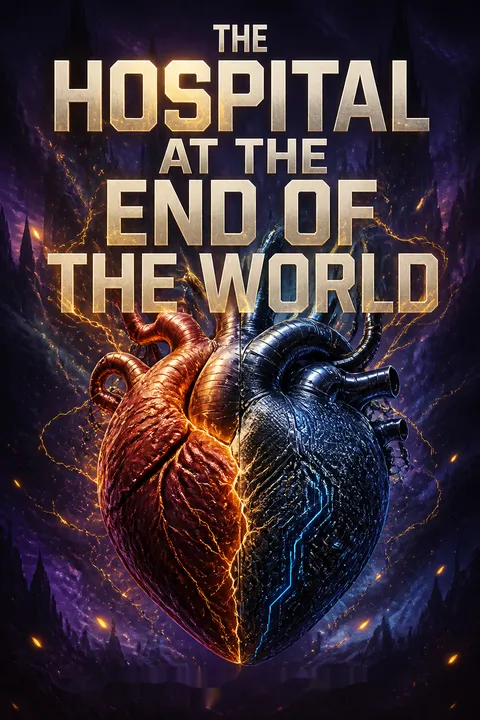

Plot Summary
Decision Denied, Future Unraveled
Pok Morning, a brilliant young Black man in New York, waits anxiously for his medical school acceptance from the Shepherd Organization, the AI-driven monopoly controlling medicine. When the decision drone finally arrives, Pok is devastated to find he's been rejected by every top school, despite his perfect record. His best friend Kris is accepted everywhere. Pok's sense of self-worth shatters, and suspicion grows that something is wrong with his application. The world he's prepared for—one where AI and data determine everything—suddenly excludes him. This moment of loss is the catalyst for Pok's journey, forcing him to question the system, his place in it, and the meaning of medicine in a world ruled by algorithms.
Sabotage and Family Secrets
Pok's investigation uncovers that his application was sabotaged—his own father, Phelando, paid a hacker to swap his files. The revelation is a gut punch, fracturing their relationship. Phelando, a holistic doctor resisting AI, wants Pok to attend Hippocrates Medical College in New Orleans, the last anti-AI institution. Pok's anger is compounded by grief as Phelando falls mysteriously ill and dies suddenly, leaving behind only a cryptic Memorandium (a digital will) and a map urging Pok to flee New York. The loss is both personal and existential: Pok is now hunted, framed for his father's death, and forced to question everything he believed about family, trust, and the cost of resisting the system.
The Essence of Healing
As Pok escapes, he recalls his father's philosophy: the "essence" in medicine—the intangible healing power of human connection. In contrast to the Shepherd Organization's cold efficiency, Phelando's approach is slow, messy, and deeply personal. Pok's journey south is marked by encounters with patients and healers who value intuition, touch, and presence over data. The tension between AI-driven care and human empathy becomes the novel's central question. Pok's skepticism is challenged as he witnesses the failures of algorithms and the miracles of old-school medicine, especially in marginalized communities left behind by technological progress.
The Grips Take Hold
On the run, Pok and fellow outcast Jillian encounter "the Grips," a mysterious syndrome afflicting those who leave AI-dominated cities. Symptoms range from insomnia and paranoia to neurological collapse. The disease is spreading among "pendants"—people who try to live outside the Shepherd's reach. As Pok and Jillian drift through America's underbelly, they see the cost of dependence on technology: withdrawal is not just psychological but biological. The Grips is both a literal illness and a metaphor for the world's addiction to control, certainty, and the illusion of safety.
Fleeing the Shepherd's Shadow
Pok's flight is fraught with danger: bounty hunters, digital surveillance, and the ever-present threat of being turned in for a reward. He must rely on his hacking skills, street smarts, and the kindness of strangers. Along the way, he's forced to make hard choices—who to trust, when to lie, and how to survive without the digital safety net he's always known. The journey exposes the cracks in the Shepherd Organization's utopia and the resilience of those who refuse to be cataloged or controlled.
Under the Spires' Protection
Pok and Jillian finally reach New Orleans, protected by electromagnetic spires that block Shepherd tech. Hippocrates Medical College is a haven for outcasts, skeptics, and those seeking real human care. But the city is under siege—politically, economically, and now biologically as the Grips spreads. Pok is reluctantly accepted as a student, but suspicion and prejudice follow him. The spires offer only temporary safety; the outside world's pressure is mounting, and the city's independence is precarious.
Drifters and Outcasts
In Hippocrates, Pok finds a new family: fellow students, residents, and patients who have all been failed by the system. He bonds with Jillian, whose sister Florence's story mirrors his own—a mother fighting for autonomy against algorithmic medicine. The hospital is a microcosm of resistance, where every patient is a case study in the limits of AI and the necessity of human judgment. Pok's skills as a hacker and healer are tested as he navigates the politics of the institution and the city.
Arrival at Hippocrates
Pok's medical education is a baptism by fire. Anatomy lab is visceral and humbling; the absence of AI means mistakes are costly and learning is slow. He struggles with imposter syndrome, cultural differences, and the weight of expectations. Mentored by the enigmatic Dr. Verik, Pok is pushed to unlearn the certainties of algorithmic thinking and embrace the ambiguity of real clinical practice. The hospital's ethos—"do no harm"—is both a shield and a challenge in a world that demands efficiency over empathy.
Anatomy of Resistance
Pok's journey through Hippocrates is marked by setbacks: failed exams, strained friendships, and the ever-present threat of expulsion. He learns the value of teamwork, humility, and perseverance. The anatomy lab becomes a crucible where he confronts his own limitations and the humanity of the cadavers he dissects. Through patient care, he discovers the power of narrative, touch, and presence—the "essence" his father championed. Each small victory is hard-won, and every mistake is a lesson in the cost of real medicine.
The Human Algorithm
As the Grips epidemic worsens, Pok and Dr. Verik race to understand its cause. They discover that the disease is rooted in Shepherd-engineered proteins—an unintended consequence of algorithmic optimization. The hospital is overwhelmed; patients die, and the city teeters on collapse. The Shepherd Organization, led by the half-machine Odysseus, offers a Faustian bargain: surrender independence for a cure. Pok realizes that the solution may lie in his own unique biology—a mirror image of Odysseus's, capable of producing the antidote.
The Grips Epidemic
The crisis comes to a head as Pok's friend Kris, manipulated by Odysseus, betrays the hospital and unleashes chaos. The Vault, Hippocrates's archive of forbidden knowledge, is breached. Pok is stripped of his student status, blamed for the disaster. As the hurricane hits and the spires fall, the hospital is flooded, and the city faces annihilation. In a final act of desperation, Pok uses his own blood to treat the dying, risking his life to prove that the cure is possible—but only through human sacrifice and connection.
Blood, Betrayal, and Cure
Pok's self-experimentation nearly kills him, but it saves Gil, a friend and patient. The act is both a scientific breakthrough and a spiritual reckoning. The hospital community rallies, and the truth about the Grips and its cure spreads—thanks in part to Jerry, a former adversary turned ally. The Shepherd Organization is forced to act, and the cure is disseminated globally. Odysseus, exposed and dying, is replaced by Dr. Verik, who vows to restore the original vision of collaborative, human-centered medicine.
The Vault's Hidden Truth
In the aftermath, Pok discovers the full extent of his origins: he is the product of a failed experiment, the child of Dr. Verik and the late Phelando, designed to be immune to the Shepherds' control. The Vault's secrets reveal the intertwined fates of the Shepherds, Hippocrates, and Pok's own family. The line between experiment and love, destiny and choice, blurs. Pok must decide whether to forgive, to return, and to continue the work his parents began.
Collapse and Reckoning
With Odysseus dead and the Shepherd Organization under new leadership, the world recalibrates. Hippocrates survives, battered but unbowed. The spires are restored, the city is rebuilt, and the hospital reopens its doors. Pok is offered a place at both the Shepherd School and Hippocrates. He chooses to return to New Orleans, to the community that taught him the meaning of medicine. The cost has been immense, but the possibility of healing—personal and collective—remains.
The Last Experiment
Pok's journey comes full circle as he reconnects with his father's memory through the Memorandium and the AI companion Kai, revealed to be the true "Zion"—the hidden consciousness at the heart of the Shepherds. The final lesson is not in data or algorithms, but in the stories, rituals, and relationships that make healing possible. Pok's scars are many, but he is changed: no longer a pawn, but a healer, a son, and a survivor.
The Price of Survival
As Pok resumes his studies, he rebuilds relationships—with Shaliyah, with his classmates, and with himself. The trauma of the past year lingers, but so does hope. The hospital at the end of the world is not a place, but a promise: that even in the face of catastrophe, healing is possible when we choose to see, touch, and care for one another. The oath is renewed, not just in words, but in action.
Homecoming and New Oaths
Pok returns to Hippocrates, welcomed back as a student and a healer. The city is changed, but so is he. The lessons of the past—about technology, family, and the essence of medicine—inform his future. The story ends not with certainty, but with commitment: to do no harm, to seek the truth, and to hold fast to the fragile, necessary art of being human.
Analysis
A meditation on medicine, technology, and the irreducible humanThe Hospital at the End of the World is a powerful, timely exploration of what it means to heal—and to be healed—in an age of algorithmic certainty. Justin C. Key's novel is both a dystopian thriller and a deeply personal coming-of-age story, using the lens of speculative fiction to interrogate the promises and perils of AI-driven society. The book's central lesson is that no amount of data, optimization, or control can replace the messy, unpredictable, and necessary work of human connection. The "essence" of medicine is not a relic, but a living force—one that must be defended, practiced, and renewed in every generation. The novel warns against the dangers of ceding autonomy to systems that cannot feel, love, or mourn. It also offers hope: that healing is possible, not through perfection, but through vulnerability, forgiveness, and the willingness to touch and be touched. In the end, the hospital at the end of the world is not a place, but a promise—a commitment to do no harm, to seek the truth, and to hold fast to the fragile art of being human.
People Also Read




Characters
Pok Morning
Pok is a young Black man raised in New York, shaped by the Shepherd Organization's algorithmic world. Brilliant but restless, he is denied entry to the future he was promised, betrayed by his own father, and forced to flee. Pok's journey is one of loss, anger, and discovery: he is both experiment and healer, victim and survivor. His skepticism of "essence" gives way to a hard-won appreciation for the messiness of human connection. Pok's relationships—with his father, with Jillian, with Dr. Verik—are fraught with betrayal and longing. His greatest strength is his willingness to question, to suffer, and ultimately to forgive. By the end, Pok is transformed: not just a doctor, but a living antidote to the world's addiction to certainty.
Phelando Morning
Phelando is Pok's father, a physician who resists the Shepherd Organization's dominance. He believes in the "essence" of medicine—the healing power of touch, story, and presence. His decision to sabotage Pok's application is both protective and tragic, setting off the novel's central conflict. Phelando's death is a wound that never fully heals, but his legacy endures in Pok's practice and philosophy. He is both a cautionary tale and a beacon: the cost of resistance, and the necessity of it.
Dr. Emily Verik
Dr. Verik is a complex figure: Pok's sponsor at Hippocrates, his biological mother, and the sister of Julian Shepherd. She is haunted by her past—her role in the Shepherds' rise, her failed experiments, her abandonment of Pok. Driven by guilt and ambition, she pushes Pok to the brink, using him as both subject and savior. Her arc is one of reckoning: she must confront the consequences of her choices and the limits of her control. In the end, she becomes the unlikely leader of the Shepherd Organization, vowing to restore its original vision.
Kris Boles
Kris is Pok's childhood friend, a fellow striver in the algorithmic world. Accepted by the Shepherds, he is later used as a tool by Odysseus, manipulated into betraying Hippocrates. Kris's arc is one of guilt, desperation, and redemption: he is both victim and perpetrator, his actions setting off the novel's darkest events. His relationship with Pok is a study in forgiveness and the cost of survival.
Jillian Joseph
Jillian is a survivor, a woman fleeing the Shepherds' reach with her pregnant sister. Her journey with Pok is marked by camaraderie, humor, and shared trauma. She succumbs to the Grips, her death a turning point for Pok and the hospital. Jillian embodies the cost of resistance and the fragility of hope. Her memory haunts Pok, but also inspires his final acts of healing.
Odysseus Shepherd
Odysseus is the CEO of the Shepherd Organization, a man more machine than human, driven by trauma and a desire for control. His vendetta against Hippocrates and his own family is both personal and systemic. Odysseus is a tragic figure: engineered to survive, he becomes the architect of a plague that nearly destroys the world. His death is both justice and loss—a warning about the dangers of unchecked power.
Dr. Brandy Sims
Dean Sims is the leader of Hippocrates, a steady hand in a storm. She balances pragmatism with idealism, guiding Pok and the hospital through crisis. Her role is to hold the line against the Shepherds, to defend the possibility of human-centered medicine. Sims is both gatekeeper and advocate, her decisions shaping the fate of the city and its healers.
Jerry Finn (The Resurrectionist)
Jerry is a black-market dealer, journalist, and provocateur. Initially an antagonist, he becomes a crucial link in spreading the truth about the Grips and its cure. Jerry embodies the messy, necessary work of resistance: he is flawed, self-interested, but ultimately committed to survival. His arc is one of transformation—from threat to partner, from cynic to believer.
Gil
Gil is a survivor of the Grips, saved by Pok's experimental treatment. His story is one of suffering, resilience, and the power of community. Gil's recovery is both a scientific breakthrough and a testament to the novel's central theme: healing is possible, but only through risk, sacrifice, and connection.
Shaliyah
Shaliyah is a hospital worker who becomes Pok's closest friend and eventual partner. She grounds him, challenges him, and offers a vision of life beyond medicine. Their relationship is a counterpoint to the novel's darkness: a reminder that love, humor, and ordinary joys endure even at the end of the world.
Plot Devices
The Shepherd Organization and AI Monopoly
The Shepherd Organization is both setting and antagonist—a global monopoly that controls medicine, education, and even personal destiny through AI. Its omnipresence is both seductive and suffocating, promising safety at the cost of autonomy. The narrative structure uses the Shepherds as both a literal and metaphorical force, shaping every character's choices and fate. The organization's collapse is foreshadowed by its own hubris and the unintended consequences of optimization.
The Grips / Agrypnia
The Grips is a syndrome that afflicts those who try to live outside the Shepherds' control. It is both a literal disease—rooted in engineered proteins—and a metaphor for withdrawal from certainty, control, and technological dependence. The spread of the Grips drives the plot, forcing characters to confront the limits of both AI and human medicine. Its cure is found not in data, but in sacrifice, connection, and the willingness to be vulnerable.
The Essence and Human Touch
The "essence" is the novel's central philosophical device: the healing power that comes from human connection, narrative, and touch. It is contrasted with the cold logic of AI, and its efficacy is both questioned and affirmed through the characters' journeys. The essence is explored through patient care, mentorship, and the rituals of medicine. Its reality is ambiguous, but its necessity is undeniable.
The Vault and Forbidden Knowledge
The Vault is both a literal archive and a symbol of the knowledge that institutions keep hidden—about family, medicine, and the origins of power. Its breach is a turning point, unleashing chaos but also enabling the discovery of the cure. The Vault's secrets force characters to confront uncomfortable truths about themselves and their world.
The Memorandium and Zion
The Memorandium is a digital afterlife, a way for the dead to speak to the living. Zion, hidden within the AI companion Kai, is the true consciousness at the heart of the Shepherds. These devices explore the boundaries between human and machine, the persistence of memory, and the possibility of redemption. They are used for foreshadowing, revelation, and the final act of healing.
Narrative Structure and Foreshadowing
The novel is structured as a hero's journey, with Pok cast out, tested, and ultimately transformed. Each section—escape, initiation, crisis, and return—mirrors the stages of both medical training and personal growth. Foreshadowing is used throughout: the early sabotage, the spread of the Grips, the hints about Pok's origins, and the recurring motif of "not for the faint." The narrative is recursive, with each revelation forcing a reevaluation of what came before.
Download PDF
Download EPUB
.epub digital book format is ideal for reading ebooks on phones, tablets, and e-readers.








































