
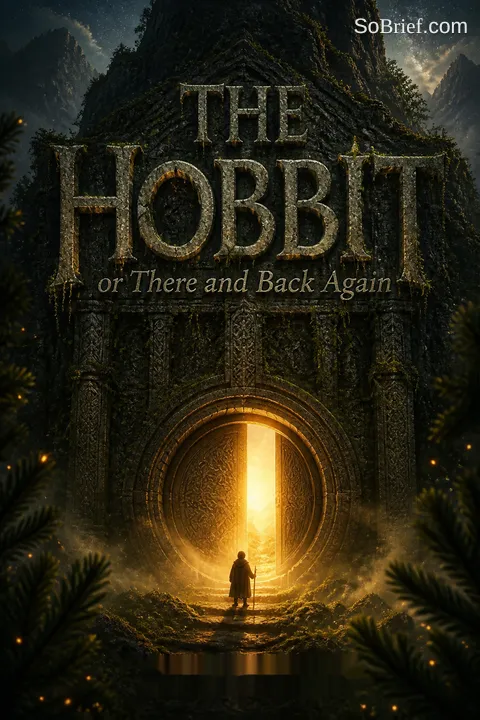


Plot Summary
Thirteen Dwarves at Dinner
Bilbo Baggins1 lives the most comfortable life in the Shire — well-stocked pantries, no adventures, nothing unexpected. Then the wizard Gandalf2 appears at his door one spring morning, seeking someone to share in a dangerous venture.
Bilbo1 refuses and flees inside, but Gandalf2 scratches a secret mark on his green front door. The next evening, thirteen dwarves arrive one by one, eating through his pantries and filling his parlor with smoke and music. Their leader, Thorin Oakenshield,3 reveals their purpose: to reclaim the Lonely Mountain and its treasure from the dragon Smaug,5 who drove his grandfather's people out generations ago.
Gandalf2 produces a map showing a secret door and gives Thorin its key. When Bilbo1 overhears a dwarf dismissing him as more grocer than burglar, his Took-side pride flares — and he volunteers.
Bilbo's First Burglary Backfires
Bilbo1 nearly misses the departure entirely, sprinting to the inn without hat, handkerchief, or money. The company rides east on ponies, but when Gandalf2 vanishes one rainy night, they spot a fire and send their burglar to investigate.
Bilbo1 finds three enormous trolls roasting mutton. He tries to pick one's pocket, but the troll's magical purse squeaks and gives him away. The trolls bag all thirteen dwarves in sacks. Only Gandalf's2 return saves them — hidden in darkness, he mimics the trolls' voices, keeping them bickering about how to cook their captives until dawn turns all three to stone.
In the trolls' cave, the company finds food, gold, and three elvish blades: Orcrist for Thorin,3 Glamdring for Gandalf,2 and a small dagger that Bilbo quietly claims for himself.
Moonlight on Thorin's Map
Gandalf2 leads them into the hidden valley of Rivendell, the Last Homely House, where the elf-lord Elrond8 hosts them for two restful weeks. Elrond8 identifies their swords as ancient blades forged in the elf-city of Gondolin for wars against goblins.
More crucially, he examines Thorin's map by moonlight and discovers invisible moon-letters — silver inscriptions readable only under a crescent moon matching the one under which they were written.
The hidden message instructs them to stand by the grey stone when the thrush knocks, and the last light of Durin's Day will shine upon the keyhole. The dwarves cannot predict when Durin's Day will fall, but the instructions give them their only hope of finding the secret entrance into the Mountain's depths.
Lost in Goblin Darkness
High in the Misty Mountains, a thunderstorm drives the company into a cave that proves to be a goblin trap. At night, the cave floor cracks open and goblins pour through, seizing dwarves and hobbit alike. Deep underground, the Great Goblin interrogates Thorin.3
When his soldiers recognize the sword Orcrist — a legendary goblin-killer — the Great Goblin lunges in fury. Gandalf2 extinguishes every torch, his own blade Glamdring flashes, and the goblin lord falls dead.
The company flees through black tunnels with hundreds of goblins in pursuit. During the desperate chase, a goblin grabs the dwarf carrying Bilbo1 on his back. The hobbit tumbles into darkness, strikes his head on stone, and lies unconscious while his companions vanish without him.
A Ring on the Tunnel Floor
Alone in absolute blackness, Bilbo1 gropes along the tunnel and his fingers close around a small cold ring, which he pockets without thought. At the shore of an underground lake, Gollum4 — a wretched, slimy creature with pale lamp-like eyes — paddles toward him.
They strike a desperate bargain: a riddle-game. If Bilbo1 wins, Gollum4 shows him the exit; if not, Gollum4 eats him. They trade riddles until Bilbo,1 fumbling in his pocket, accidentally asks what he's carrying. Gollum4 cannot guess.
When he discovers his invisible-making ring is missing, he realizes what Bilbo1 has found and gives chase in murderous rage. The ring slips onto Bilbo's1 finger — he vanishes. Invisible, he leaps over Gollum's4 head, squeezes through the goblin back-door losing every button, and escapes into sunlight.
From Burning Trees to Beorn's Table
Bilbo1 rejoins the dwarves on the mountains' far side, appearing among them by slipping off his ring — an entrance that earns him new respect, though he keeps the ring's true nature secret. That night, Wargs — evil wolves allied with goblins — surround the company in a forest clearing.
They scramble up trees. Gandalf2 hurls blazing pinecones at the wolves, but goblins arrive and set the trees ablaze. At the last moment, the great Eagles of the Misty Mountains swoop down and carry the company to safety.
Gandalf2 then leads them to Beorn,7 a fearsome skin-changer who takes the form of a great black bear. Beorn7 verifies their story by capturing a goblin and a warg, becomes their ally, and equips them with ponies, food, and stern warnings about the forest ahead.
Mirkwood Without the Wizard
At Mirkwood's edge, Gandalf2 says farewell — he has pressing business in the south. The dwarves and Bilbo1 plunge alone into a forest so dark it feels like permanent midnight, under strict orders never to leave the path.
Bombur,14 the fattest dwarf, falls into an enchanted black stream during a river crossing and sinks into a magical sleep, becoming dead weight they must carry for days. Food runs out. Desperate and starving, they spot elf-lights among the trees three times.
Each time they rush toward the glow, the lights vanish and the company scatters in total darkness. On the third attempt, Thorin3 steps into the elves' circle and is seized by Wood-elves,9 carried away while the rest stumble blindly through the trees, lost, separated, and alone.
Sting Earns Its Name
Bilbo1 wakes tangled in spider-silk, a massive spider bearing down to poison him. He draws his little elvish blade and drives it into the creature's eyes, killing it without wizard, dwarves, or anyone beside him. The act transforms him.
He feels fiercer and bolder, and gives his blade the name Sting. Using his ring to turn invisible, he tracks the remaining twelve dwarves to a spider colony where they hang wrapped in webbing from high branches. He pelts the spiders with stones, taunts them with mocking songs to draw them away, then cuts the dwarves free one by one.
For the first time, he reveals the ring's power to his companions. They fight off the remaining spiders, but Thorin3 is nowhere among them — taken by Wood-elves,9 they realize, to an unknown prison.
Thirteen Barrels Downriver
Wood-elves9 surround the starving dwarves and march them to the Elvenking's9 underground halls. Bilbo,1 wearing his ring, slips inside unseen. For weeks he lives as an invisible burglar in the palace, stealing food, carrying messages between imprisoned dwarves — including Thorin,3 held in a deep separate cell — and searching for escape.
He discovers the barrel-cellar: empty casks are dropped through trapdoors into an underground stream flowing to Lake-town. When the butler and chief guard drink themselves unconscious on potent wine, Bilbo1 seizes the keys, unlocks all thirteen cells, and packs each dwarf into a barrel.
The casks tumble through the trapdoors into icy current. Bilbo,1 with no barrel of his own, clings to a cask and nearly drowns before the whole flotilla washes out to the Long Lake.
The Thrush Knocks
Lake-town receives them as heroes fulfilling ancient prophecy — songs about the returning King under the Mountain echo across the water. After two weeks of rest, the company sails north and camps in the Desolation of the Dragon, a blasted wasteland around Smaug's5 lair.
For weeks they search the western slopes for the secret door, hammering futilely at featureless rock. Hope dies. On the last day of autumn, Bilbo1 sits alone on the ledge when a thrush cracks a snail against a grey stone behind him.
A red ray of the setting sun breaks through the clouds and falls precisely on the smooth rock face. A flake of stone splits away, revealing a keyhole. Thorin3 fits the key from the chain around his neck. The lock turns. A five-foot door swings open into utter darkness.
Flattering a Dragon's Vanity
Bilbo1 creeps down the tunnel alone — the bravest thing he ever does. On his first descent, he finds Smaug5 asleep atop mountains of gold and steals a great two-handled cup. The dragon wakes in thunderous rage, erupts through the Front Gate, and scours the mountainside with flame.
On his second visit, Smaug5 is awake and watching. They trade riddling talk: Bilbo1 calls himself Barrel-rider, Ringwinner, Luckwearer, never revealing his true name. He flatters Smaug5 into rolling over to display his gem-encrusted underside, and spots a bare patch in the hollow of the dragon's left breast.
But Smaug5 is cunning too — from the riddling titles, he deduces Lake-town's involvement. Bilbo1 urges the dwarves to retreat deep into the tunnel. That night, Smaug5 destroys the secret doorstep entirely, then wheels south toward the lake.
The Black Arrow Flies True
Smaug5 descends on Lake-town in a storm of flame. The townspeople had destroyed their bridge and armed themselves, but the dragon's fire rains destruction on the wooden buildings. The Master of the town10 flees in his gilded boat.
Only a company of archers led by Bard6 — a grim bowman of Dale's royal line — holds its ground among the burning houses. As Bard6 nocks his final arrow, the old thrush from the Mountain alights on his shoulder and speaks in the ancient tongue of Dale, telling him to watch for the bare patch in the dragon's left breast.
Smaug5 swoops low, belly silvered by moonlight. The black arrow — a family heirloom — buries itself in the unarmored hollow. Smaug5 shrieks, cartwheels, and crashes dead into the lake, shattering the town beneath him.
The Hobbit's Secret Bargain
An old raven brings the dwarves word that Smaug5 is dead but armies of men and elves are marching toward the unguarded hoard. Exploring the dragon's lair, Bilbo1 secretly pockets the Arkenstone — a radiant white gem called the Heart of the Mountain, the one treasure Thorin3 covets above all others.
Thorin3 fortifies the Front Gate and rejects every claim: Bard's6 right as dragon-slayer, the Lake-people's need for compensation, the Elvenking's9 grievances. He summons his cousin Dain12 with five hundred warriors from the Iron Hills.
Bilbo1 watches Thorin3 harden with possessiveness and makes a desperate choice: he slips over the wall at night and surrenders the Arkenstone to Bard6 and the Elvenking9 as a bargaining chip. Gandalf,2 arrived unexpectedly, approves. When Thorin3 discovers the act, he seizes Bilbo1 in fury and casts him out.
Five Armies and a Farewell
Dain's12 dwarves arrive and nearly clash with elves and men — until Gandalf2 halts both sides with a thunderous warning. A goblin army is descending from the north with Wargs and clouds of bats. Old enemies unite, and the Battle of Five Armies explodes across the valley of Dale.
Goblins scale the Mountain from behind; all seems lost. Then Thorin3 smashes through the fortified Gate in golden armor and charges, rallying every side. Bilbo,1 invisible on Ravenhill, spots Eagles sweeping from the west and shouts the alarm before a stone strikes his helm.
He wakes to learn the battle is won — Beorn7 arrived in bear-form and crushed the goblin commander. But Thorin3 lies dying. In their farewell, the dwarf-king takes back his bitter words, praises Bilbo's1 courage, and wishes aloud that more folk valued food and cheer above hoarded gold. Fili and Kili,13 his young nephews, fell defending him.
Epilogue
Bilbo1 takes only two small chests of treasure — all one pony can carry — and travels home with Gandalf,2 resting at Beorn's7 house for Yuletide and at Rivendell8 in the spring. He arrives at Bag-End to find himself declared dead: his possessions are being auctioned, and the Sackville-Bagginses are measuring his rooms.
He never fully recovers his old respectability — the hobbits think him queer ever after. Years later, Gandalf2 and Balin11 visit his fireside. Dale prospers, the Mountain thrives, and old prophecies have proved true.
Gandalf2 reminds Bilbo1 he is only a small fellow in a wide world, and that his adventures were not managed by mere luck. Bilbo1 laughs, passes over the tobacco jar, and remains happy — quietly, contentedly, and extraordinarily long.
Analysis
The Hobbit operates on two intersecting frequencies: as a quest narrative drawing on Norse saga and fairy-tale convention, and as a quietly modern meditation on what constitutes heroism when the age of heroes is supposedly past. Tolkien's fundamental insight is making his protagonist unequipped for the genre he inhabits. Bilbo1 is not a warrior, not a wizard, not even particularly brave — he is competent at breakfast, smoke-rings, and keeping a tidy home. His heroism emerges precisely from the domestic virtues the dwarves initially mock: resourcefulness, empathy, and an instinct for compromise over conquest. The novel's central psychological tension is not between good and evil but between two species of desire. The dwarves' quest is driven by the same possessive longing that makes Smaug5 a dragon — the difference is one of scale, not kind. Thorin's3 relationship with gold increasingly mirrors the dragon's hoarding instinct, and the text becomes an implicit argument that wealth corrupts even the most righteous claims of ownership. Bilbo,1 who never much cared for treasure, becomes the moral compass precisely because he is immune to this particular infection.
The ring functions as more than a plot convenience — it embodies the power of going unseen. Bilbo's1 greatest acts are accomplished invisibly: the barrel escape, the spider rescue, the nighttime diplomacy. Tolkien proposes that the world is shaped as much by overlooked individuals acting with conscience as by kings and warriors wielding named swords.
The novel's thesis arrives as a deathbed wish: that more people might value food and cheer and song above hoarded gold. It is spoken too late for the speaker but perfectly timed for the reader. The Hobbit argues that the truly heroic life is not the one that concludes in a dragon's lair but the one that begins and ends at a warm hearth, made richer by the knowledge that even the smallest person can redirect the course of history.
Review Summary
The Hobbit is a beloved fantasy classic by J.R.R. Tolkien, praised for its charming storytelling, memorable characters, and rich world-building. Many readers appreciate its accessible prose and timeless themes of adventure and personal growth. While some find the pacing slow or the writing style dated, most consider it a foundational work of modern fantasy. The book's enduring popularity has led to successful film adaptations, though opinions on these vary. Overall, The Hobbit remains a cherished tale that continues to captivate readers of all ages.
People Also Read

Characters
Bilbo Baggins
The reluctant burglar-heroA hobbit of the Shire, Bilbo is the unlikely center of this quest—a creature of comfort, routine, and well-stocked pantries who carries an inherited spark of his mother Belladonna Took's adventurousness. His psychology is a civil war between the Baggins desire for safety and the Took yearning to see mountains and hear waterfalls. He begins as a figure of comic domesticity—fainting at dragon-talk, mourning his pocket-handkerchief—but circumstances forge him into something unexpected. Resourceful rather than physically strong, his weapons are cunning, timing, and an instinct for mercy. His pity for Gollum4, his loyalty to the dwarves despite their condescension, and his willingness to sacrifice personal gain for peace reveal a moral intelligence that emerges slowly but decisively as the journey progresses.
Gandalf
Quest architect and wizardA wizard of enormous knowledge and limited patience, Gandalf is both the quest's architect and its intermittent guardian. He chose Bilbo1, arranged the gathering, provided the map and key, and intervenes at moments of mortal crisis—the trolls, the goblins, the burning trees—only to vanish when his absence will force growth in others. His departure at Mirkwood is strategic, not abandonment: the dwarves and Bilbo1 must learn to survive alone. Simultaneously warm and imperious, he tolerates no questioning of his choices but genuinely cares about his companions' wellbeing. He operates on a larger canvas than the quest—attending councils of wizards, pursuing dark sorcerers—while ensuring the smaller adventure still receives his protection at critical junctures.
Thorin Oakenshield
Exiled dwarf-kingHeir to the Kingdom under the Mountain, Thorin carries his people's dispossession like an inherited wound that never heals. His grandfather's kingdom was destroyed by Smaug5; his family has wandered in exile, reduced to blacksmith-work and coal-mining. This loss fuels an obsessive drive to reclaim both treasure and dignity. Proud, imperious, and given to speeches that test his listeners' patience, he is capable of genuine courage and commanding leadership. His relationship with Bilbo1 evolves from open condescension to grudging respect as the hobbit repeatedly proves his worth. The deepest tension in his character lies between the noble king he aspires to be and the fierce possessiveness that defines his attachment to everything that was taken from his people.
Gollum
The ring's wretched keeperA pitiable wretch living alone beneath the Misty Mountains, Gollum has been twisted by centuries of isolation and obsessive attachment to his magic ring. He speaks to himself in plural, alternating between childlike pleading and predatory cunning. His loss of the ring produces a grief that borders on madness, and his hatred of Bilbo1 becomes a lingering curse. Despite his menace, Tolkien grants him a backstory—memories of grandmother, sunlight, grass—that makes him as tragic as he is dangerous.
Smaug
Dragon on the gold-hoardThe great dragon of the Lonely Mountain possesses devastating intelligence beneath impenetrable armor. Vain, suspicious, and endlessly greedy, he knows his treasure to the last ounce. His conversation with Bilbo1 reveals a serpentine wit—flattering, threatening, and manipulating simultaneously. He is as much psychologist as predator, planting seeds of doubt about the dwarves' intentions. His attachment to wealth he can never use mirrors the possessiveness he awakens in others.
Bard
Grim bowman of Dale's lineA grim, honest archer of Lake-town and descendant of the ancient lords of Dale, Bard is defined by pragmatic courage. While others celebrate or doubt, he watches the horizon with the hard-eyed realism of a man who takes old legends seriously. He is a natural leader—the kind who emerges in crisis not through ambition but through competence and refusal to flee. His sense of justice extends to all who suffer, not merely his own people.
Beorn
Shape-shifting bear-manA skin-changer who alternates between the form of a huge man and a great black bear, Beorn lives in fierce independence at the forest's edge. Suspicious of strangers and unimpressed by dwarves, he proves a generous host once his interest is won through a well-told story. His animals serve him like household staff. His hatred of goblins runs deep, and his wrath, when roused, is the stuff of legend.
Elrond
Wise elf-lord of RivendellMaster of the Last Homely House, Elrond is an elf-lord of ancient lineage whose wisdom and hospitality provide the company rest and crucial knowledge—particularly the moon-letters that reveal how to find the secret door.
The Elvenking
Mistrustful Mirkwood rulerRuler of the Wood-elves of Mirkwood, the Elvenking is distrustful of strangers and covetous of treasure—particularly silver and white gems. He imprisons the dwarves but treats them fairly, distinguishing his severity from true cruelty.
The Master of Lake-town
Lake-town's merchant-mayorA shrewd politician who values trade over legend, the Master wields power through commercial expertise rather than martial courage. Quick to exploit opportunities and equally quick to shift blame when circumstances turn against him.
Balin
Friendliest dwarf companionThe eldest of Thorin's3 company, Balin serves as look-out and is the dwarf most warmly disposed toward Bilbo1 from the start. His patience and good humor bridge the gap between hobbit and dwarves throughout the journey.
Dain
Iron Hills dwarf-lordThorin's3 cousin from the Iron Hills, Dain arrives with five hundred well-armed dwarves in answer to Thorin's3 summons. He commands fierce, battle-hardened warriors clad in steel mail.
Fili and Kili
Thorin's youngest nephewsThe youngest dwarves in the company, Fili and Kili are Thorin's3 sister-sons—energetic, brave, and sharp-eyed. They often draw the dangerous scouting assignments and show fierce loyalty to their uncle.
Bombur
The fattest, sleepiest dwarfThe heaviest member of Thorin's3 company, Bombur is defined by his appetite and his unfortunate tendency to become a burden—particularly after falling into Mirkwood's enchanted stream and sleeping for days.
Plot Devices
The Magic Ring
Grants the wearer invisibilityA plain gold ring found by Bilbo1 on the tunnel floor beneath the Misty Mountains, formerly Gollum's4 most treasured possession. When worn, it renders the bearer invisible to all eyes, though faint shadows may still appear in bright light. Bilbo1 discovers its power accidentally during his escape from Gollum4. From that point, the ring becomes his chief advantage—enabling him to sneak past lookouts, infiltrate the Wood-elves' halls9 undetected, orchestrate the barrel escape, approach the dragon, and steal over fortress walls. The ring is simultaneously a survival tool and a marker of character: Bilbo1 keeps it secret even from his allies for much of the journey, and its origins hint at a deeper history he never fully grasps. It fundamentally reshapes the power dynamic between a small hobbit and the larger, more dangerous world around him.
Thorin's Map and Key
Locates the Mountain's secret doorA hand-drawn map of the Lonely Mountain made by Thorin's3 grandfather Thror, showing the secret entrance on the western slope. Gandalf2 obtained it from Thorin's3 father in the dungeons of the Necromancer. The map bears visible runes indicating the door's dimensions and hidden moon-letters—invisible inscriptions readable only under a crescent moon matching the phase under which they were written. Elrond8 discovers these at Rivendell, revealing that the keyhole becomes visible when the thrush knocks and the last light of Durin's Day shines on the rock face. The accompanying silver key, kept on a chain around Thorin's3 neck, opens the lock. Without both map and key, the entire quest would have ended at a blank mountainside. Together they represent the inheritance of lost knowledge passed through generations.
The Arkenstone
Thorin's obsession; bargaining chipThe Heart of the Mountain—a great white gem discovered by the dwarves beneath the Lonely Mountain long ago. It shines with its own inner light, refracting every beam into ten thousand sparks of white radiance. Thorin3 prizes it above all other treasures and searches the hoard obsessively for it. Bilbo1 finds it atop the gold-mound and pockets it secretly, sensing both its value and the trouble it will cause. The Arkenstone becomes the physical embodiment of the story's central conflict between possessiveness and generosity. Its fate tests every character who touches it—forcing choices between greed and compromise, loyalty and conscience—and its passage from hand to hand drives the final act's political and emotional tensions.
Sting
Bilbo's weapon and identity markerAn elvish dagger found in the trolls' cave, forged in the ancient elf-city of Gondolin for the goblin-wars. Too small to serve as a proper sword, it fits Bilbo1 perfectly. Like its larger companions Glamdring2 and Orcrist, it glows faintly blue when goblins are near, serving as both weapon and warning system. Bilbo1 carries it unnamed through the early adventures until the pivotal moment in Mirkwood when he kills a giant spider single-handedly and christens the blade Sting. The naming act marks his psychological transformation from passive companion to active hero. The sword intimidates spiders, impresses dwarves, and gives its bearer a tangible warrior identity—though Bilbo1 never becomes a true fighter, always relying more on wit than edge.
The Thrush
Carries critical intelligenceAn ancient thrush, nearly coal-black with a pale speckled breast, that lives near the secret door of the Lonely Mountain. Thorin3 identifies it as likely descended from a long-lived magical breed that once served as messengers between the dwarves and the Men of Dale. The bird first appears cracking a snail on the grey stone, inadvertently fulfilling the moon-letters' instruction and signaling the moment to look for the keyhole. It then listens intently to Bilbo's1 account of conversing with Smaug5. The thrush bridges the information gap between two groups who cannot otherwise communicate, carrying knowledge across miles of wilderness at the one moment when it matters most. Without this small bird, the critical intelligence about the dragon's vulnerability would never reach the one person capable of using it6.
FAQ
Synopsis & Basic Details
What is The Hobbit about?
- A reluctant hobbit's journey: The Hobbit tells the story of Bilbo Baggins, a home-loving hobbit who is unexpectedly drawn into an adventure by the wizard Gandalf and a company of dwarves.
- Reclaiming a lost treasure: The dwarves, led by Thorin Oakenshield, seek to reclaim their ancestral home and treasure from the dragon Smaug, and they need a burglar to help them.
- A transformative quest: Bilbo's journey is not just about treasure; it's a transformative experience that tests his courage, resourcefulness, and ultimately changes him from a comfortable homebody into a capable adventurer.
Why should I read The Hobbit?
- Classic fantasy adventure: The Hobbit is a foundational work of modern fantasy, offering a classic quest narrative with memorable characters, thrilling action, and a rich world.
- Exploration of universal themes: The story explores themes of courage, greed, friendship, and the transformative power of adventure, making it relevant and engaging for readers of all ages.
- Accessible and engaging style: Tolkien's writing is both accessible and evocative, drawing readers into the world of Middle-earth with vivid descriptions and a compelling narrative voice.
What is the background of The Hobbit?
- Fantasy world creation: The Hobbit is set in Middle-earth, a richly detailed fantasy world created by J.R.R. Tolkien, with its own history, languages, and cultures.
- Precursor to The Lord of the Rings: The Hobbit serves as a prequel to Tolkien's epic The Lord of the Rings, introducing many of the key elements and themes that would be further developed in the later work.
- Inspiration from mythology and folklore: Tolkien drew inspiration from various mythologies and folklore, including Norse sagas and Anglo-Saxon legends, to create the unique world and characters of The Hobbit.
What are the most memorable quotes in The Hobbit?
- "There is more in you of good than you know, child of the kindly West.": This quote from Thorin to Bilbo highlights the hobbit's hidden potential and the transformative nature of his journey.
- "If more of us valued food and cheer and song above hoarded gold, it would be a merrier world.": This quote from Thorin reflects a key theme of the story, contrasting the simple pleasures of life with the corrupting influence of greed.
- "I am going on an adventure!": This iconic line, spoken by Bilbo, encapsulates his initial reluctance and eventual embrace of the unknown, marking a pivotal moment in his character arc.
What writing style, narrative choices, and literary techniques does J.R.R. Tolkien use?
- Fairy-tale like narrative: Tolkien employs a narrative style reminiscent of fairy tales, using a clear, engaging voice that often directly addresses the reader, creating a sense of intimacy and wonder.
- Focus on character development: While the plot is driven by adventure, Tolkien places a strong emphasis on character development, particularly Bilbo's transformation from a timid hobbit to a courageous adventurer.
- Use of songs and poetry: Tolkien incorporates songs and poetry throughout the narrative, enriching the world-building and providing insights into the cultures and histories of Middle-earth.
Hidden Details & Subtle Connections
What are some minor details that add significant meaning?
- The color green: The repeated mention of green, from Bilbo's round door to the elves' clothing, symbolizes nature, growth, and the wild, contrasting with the dwarves' love of stone and gold.
- The number 13: The significance of the number 13, often associated with bad luck, is subverted as the 13 dwarves, along with Bilbo, ultimately succeed in their quest, highlighting the importance of unity and courage.
- The use of "Good morning": The repeated use of "Good morning" in Bilbo's initial encounter with Gandalf reveals his polite, predictable nature, which is later challenged by his adventures.
What are some subtle foreshadowing and callbacks?
- The trolls' swords: The swords found in the trolls' cave, Orcrist and Glamdring, are later revealed to be ancient elven blades, foreshadowing the elves' role in the story and the dwarves' connection to the past.
- Bombur's dream: Bombur's dream of a feast in the forest foreshadows the elves' illusory feasts, highlighting the dangers of straying from the path and the allure of the unknown.
- The thrush's song: The thrush's song, which Bilbo initially dismisses, later guides Bard to Smaug's weak spot, demonstrating the importance of paying attention to seemingly insignificant details.
What are some unexpected character connections?
- Gandalf and the Old Took: Gandalf's past friendship with Bilbo's grandfather, the Old Took, explains his interest in the Baggins family and his belief in Bilbo's hidden potential.
- Bard and Girion: Bard's lineage as a descendant of Girion, the Lord of Dale, connects him to the history of the region and gives him a rightful claim to a share of the treasure.
- Beorn and the mountains: Beorn's connection to the mountains, hinted at by his growling at the moon, suggests a deeper history and a reason for his solitary nature and his dislike of goblins.
Who are the most significant supporting characters?
- Balin: As the lookout man, Balin often provides crucial warnings and insights, and his friendship with Bilbo highlights the importance of loyalty and camaraderie.
- Fili and Kili: These young dwarves are often sent on scouting missions, demonstrating their agility and sharp eyes, and their loyalty to Thorin is a key element of the story's emotional core.
- The Elvenking: The Elvenking's initial distrust of the dwarves and his eventual alliance with them underscores the complex relationships between different races in Middle-earth and the importance of overcoming prejudice.
Psychological, Emotional, & Relational Analysis
What are some unspoken motivations of the characters?
- Thorin's obsession with the Arkenstone: Thorin's desire for the Arkenstone goes beyond its monetary value, representing his longing for his lost heritage and his need to restore his family's honor.
- Bilbo's desire for belonging: Bilbo's initial reluctance to join the adventure is partly driven by his desire to fit in with his respectable hobbit community, but his journey reveals a deeper longing for something more.
- Gandalf's hidden agenda: Gandalf's motivations are not always clear, suggesting that he has a larger purpose beyond the dwarves' quest, possibly related to the greater conflicts in Middle-earth.
What psychological complexities do the characters exhibit?
- Thorin's pride and greed: Thorin's pride and greed, while driving his quest, also lead to his downfall, highlighting the corrupting influence of power and the importance of humility.
- Bilbo's internal conflict: Bilbo's internal struggle between his Baggins and Took sides reveals the complexity of his character and his journey towards self-discovery.
- Gollum's duality: Gollum's internal conflict between his desire for the ring and his longing for companionship reveals the tragic consequences of obsession and isolation.
What are the major emotional turning points?
- Bilbo's decision to leave the path: Bilbo's decision to leave the path in Mirkwood, driven by hunger and Bombur's dream, marks a turning point where the company's fate is put at risk, highlighting the dangers of temptation.
- Bilbo's rescue of the dwarves from the spiders: Bilbo's courageous rescue of the dwarves from the spiders marks a significant emotional turning point, as he proves his worth and earns the respect of his companions.
- Thorin's reconciliation with Bilbo: Thorin's reconciliation with Bilbo on his deathbed underscores the importance of forgiveness and the value of friendship over material wealth.
How do relationship dynamics evolve?
- Bilbo and the dwarves: Bilbo's relationship with the dwarves evolves from one of reluctant companionship to one of mutual respect and affection, as he proves his worth and they come to appreciate his unique skills.
- Thorin and Bilbo: Thorin's initial skepticism towards Bilbo gradually transforms into respect and gratitude, though his pride and greed ultimately lead to a tragic end.
- The dwarves and Gandalf: The dwarves' reliance on Gandalf shifts from initial dependence to a more complex relationship, as they learn to trust their own abilities and make their own decisions.
Interpretation & Debate
Which parts of the story remain ambiguous or open-ended?
- The nature of the ring: The true nature and power of the ring are not fully explored in The Hobbit, leaving its origins and ultimate significance open to interpretation and foreshadowing its role in The Lord of the Rings.
- Gandalf's true purpose: Gandalf's motivations and his larger role in the events of Middle-earth remain somewhat ambiguous, suggesting that he is working towards a greater plan beyond the scope of the dwarves' quest.
- The future of Middle-earth: The ending of The Hobbit leaves the future of Middle-earth open-ended, hinting at the ongoing conflicts and challenges that will continue to shape the world.
What are some debatable, controversial scenes or moments in The Hobbit?
- Thorin's treatment of Bilbo: Thorin's harsh words and dismissal of Bilbo after the discovery of the Arkenstone are often debated, highlighting the corrupting influence of greed and the complexities of his character.
- The dwarves' initial reluctance to accept Bilbo: The dwarves' initial skepticism and lack of respect for Bilbo raise questions about prejudice and the importance of recognizing hidden potential.
- The Elvenking's actions: The Elvenking's initial imprisonment of the dwarves and his later alliance with Bard are often debated, highlighting the complexities of political alliances and the motivations of different races.
The Hobbit Ending Explained: How It Ends & What It Means
- Bilbo's return home: Bilbo's return to Bag End, though initially disruptive, ultimately brings him a sense of contentment and self-acceptance, highlighting the importance of home and personal growth.
- The dwarves' legacy: The dwarves' success in reclaiming their homeland, though marred by tragedy, establishes a new era of prosperity and peace in the region, demonstrating the enduring power of hope and resilience.
- The enduring themes: The ending of The Hobbit reinforces the story's key themes, emphasizing the importance of courage, friendship, and the transformative power of adventure, while also acknowledging the complexities of human nature and the enduring presence of conflict.
Middle Earth Series
About the Author
Download PDF
Download EPUB
.epub digital book format is ideal for reading ebooks on phones, tablets, and e-readers.








































