
Key Takeaways
1. The Rebus: Writing's Accidental Birth
Magic. Or better yet, surprise. The sound is the same, but the meaning is completely different.
Spontaneous discovery. The invention of writing was not a planned, mechanical process but often a spontaneous flash of intuition, a "rebus" moment where a symbol's sound was repurposed for a different meaning. This principle, known as homophony, allowed early scribes to represent abstract concepts that were difficult to draw. For instance, in Sumerian, the logogram for "cane" (gi) also meant "to reimburse," leveraging the identical sound for a new semantic purpose.
Playful origins. This wordplay, or rebus principle, is intuitive and natural to human cognition, often eliciting humor. Modern emojis serve as a contemporary example, where an image like a bee 🐝 combined with a leaf 🍃 can represent "believe." This demonstrates how easily humans manipulate meanings based on shared sounds, making the rebus a fundamental mechanism in the initial stages of script invention across diverse cultures like Sumer, China, and Egypt.
Beyond mere drawing. Early "pictograms" were not just drawings; they were signs charged with potential, ready to be detached from their literal depiction and imbued with phonetic value. This cognitive leap, from drawing a horse to using its sound (ma) to represent "mother" in Old Chinese, marked the true beginning of writing, transforming mute images into components of a linguistic system. It was a tantalizing discovery that paved the way for real invention.
2. Writing: A Social, Evolving Human Endeavor
Writing wasn’t invented in an armchair.
Collective creation. The invention of writing, especially when originating from scratch, was not the work of a lone genius but a gradual, cumulative process involving many individuals. Through communication, debate, and eventual agreement, a multitude built a common, approved, and standardized repertoire of signs. This social aspect, with its coordination and feedback, was essential for writing to become a complete and organized system.
Stages of development. Writing systems developed in stages, often taking several generations to mature into a polished form. This journey was filled with experiments, attempts, and adjustments, reflecting a process of reiteration and transmission rather than a sudden, perfect creation. While some individuals like Sequoyah or Hildegard of Bingen did invent scripts, these were often derivative or imposed, lacking the organic, collaborative evolution of primary inventions.
Cultural artifact. Ultimately, writing is a cultural product, a technology, an artifact shaped by human interaction and perception. Its forms adapt to our visual anatomy and engage our innate capacity for abstraction and symbol creation. This shared effort, building an ordered system, highlights writing as a profoundly social invention, deeply ingrained in our versatile human nature.
3. Nature's Blueprint: The Visual Roots of Script
It’s as if writing, in its evolution, sought to copy nature’s contours, to make itself easier to perceive and simpler to read.
Visual primacy. Humans are fundamentally visual creatures, relying heavily on sight to navigate the world. Neurophysiological research, like Hubel and Wiesel's Nobel-winning work with cats, revealed that our visual cortex is highly attuned to lines, edges, and contrasts in our environment. This innate preference for contours forms the "alphabet in things" that surrounds us daily.
Cognitive recycling. Writing systems, in their graphic evolution, appear to have mimicked these natural contours, making signs easier for the brain to perceive and recognize. Our brain's existing pathways for object perception were "recycled" to recognize written signs, demonstrating a remarkable efficiency in human cognition. This process involved simplifying and abstracting shapes, making them recognizable without being exact replicas.
Universal patterns. The frequency of certain line-segment combinations (like L or T shapes) remains constant across diverse writing systems throughout history, mirroring their distribution in the natural world. This suggests that writing's DNA is interwoven with nature's architecture, making it a created object that is nonetheless deeply ingrained in our versatile ability to see and interpret the world.
4. Beyond Bureaucracy: Writing's Diverse Origins
The most grievous error, however, is to label bureaucracy as the ultimate aim—the beginning and end—of writing.
Challenging assumptions. The prevailing model that complex societies, particularly states, must develop writing for bureaucratic control is flawed. While primary states like Egypt and Mesopotamia did invent scripts that served administrative functions, this correlation is not universal. Many magnificent cultures, such as the Kerma state in Sudan, thrived for millennia without developing a writing system.
Unexpected flourishing. Writing systems can emerge and flourish in diverse contexts, often outside the confines of centralized, bureaucratized states. Examples include:
- Runes (Futhark): Used for magic and divination in decentralized Norse societies.
- Tifinagh: An ancient consonantal script for Berber Tuareg languages, used for fun, puzzle-making, and graffiti in oral societies.
- Dongba: A highly iconic, logo-syllabic system created by the Nakhi minority in China for religious texts and cultural identity, not state administration.
- Woleaian: A syllabary invented in Micronesia for decorating canoes and homes, not for tax collection.
Beyond utility. Attributing writing solely to bureaucratic necessity strips it of its inherent creativity and broader cultural significance. Writing is a profound human desire to name, anchor, and express identity, imagination, and emotion, not merely a tool for control. Its existence is a testament to human ingenuity, often arising from unexpected creative-alchemical combinations rather than strict functional demands.
5. The Enduring Allure of Iconic Communication
The truth is that we’re hopelessly drawn to iconicity: icons have an undeniable gravitational force when it comes to scripts.
Visual preference. Humans possess a deep, almost biological, need for images and visual cues in communication. This preference for iconicity is evident in early writing systems like Egyptian hieroglyphs and Mayan glyphs, where figurative signs persisted for centuries, even as scripts evolved. These cultures deliberately maintained iconicity as a means of preserving writing's artistic, figurative, and evocative qualities.
Modern resurgence. In the digital age, this innate draw to images has resurfaced powerfully in the form of emojis. Emojis serve to convey nuance, gestures, and expressions in asynchronous communication, mirroring our face-to-face interactions. They are not a written language but a stark reminder of our enduring need for visual anchors, often transforming into modern rebuses to expand their communicative potential.
Beyond efficiency. While abstract alphabets offer efficiency and flexibility, they often lack the immediate, intuitive recognition that iconic signs provide. Our brain's hardwired ability to quickly distinguish faces and shapes means we are constantly seeking and interpreting visual information, even seeing faces where none exist. This "cursed, blessed need of iconicity" explains why image-based communication, from ancient glyphs to contemporary emojis, continues to exert a powerful gravitational force on human expression.
6. Memory's Domain: Writing as a Cultural Extension
There’s nothing inevitable, deterministic, or teleological about the invention of writing.
Cultural artifact, not innate. Writing is a cultural invention, a "cultural gizmo," not an innate biological faculty. Unlike language, which is universal, writing is infinitely rarer and must be learned through effort, as it is an artificial instrument. Its late arrival in human history—five millennia compared to two hundred thousand years of spoken language—underscores that it was not a preordained evolutionary outcome.
Pre-literate memory. Before writing, and in oral cultures, human memory was highly trained and sophisticated. Techniques like the "method of loci," invented by Simonides of Ceos, allowed individuals to recall vast amounts of information by linking concepts to specific spatial locations. Homeric bards, for instance, could recite thousands of lines of epic poetry not through rote memorization, but by mastering a flexible framework of formulaic expressions.
Plato's prophecy. The invention of writing, while revolutionary for data storage and transmission, also brought a shift in cognitive reliance. Plato, in Phaedrus, warned that writing would "implant forgetfulness in the souls of all who learn it," as people would rely on external signs rather than internal memory. This prophecy resonates today with our dependence on digital devices for remembering basic information, highlighting how writing, while powerful, is an artificial extension that can diminish our natural memory capabilities.
7. Decipherment: A Quest of Logic, Luck, and Collaboration
Luck, in short, looks no one in the face—it’s up to us to recognize and scrutinize it when it crosses our path.
The decipherer's challenge. Deciphering ancient scripts is a complex endeavor, requiring a blend of rigorous scientific methodology, keen intuition, and often, a stroke of luck. The "Johari window" analogy illustrates the varying degrees of known and unknown between script and language, from transparent translations to the "unknown unknown" nightmare where both are lost. Prejudices, like the initial belief that Egyptian hieroglyphs were purely ideographic, often hinder progress, as seen with Champollion's breakthrough on the Rosetta Stone.
Methodical approach. Successful decipherment follows a structured, multi-step process:
- Inventory of signs: Cataloging all unique symbols to determine if it's an alphabet, syllabary, or logo-syllabary.
- Positional frequency: Analyzing where signs appear in words (e.g., initial vowels in open syllabic systems).
- Grammatical patterns: Identifying roots, suffixes, and inflectional changes, as Alice Kober did for Linear B.
- Typological concatenations: Using archaeological context to understand the purpose and macro-usage of texts.
- Related scripts: Comparing with known or related systems to identify derivations or shared features.
The "sixth step": Phonetic values. The ultimate goal is to assign phonetic values to signs, allowing the language to be "heard." Michael Ventris, building on Kober's meticulous work on Linear B's grammatical patterns, famously identified place names like Knossos, confirming the language was an archaic form of Greek. This highlights that while quantity of texts is crucial, quality (repetitive patterns, coherent structure) and collaborative effort are equally vital for success.
8. The Enigma of Isolated Scripts: Uncracked Codes
Cursed because it bars us from applying the scientific method—meaning that no one, not ever, will be able to decipher it.
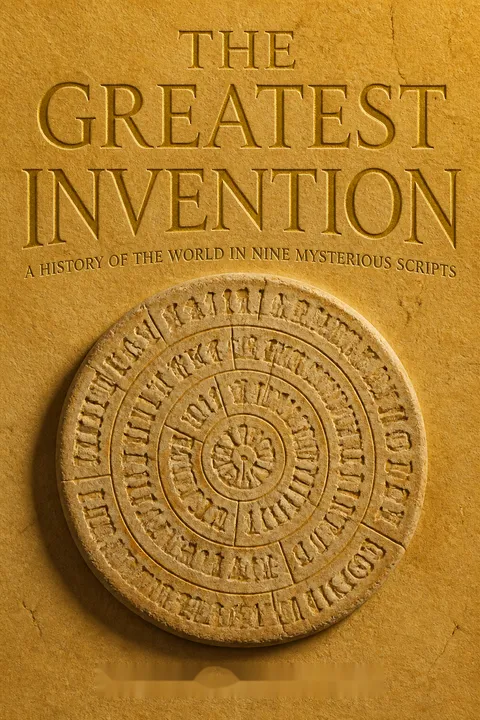
The curse of uniqueness. Some ancient scripts remain undeciphered due to their extreme isolation, lacking related systems or sufficient textual evidence. The Phaistos Disk, a unique object from Crete, exemplifies this "black swan" phenomenon. Its perfectly stamped, spiraling symbols, while visually intriguing, offer no clear parallels to other Cretan scripts, and its limited text quantity (242 signs) makes scientific decipherment impossible, even with its high-temperature baking for longevity.
Fragmented evidence. The Indus Valley Script (IVS), despite thousands of surviving inscriptions on small seals, presents a different challenge. Its texts are extremely brief (typically 5-6 signs), highly repetitive, and often accompanied by animal figures whose purpose (religious, political, genealogical) is unclear. The debate rages whether IVS is a true linguistic script or merely a system of non-linguistic symbols like heraldic emblems, making it one of the most fiercely contested undeciphered systems.
Three-dimensional enigma. The Inca quipu represent a unique "3D script" of knotted cords, used to govern a vast empire. While clearly recording mathematical notations, censuses, and taxes, the extent to which they encoded narrative or phonetic language remains a profound mystery. Without a "Rosetta stone" to decode the meaning of knot types, colors, and positions, quipu are often considered semasiographic (carrying information without specific language), challenging our conventional definitions of writing and highlighting the limits of our imagination.
9. Tomorrow's Trace: Writing's Enduring Emotional Legacy
As long as there are emotions, there will be written letters.
Writing's late arrival. Writing arrived late to the human communication party, millennia after spoken language evolved. This delay, coupled with its inherent slowness and resistance to change compared to the agile, dynamic nature of dialogue, makes it an "out of sync" medium. Yet, this asynchronous quality is precisely where its magic lies, allowing minds to connect across time and space without direct interaction.
Beyond utility and rank. Despite its profound impact on human history, writing is often underestimated. In a Swedish survey of the 100 most important inventions, writing ranked 30th for adults and 38th for children, far below the wheel, electricity, or computers. This low ranking overlooks that many top inventions, like the internet or printing press, are fundamentally dependent on writing. Writing is not merely a tool; it is a daughter of the gods, a revelation, a magical act that allows us to enter another's mind.
The enduring human need. While future communication may involve advanced technologies like AI, neuro-reality, and synthetic telepathy, the fundamental human need to leave a lasting trace of emotions will persist. Just as Paleolithic cave symbols from forty thousand years ago still convey a desire to be remembered, written letters will continue to serve as tangible anchors for our deepest feelings. Our emotional brain, evolving for 200 million years, ensures that as long as emotions exist, so too will the living letters that capture them.
People Also Read
Download PDF
Download EPUB
.epub digital book format is ideal for reading ebooks on phones, tablets, and e-readers.








































