
Key Takeaways
1. The Notebook: An Ancient Tool for Fleeting Thoughts
The oldest item that looks to modern eyes like a notebook sits in a display case in a castle in a Turkish city, thousands of years ago a thriving commercial and intellectul hub and now an equally busy holiday resort.
Ancient origins. The concept of a portable, reusable writing surface dates back millennia, with the earliest known example being a hinged wax tablet (diptych) found in the Ulu Burun shipwreck, dating to around 1305 BCE. These early "handhelds" were limited in capacity but served for temporary notes, lists, or drafts. Romans later expanded on this, creating tablets with multiple leaves for more extensive writing.
Material evolution. Before paper, various materials served as writing surfaces, each with pros and cons. Clay tablets offered permanence but lacked portability, while papyrus scrolls were practical for longer texts but fragile. Parchment, made from animal hide, was durable but expensive and laborious to produce. The invention of paper in Han dynasty China by Cai Lun around 60 CE revolutionized writing, offering a durable, versatile, and affordable material that would slowly make its way west.
Paper's slow journey. Paper's adoption in Europe was initially hindered by protectionism and skepticism, particularly from the clergy who disliked its "infidel origins" and recycled nature. However, the capture of Xátiva's paper mills by King Jaume of Aragon in 1244, and the subsequent spread of paper production, made it widely available. This affordability and permanence would soon unlock new possibilities for record-keeping and intellectual pursuits across the continent.
2. Double-Entry Bookkeeping: The Genesis of Modern Finance on Paper
What makes the Farolfi ledger a key document in European history – indeed, world history – is that this wreck of a notebook is the first place where we see all the abstract concepts of accountancy, and the practical techniques by which they were managed, used at once.
Florentine innovation. Around 1299, in the Provençal city of Salon-de-Crau, a Florentine merchant's bookkeeper, Amatino Manucci, meticulously recorded transactions in a series of ledgers. His "Farolfi ledger" is the earliest surviving example of double-entry bookkeeping, a system that tracked both debits and credits, allowing for the calculation of profit and loss. This sophistication was unprecedented, moving beyond simple cash and inventory tracking.
Conceptual leaps. Manucci's ledger demonstrated mastery of several nascent financial concepts:
- Accounting entity: Treating the Salon office as separate from the head office or owner.
- Accounting period: Defining a financial year.
- Algebraic opposition: Reconciling assets and liabilities.
- Single monetary unit: Converting all transactions to a common currency.
- Proprietor's equity and profit: Calculating business worth and profitability.
- Depreciation: Connecting asset value to its useful life.
Paper's crucial role. The widespread availability of cheap, tamper-proof paper from mills like Fabriano was essential for this accounting revolution. Unlike parchment, ink soaked into paper, making records permanent and preventing fraud. This allowed merchants to delegate tasks and expand their businesses, creating "super-companies" like the Bardi and Peruzzi. This "Italian method" of bookkeeping became Florence's "unfair advantage," driving its commercial dominance and laying the foundation for modern capitalism.
3. The Sketchbook: Fueling Artistic Revolution and Observation
Cimabue, he asserts, unlike his precursors, unlike the Greeks, painted people ‘from nature’ – ‘something new in those days’ – on ‘books and other papers’.
Breaking from tradition. Medieval European art, heavily influenced by Byzantine conventions, focused on symbolic rather than realistic depictions. Figures were often distorted, and perspective was absent. Cimabue (born 1240) and his apprentice Giotto (born 1267) revolutionized this by drawing "from nature," capturing realistic forms, light, shade, and perspective. This shift marked the beginning of the Renaissance in painting.
Paper's artistic affordance. The availability of affordable paper notebooks, coinciding with Giotto's formative years, was crucial. Unlike expensive parchment, paper allowed artists to:
- Practice daily: Sketch constantly without financial burden.
- Plan and revise: Develop compositions and techniques through multiple studies.
- Build a repertoire: Collect reference poses, models, and inspirations from travels.
- Experiment: Explore new visual grammars and artistic ideas.
The birth of the sketchbook. Young Cimabue, playing truant to draw "men, horses, houses, and diverse other things of fancy" on paper, effectively invented the sketchbook. This tool enabled artists like Giotto to achieve virtuosic levels of skill, creating scenes that drew viewers in and "happened before our very eyes." Leonardo da Vinci, a century later, would emphasize the sketchbook's role as a "guide and master" for retaining infinite forms and positions of objects.
4. Personal Anthologies: Democratizing Knowledge and Self-Expression
No-one knows exactly when the gloriously sonorous noun zibaldone appeared, or what it originally meant.
The Florentine "salad of herbs." Beyond the counting house, paper notebooks permeated Florentine homes, giving rise to new forms of personal record-keeping. The ricordanze (home account books) evolved into libri di ricordi (memoirs) and libri di famiglia (family books), blending financial records with personal histories and anecdotes. The most distinctive was the zibaldone, a personal anthology or miscellany, often described as "a salad of many herbs."
A mirror of culture. Zibaldoni were idiosyncratic collections of "everything":
- Poems, prayers, songs, recipes, lists.
- Excerpts from classical and vernacular literature.
- Astrological predictions, dream interpretations, moral precepts.
- Drawings and diagrams.
These notebooks were not always private; they were shared, copied, and passed down through generations, reflecting a vibrant, literate culture.
Democratizing literature. Zibaldoni played a crucial role in making literature accessible beyond monasteries and courts. Ordinary people copied favorite texts, fostering a deeper engagement with the written word and creating a wide readership for vernacular authors like Dante, Petrarch, and Boccaccio. This informal, rapid transmission of ideas, often in cursive scripts, outpaced formal scribal production and laid the groundwork for the Renaissance's intellectual flowering.
5. The Navigator's Log: Charting the World and Human Endeavor
The record Albo kept, in an informal and easily read cursive hand, now rests in an archive in Seville, and it shows that he felt no pressure to make a particularly thorough or systematic record of the voyage.
Early, incomplete records. Despite the critical importance of navigation, early ship logs were often imprecise and partial. Francisco Albo's log from Magellan's circumnavigation (1519-1522) primarily recorded latitude and headings, omitting crucial details like mutinies, shipwrecks, and even Magellan's death. This reflected a time when systematic record-keeping was not a universal expectation for ship masters.
The power of complementary accounts. Albo's omissions are starkly contrasted by Antonio Pigafetta's journal, which, though not an original notebook, provided a vivid narrative of the voyage's calamities and Magellan's eventual fate. Pigafetta's detailed account, later transcribed into illuminated manuscripts, was instrumental in rehabilitating Magellan's reputation. This highlights how multiple, even conflicting, notebook accounts can collectively reconstruct a more complete historical picture.
Professionalization of logs. Over centuries, the "mania for tidy bookkeeping" that swept Europe gradually impacted ships' logs. By the late 17th century, East India Company vessels like the Rook (1699) kept far more detailed and professional journals. These logs recorded:
- Meticulous navigational data (latitude, progress, winds).
- Ornithological notes and sketches.
- Observations of coastlines and local cultures.
This data became invaluable for charting safe and efficient trade routes, demonstrating the shift towards systematic record-keeping for commercial and colonial purposes.
6. Industrial Innovation: Notebooks as Blueprints for Progress
There were no engineering schools, or architectural schools, at the time,’ he told me. ‘Travelling was more or less obligatory.’
Learning through observation. In the late medieval and early modern periods, technological knowledge spread not through formal education but through travel and direct observation. Engineers like Heinrich Schickhardt, Duke Friedrich of Württemberg's master builder, undertook extensive industrial tours of Italy and the Netherlands in the late 16th century to gather new ideas for canals, mills, bridges, and fortifications.
The travel journal as a technical manual. Schickhardt's notebooks, filled with sketches, diagrams, and detailed notes, served as invaluable repositories of observed technology. He meticulously recorded:
- Water displacement machines and pumps.
- Roof designs for bridges.
- Lock gates and ingenious street lanterns.
- Fortification plans (e.g., Casale Monferrato's hexagonal layout).
- Costs, materials, and construction times.
These "gems" were not just personal records but practical blueprints for his projects back home, demonstrating the notebook's role in technological transfer and industrial development.
Transforming a region. Unlike Leonardo da Vinci's notebooks, which remained largely unread, Schickhardt's notes directly fueled a building spree in Württemberg. He designed entire industrial quarters, rebuilt towns, and constructed numerous castles, churches, tunnels, and mills. His work, though not involving original inventions, was crucial in modernizing the region's infrastructure and economy, illustrating how notebooks facilitated the "industrious revolution" that preceded the Industrial Revolution.
7. The Common-Place Book: A System for Organizing Knowledge and Rhetoric
All commercial occurrences of problems and rules, that is by hundredweights, thousands, pounds, ounces, investments, sales, profits, losses, journeys or transportation of goods, weights, measures, and money from place to place.
Erasmus's influence. The Dutch scholar Erasmus of Rotterdam, through his 1512 work De Copia, popularized the common-place book as a systematic method for organizing knowledge. He encouraged students to collect "stories, fables, proverbs, opinions, parallels" from diverse sources and arrange them logically under "common places" or headwords. This transformed the notebook into an information technology for storing, categorizing, and retrieving data.
Intellectual benefits. Common-placing offered significant cognitive advantages:
- Enhanced reading comprehension: Selecting passages required greater concentration and judgment ("I don't collect, I select").
- Deeper engagement: Categorizing excerpts fostered deeper engagement with ideas.
- Externalized memory: Liberated the mind from memorizing passages, freeing capacity for "reasoning and reflection."
- Rhetorical resource: Provided a "mass of material" for crafting persuasive arguments and orations.
This method became a cornerstone of grammar school and university education across Europe.
Literary impact and evolution. Common-placing profoundly influenced writers like William Shakespeare, who drew on multiple sources for his plays, and Michel de Montaigne, whose essays explored subjects by piling anecdotes and precedents. While initially a tool for serious intellectual work, common-place books also became commercial products, like John Bell's 18th-century versions, offering pre-formatted pages for aspiring scholars. The practice eventually declined as diaries and sketchbooks gained popularity, but its legacy as a system for organizing thought remains.
8. The Diary: A Mirror for the Self and a Record of Life's Turmoil
I hope I will be able to confide everything to you, as I have never been able to confide in anyone, and I hope you will be a great source of comfort and support.
A late arrival. Despite ancient traditions of introspection and medieval chronicles, the personal, confessional diary as we know it today is a relatively recent invention, gaining widespread popularity in 17th-century England. Early examples like Lady Anne Clifford's and Adam Eyre's "diurnals" mixed business, daily events, and emotional responses, including marital strife.
The English phenomenon. The surge in English diary-keeping was driven by:
- Social and ideological tension: Reflecting the upheaval of religious conflict and civil war.
- High literacy rates and social mobility: More people had the means and motivation to write.
- Normalizing influence: Prominent writers like Donne, Jonson, and Bacon discussed the habit.
- Emotional outlet: Diaries offered a private space for self-expression and processing feelings, as eloquently articulated by Magdalena van Schinne in 1788 and Anne Frank in 1942.
Commercialization and literary impact. The 19th century saw the commercialization of diaries with John Letts's dated "datebooks," which quickly became popular for both planning and retrospective journaling. The publication of John Evelyn's and Samuel Pepys's diaries provided influential role models, inspiring a generation of lifelong journal-keepers. Diaries also emerged as a fictional form, from Gogol's Diary of a Madman to Bridget Jones's Diary, demonstrating their unique ability to convey inner life and comic irony.
9. The Police Notebook: A Tool of Control, Evidence, and Sometimes Deception
Notebooks are about control of the copper.
Control, not detection. The police notebook, or "pocket book," was initially conceived not as an investigative tool but as a mechanism for controlling officers. When London's Metropolitan Police was formed in 1829, constables were required to log their progress on fixed "beats," with sergeants and inspectors verifying their records to ensure diligence. This system of internal accountability was paramount.
Evolving functions. As policing evolved, the notebook's role expanded. Constables began to record details of crimes, witness statements, and other observations, transferring them to larger "Occurrence Books" at the station. These on-the-spot notes became crucial for investigations and legal proceedings, making the notebook an essential piece of evidence.
Vulnerability to corruption. The notebook's evidentiary power also made it a target for manipulation. Regulations were introduced to prevent tampering—such as requiring notes to be made at the time of occurrence, numbered pages, and no gaps. However, high-profile cases like the West Midlands Serious Crime Squad and the Hillsborough disaster revealed systemic falsification of notes and confessions. The invention of the ESDA machine, which could detect invisible indentations on paper, exposed these deceptions, leading to a shift towards digital record-keeping in modern policing.
10. Authors' Notebooks: The Unseen Engine of Literary Creation
It is surprising how often one sentence, jotted in a notebook, leads immediately to a second sentence.
Germs of creation. For centuries, authors have used notebooks as fertile ground for ideas, or "germs," as Henry James called them. James, who regretted not adopting the habit earlier, meticulously collected character names, overheard gossip, and "vividest little note[s] for sinister romance" that later blossomed into works like The Turn of the Screw. Notebooks served as a space for ideas to mature and develop.
Diverse creative processes. Authors employed notebooks in varied ways:
- Virginia Woolf: Used "reading notebooks" for reviews and drafted novels like The Waves in small hardbacks.
- Paul Valéry: Filled 261 copybooks over 50 years, calling them his "true oeuvre," engaging with art, memory, and psychology.
- Patricia Highsmith: Maintained parallel diaries and "Columbia" jotters for self-scrutiny and plotting suspense fiction, emphasizing the notebook's role in developing plots.
- Joan Didion: Used loose-leaf pads for journalistic notes and observations, later typing them up with her distinctive style.
Chaos and genius. Even the most chaotic notebooks, like Agatha Christie's seventy-three exercise books, were integral to her prolific output. Despite being disorganized, with notes for multiple novels scattered across pages, they served as a "sounding board and literary sketchpad" for brainstorming, developing motives, and refining plots. Christie's process of "testing and teasing the story and plot into a convincing whole" in her notebooks allowed her to create works of "clockwork neatness."
11. Patient Diaries: Restoring Lost Time and Healing Trauma
Att ge tillbaka förlorad tid – ‘to give back lost time’.
A Danish innovation. Intensive care, invented in Copenhagen in 1952, saves lives but can leave patients with traumatic memories, delirium, and a "rupture in time." In the 1970s, Danish nurses devised the patient diary to address these psychological challenges. Nurses write informal daily entries, telling the sedated patient what has happened, how they are, and what is being done to them, focusing on empathy rather than medical details.
Healing fragmented memories. Upon recovery, patients receive their diaries, which help them:
- Piece together fragmented memories: Reconstruct the narrative of their illness.
- Decode delusions: Understand that terrifying hallucinations were not real.
- Reconstruct body changes: Explain new scars or physical alterations.
- Reduce PTSD risk: Studies show a significant reduction in post-traumatic stress disorder, panic attacks, and depression.
A testament to care. Patient diaries are often enriched by family members' contributions and photos, creating a vital link between the patient, their loved ones, and the care team. Michael Rosen, a Covid survivor, described his diary as a "treasure," a "relic of the selflessness and compassion" of his nurses, who recorded encouragement and positivity amidst the horrors of the pandemic. This grassroots innovation, born from nurses' empathy, transforms a plain page into a powerful tool for hope and healing.
12. The Extended Mind: How Notebooks Literally Change Our Brains
If, as we confront some task, a part of the world functions as a process which were it done in the head, we would have no hesitation in recognizing as part of the cognitive process, then that part of the world is (so we claim) part of the cognitive process.
Beyond the skull. Philosophers Andy Clark and David Chalmers proposed the "Extended Mind" thesis in 1998, arguing that the mind is not confined to the brain but can extend into the environment through external tools. They introduced the concept of "epistemic actions"—actions that help us think or gather information, like writing on a blackboard or arranging Scrabble tiles—which should be considered part of the cognitive process.
Otto's notebook. To illustrate, they imagined Otto, an Alzheimer's patient who relies on a notebook for memory. When Otto consults his notebook for an address, it functions for him just as biological memory does for his friend Inga. Clark and Chalmers argued that if information is reliably available and used, its location (in the brain or a notebook) doesn't philosophically matter. Thus, Otto's mind "has expanded to include his notebook."
Neurological evidence. Modern research supports the idea that notebooks profoundly impact our brains:
- Artists' brains: MRI studies show trained artists repurpose brain areas (e.g., right middle frontal area for spatial awareness) and develop denser grey matter in specific regions, literally changing their brain structure through drawing.
- Learning tools: Studies reveal students taking notes by hand learn more effectively than those on laptops, as handwriting encourages paraphrasing and concept mapping, leading to "deeper and more solid" cognitive processes.
- Brain activation: Japanese MRI studies show paper notebook users have significantly more active hippocampi, precunei, visual cortices, and language-related frontal regions during memory retrieval.
An extension of self. The notebook, therefore, is not merely an external aid but an integral part of our cognitive system. It allows us to externalize thoughts, manipulate ideas, and encode memories more effectively. This understanding explains the deep, often irrational, bond we form with our notebooks—they are, in a very real sense, extensions of our minds, helping us to create, explore, analyze, and live fuller lives.
Review Summary
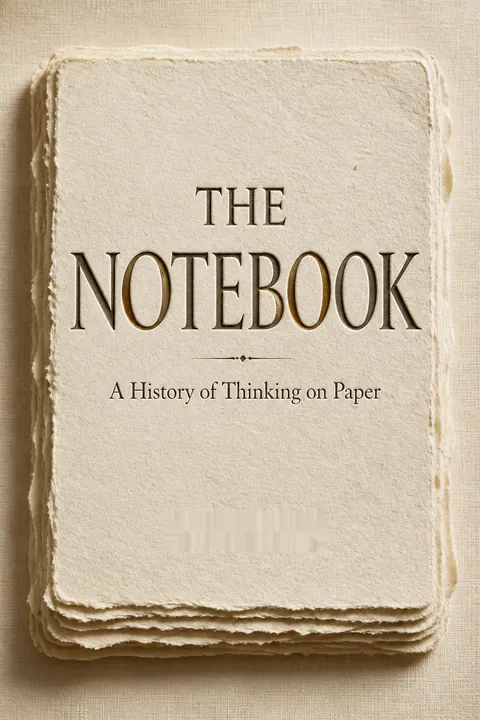
The Notebook by Roland Allen is a captivating exploration of the history and significance of notebooks. Readers praise Allen's engaging writing style, extensive research, and the book's ability to weave together fascinating stories about famous notebook users throughout history. Many find it inspiring for their own note-taking practices. The book covers various types of notebooks, from artists' sketchbooks to scientific journals, and examines how they've shaped human thought and progress. While some reviewers note a Western-centric focus, most appreciate the book's depth and unique perspective on intellectual history.
People Also Read



Download PDF
Download EPUB
.epub digital book format is ideal for reading ebooks on phones, tablets, and e-readers.








































