

Key Takeaways
Treat economics and art as lenses, not just subjects to study
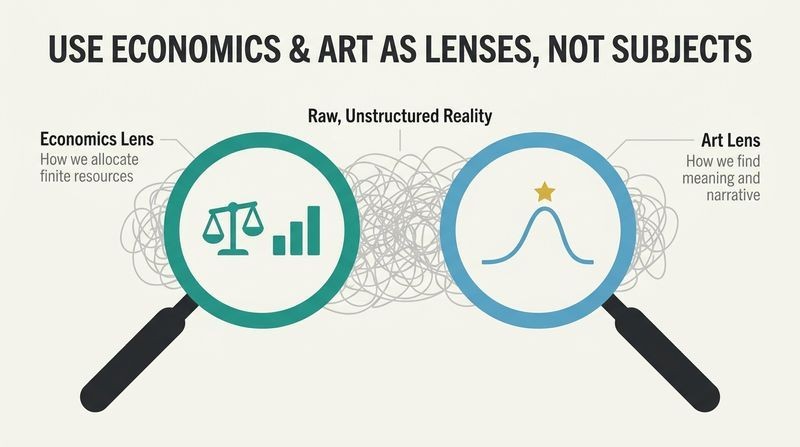
Mental models are borrowed tools. This fourth volume of Parrish's series argues that concepts from economics (scarcity, debt, monopoly) and art (plot, character, framing) are not confined to their home fields. They are portable lenses for understanding any situation. A mental model is simply a representation of how something works, a way to chunk patterns so you do not relearn the world every day.
The pairing is deliberate. Economics governs how we allocate finite resources; art governs how we find meaning. Together they shape behavior, the world we build, and the stories we tell ourselves. Parrish stresses these models are value-neutral and imperfect: as the statistician George Box put it, all models are wrong but some are useful. The skill is knowing which tool fits which job.
What's striking is the intellectual lineage here: Charlie Munger's 'latticework of mental models' from multiple disciplines, which Munger credited for Berkshire Hathaway's edge. The claim that cross-domain thinking beats specialization echoes research on 'range' by David Epstein, who found that breadth of analogy often outperforms narrow expertise in unpredictable fields. The risk, worth flagging, is analogy seduction: a lens can illuminate or distort, and the book itself warns against confusing storytelling with causation. Used carelessly, mental models become confirmation machines. Used well, they are what psychologists call 'far transfer,' the rare and valuable ability to apply a solution learned in one domain to an unrelated one.
When you reduce a core resource's scarcity, ripples reshape everything
Scarcity means finite supply of what people want. Value requires both scarcity and desirability: a thing that is rare but unwanted is worthless, and a thing wanted but abundant is cheap. Luxury brands weaponize this. Hermes makes fewer than 100,000 Birkin bags a year by choice, selling the story of exclusivity rather than the leather.
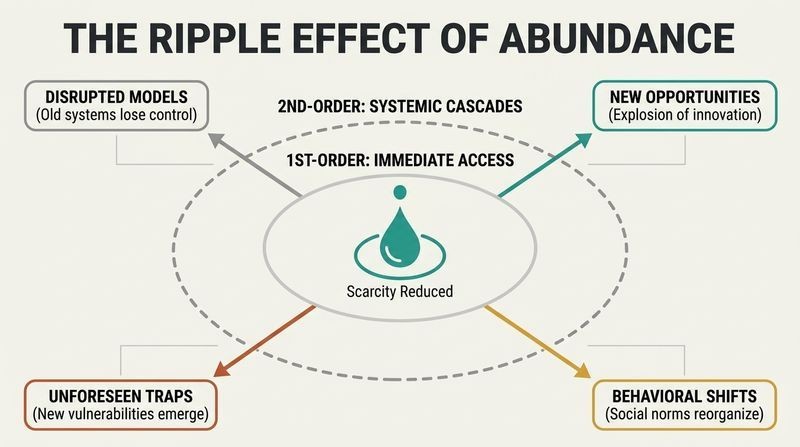
Reducing scarcity of something fundamental triggers cascades. Gutenberg's printing press made information abundant, and the consequences he never foresaw were vast: texts could be compared side by side, propaganda became possible, apprenticeships were disrupted by how-to books, and preservation shifted from hoarding secrets to publishing widely. The lesson for individuals: time and money are your core resources. When you gain more of either, do the second-order thinking. Lottery winners get richer but rarely happier, walking into new problems of privacy and exploitation.
The scarcity-abundance flip is underappreciated. Mullainathan and Shafir's research (cited by Parrish) shows scarcity itself taxes cognition, consuming mental bandwidth so that the poor and the overbooked both make worse long-term decisions. But abundance carries its own trap, as Herbert Simon noted: a wealth of information creates a poverty of attention. What's useful here is the anti-intuitive move: happiness gains from more money plateau, a finding echoed in Kahneman and Deaton's work. The Birkin example deserves scrutiny too, since manufactured scarcity is a fragile moat: lab-grown diamonds already threaten De Beers' century-long grip on the 'diamonds are forever' story.
You can regulate supply, but you can never legislate away demand
Supply and demand set prices dynamically, never at rest. Both can be manipulated: firms create artificial scarcity, and marketing manufactures wants people never knew they had. Josh Kaufman notes effective marketing finds what people already desire and intersects with it.
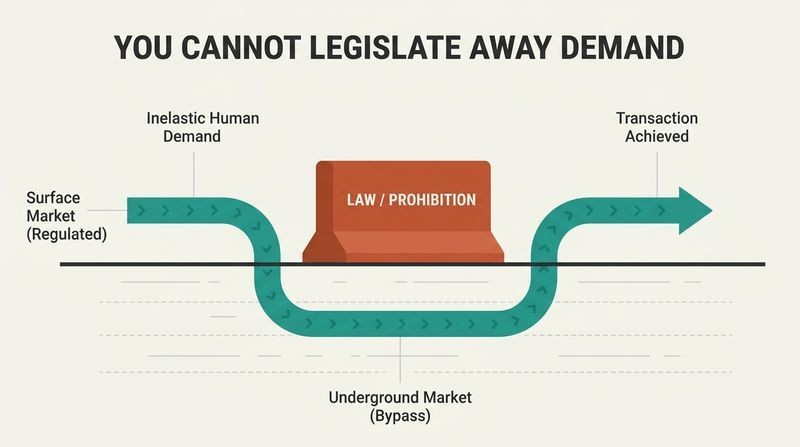
Demand is nearly impossible to suppress by law. Centuries of attempts to regulate sex work targeted only the supply side (zoning, dress codes, health checks, outright bans) through stigma, yet the trade never disappeared because the demand never did. Bologna cut off noses in 1259; China forced it underground in 1949. All that changed was that workers lost legal protection. General Motors offers the flip side: Alfred Sloan invented the annual model year, restyling cars cosmetically to make owners crave the newest look. Harley Earl's designers ran three-year cycles, hastening obsolescence. People paid for a psychological upgrade, not a better car.
The asymmetry between regulating supply and demand is a profound governance insight with modern stakes: drug prohibition, piracy, and immigration all founder on the same rock. Economists call the underground result a 'deadweight loss' plus a risk premium that enriches criminals. GM's planned obsolescence, meanwhile, prefigures today's smartphone upgrade culture and fast fashion, and it exposes a tension the book only gestures at: demand creation at scale collides with finite resources. Earl's dream of a one-year ownership cycle is an ecological nightmare. Vance Packard's 1960 classic 'The Waste Makers' attacked exactly this, and the critique has only sharpened in the age of e-waste.
Every choice is a trade-off, and the invisible cost is what you gave up
Trade-offs are unavoidable because resources are finite. A true trade-off cannot be planned away: you cannot have both a serious donut habit and healthy cholesterol. The companion concept is opportunity cost, the value of the best alternative you forgo. Every yes is a silent no to something else, and those costs are often invisible and hard to quantify.
Slack changes how trade-offs feel. With income slack, a ten-dollar latte barely registers; with none, it may mean skipping dinner. Migration illustrates trade-offs that cannot be resolved with more time or money. People leave home weighing what they lose (family, status, belonging) against uncertain gains, and many report never fully belonging anywhere again. As Kay Iguh wrote, in building a future you dismantle a past. Knowing what you value is how you make trade-offs that actually satisfy you.
Opportunity cost is the economist's most transferable gift to daily life, yet behavioral research shows people systematically ignore it. Frederick and colleagues found that simply reminding shoppers 'the money could be spent on other things' changed decisions. The slack insight connects to Parrish's own scarcity chapter and to organizational theory: systems run at 100% utilization have no capacity to absorb shocks, which is why hospitals and highways collapse at peak load. The migration framing is humane and correct, though it underplays that many trade-off calculations are made under coercion or grossly incomplete information, where the 'rational chooser' model breaks down entirely.
Specialize to go deep, but specialization quietly builds fragile dependence
Division of labor multiplies output. Adam Smith's pin factory: one untrained worker makes maybe one pin a day, but ten workers splitting the task make 48,000. Specialization pairs with trade in a feedback loop, since you can only specialize if you can trade for everything else you need.
The hidden cost is interdependence and vulnerability. Coordination costs grow with the number of specialists, and trust becomes essential. The 1940s women 'computers' who programmed ENIAC show specialization emerging bottom-up: no one knew hardware and software would split into two crafts until it happened, and prior experience shaped who got there first. Comparative advantage (Ricardo's principle) says trade benefits both parties even when one is better at everything, but critics like Prebisch note poor nations exporting raw goods can get locked into poverty while rich nations capture the markup.
The ENIAC story is a gem of gendered labor history: programming was dismissed as clerical 'women's work' precisely because it seemed subordinate to the 'real' engineering, until software ate the world. This mirrors sociologist Andrew Abbott's work on how professions draw and defend jurisdictional boundaries. Parrish's honesty about comparative advantage is valuable; the textbook version assumes frictionless mobility and ignores power. Ha-Joon Chang has argued nearly every rich country, including Britain and the US, industrialized behind protectionist walls, then 'kicked away the ladder.' The deeper warning is fragility: hyper-specialized just-in-time supply chains, like the 2007 Riken piston-ring shutdown, snap catastrophically when one node fails.
Maximum efficiency today makes you dangerously brittle tomorrow
Pareto efficiency means no waste. An economy is efficient when you cannot make anyone better off without making someone worse off. Crucially, this says nothing about fairness: an economy where one person holds 99 oranges and another holds one can still be 'efficient.' Efficiency is a technical state, not a moral one.
The pursuit of efficiency erodes safety margins. A perfectly lean system, with no spare cash, inventory, or slack people, is exquisitely vulnerable to any shock. Parrish's counterintuitive claim: short-term inefficiency is often long-term efficiency, because slack lets you adapt to an uncertain world. He also shows efficiency depends on shared information. Colonial American taverns worked as 'third places' where people of all ranks mixed and news, business, and revolutionary ideas spread freely. Common knowledge (everyone knowing that everyone knows) lowers the risk of collective action.
This is arguably the book's most contrarian and important economic claim, and it aligns with Nassim Taleb's 'antifragility' and with resilience ecology: monocultures are efficient until a single pathogen wipes them out. The 2020 pandemic vindicated the argument brutally, as toilet-paper hoarding and ventilator shortages exposed how 'lean' had become 'brittle.' The tavern-as-information-commons idea connects to Habermas's 'public sphere' and to modern debates about whether social media platforms are third places or something more manipulable. The uncomfortable truth Parrish surfaces, that efficiency and equity are orthogonal, should be repeated to anyone who invokes 'the efficient market' as though it were self-evidently just.
Debt's benefits shout in the present; its costs hide in the future
Debt borrows from your future self. Repayment usually exceeds what was borrowed, because lenders charge interest for risk. Debt can be productive: Japan's Meiji government borrowed around 1873 to build banks and railroads, defended itself, and repaid within thirty years. A degree that raises your income is 'good debt.'
But debt makes you fragile. Parrish uses land mines as a metaphor for borrowing against the future. Deploying them buys a battlefield advantage now, but the repayment is monstrous: they keep killing civilians for decades (roughly 110 million still buried across 60 countries as of 2016, maiming someone every hour). The cost of making right what you did today can exceed anything you gained. Bronze Age rulers understood debt's corrosive power, periodically canceling agrarian debts to prevent citizens from falling into bondage and destabilizing the kingdom.
The land-mine metaphor is emotionally powerful but conceptually loose; it stretches 'debt' to mean any deferred consequence, which risks diluting the model. Still, the underlying point about hidden future liabilities is exactly right and maps onto climate change, pension underfunding, and antibiotic overuse, all cases where present benefit and future cost are radically mispriced. The debt-jubilee history, drawn from Michael Hudson, is genuinely subversive: it reframes debt forgiveness not as charity but as statecraft, a tool to preserve social stability. David Graeber made the same argument in 'Debt: The First 5,000 Years,' noting that the moral certainty that 'debts must be paid' is historically recent and politically convenient for creditors.
Bad drives out good whenever asymmetry corrodes trust
Gresham's law: bad money drives out good. When two coins are legally equal but one holds more precious metal, people spend the cheap coin and hoard the valuable one. The deeper principle is that hidden asymmetry, where things supposed to be equal are not, breaks the trust that human systems run on.
Asymmetry of information does the same damage. George Akerlof's 'market for lemons' showed that when used-car buyers cannot tell peaches from lemons, they only pay an average price, sellers of good cars exit, and the market can collapse into bad cars only. Professional cycling shows how systemic bad behavior drives out good: Tyler Hamilton described doping becoming so pervasive that clean riders simply could not win, so the choice was to dope or quit. As one rider put it, he was tested 200 times and had drugs in his body for 100 of them.
Akerlof's 1970 lemons paper won a Nobel and founded information economics; its reach extends to insurance (adverse selection), online dating, and hiring. Parrish's move to extend Gresham's logic to ethics ('bad morals drive out good') is provocative and echoes Tom Tyler's research on why people obey laws: perceived fairness and trust, not just penalties, sustain cooperation. The cycling case is a textbook collective-action trap, a multi-player prisoner's dilemma where individual rationality produces collective ruin. The fix Hamilton advocates, changing the system's incentives rather than blaming individuals, aligns with Elinor Ostrom's Nobel work showing that well-designed rules and monitoring, not moral exhortation, prevent races to the bottom.
Every bubble pops, so never mistake exuberance for a new normal
Bubbles are emergent, not orchestrated. An asset's price soars because buyers expect it to keep soaring, until expectations reverse and everyone rushes for the exit at once. Late entrants get crushed. Keynes described stock-picking as a beauty contest where you win by guessing which faces others will pick, meaning prices reflect perceptions of others' perceptions, not intrinsic value. This second-order thinking fuels irrationality.
Bubbles still serve a purpose. The 1990s dot-com mania destroyed vast wealth but built infrastructure for the internet age. Parrish's surprising example is NASA's Apollo program: driven by Cold War prestige rather than public or scientific demand, it inflated with wild enthusiasm, peaked as 600 million watched the moon landing, then burst. It produced real innovations at a cost documented as disproportionate to returns. The takeaway: harness the exuberance for creativity, but never believe the good times are permanent.
Framing Apollo as a bubble is genuinely original and a little heretical, and it works because bubbles are fundamentally about unsustainable, self-reinforcing enthusiasm detached from cost-benefit reality. The Keynesian beauty contest remains the sharpest explanation for why smart, informed investors still ride bubbles: as Chuck Prince infamously said in 2007, 'as long as the music is playing, you've got to get up and dance.' Charles Kindleberger and Hyman Minsky formalized the phases (displacement, boom, euphoria, crisis) and Minsky's insight, that stability itself breeds the risk-taking that ends stability, deserves a place beside this chapter. The constructive tension: some 'bubbles' fund revolutions, so blanket bubble-avoidance can mean missing genuine paradigm shifts.
Know your audience precisely, but never let them dictate your work
Art is a collaboration with whoever receives it. The audience is a cocreator: a sunset painting evokes peace in one viewer and loss in another. Anticipating the audience shapes what gets made. Clarence Darrow, the American defense attorney, won impossible cases by reading his audiences with surgical care. Defending teenage killers Leopold and Loeb, he chose to plead guilty and argue to a single judge rather than risk a jury, tailoring his marathon speech to three audiences at once: the judge, the nation, and Chicago public opinion. The boys got life instead of death.
But pandering kills authenticity. John Updike imagined writing for one battered paperback found by a teenager east of Kansas, not for reviewers. Kurt Vonnegut warned that opening a window and making love to the world gives your story pneumonia. The tightrope: communicate clearly while staying true to your vision.
The audience-as-cocreator idea is well grounded in reader-response theory (Wolfgang Iser, Stanley Fish), which holds that meaning is completed by the reader, not fixed by the author. Darrow's three-audience calculus prefigures modern communication strategy, where a single message must land simultaneously with a courtroom, the press, and the public, an early version of what political operatives now call multi-audience framing. The pandering warning has fresh urgency in the age of algorithmic feedback: creators who optimize purely for engagement metrics converge on bland, derivative sameness, exactly the pneumonia Vonnegut diagnosed. The genuine tension, which the book honors, is that ignoring the audience entirely produces indulgent, uncommunicative work. Mastery lives in the calibration.
Whoever tells the better story usually wins the argument
Plot is causality, not just sequence. E. M. Forster's distinction: 'the king died and then the queen died' is a story, but 'the queen died of grief' is a plot, because one event causes the other. Humans crave this cause-and-effect structure, which is exactly why it can mislead. Johannes Kepler saved his mother Katharina from execution for witchcraft in 1615 not by disproving magic but by out-narrating the accusers. Against 49 accusations that amounted to 'something bad happened and she was nearby,' he substituted plausible scientific and social explanations for each, a more convincing plot delivered to the law professors who held her fate.
The stories we tell ourselves gate what we accept. For most of history, pain was seen as ennobling and endurable, so effective anesthetics like nitrous oxide (its pain-killing property noted in 1800) sat unused for medicine for decades. Changing behavior required changing the narrative.
Kepler's defense is a masterclass in what cognitive scientists call the 'narrative fallacy,' the mind's compulsion to impose causal stories on random events, which Kahneman and Taleb both warn against. The witch trial was lethal precisely because the prosecution's plot was seductive and coherent. The pain history is subtler and more disturbing: it shows narratives don't just explain the world, they gate which technologies and reforms a society will accept. The opioid crisis is the dark mirror image, where the pendulum swung to 'no one should feel any pain,' and a new story, aided by pharmaceutical lies, produced mass addiction. Narratives are infrastructure for decisions, and swapping one dogma for its opposite is not the same as wisdom.
To change your behavior, change your environment before it changes you
Setting silently dictates what is possible. Where something happens shapes what happens. Byrne observed musicians unconsciously write music to fit the venue: African drum polyrhythms carry outdoors where they would muddy in a cathedral, and 1960s arena acoustics birthed the blunt force of 'arena rock.' Cuisine works the same way. England's abundant firewood and grazing land produced the roasting tradition and an entire etiquette of table knives, because meat was carved after cooking.
Ideas themselves are products of their setting. The number zero, one of humanity's most powerful abstractions, first appeared as a dot in sixth-century Cambodia, an Indian-influenced Buddhist culture already comfortable with the concept of emptiness and the void. Western binary thinking (a thing either is or is not) resisted treating nothing as something. The practical lesson is blunt: your environment moves you more than you realize, so if you want different behavior, redesign your surroundings.
The closing prescription, change your environment to change yourself, is one of the most empirically supported ideas in behavioral science, from James Clear's habit design to Thaler and Sunstein's 'choice architecture' showing default settings quietly govern retirement savings and organ donation. The zero-from-Buddhism argument is more speculative and contested: mathematicians debate whether the Mayan and Babylonian placeholders count as 'zero,' and cultural-determinist explanations for mathematical invention risk overreach. Still, the core claim that abstractions grow from the conceptual soil of their setting is sound and humbling. It suggests that what we take for universal and inevitable, even numbers, bears the fingerprints of a particular place, time, and worldview.
Analysis
This is the fourth installment of Shane Parrish's 'Great Mental Models' series, a framework-based reference work rather than a thesis-driven argument. Its structure, roughly twenty short chapters each pairing a concept with one or two historical case studies, makes it hard to summarize precisely because it resists a single spine. The book's unifying wager is Mungerian: that fluency across disciplines produces better decisions than depth in one. The economics half is stronger and more coherent than the art half, where models like 'melody' and 'setting' are stretched metaphorically to cover comic-book publishing and the invention of zero, sometimes past the breaking point.
The book's greatest strength is its case-study method. Using Kepler's witch-trial defense to teach plot, the ENIAC women to teach specialization, and Apollo to teach bubbles is genuinely illuminating and memorable. Parrish is also refreshingly honest about limits: he repeatedly notes that Pareto efficiency ignores fairness, that comparative advantage can entrench inequality, and that models illustrate rather than prove causation. This intellectual humility distinguishes the book from lazier 'mental models' content that treats every framework as a magic key.
The central weakness is the same as its method: analogical reach can become analogical slippage. Calling land mines 'debt' or Apollo a 'bubble' is clever, but a skeptic could argue these stretch the technical concept until it means little. The models are also presented as timeless and value-neutral, which occasionally obscures how contested some are (comparative advantage, efficiency-as-goal). A reader hoping for operational how-to guidance will find inspiration more than instruction.
What the book does best is retrain perception. After reading, a reader genuinely sees supply-side regulation, information asymmetry, opportunity cost, and narrative framing operating in daily life. That perceptual upgrade, the ability to reach for a different lens when the obvious one fails, is the real deliverable, and it justifies the collection despite its uneven second half.
Review Summary
The Great Mental Models, Volume 4 receives mixed reviews averaging 3.95 out of 5 stars. Readers appreciate the exploration of economics and art concepts, particularly finding the economics section more engaging. Many praise the accessible writing style and practical mental frameworks, though some criticize the book as too basic or shallow. Common complaints include the simplified format and less compelling examples compared to earlier volumes. Several reviewers value the series for improving critical thinking and decision-making skills, while others find it repetitive or lacking depth for advanced readers.
People Also Read




Glossary
Mental model
Simplified representation of how something worksA compressed representation of how some part of the world functions, used to chunk patterns and navigate reality efficiently without relearning everything. Parrish's series treats models drawn from many disciplines as portable, value-neutral lenses that can be applied outside their original field to spot opportunities and prevent problems.
Latticework of mental models
Interconnected web of cross-disciplinary modelsCharlie Munger's concept, central to Parrish's series, of building a mind-toolkit by collecting foundational ideas from many fields (physics, biology, economics, art) and interlinking them. The goal is to reduce blind spots by viewing any problem through multiple complementary lenses rather than one narrow specialty.
Second-order thinking
Considering the consequences of consequencesThe practice of thinking beyond the immediate result of a decision to its downstream effects. Parrish applies it to scarcity (after gaining money or time, ask how life actually changes) and to bubbles (predicting how others will react to information rather than judging the asset's intrinsic value).
Pareto efficiency
No one better off without harming anotherNamed for Vilfredo Pareto, a state where resources are allocated such that no one can be made better off without making someone else worse off. Parrish stresses it is purely technical and says nothing about fairness: a wildly unequal distribution can still be Pareto efficient.
Comparative advantage
Specialize where your opportunity cost is lowestDavid Ricardo's principle that two parties both gain from trade if each specializes in what it produces at lower opportunity cost, even if one is better at everything. Parrish notes critics like Prebisch argue it can lock poorer nations into exporting cheap raw goods and reinforce inequality.
Gresham's law
Bad money drives out goodThe principle that when coins of equal legal value contain different amounts of precious metal, people spend the debased coins and hoard the valuable ones. Parrish generalizes it: whenever hidden asymmetry corrupts things meant to be equal, it erodes trust and lets bad behavior drive out good.
Market for lemons
Information asymmetry collapses quality marketsGeorge Akerlof's 1970 model showing that when sellers know more than buyers (as with used cars, where 'lemons' hide defects and 'peaches' are sound), buyers only pay an average price, good sellers exit, and the market can degrade to bad goods only. A foundational example of information asymmetry.
Keynesian beauty contest
Pricing based on others' expectationsJohn Maynard Keynes's metaphor for asset markets: like a contest where you win by picking the faces most other people pick, investors price assets not by intrinsic value but by guessing what others believe others will value. This recursive second-order thinking helps explain irrational bubbles.
Creative destruction
New innovations replace old orderJoseph Schumpeter's term for capitalism's engine, where new technologies and methods relentlessly destroy established industries and create new ones. Parrish extends it into an evolutionary model where markets are ecosystems, firms are organisms, and technology acts like mutation, applying it even to scientific paradigm shifts and the rule of law.
Third place
Neutral social space beyond home and workRay Oldenburg's concept for a neutral gathering place, neither home nor work, where people of different ranks mix as equals and conversation is the main activity. Parrish links it to economic efficiency: colonial American taverns spread information freely, incubating business, culture, and revolutionary organizing.
Chekhov's gun
Every element must serve the plotAnton Chekhov's principle that everything introduced in a story must have a purpose: a gun shown on the wall must eventually fire. Parrish contrasts it with the 'red herring' (a deliberate false clue) and notes that in real life, unlike fiction, not every present detail is relevant to what happens later.
Subtext
Implied meaning beneath the surfaceThe meaning an artist conveys without stating it directly, distinct from the explicit 'text.' Parrish notes it deepens engagement and lets artists under oppressive regimes smuggle criticism past censors, as Arthur Miller's 'The Crucible' used the Salem witch trials to attack 1950s McCarthyism without naming it.
About the Author

Download PDF
Download EPUB
.epub digital book format is ideal for reading ebooks on phones, tablets, and e-readers.








































