

Key Takeaways
Use AI to sharpen strategy, not just to write better emails
The real prize is thinking, not typing. Geoff Woods argues most leaders sell AI short by treating it like a fancier Google or an autocomplete for memos. The transformative move is harnessing AI as a strategic Thought Partner: a 24/7 collaborator that challenges your assumptions, analyzes mountains of data, and helps you make faster, smarter decisions. A Boston Consulting Group and Harvard study of 758 consultants found those using AI produced 40% higher quality work, finished 25% faster, and completed 12.2 times more tasks.
Strategy first, technology second. Woods is emphatic that this is a leadership book, not an AI book. AI is a tool to reach your goals, never the goal itself. As FedEx and Tesla veteran Chris Winton told him, asking How do we use AI? is the wrong question. Start with the business problem, then ask whether AI is the right instrument.
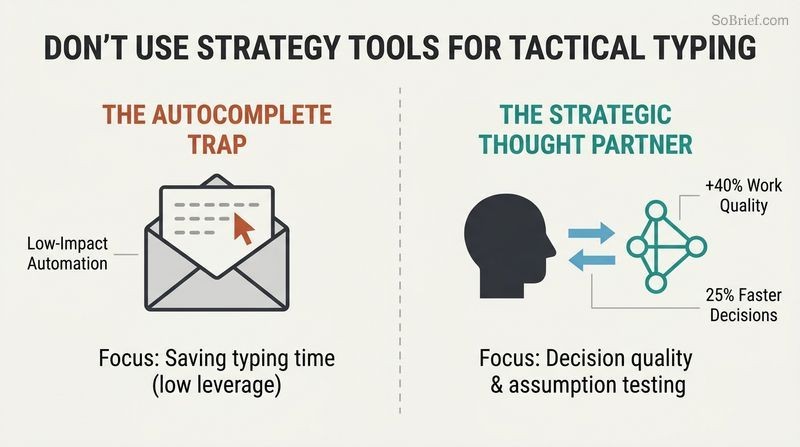
What's striking is the reframing of AI from clerical assistant to cognitive sparring partner, which aligns with research on the centaur model in chess, where human-machine teams outperform either alone. The BCG study Woods cites also carries a caution he underplays: on tasks outside AI's competence, consultants using it performed worse, lulled into trusting plausible but wrong output. That nuance matters. The Thought Partner framing is powerful precisely because it keeps a skeptical human in the loop, but it demands the discipline to verify. The strategy-first mantra is a useful antidote to technology theater, where firms adopt tools to look modern rather than to solve anything.
Swap How do I do this? for How might AI help me do this?
One reworded question rewires your behavior. Woods says the simplest lever for becoming AI-driven is changing the question you ask yourself dozens of times a day. The old industrial reflex is How can I solve this? The AI-driven reflex is How might AI help me solve this? That single shift creates awareness of use cases you would otherwise miss, prompting you to test AI where you used to grind alone.
It started in a traffic jam. Woods describes handing his phone to his ten-year-old daughter Daphne so she could ask AI a question during a school commute, and watching a relatable moment become remarkable. He calls this the engine of his AI Empowerment Flywheel: ask the new question, gain awareness, take action, improve your communication, get better results, repeat. Momentum builds with each turn.
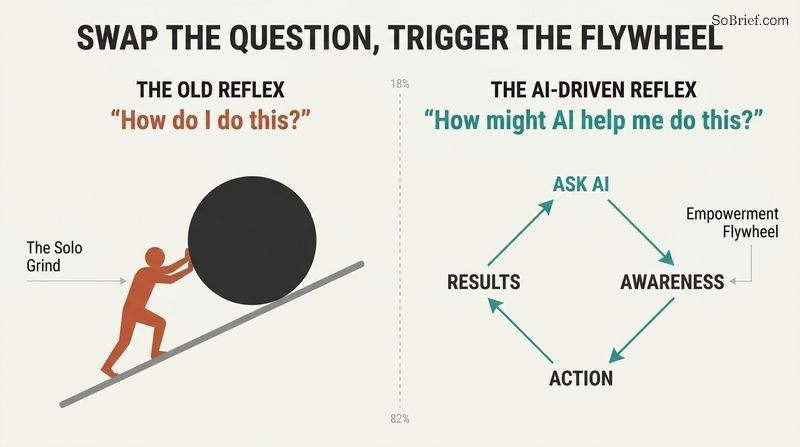
The insight echoes a classic finding from cognitive science: framing determines what solutions become visible. By installing a trigger question, Woods is essentially designing an implementation intention, the if-then planning structure psychologist Peter Gollwitzer showed reliably converts good intentions into action. The elegance is that it requires no new software, only a mental habit. A fair challenge: the reflex can curdle into reaching for AI on tasks where a five-second human judgment would suffice, adding friction rather than removing it. The skill is discernment about when the question is worth asking, not asking it indiscriminately.
Unexamined assumptions sank Blockbuster and cost Keith Cunningham $100 million
The wrong questions are expensive. Woods opens with Blockbuster CEO John Antioco declining to buy Netflix for $50 million in 2000, then watching streaming and convenience destroy his $8.7 billion empire by 2010. The killers were two unchallenged biases: that brick-and-mortar and late fees were permanent. Entrepreneur Keith Cunningham learned the same lesson when his 1980s real estate fortune collapsed because he kept asking how to acquire more property rather than how he might be wrong, a course he says cost over $100 million in tuition.
Three biases ambush leaders. Woods names confirmation bias (hearing only agreement), anchoring bias (overweighting the first number), and the sunk cost fallacy (funding failing projects because of past investment). Ron Johnson's JCPenney flameout came from assuming Apple's no-discount playbook would work on coupon-loving shoppers.
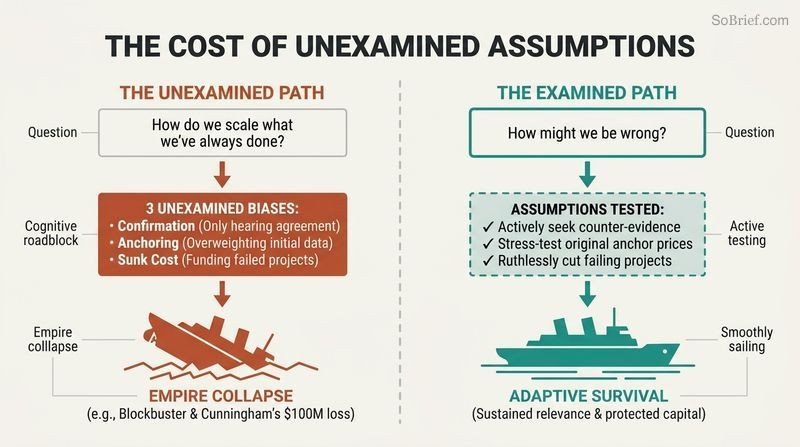
These are textbook cognitive biases from Kahneman and Tversky, and Woods's contribution is practical: deploy AI as a Challenger to surface them. There is genuine promise here, since an impartial model has no ego invested in your plan. But a sharp caveat surfaces in the book's own EMC Insurance example, where agents asked AI to improve their existing ideas and it merely amplified their biases rather than breaking them. Large language models trained on human text inherit human blind spots and tend toward sycophancy, agreeing with the user. The bias-busting only works if you explicitly instruct AI to generate alternatives and play devil's advocate, not to validate.
Stay the Thought Leader; let AI ride shotgun as Thought Partner
Two roles, never blurred. Woods insists on a clear division of labor. You are the Thought Leader who supplies context, judgment, and direction. AI is the Thought Partner that clarifies thinking, analyzes data, structures communication, and challenges biases. AI lacks your perspective and leadership, so abdicating your thinking to it is the cardinal sin.
AI is a prediction machine, not an oracle. It guesses the next most likely word from its training data, which is why it can confidently fabricate, a flaw called hallucination. One Meta model was trained on 15 trillion tokens, roughly 200 million books, yet still requires fact-checking. Woods recommends always asking AI to cite sources and verify itself. A first draft typically lands at 50% to 60% of what you need; you finish it. Florian Zirnstein, CFO of Bayer Indonesia, collapsed weeks of stalled deliberation into a 30-minute decision this way.
The Thought Leader framing is a healthy guardrail against automation bias, the documented human tendency to over-trust machine output even when it conflicts with evidence. Woods's insistence that AI gets you 50-60% of the way echoes the editing-versus-creating distinction: humans are often better critics than blank-page authors, and AI inverts the bottleneck by handling the blank page. One tension worth naming: the more fluent and persuasive AI becomes, the harder it gets to maintain genuine skepticism, especially under time pressure. The discipline of demanding citations is sound, though current models sometimes fabricate plausible-looking sources too, so verification must extend to the verification itself.
Expect a reality check before AI feels magical
Adoption follows a predictable emotional arc. Woods maps the AI Empowerment Curve in five stages: the lightbulb moment (wow, what else can it do?), the reality check (frustration when results disappoint), building momentum, accelerating progress, and expanding what's possible. Most people quit at the reality check, concluding AI is overhyped. The truth, he says, is that they simply have not learned to communicate with it yet.
Communication quality determines result quality. Like any relationship, your output mirrors your input. Woods offers prompt ingredients: describe the task, give rich context, assign a persona (act as a CFO or board member), specify format, set limits, ask it to explain its reasoning, and crucially, have it interview you one question at a time. When he hit the reality check, he committed to 10 hours of practice over a month to push through.
Framing inevitable frustration as a stage rather than a verdict is psychologically astute; it inoculates users against premature quitting, much like the dip Seth Godin describes in skill acquisition. The interview-me technique is the sleeper insight here. By forcing AI to extract context conversationally, users overcome the blank-prompt problem that defeats most beginners, and the back-and-forth surfaces tacit knowledge they did not know they had. The persona trick has real grounding too: research shows role-prompting can shift model output meaningfully. The honest limitation is that prompt craft is a moving target, since each model generation responds differently, so the specific techniques age faster than the underlying principle of clear, contextual communication.
Deploy AI as Interviewer, Communicator, and Challenger
Three personas multiply AI's strategic value. Woods packages prompting into three repeatable roles.
1. The Interviewer asks you one question at a time like a skilled journalist, drawing out ideas you did not know you had.
2. The Communicator turns messy thoughts into crisp messages, useful for pitches, crisis statements, and performance reviews.
3. The Challenger stress-tests your plan, hunting for blind spots and second-order consequences.
Real leaders, real results. Primally Pure CEO Tanner Luster generated tailored interview questions in under a minute that would have taken 30 minutes of solo thinking. MALK Organics CRO Adria Campbell used the Interviewer then the Communicator to draft a performance review that landed 90% finished. A consumer goods CEO had AI role-play Whole Foods CEO Jason Buechel, exposing that his pitch omitted ethical sourcing, a fix made in under 15 minutes.
Naming the personas is shrewd product design: discrete, memorable roles lower the cognitive cost of remembering how to use a general-purpose tool. The Challenger maps neatly onto Gary Klein's premortem technique, where teams imagine a project has failed and work backward to causes, a method shown to improve risk identification. The Whole Foods simulation is the most provocative claim, essentially using AI as a synthetic focus group. It works when the target's priorities are publicly documented, but degrades into confident guesswork for private individuals, and risks anchoring a team on a plausible fiction. The personas are scaffolding for beginners; experienced users blend them fluidly within a single conversation.
Set goals that scare you; their job is to reshape who you become
A goal is a compass, not a finish line. Woods argues leaders cap their potential by setting goals against current resources. The real purpose of a goal is to inform who you must become to reach it. He advised a power company whose board wanted free cash flow lifted from $525 million to $725 million, with a bonus at $850 million. The team stretched to a plan totaling exactly $850 million, then Woods told them they had a plan to fail, because plans never unfold perfectly.
Build in a buffer that forces transformation. The CEO named $1 billion as the number that would feel safe. Forced to ask what would have to be true, what talent and technology they would need, the team rebuilt the plan to a billion. Reality threw curveballs all year, yet they landed at $828 million, far above the original target they had called impossible.
This is the 10x philosophy of Dan Sullivan and Benjamin Hardy, which Woods cites, and it has real grounding in goal-setting theory: Locke and Latham found specific, ambitious goals consistently outperform do-your-best targets. The buffer logic is also sound risk management, acknowledging that execution variance erodes any plan. The danger Woods soft-pedals is that audacious goals can backfire, fueling burnout, unethical shortcuts, or demoralization when chronically missed, as the Wells Fargo cross-selling scandal showed. The reconciliation he offers is smart: budget conservatively while aiming people's actions at the higher trajectory, so falling short still means exceeding the realistic baseline.
Concentrate on the 20% of each role that drives 80% of results
10x the impact of every employee. Woods says stop treating job descriptions as exhaustive to-do lists. Identify the vital 20% of a role that produces 80% of results, hire and coach to that, then supercharge it with AI and strip away the low-value rest. For a VP of Operations, that 20% was turning vision into results, building a high-performance team, and creating systems for scale.
Free people by deleting work, Musk-style. Borrowing Elon Musk's five rules, Woods says before automating anything, question every requirement, delete what you can (cut so deep you must add 10% back), simplify, accelerate, and only then automate. Most leaders skip straight to automating tasks that should not exist. He illustrates with a Tesla Model 3 that eliminated the start button, the brake pedal for stopping, and the off switch, by questioning why each was assumed necessary.
The 20/80 framing is the Pareto principle applied to role design, and pairing it with Musk's deletion-first sequence is genuinely useful, because the most common automation mistake is digitizing waste. Lean manufacturing has preached this for decades: eliminate before you optimize. The provocative implication is that AI's biggest productivity gains may come not from doing tasks faster but from revealing which tasks need not exist at all. A counterpoint: ruthless deletion assumes you can cleanly identify the trivial many, but in knowledge work, seemingly low-value activities sometimes carry hidden relational or informational value that only surfaces when they are gone.
Stop absorbing your team's work; demand thinking leverage instead
Own 100% of your job, and make them own theirs. Woods describes a trap where direct reports own only 80%, 90%, and 95% of their roles, dumping the remaining 35% back onto the leader who burns out. The cause is usually the leader's own behavior, training people that falling short is safe because the boss rescues them. He credits Gary Keller, who on day one warned that if Woods tried to hand him pieces of his job, he would no longer have one.
Three moves to raise the standard.
1. Ask more, give less: respond to questions with What do you think you should do?
2. Explain why when you do give an answer, teaching them to think at your level.
3. Bring consequences to standards not met, because as Gene Rivers put it, standards without consequences are merely suggestions.
This is delegation theory with teeth, resonating with the management-by-questions ethos of Michael Bungay Stanier's coaching habit and with the developmental psychology of productive struggle. Woods's parenting analogy, that you cannot carry a child who is learning to walk just because it is faster, captures why answer-giving feels efficient but stunts growth. The deeper organizational payoff he names is succession: leaders who think for their people never build replacements and become bottlenecks to their own promotion. The tension worth flagging is calibration, since under genuine time-critical pressure, Socratic questioning can be the wrong tool, and his own example of guiding rather than questioning a stuck colleague acknowledges this.
March 20 miles daily; never let the storm grab your wheel
Consistent execution beats opportunistic bursts. Woods retells the 1911 race to the South Pole. Amundsen's Norwegians advanced a disciplined 20 miles every day regardless of weather and won by a month. Scott's British team sprinted in good conditions and hunkered down in bad ones, and died on the return. The lesson: when chaos hits, you choose what to prioritize rather than reacting.
The first 30 days decide your results. Woods says break the strategic plan into 30-day milestones, block calendar time for them (interest is shown by intentions, commitment is shown by the calendar), and build a common language of prioritization where saying yes to something new requires naming what gets deprioritized. Tanner Luster's monthly line-by-line plan reviews helped Primally Pure grow from $7 million to a $50 million trajectory over four years.
Jim Collins popularized the 20 Mile March in Great by Choice, and Woods adapts it well to the executive cadence problem. The behavioral core is sound: consistency under variable conditions compounds, and self-imposed constraints reduce decision fatigue. The calendar-as-proof-of-commitment line is the practical gem, since stated priorities that never claim time are merely wishes. The common-language-of-prioritization move is underrated organizationally, because most strategic drift happens not from bad plans but from silent reprioritization as new requests pile on. The honest limit is that rigid daily pacing can blind a team to genuine inflection points where the right move is to sprint or stop entirely.
You are you, not what you do; align your work with your identity
The deepest fear about AI is identity, not unemployment. Woods closes by confronting why people resist AI: not because they will lose a job but because they have fused their identity with their work. When he exited the company behind The ONE Thing and was no longer its public face, he fell into one of the darkest seasons of his life until he learned to separate who he is from what he does.
Jobs are combinations of skills and processes. AI will automate some skills and processes, but not you. Woods cites MIT research that six of ten jobs today did not exist in 1940, evidence that roles evolve without erasing people. The invitation is to treat life as a journey of becoming, harness your innate strengths at work, and use AI to enhance rather than replace what makes you human.
Ending a tactical AI playbook on identity is an unexpectedly humane move, and it lands. The distinction between fusing identity with work and aligning identity with work parallels research on enmeshment and burnout, where workers whose self-worth depends entirely on job performance suffer worse mental health when work falters. Woods's reframe of jobs as bundles of skills and processes is also the most constructive available response to automation anxiety, shifting workers from defending a title to cultivating transferable capabilities. The MIT statistic is real and reassuring at the aggregate level, though it offers cold comfort to individuals caught in the painful transition between the old job and the new one.
Analysis
The AI-Driven Leader occupies a deliberate niche: it is a leadership book wearing AI clothing, and its central wager is that the highest-value use of generative AI is not operational automation but cognitive augmentation of executives. Woods, drawing on his arc from medical-device salesman to chief growth officer who helped grow Jindal Steel's market cap from $750 million to $12 billion, structures the argument around a single relationship: human as Thought Leader, AI as Thought Partner. That framing is the book's intellectual spine and its strongest contribution, because it resolves the anxiety binary (AI as savior versus destroyer) into a workable division of labor.
The book is most original where it fuses established leadership wisdom with AI practice. The Pareto-based 20% role design, Musk's deletion-first process rules, Collins-style consistent execution, and 10x goal-setting are not new, but routing each through concrete AI prompts gives them fresh operational teeth. The interview-me prompting technique and the three personas (Interviewer, Communicator, Challenger) are the most transferable tools, lowering the activation energy that defeats most first-time users.
The weaknesses are those of a practitioner-evangelist. Evidence is largely anecdotal and self-sourced, with vivid but unverifiable client stories and percentage claims (91% board-question prediction, 90%-finished drafts) that invite skepticism. The book also underweights the failure mode its own EMC example exposes: AI amplifies rather than challenges biases unless explicitly directed otherwise, and current models tend toward sycophancy and confident fabrication. The relentless funneling toward the author's Collective, podcast, and proprietary Thought Partner tool gives the text a marketing undertow.
Still, for its target reader, a time-starved executive frozen at zero, the book delivers exactly what the market lacked: a non-technical, strategy-first on-ramp. Its enduring claim, that the differentiator is leadership rather than technology, is both a useful corrective to tool-worship and a quietly self-protecting thesis, since it remains true no matter which model wins.
People Also Read







FAQ
What’s "The AI-Driven Leader" by Geoff Woods about?
- AI for Strategic Leadership: The book explores how leaders can harness artificial intelligence as a strategic Thought Partner to make faster, smarter decisions and avoid the fate of companies like Blockbuster and Nokia.
- Leadership Transformation: It’s a leadership book, not just a tech manual, focused on helping executives shift from operational overwhelm to strategic clarity in the AI era.
- Practical Frameworks: Woods provides actionable frameworks, prompts, and real-world case studies to help leaders integrate AI into their decision-making, team management, and organizational strategy.
- Mindset and Culture Shift: The book emphasizes the mindset and cultural changes required to thrive as an AI-driven leader, including overcoming resistance, empowering teams, and redefining success.
Why should I read "The AI-Driven Leader" by Geoff Woods?
- Stay Competitive: The book argues that AI is rapidly transforming business, and leaders who don’t adapt risk falling behind or becoming obsolete.
- Actionable Guidance: It offers practical steps, prompts, and frameworks for immediate application, not just theory or hype.
- Leadership Focus: Unlike most AI books, it centers on leadership skills, strategic thinking, and people development, making it relevant for executives and managers.
- Real-World Examples: The book is filled with case studies and stories from companies and leaders who have successfully leveraged AI for growth and innovation.
What are the key takeaways from "The AI-Driven Leader"?
- AI as Thought Partner: Use AI not just for automation, but as a strategic partner to challenge assumptions, generate ideas, and accelerate decision-making.
- Strategy First, Technology Second: Focus on business goals and strategy before choosing or implementing AI tools.
- Empower People, Don’t Replace Them: AI should enhance human strengths—creativity, strategic thinking, problem-solving—not replace people.
- Continuous Learning and Adaptation: Leaders and organizations must adopt a growth mindset, continuously learning and evolving with technology.
What is Geoff Woods’ definition of an "AI-Driven Leader"?
- Composer and Conductor: An AI-driven leader is both a composer of strategy (setting vision and direction) and a conductor of teams and technology (aligning people and tools to execute).
- Thought Leader Role: The leader remains the Thought Leader, providing context, judgment, and direction, while AI acts as the Thought Partner.
- Empowering Teams: They empower teams to own their roles, think strategically, and use AI to amplify their impact.
- Ethical and Empathetic: AI-driven leaders balance empathy with strength, keeping people’s interests at the center while driving business results.
How does "The AI-Driven Leader" recommend integrating AI into leadership and decision-making?
- Start with Strategic Questions: Shift from “How do I solve this?” to “How can AI help me solve this?” for any business challenge.
- Use AI Personas: Leverage AI as the Interviewer (to clarify thinking), the Communicator (to craft messages), and the Challenger (to stress-test ideas).
- Prompt Engineering: Learn to communicate effectively with AI using clear, contextual, and well-structured prompts for better results.
- Iterative Process: Use AI to generate options, challenge biases, simulate scenarios, and refine decisions, always applying human judgment.
What are the main barriers to becoming an AI-driven leader, according to Geoff Woods?
- Time Constraints: Leaders often lack time for strategic thinking due to operational overload.
- Resistance to Change: Psychological, organizational, and leadership-related resistance can slow AI adoption.
- Skill Gaps: Many leaders and teams lack understanding of AI’s potential and how to use it effectively.
- Lack of Support: Navigating AI alone without a supportive network or community can hinder progress.
What is the "AI Empowerment Curve" in "The AI-Driven Leader"?
- Five Stages: The curve includes the Starting Point, Lightbulb Moment, Reality Check, Building Momentum, and Expanding What’s Possible.
- Emotional Journey: Leaders move from curiosity and skepticism, to excitement, to frustration, to confidence and mastery as they learn to use AI.
- Communication Quality: Progress depends on improving communication with AI (prompt engineering) and learning from setbacks.
- Empowering Others: Once leaders gain momentum, they are encouraged to help their teams through the same stages.
How does "The AI-Driven Leader" suggest overcoming biases and asking better questions?
- Challenge Assumptions: Use AI to play the role of Challenger or Devil’s Advocate, identifying blind spots and second-order consequences.
- Data-Driven Insights: Leverage AI to analyze large datasets, validate or challenge assumptions, and simulate stakeholder responses.
- Great Questions Checklist: Ensure questions are aligned with goals, clear and concise, and provoke deeper thinking.
- Continuous Improvement: Regularly revisit and refine questions and strategies with AI’s help.
What are the top five AI use cases for leaders highlighted in "The AI-Driven Leader"?
- Strategic Thinking: Use AI as a Thought Partner to brainstorm, clarify, and expand ideas.
- Decision-Making: Accelerate and improve decisions by analyzing data, simulating scenarios, and challenging biases.
- Content Creation: Draft communications, reports, and presentations faster and with higher quality.
- Idea Generation: Generate and refine innovative solutions, products, or strategies.
- Analysis: Rapidly analyze data, customer feedback, or business documents to extract actionable insights.
How does "The AI-Driven Leader" recommend building an AI-driven organization?
- Quarterly Strategic Reviews: Regularly revisit strategy, execution, people, and technology to ensure alignment and adaptability.
- Focus on 20% Priorities: Identify and empower employees to focus on the 20% of their role that drives 80% of results, supercharged by AI.
- Streamline and Automate: Use Elon Musk’s five-step process: question requirements, delete unnecessary steps, simplify, accelerate, and then automate.
- Change Management: Gain executive buy-in, map stakeholders, co-author solutions, and address concerns empathetically.
What are the best prompts and practical tools from "The AI-Driven Leader"?
- Thought Partner Prompts: “I want you to act as my Thought Partner by asking me one question at a time to challenge my biases and assumptions.”
- Quarterly Review Prompts: “Act as my Thought Partner and interview me with one question at a time to conduct a quarterly strategic review of my business.”
- Role-Playing Stakeholders: “Role-play with me as if you are the decision maker. Challenge me where they might resist so I can practice my responses.”
- Appendix Resource: The book’s appendix provides dozens of categorized prompts for strategic planning, decision-making, people management, and more.
What are the most impactful quotes from "The AI-Driven Leader" and what do they mean?
- “If you see AI as just another Google or a tool for writing better emails, you’re selling yourself short.” — AI’s true value is as a strategic partner, not just a productivity tool.
- “Strategy first; technology second.” — Focus on business goals and strategy before adopting new tech.
- “The questions you ask yourself determine your future; they guide your focus, which guides your actions and ultimately your results.” — Great leadership starts with asking the right questions.
- “You are you, not what you do.” — Leaders should align their identity with their strengths and values, not just their job title or tasks, especially in an era of rapid change.
What is the ultimate goal of "The AI-Driven Leader" by Geoff Woods?
- Transform Leadership: To help leaders escape operational overwhelm and lead with strategic clarity in the AI era.
- Build Competitive Advantage: Equip organizations to make faster, smarter decisions and stay ahead of disruption.
- Empower People: Create a culture where AI enhances human strengths, enabling teams to focus on high-impact work.
- Redefine Success: Encourage leaders to continuously grow, adapt, and align what they do with who they are, using AI as a catalyst for better business and better lives.
Download PDF
Download EPUB
.epub digital book format is ideal for reading ebooks on phones, tablets, and e-readers.








































