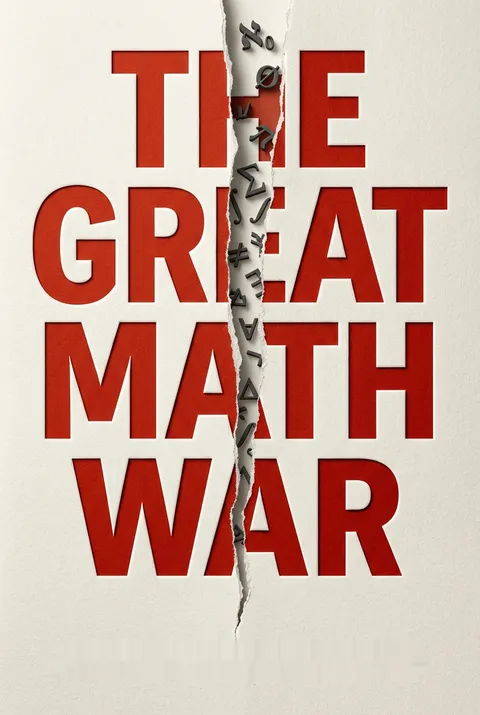

Key Takeaways
1. A Crisis of Certainty: The Foundations of Math Shaken
What we talk about when we talk about the foundations of anything is danger.
Cracks in the bedrock. At the dawn of the 20th century, mathematics, long considered the "Queen of the Sciences" and a bastion of absolute truth, faced a profound crisis. Paradoxes emerged within foundational theories like Georg Cantor's set theory, challenging the very consistency and certainty of mathematical knowledge. This instability prompted leading mathematicians to seek new, unshakeable foundations for their discipline.
The paradox problem. These paradoxes, such as Cantor's Paradox and later Russell's Paradox, revealed that seemingly logical constructions could lead to self-contradictory conclusions. For instance, Russell's Paradox questioned whether the set of all sets that do not contain themselves could, in fact, contain itself, leading to an "it is if it isn't, and it isn't if it is" dilemma. Such inconsistencies were kryptonite to mathematical truth, implying that a system could prove both a statement and its negation.
A desperate search. The cumulative effect of these logical inconsistencies was a widespread fear that the entire edifice of mathematics might be built on "loose sand" rather than "reinforced concrete." This spurred a desperate, decades-long intellectual "war" among mathematicians to re-establish certainty, leading to three major competing philosophical camps: logicism, formalism, and intuitionism, each proposing a radical new approach to secure math's foundations.
2. Logicism's Grand Ambition: Math as Pure Logic
The grand object of Principia was to demonstrate that mathematics is only a chapter of logic.
Reducing math to logic. Bertrand Russell, deeply influenced by Gottlob Frege and Giuseppe Peano, spearheaded logicism, the ambitious project to prove that all mathematics could be derived from fundamental logical principles. He believed that mathematical truths were, at their core, logical truths, and that a sufficiently rigorous symbolic language could reveal this underlying unity.
The Principia Mathematica. Collaborating with Alfred North Whitehead, Russell embarked on the monumental Principia Mathematica, a three-volume work spanning thousands of pages and years of intense labor. This dense, symbol-laden treatise aimed to systematically deduce ordinary mathematics from a limited set of logical axioms and primitive predicates like "and," "or," and "not," using a new, unambiguous symbolic language.
A heroic, yet flawed, effort. Despite its immense scope and intellectual rigor, Principia Mathematica ultimately fell short of its primary goal. While it demonstrated how classical mathematics could be derived from set theory, it failed to fully reduce set theory to logic without introducing additional, unproven axioms (like the "axiom of reducibility") or resorting to "awkward reconstructions" to avoid paradoxes. Russell himself later viewed the work as a "cold and unresponsive love," a testament to its demanding nature and perceived foundational shortcomings.
3. Formalism's Game: Rules Over Meaning
In mathematics, there is no ignorabimus.
The game of math. David Hilbert, a towering figure in mathematics, proposed formalism as an alternative to logicism, envisioning mathematics as a rule-bound "game" where mathematical objects are "meaningless marks on the page." The focus shifted from the inherent meaning of numbers or shapes to the consistent application of formal rules (axioms) for deducing mathematical truths.
Axiomatizing everything. Hilbert's program aimed to axiomatize all branches of mathematics, ensuring consistency and completeness. He believed that any logically stated problem could eventually be solved, either by finding a solution or proving its impossibility – a philosophy he termed "exuberant solutionism." This approach sought to provide "absolute" proofs, independent of human intuition or external reality, by treating math itself as an object of investigation ("metamathematics" or "proof theory").
Paradise defended. Hilbert saw Brouwer's intuitionism as a destructive threat to the "paradise that Cantor has created for us," fearing it would discard vast portions of modern mathematics. His formalism, in contrast, offered a path to secure these treasures by demonstrating that even proofs involving infinite sets could be justified through finite, consistent methods. He believed that by clarifying and justifying the use of the infinite, he could defend the foundations of mathematics against all challenges.
4. Intuitionism's Radical Vision: Math as Mental Act
Mathematics is independent of logic, and logic depends on mathematics.
Math as human primitive. L. E. J. Brouwer, a Dutch mathematician, developed intuitionism, a radical "constructivist" philosophy that asserted mathematical objects only exist if they can be explicitly constructed in the human mind. He believed mathematics was an innate human ability, preceding language and logic, and should be built from this "primordial intuition" for natural numbers.
Rejecting the excluded middle. A cornerstone of Brouwer's intuitionism was the rejection of the "law of the excluded middle" (Tertium non datur), which states that a proposition is either true or false, with no third possibility. Brouwer argued that for infinite sets, one cannot always definitively prove either A or not A, thus invalidating many classical proofs, including "pure existence proofs" that merely show something exists without constructing it.
A destructive revolution. Brouwer's approach was seen as "utterly destructive" by many, as it demanded discarding large parts of modern mathematics, including cherished concepts like irrational and transfinite numbers. He derisively labeled Hilbert's formalism "empty formalism," arguing that symbolic language, however abstract, was still a human language prone to contradiction. This uncompromising stance, framed by his ally Hermann Weyl as "the revolution," set him on a collision course with Hilbert.
5. The Personal Battles of the Math War: Rivalries and Betrayals
Never before or after in his life did Hilbert take such an activist, and outright personal, position in a scientific debate as he did with Brouwer.
Clash of titans. The "Great Math War" was not merely an abstract philosophical debate but a deeply personal conflict fueled by strong personalities and bitter rivalries. David Hilbert, the revered "Pied Piper of Paradise," saw Brouwer's intuitionism as an existential threat to mathematics and his life's work, leading to an "absurdly incompetent" campaign to oust Brouwer from the prestigious Mathematische Annalen journal.
Betrayal and indignation. Hilbert's protégé, Hermann Weyl, initially championed Brouwer's "revolution," coining the term "foundational crisis" and writing a "propaganda pamphlet" for intuitionism. This perceived betrayal deeply wounded Hilbert, who viewed Weyl as his "intellectual son." Brouwer, in turn, felt unjustly targeted by Hilbert, accusing him of being "of unsound mind" and driven by "continuously increasing anger" after Brouwer declined a Göttingen offer years prior.
The "War of the Frogs and Mice." The conflict escalated into what Albert Einstein dismissively called the "Frosch Mäusekrieg" (war of the frogs and mice), a petty "ink war" that he refused to champion. Brouwer's stubbornness, his history of academic squabbles (e.g., with Lebesgue), and his "unfriendly and unpleasant ring" in correspondence contributed to his isolation, culminating in his forced removal from the journal's editorial board in 1929, a move that left him "bitter and disillusioned."
6. War and Exile: Geopolitics Shapes Intellectual Fates
My life before 1910 and my life after 1914 were as sharply separated as Faust’s life before and after he met Mephistopheles.
WWI's profound impact. World War I profoundly reshaped the lives and intellectual pursuits of the mathematicians. Bertrand Russell, initially an imperialist, underwent a "peace conversion" during the Boer War and became a staunch anti-war activist during WWI, leading to his imprisonment for sedition. Ludwig Wittgenstein, Russell's protégé, volunteered for the Austrian army, seeking meaning in the face of death and writing his seminal Tractatus Logico-Philosophicus on the front lines.
Academic isolation and boycotts. The war also fractured the international scientific community. French mathematician Charles Émile Picard led a bitter campaign to boycott German scientists, banning them from international conferences and journals for years. This "une affaire française" isolated German scholars like Hilbert and Emmy Noether, hindering collaboration and the free exchange of ideas.
The human cost. The immense scale of death and destruction in WWI, with millions of casualties, created a backdrop of horror that influenced intellectual debates. Russell's activism, though controversial, reflected a deep moral revulsion against the "mad horror" of war, while the economic devastation, particularly in Germany, contributed to a climate of instability that would have further consequences for academia.
7. Gödel's Incompleteness: The End of Absolute Certainty
There are true statements you can make using the logical tools Russell and Whitehead established in Principia Mathematica, Gödel tells the crowd. But some of them are neither provable nor disprovable using those same tools.
A bombshell in Königsberg. In 1930, at a conference in Königsberg, a young Kurt Gödel delivered a stunning blow to Hilbert's program and the entire quest for absolute mathematical certainty. He announced his incompleteness theorems, demonstrating that within any sufficiently powerful axiomatic system (like classical mathematics), there would always be true statements that could neither be proven nor disproven within that system.
Shattering Hilbert's dream. Gödel's work directly contradicted Hilbert's lifelong conviction of "exuberant solutionism" – "Wir müssen wissen, wir werden wissen" (We must know, we shall know). It proved that there are inherently "unsolvable problems" within mathematics, effectively ending the hope of a complete and consistent axiomatic foundation for the entire discipline. Hilbert, already ill, was "crushed" by this revelation, seeing his life's ambitions "utterly smashed to pieces."
The death of the debate. Gödel's theorems, published in 1931, were the "final nails in the coffin" of the foundational crisis. They rendered the debate over logicism, formalism, and intuitionism largely moot, as no single system could achieve absolute completeness and consistency. Interest in the foundations of mathematics waned, and many mathematicians "threw up their hands in frustration," turning away from the philosophical quest for ultimate certainty.
8. The Great Migration: A Forced Academic Exodus
It hasn’t suffered, Herr Minister,” Hilbert says. “It just doesn’t exist anymore.”
Nazism's academic purge. In 1933, the rise of Adolf Hitler and the Nazi regime in Germany initiated a brutal campaign against Jewish scholars and "Jewish mathematics." The "Restoration of the Professional Civil Service Act" led to the mass firing of Jewish faculty, including prominent figures like Richard Courant and Emmy Noether from the world-renowned University of Göttingen.
Göttingen's demise. Göttingen, once the "Mecca of mathematics" and a "center of the scientific world" under Hilbert and Felix Klein, was decimated. James Franck, a Nobel laureate and war hero, publicly resigned in protest, followed by the forced dismissals of Courant, Noether, and the eventual emigration of Hermann Weyl. Hilbert, witnessing the destruction of his beloved institution, famously declared to the Nazi minister of culture, "It just doesn't exist anymore."
A global diaspora. This "Great Migration" saw hundreds of scholars flee Germany, many finding refuge in the United States through initiatives like the Rockefeller-funded Emergency Committee in Aid of Displaced German Scholars. This exodus, while a tragedy for Germany, enriched American universities and profoundly reshaped the global academic landscape, though it also faced challenges from American anti-Semitism, xenophobia, and the economic hardships of the Great Depression.
9. The Fallacy of Seeming: Why We Cling to Falsehoods
The more we invest in a concept mentally and the more we come to consider it true and meaningful, the harder it is to let it go.
Ego as copilot. The "fallacy of seeming" describes the psychological phenomenon where deep personal investment in an idea makes it appear more true, making it incredibly difficult to abandon, even when evidence suggests otherwise. This cognitive bias played a significant role in the Great Math War, as mathematicians clung fiercely to their foundational philosophies despite mounting criticisms and paradoxes.
Resistance to new truths. Figures like Brouwer, despite his own groundbreaking work in topology being non-constructive, rigidly rejected any mathematical concept that couldn't be mentally constructed, even familiar ones like irrational numbers. Similarly, Hilbert's unwavering "exuberant solutionism" persisted even after Gödel proved the existence of unsolvable problems. Their personal convictions often overshadowed objective evidence, illustrating how ego and obstinacy can blind even the most brilliant minds.
History's lessons. The book highlights how this fallacy extends beyond mathematics, influencing political decisions and societal beliefs. From the British public's initial "punch-drunk" enthusiasm for World War I to the German medical profession's complicity in Nazi eugenics, the human tendency to rationalize and cling to deeply held, often flawed, beliefs has devastating consequences. Understanding this psychological trap is crucial for learning from history and avoiding its repetition.
10. A War Without Winners: The Liberating Legacy of Failure
We are less certain than ever about the ultimate foundations of (logic and) mathematics. And yet, outwardly it does not seem to hamper our daily work.
A draw, not a victory. The Great Math War ended not with a decisive victory for any single camp, but with a "Zermelo draw" and a collective loss of interest in the foundational debate itself. Gödel's incompleteness theorems rendered the quest for absolute certainty unattainable, leading mathematicians to largely abandon the philosophical pursuit of a single, unified foundation for their discipline.
Unexpected golden outcomes. Despite this "failure" to find a definitive answer, the foundational crisis had profoundly liberating and transformative effects. The rigorous investigations spurred by the debate led to unforeseen "golden outcomes" and new discoveries.
- Logicism, channeled through Gödel's work, laid the groundwork for computer science, algorithms, and computability theory, ushering in a "golden age of logic."
- Formalism, despite its inability to prove overall consistency, established proof theory as an essential tool and became the "avowed ideology of 20th-century mathematics."
- Intuitionism, though largely rejected in its strict form, is seeing a potential renaissance in neuroscience, as researchers explore the brain's innate, constructive mathematical abilities.
Freedom through uncertainty. By 1938, mathematicians were "set free" from the burden of foundational worries. They could now freely employ elements from logicism, formalism, or intuitionism without needing to reconcile them into a single, perfect system. The debate, once a source of bitter conflict, ultimately fostered a richer, more diverse, and more adaptable mathematical landscape, proving that even intellectual "wars" can yield unexpected progress.
People Also Read









Download PDF
Download EPUB
.epub digital book format is ideal for reading ebooks on phones, tablets, and e-readers.








































