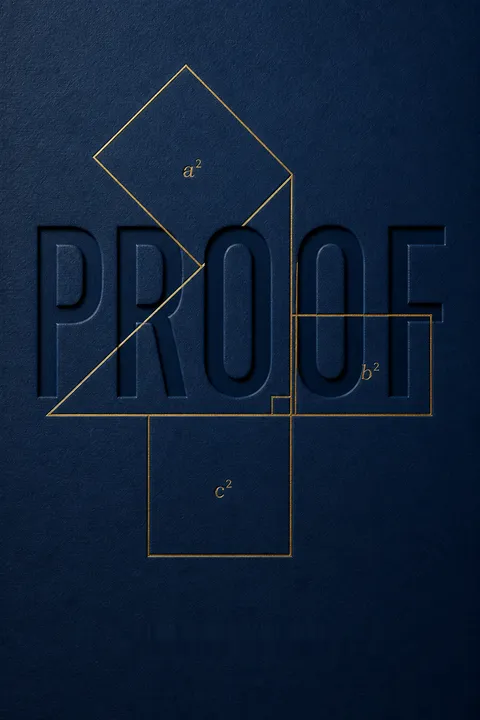

Key Takeaways
1. Proof's Elusive Nature Demands Diverse Approaches
Proof often carries a certain urgency. It is not just about what is true; it is about convincing ourselves – and others – that something is true.
The urgency of proof. Proof is not merely an abstract concept but a pressing need to establish truth, both for personal conviction and for persuading others. The Monty Hall problem, where even brilliant mathematicians like Paul Erdős struggled to grasp a counter-intuitive solution, highlights how difficult it can be to convince others, even with clear mathematical logic. This puzzle demonstrated that understanding a solution doesn't always equate to being able to explain or prove it intuitively.
Beyond intuition. The Monty Hall problem illustrated two distinct methods of proof: proof by exhaustion, systematically testing every combination, and proof by simulation, repeatedly playing the game to observe outcomes. While Erdős was initially unconvinced by the former, a computer simulation running 100,000 times finally swayed him, showing that even non-human species like pigeons can learn optimal strategies through trial and error. This suggests that practical observation can sometimes overcome logical blind spots.
Social dynamics of evidence. The controversy surrounding Marilyn vos Savant's correct solution to the Monty Hall problem, met with thousands of angry letters, revealed that acceptance of proof is not solely about evidence but also about social dynamics. As the author experienced during the COVID-19 pandemic, even when multiple sources of evidence point in the same direction, people's prior beliefs and biases can lead to staunch disagreement, highlighting the human element in the pursuit of truth.
2. Classical Logic Shaped Early Ideas of Truth and Governance
Euclid had created a system for knowledge, a way of constructing seemingly universal truths from fundamental principles.
Euclid's foundational influence. Abraham Lincoln, a self-taught lawyer, found profound inspiration in Euclid's The Elements, a 2,000-year-old text that established a system for deriving universal truths from definitions and self-evident axioms. This structured approach to proof, moving from fundamental principles to undeniable conclusions, became a bestseller, second only to the Bible, and profoundly influenced Western thought, including the foundations of democracy.
Logic in law and politics. Enlightenment thinkers like John Locke applied Euclidean logic to define "natural rights" and the purpose of government, believing moral principles could be as certain as geometric demonstrations. Voltaire argued that objective reasoning could unify populations, stating, "There are no sects in geometry." Benjamin Franklin, a keen student of mathematics, even edited the US Declaration of Independence to replace "sacred and undeniable" with "self-evident," emphasizing a scientific basis for truth.
Proof by contradiction. Lincoln himself employed Euclid's method of proof by contradiction to argue against slavery. By assuming slavery was legitimate, he showed it led to the absurd conclusion that an enslaver could also be enslaved by the same logic, thus proving the initial assumption false. This powerful logical tool, which G. H. Hardy called "one of a mathematician’s finest weapons," became central to Lincoln's arguments against Stephen Douglas, exposing contradictions in his rival's stance on popular sovereignty and slavery.
3. Mathematical "Monsters" Shattered Intuition and Certainty
With one bizarre equation, Weierstrass had demonstrated that physical intuition was not a reliable foundation on which to build mathematical theories.
Zeno's paradoxes and the crisis of intuition. Zeno of Elea's ancient riddles, like "Achilles and the tortoise," exposed conflicts between mathematical theory and physical reality, suggesting motion itself was an illusion. Centuries later, Karl Weierstrass created a "monster" function that was continuous but nowhere differentiable, challenging the intuitive belief that continuous curves must have smooth sections. This creature, along with Bernhard Riemann's non-Euclidean geometries, revealed that physical intuition was an unreliable foundation for mathematics.
Beyond tangible reality. Weierstrass's rigorous, equation-based definitions, rather than vague prose, redefined the building blocks of mathematics, resolving Zeno's paradox by showing infinitesimally small distances could be traversed in zero time. Georg Cantor further challenged intuition with set theory, demonstrating that infinite sets could have different "sizes" and that the "whole is not always larger than its part." These abstract concepts, initially met with resistance and labeled "monsters," forced mathematics to confront its reliance on tangible, intuitive models.
Monsters in the real world. Despite initial rejection, these mathematical monsters found their way into practical applications. Brownian motion, the unpredictable jiggling of particles, was explained by Einstein using Weierstrass's concepts, leading to the estimation of atomic sizes. Helge von Koch's "snowflake" visualized a continuous, non-differentiable fractal, revealing self-similarity ubiquitous in nature, from coastlines to blood vessels. Kurt Gödel's incompleteness theorems further showed that any axiomatic system, including legal codes, cannot be both complete and non-contradictory, explaining why comprehensive rulebooks inevitably have gaps or conflicts.
4. Legal Justice Navigates Doubt with Probabilistic Evidence
It is better that ten guilty persons escape than that one innocent suffer.
The inevitability of error. Legal systems, unlike pure mathematics, must confront the inevitability of error, balancing the harm of wrongful convictions against wrongful acquittals. William Blackstone's ratio, suggesting it's "better that ten guilty persons escape than that one innocent suffer," highlights this trade-off, with different jurisdictions adopting varying levels of leniency. Marquis de Condorcet even attempted to quantify acceptable risk, proposing a probability of 1 in 144,768 for a false conviction.
Beyond reasonable doubt. While civil disputes often rely on a "balance of probabilities" (more than 50% likely), criminal cases demand "proof beyond a reasonable doubt," a concept rooted in medieval religious fears of divine wrath for unjust verdicts. However, translating this into an exact probability remains contentious, with some studies suggesting jurors' interpretations can be as low as 50%. The French "conviction intime" system, replacing complex "fractional proofs" with a judge's internal feeling of conviction, further illustrates the historical struggle to quantify legal certainty.
Algorithms and bias. Modern justice increasingly uses algorithmic risk assessments (e.g., COMPAS, PSA) to predict reoffending, raising concerns about transparency, fairness, and accuracy. Research has shown inherent trade-offs in defining algorithmic fairness, as it's "not possible to satisfy these three constraints simultaneously" (calibration, balanced release, balanced custody) if real-world biases exist. The Post Office scandal, where a legal presumption of computer system accuracy led to hundreds of wrongful prosecutions, starkly demonstrated the dangers of unquestioning trust in opaque systems and the need for human oversight.
5. Science Seeks Causation Amidst Confounding and Bias
Every experiment may be said to exist only in order to give the facts a chance of disproving the null hypothesis.
From correlation to causation. Early scientific progress, like Ibn Sina's work on polydactyly, sought natural explanations for phenomena, moving beyond superstition. Francis Galton's statistical inquiry into the efficacy of prayer highlighted the challenge of separating genuine effects from confounding factors, a problem now fundamental to modern science. Janet Lane-Claypon pioneered methods to address this, including:
- Retrospective cohort studies
- Adjusting for confounding factors
- Case-control studies
- Applying William Sealy Gosset's (Student's) small-sample statistics to epidemiological data.
The birth of modern experimental design. William Sealy Gosset, a Guinness brewer, developed methods for analyzing small datasets, realizing that randomness could heavily influence results. Ronald Fisher, inspired by a tea-tasting experiment, formalized null hypothesis testing and the concept of p-values, suggesting a 5% threshold for "statistical significance." This framework, though later criticized by Jerzy Neyman and Egon Pearson for its lack of decision-making, became central to scientific inquiry, aiming to give "facts a chance of disproving the null hypothesis."
Randomized Controlled Trials (RCTs). Austin Bradford Hill's 1947 streptomycin trial for tuberculosis marked the first randomized controlled trial (RCT) in medicine, using random allocation and blinding to minimize bias. RCTs became the "gold standard" for establishing causation, revealing that many intuitive interventions (e.g., bed rest for back pain, prison visits for troubled youth) were ineffective or even harmful. However, the "transportation problem" highlights that efficacy in a trial doesn't always translate to effectiveness in real-world populations, as seen with the flu nasal spray.
6. Falsification and Triangulation Refine Scientific Understanding
Inductive inference is the only process known to us by which essentially new knowledge comes into the world.
The ladder of causation. Judea Pearl's "ladder of causation" outlines three levels of understanding: association (seeing), intervention (doing), and counterfactuals (imagining). While correlation doesn't imply causation, science aims to climb this ladder, moving from observing relationships to predicting outcomes of interventions and imagining alternative realities. This is crucial for addressing complex problems like climate change or pandemics, where understanding why something happens is as important as what happens.
Popper's falsification and scientific progress. Karl Popper argued that science progresses not by proving theories true, but by disproving them. "The more a theory forbids, the better it is." This concept of falsification, where bold predictions are tested against reality, was exemplified by Einstein's general relativity. The real-time analysis of COVID-19 variants like Alpha and Delta demonstrated this, with scientists making testable predictions about transmissibility that, if wrong, would falsify their theories.
Triangulation of evidence. When facing complex questions and fragmented data, "triangulation" becomes essential. This involves combining different types of studies or data sources, ideally with unrelated biases, to converge on a more robust conclusion. Just as Thales estimated the height of a pyramid using shadow lengths and geometric rules, modern science combines diverse data (e.g., contact tracing, community surveys, global patterns for COVID variants) and methods (cohort studies, RCTs, natural experiments) to overcome individual study weaknesses and the "big data paradox" where large, biased datasets can mislead.
7. Misinformation Exploits Human Quirks and Erodes Trust
People will believe a big lie sooner than a little one; and if you repeat it frequently enough people will sooner or later believe it.
The psychology of belief. The spread of false information, from rumors to elaborate conspiracy theories, is driven by more than just a lack of evidence. Studies show people often prioritize political alignment over accuracy when sharing online content, and the "illusory truth effect" makes repeated statements seem more credible, regardless of plausibility. This vulnerability is exploited by those who propagate "big lies," a tactic famously described in a CIA report on Adolf Hitler, who believed people "more readily fall victims to the big lie than the small lie."
Flawed science and eroded trust. The scientific community itself has contributed to the problem through practices like "p-hacking" (selectively reporting significant results) and "publication bias" (favoring positive findings), leading to a "replication crisis" where many published discoveries fail to hold up. Examples like the "marshmallow test" and "power poses" highlight how seemingly robust findings can be unreliable. This erosion of trust is exacerbated by:
- Fraudulent data and image manipulation
- Overhyped press releases
- Lingering flawed papers
- Appeals to authority over evidence
The challenge of "folk Popperism." An overly simplistic interpretation of Popper's falsification, where only direct experimental disproof is accepted, can hinder scientific progress and fuel skepticism. This "folk Popperism" ignores the complexities of converting hypotheses into testable models and the ethical dilemmas of certain experiments (e.g., dropping a baby to test gravity). The thalidomide tragedy, where a drug was approved despite insufficient safety data, and Ronald Fisher's staunch denial of smoking's link to cancer, illustrate how biases and conflicts of interest can override scientific evidence, with devastating consequences.
8. AI Transforms Proof, Demanding New Forms of Trust
Would you be prepared to have a self-driving car that was less safe if it meant having a more clear-cut decision-making process?
The black box dilemma. As AI algorithms become more complex and opaque, capable of superhuman performance in tasks like driving or playing Go, the question arises: can we trust decisions we don't understand? The "trolley problem" highlights ethical dilemmas for self-driving cars, but the core issue is that AI doesn't "see" the world or make decisions like humans. The effectiveness of traditional medical interventions like defibrillation and anesthesia, whose mechanisms are not fully understood, suggests that trust can exist without complete explainability, but AI's novelty makes this harder to accept.
Computational proof and its limits. Computers have enabled "proof by exhaustion" for complex mathematical problems like the Four-Color Theorem, but these proofs are often too vast for humans to verify, demanding trust in machines. Probabilistic proof, showing a high likelihood of truth rather than certainty, offers a pragmatic approach to intractable problems, akin to the statistical reasoning in RCTs. Zero-knowledge proofs allow verification of knowledge without revealing the information itself, crucial for online privacy.
Deep learning and human intuition. Artificial neural networks, particularly "deep learning" models like Google's Transformer and OpenAI's GPT series, mimic the brain's ability to process vast data and identify complex patterns, leading to breakthroughs in language translation and protein folding (AlphaFold). These models learn efficiently without explicit human instructions, often producing "superhuman" results. However, they can also exhibit "adversarial AI" vulnerabilities, where subtle, human-imperceptible inputs can trick them into making absurd errors, highlighting that even advanced AI can be distracted or have distorted perceptions.
9. The Evolving Quest for Truth Requires Adaptability
All scientific work is liable to be upset or modified by advancing knowledge. That does not confer upon us a freedom to ignore the knowledge we already have, or to postpone the action that it appears to demand at a given time.
Beyond rote learning and fixed rules. The author's personal experience with COVID-19 communication highlighted the challenge of conveying complex, uncertain scientific information in a crisis, where "debate about reality" can overshadow "debate about policy." Just as Lincoln learned Euclid's methods rather than just memorizing conclusions, modern science needs to move beyond simplistic p-value thresholds and rigid evidence hierarchies. Research is a dynamic process, like "building a house on a swamp," requiring constant adaptation and a toolkit of methods rather than fixed rules.
The value of "how much do we lose?" William Gosset's pragmatic approach to statistics emphasized the importance of making the best use of available information, even small samples, and defining the "amount of dependence that can be placed on their results." This contrasts with Fisher's rigid significance cut-offs. Austin Bradford Hill similarly argued that the "degree of sufficient evidence" depends on the "importance of the conclusion and the difficulty of obtaining suitable experience," advocating for action based on available knowledge, even if incomplete, especially in urgent situations like pandemics.
Navigating uncertainty and building trust. The increasing complexity of science, driven by computational power and AI, means proof will increasingly rely on trust in researchers, institutions, and machines. This necessitates greater transparency, data sharing, and a better understanding of AI's limitations and biases. Countering misinformation requires understanding people's prior beliefs and addressing their specific doubts, rather than relying on "proof by intimidation." Ultimately, the quest for truth demands embracing uncertainty, triangulating evidence, and fostering a culture where scientific insights can inform timely, effective action, even when complete certainty remains elusive.
Review Summary
Proof by Adam Kucharski explores how we define and establish certainty across mathematics, science, law, and medicine. Reviews are mixed (3.88/5 average). Positive readers appreciate the interdisciplinary approach, accessible explanations of complex concepts, and timely examination of misinformation. The book's discussion of COVID-19 decision-making and algorithms in criminal justice particularly resonates. However, critics cite poor structure, overly long chapters that ramble, excessive focus on COVID and the author's personal work, and shallow treatment of mathematical proof concepts. Many feel the book promises an exploration of "proof" but delivers more about evidence and uncertainty, with some calling it unfocused and meandering despite interesting content.
People Also Read

Download PDF
Download EPUB
.epub digital book format is ideal for reading ebooks on phones, tablets, and e-readers.








































