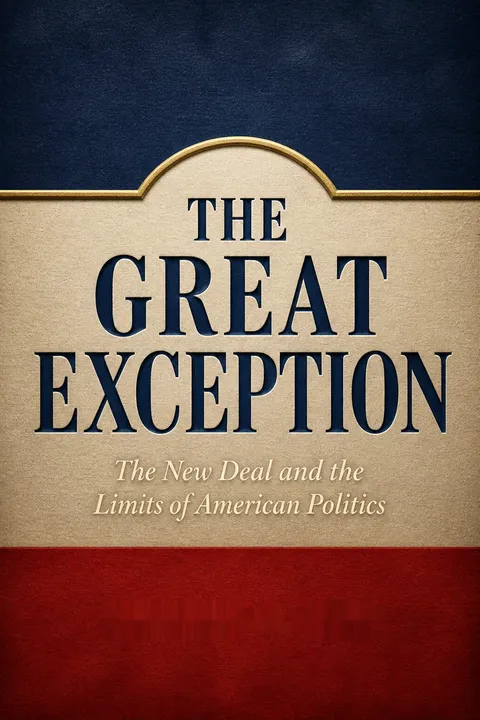

Key Takeaways
1. The New Deal: A "Great Exception" in American History
the political era between the 1930s and the 1970s marks what might be called a “great exception”—a sustained deviation, an extended detour—from some of the main contours of American political practice, economic structure, and cultural outlook.
A unique deviation. The New Deal era (1930s-1970s) was an anomalous period where the U.S. central government systematically supported non-elite Americans, leading to unprecedented economic equality. This "great exception" is visible in rising union density, increasing working-class income, and a dip in wealth concentration at the top, a temporary but significant departure from historical norms.
Fragile juggernaut. Despite its transformative impact, this era was a "fragile juggernaut," a powerful yet vulnerable alignment of political and economic forces. It was not a permanent domestication of capitalism but a product of specific, short-lived historical circumstances, ultimately limited by internal contradictions and deep-seated American political culture.
2. Pre-New Deal America: Corporate Power, Fragmented Labor
The problem with such richly evocative metaphors is that they allow us to distance ourselves from the era more than we should—to think of it as something other than what we are now, other than what the nation “really” is or believes itself to be.
Incorporation of America. The late 19th century, the "Gilded Age," was fundamentally shaped by the rise of massive corporations. Legal frameworks, like the Fourteenth Amendment, protected corporate "persons" while suppressing collective labor action through injunctions and militias, shifting the nation to permanent wage dependency and concentrated capital.
Divided working class. Despite intense class conflict and labor uprisings, American workers remained fragmented by race, ethnicity, religion, and skill. Nativism, racial prejudice, and partisan divisions (e.g., over tariffs) prevented sustained working-class solidarity, with movements often struggling against state hostility and internal disunity.
3. FDR's "Forgotten Man": A New Vision for the State
The American People wanted their government to do something, anything, so long as it acted with assurance and vigor.
Crisis and experimentation. The Great Depression, with widespread unemployment and despair, created an urgent demand for government action, overcoming historical American ambivalence towards state intervention. FDR's "forgotten man" rhetoric promised economic security and a new kind of liberty, marking a dramatic break from past anti-monopoly traditions.
Legislative whirlwind. The "First New Deal" (1933-1935) saw a flurry of experimental, often contradictory, policies like the National Industrial Recovery Act (NIRA). Though NIRA was largely ineffective and unconstitutional, its Section 7a inadvertently spurred a massive strike wave, raising expectations for labor rights and laying crucial groundwork for more enduring reforms.
4. The New Deal's Fragile Foundations: Compromise and Exclusion
The tragedy and the irony of the New Deal was how such an advance in economic democracy required compromise with “the most violent and illiberal part of the political system.”
Racial pact. The New Deal's legislative success depended on a "Faustian pact" with Southern Democrats, necessitating the exclusion of African Americans from many key programs like Social Security and the Wagner Act. Occupations dominated by black workers were deliberately omitted to preserve the South's low-wage, segregated labor system, embedding deep racial inequalities.
Temporary homogeneity. Immigration restrictions (1924) created a "breathing space," reducing ethnic tensions among white workers and fostering a sense of "monolithic whiteness." This artificial homogeneity, coupled with a muted "culture war" over religious values, allowed for a rare period of working-class unity, but these conditions were contingent and would not last.
5. Postwar "Golden Age": The Exception in Action
For the very first time in U.S. history, business, the government, and workers all accepted unions and collective bargaining as legitimate pillars of American working life.
Unprecedented prosperity. The postwar era (1940s-1970s) represented the "great exception" in full swing, offering unparalleled economic benefits to white, male industrial workers. Union density peaked, wages rose significantly, and high marginal tax rates redistributed wealth, consolidating Social Security, unemployment insurance, and the GI Bill.
Compromised peace. Despite labor's newfound power, exemplified by the massive 1946 strike wave, its gains were often a "compromised peace." The Taft-Hartley Act (1947) imposed significant restrictions on unions, limiting their political power and ability to expand, marking the end of labor's social movement phase.
6. The Unraveling: Return of Individualism and Cultural Divides
The blue collar, lower middle-class ethnics and white Southerners “who gave FDR those great landslides” were in rebellion against the “intellectual aristocracy and liberal elite who now set the course” of the Democratic Party.
Nixon's "New Majority." By the late 1960s, the New Deal coalition began to unravel. Richard Nixon strategically appealed to "forgotten Americans"—disgruntled white working-class voters—by shifting political focus from economic issues to cultural, social, and racial divisions, exploiting white backlash against civil rights and perceived liberal elites.
Rise of identity politics. The post-1960s era saw a surge in "rights consciousness" and identity politics, expanding individual rights for previously excluded groups. While democratizing access, this focus often overshadowed collective economic solidarity, leading the Democratic Party to inadvertently cede the powerful narrative of Jeffersonian individualism to the burgeoning conservative movement.
7. Reagan's "Restoration": Back to a "New Gilded Age"
If we substitute Greenspan’s phrase “freedom to fire” with “freedom to break unions, strip them of the right to strike, redistribute wealth upward, and create massive economic insecurity,” then we have a story that also resonates with the labor movement.
Conservative resurgence. Ronald Reagan's presidency marked a "restoration" of pre-New Deal political and economic patterns. His firing of air traffic controllers (PATCO strike) signaled employer aggression against unions, effectively ending the right to strike in the private sector, while deregulation and tax cuts shifted power back to corporations and the wealthy.
New Gilded Age. The 1970s and 1980s saw a return to high levels of economic inequality. Immigration re-emerged as a divisive political issue, fueling nativism, and religious fundamentalism (Moral Majority) became a powerful political force, further eroding collective economic solidarity in favor of cultural battles.
8. The Enduring Power of American Individualism
The collective dimensions of the New Deal, however limited they may have been to begin with, were never able to take root in the uniquely challenging ideological soils of the United States where “individualism for the masses” remained one its most powerful contradictions.
Deep-seated ethos. American political culture has a profound, enduring commitment to Jeffersonian individualism, which proved resistant to the New Deal's collective vision. Even FDR's efforts to redefine individualism around economic security were often framed within existing national myths, making it difficult for collective economic rights to achieve permanent status.
Conservative appropriation. As liberals embraced large-scale government and regulation, they inadvertently ceded the powerful narrative of individual liberty and anti-statism to conservatives. This allowed the right to effectively rally voters against "big government" and "liberal elites," even while expanding federal power for corporate interests.
9. Race and Immigration: Persistent Fault Lines
Americans seem to like to fight with each other more than they do with the economic powers that rule them.
Historical divisions. Race and immigration have consistently been America's most intractable social and political fault lines, often preventing working-class unity. From the systematic exclusion of African Americans in the South to nativist sentiments against various immigrant groups, these divisions have historically trumped shared economic interests.
Re-politicized identities. The Civil Rights movement, while a monumental achievement, triggered a white backlash that fractured the Democratic coalition. The 1965 Immigration Act, intended as reform, inadvertently led to new waves of immigration and renewed nativist anxieties, which continue to divide the electorate and deflect attention from underlying economic inequalities.
10. Lessons for Today: Beyond the New Deal Metaphor
Bad history makes for weak political strategy.
The illusion of return. Many contemporary calls for a "new New Deal" are based on a flawed understanding of history. The unique circumstances that enabled the New Deal—a deep depression, a unified political will, temporary social homogeneity—are largely absent today, blinding reformers to the need for new strategies.
Rethinking reform. The "great exception" suggests that progressive victories are precious and often contingent. Future movements for economic justice may find more useful analogies in the "kaleidoscopic" and decentralized nature of the Progressive Era, focusing on local innovation, cross-class alliances, and a redefinition of rights that genuinely bridges individualism with the common good.
Review Summary
The Great Exception examines the New Deal era (1935-1970) as an anomaly in American history, arguing it was a temporary break from the nation's typical individualism and corporate dominance. Readers praised Cowie's analysis of how unique circumstances—including immigration restrictions and the Depression's severity—enabled labor's brief ascendance, though critics noted the book's dense prose and pessimistic tone. Many found it educational for understanding US political history, though some felt it lacked novel insights or practical solutions for contemporary challenges.
People Also Read



About the Author
Other books by Jefferson R. Cowie
Download PDF
Download EPUB
.epub digital book format is ideal for reading ebooks on phones, tablets, and e-readers.








































