
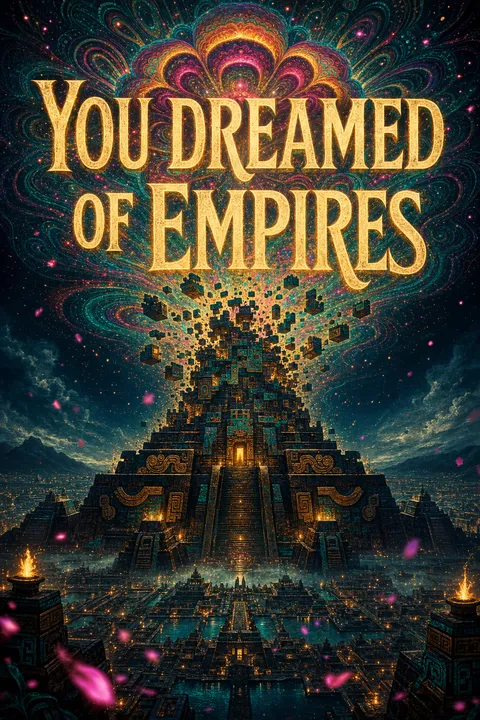


Plot Summary
The Poisoned Banquet
Captain Jazmín Caldera,6 a wealthy investor in the expedition, sits at Axayacatl's palace wedged between two priests reeking of dried blood and rotting skin, unable to swallow the turkey and flower broth. From the table's head, beside Empress Atotoxtli,4 Cortés2 silently orders him to eat or ruin their welcome. The translators Malinalli3 and Aguilar7 launder every insult the Spaniards and Colhua trade into flattery.
Caldera6 finally forces down the soup. But when Cortés2 boasts of the huge Tlaxcalteca army camped at Iztapalapa, Atotoxtli4 realizes the mayor lied to her, singles out Caldera6 as the only honest foreigner, and demands the truth. He gives it. The empress rises like a jaguar and sweeps out, fury exposing the rot beneath the ceremony.
Enrigue opens with the body as diplomatic battlefield: smell, nausea, and appetite carry more meaning than speeches. The double-filtered translation establishes the novel's governing irony, that history turns on what two interpreters choose to say. Caldera's revulsion marks him as the outsider capable of honesty, and his honesty, prized by the empress, becomes destabilizing rather than useful. The scene compresses the whole colonial encounter into table manners, where mutual disgust masquerades as courtesy. Power here is performative and precarious, sustained by everyone pretending not to notice how badly everyone else stinks, literally and politically.
The Empress Storms the Emperor
Atotoxtli4 marches to Moctezuma's1 private dining room, hurls down her headdress, and accuses him of lodging the filthy foreigners in her rooms and of letting the mayor lie to her about the enemy army. Half-dressed and unshaven, gnawing a grasshopper taco, the emperor reminds her he could have her killed and sends her back to reflect on her conduct.
Their marriage, we learn, is symbolic, meant to freeze the succession, and she has spread a rumor that they sleep together to silence the scheming concubines. In the same breath, Moctezuma1 condemns his serving niece Xochitl13 to public execution over a small defiance. She protests that after twenty-three years he has never learned her name. He does not relent.
The chapter anatomizes absolute power as intimacy weaponized. Atotoxtli is simultaneously queen, sister, and disposable subject, her boldness underwritten by the knowledge that even her death would carry mythic dignity. Moctezuma's casual death sentence on Xochitl exposes the moral vertigo of a court where being unseen means being unreal: the girl's lament, that she will vanish leaving no trace, indicts a system that reduces persons to functions. Enrigue plays domestic pettiness against cosmic stakes, showing empire as a family quarrel with a body count, where affection and annihilation share the same casual tone.
The Emperor Who Collects Horses
In a jasmine-scented courtyard, the aging mayor Tlilpotonqui5 finds Moctezuma1 sunk in melancholy and smoke. Pressed on why he admitted the Spaniards into the invincible city, the emperor confesses his fixation: the pale bearded strangers and, above all, their hornless deer, the cahuayos, must belong to him or a rival will seize them.
For months he has drawn the foreigners inward with gold and seeded rumors that they descend from the god Quetzalcoatl. He waves away the crises multiplying around him, Tlaxcalteca massing at the Hill of the Star, Texcoco in revolt, his heir-brother Cuitlahuac10 mysteriously missing.
Nothing matters but keeping the animals alive. He declares he will receive the Spanish leader after supper, then laps up more mushrooms to summon sleep.
The horse becomes the novel's engine of history: not gold, not God, but a coveted new technology of power. Moctezuma is reframed not as a paralyzed mystic awaiting doom but as a collector, a strategist so far ahead he seems mad. His melancholy is dynastic, an inherited affliction of rulers who have known no limits until their own bodies impose them. Enrigue slyly rewrites the fatalism of conquest narratives: the emperor invited the invaders as specimens. The chapter also seeds every later payoff, the missing brother, the Quetzalcoatl rumor, the mushroom haze, planting the machinery of a reversal no one yet suspects.
Lost in the Palace Trap
Ordered to find the mounts, Caldera,6 Vidal, and Luengas wander the deserted palace, turning identical corner after corner until they are hopelessly lost, half-convinced a spell has snared them.
Gathering scattered soldiers and following the smell of ground cacao, they climb at last to the roof and grasp their predicament: the palace stands unguarded, yet the causeway bridges can be raised in an instant, sealing the island city. Below, in a ravaged orchard, the placid stable boy Badillo11 lounges among the twenty-seven horses, having let them devour priceless flowers and fruit trees.
Asked for a headcount, Badillo11 tallies only to twenty, counting on his bare toes. The captains understand the humiliating truth: the Mexica treat them as harmless creatures, not as a threat.
The labyrinth literalizes the conquistadors' epistemic helplessness: they cannot map the space they occupy or the plot enclosing them. The unguarded palace is the cruelest revelation, contempt disguised as hospitality, since guards would imply the guests were dangerous. Badillo, the man who speaks horse better than Castilian, embodies a comic tenderness the expedition otherwise lacks, and his inability to count past his toes underscores how little the Spaniards command their own instrument of power. Enrigue inverts the myth of European mastery: here the invaders are children in a machine city, monitored, indulged, and quietly appraised like livestock.
The Nap and the Reprisal Vow
Moctezuma's1 afternoon sleep is sacred; the whole city holds still until his little silver bell rings the world awake. As he dreams, Cortés2 returns from bathing and catches Malinalli3 reading his Castilian book, extracting her secret: she now understands Spanish. She warns him a priest muttered that the walls have eyes, and he orders her to hide her fluency from Aguilar.7
Anxious about facing the emperor, Cortés2 stifles his fear the way he always does, by lashing out, dragging Malinalli3 down and raping her. She rearranges her huipil, lowers her stinging body into the courtyard pool, and silently swears he will pay. Nearby, Caldera6 coaxes the tattooed friar Aguilar7 to teach him how to wear the native breechcloth and mantle.
The imperial nap, an act of pure control, frames a chapter about who truly holds knowledge. Malinalli's concealed Castilian makes her the expedition's real intelligence and its greatest liability; her interior vow converts private violation into political motive. Enrigue refuses to aestheticize the assault, presenting it as the reflexive cruelty of a man who manages terror through domination. The juxtaposition is deliberate: while Cortés reasserts mastery through violence, Caldera experiments with becoming other, trying on a new skin. Both men respond to the same dread of the coming audience, one by wounding, one by transforming, and the difference will decide their fates.
Caldera Sheds His Skin
Restless and captivated by the ordered metropolis, Caldera6 shaves his beard, crops his hair, dresses as a Colhua lord, and slips out alone across the temple citadel.
He crosses the gleaming white plaza, forces himself past the great skull rack of some forty thousand perforated heads rattling in the breeze, and drifts north to the immense Tlatelolco market with its aviaries, furriers, and slave stalls. There he finally names what unnerves him: Tenochtitlan is a city planned to obsessive geometric perfection, punctual and spotless, unlike any European sprawl.
Preferring this world to Cortés's,2 he turns his back on the palace. The empress,4 recognizing the disguised captain in the square, sends a lady bearing her own tiara as a token to guide him to safety, meaning to keep him alive to teach horsemanship later.
Caldera is the counter-conquistador, the reader-soldier who sees the New World as marvel rather than prey. His disguise dramatizes assimilation as liberation from the shit-ship of Europe, a phrase the novel uses for the whole imperial project. The tzompantli, hygienic and geometric, forces him to read Mexica death culture not as savagery but as design, a mirror to European autos-da-fe. Enrigue uses him to voice the book's aesthetic thesis: Tenochtitlan as a Renaissance dream of the planned city made real. Atotoxtli's quiet salvage of him also shows the Mexica already thinking past the encounter, treating a horseman as an asset to keep.
The Garden Conspiracy
Tlilpotonqui5 discovers that his own son, Tlacaelel,9 summoned the Council in his name, a signal that Moctezuma1 no longer trusts him and may soon dispose of him, as the vanished heir Cuitlahuac10 appears already disposed of.
In a private garden the sidelined mayor, a weeping Atotoxtli,4 and the stone-faced young general Cuauhtemoc8 combine what each knows. The call to arms came from the emperor through his son-in-law. The real strategy surfaces: rather than battle the four Tlaxcalteca lords, Moctezuma1 intends to offer them Texcoco's seat in the Triple Alliance if they annihilate the rebel city.
Grieving and expecting death, the old mayor still resolves to serve one more day. The ancient councillors, meanwhile, answer his questions only with the maddening riddle of Quetzalcoatl's ant.
The chapter reframes apparent imperial collapse as coordinated maneuver, the emperor governing by opacity, moving allies like pieces while his own lieutenants guess at the board. Tlilpotonqui's tragedy is the loyal servant who cannot tell whether his removal is betrayal or protection, a paranoia native to any autocracy. Enrigue threads the ant motif from the epigraph as the book's philosophical spine: the ant who will not speak yet finally shows the way, an emblem of strategic silence and of history's hidden path to sustenance. The garden becomes a space where power is decoded rather than exercised, intimacy standing in for institutions.
The Chapel That Failed
Emboldened by a dream in which Jesus tells him to spread the faith, Cortés2 arms his captains and marches to the Great Temple to topple the idols and install Christian icons. They labor up the steps, dwarfed by the citadel's scale.
Unknown to them, Moctezuma1 is ascending the same pyramid from within, staggering through lit tunnels on mushrooms, to consult the priest of Huitzilopochtli. In the reeking inner sanctum, emperor and priest, both tripping, sway to music that cannot exist and glimpse a distant author composing this very book.
The veiled god counsels following instinct. When the Spaniards finally reach the blood-caked shrine, they gag and vomit; Aguilar7 refuses to enter at all. Cortés2 retreats, promising to return once the place is scrubbed.
Enrigue stages a collision of two mysticisms, Christian zeal and Mexica hallucination, and finds them equally intoxicated. The anachronistic intrusions, rock music and the writer on Shelter Island, tear the fabric of realism to insist that history is a dream someone is authoring, and possibly rewriting. Cortés's chapel campaign, historically a flashpoint, here dissolves into slapstick vomiting, deflating the conqueror's grandeur. The parallel ascents, one loud and blundering outside, one silent and visionary within, dramatize who actually inhabits the sacred architecture. The god's advice to trust instinct over the broken calendar quietly licenses the emperor's coming improvisation.
The Cactus of Tongues
That night the mayor leads the disarmed Spaniards into the blue throne room under rigid protocol: heads veiled, boots the sole concession, Alvarado12 barred, Cortés2 made to drop his sword. Moctezuma,1 freewheeling on peyote, introduces his family and invites the captain to speak.
Prompted by his dream, Cortés2 preaches about Jesus, and the emperor, enthralled by the story of Pentecost and speaking in tongues, produces two honeyed slices of cactus-of-tongues, claiming they let men converse in Greek without translators.
Malinalli,3 relishing her revenge, quietly urges Cortés2 to take it. He chews and swallows. Reality warps: Aguilar7 turns black and star-flecked, Moctezuma1 sprouts an eagle's beak and wings, and the terrified captains bolt from the hall as animals while only Tlacaelel9 stays as witness.
The audience is choreographed as ritual submission, each protocol stripping Cortés of the props of his authority until only his tongue remains, and even that is turned against him. Malinalli's whispered encouragement is the novel's exquisite reversal: the violated translator engineers the invader's undoing through his own vanity and curiosity. The cactus collapses the boundary between diplomacy and shamanism, converting a negotiation into a shared trip where the emperor holds the map. Enrigue literalizes the peril of speaking in tongues: language, the conquistador's weapon, becomes the trap. The metamorphoses signal that Cortés has entered Moctezuma's cosmology, where he no longer sets the terms.
Cortés Dreams the Conquest
Sinking to the floor, Cortés2 watches his whole life stream past, then dreams the history that does not happen here: he seizes and imprisons Moctezuma,1 the emperor dies stoned by his own people, the Spaniards flee weeping through the night, smallpox ravages the valley, and on the day of Saint Hippolytus in 1521 Tenochtitlan falls.
The vision rolls onward through colonial New Spain, the silver mines, the apparition of Guadalupe, revolutions and gringos, a Zapotec president, Zapata striding through the palace, centuries stacking up until the dream arrives at this very book and the reader holding it.
Certain he has witnessed his own triumph and eternal fame, Cortés2 wakes taller and emboldened, only to find his words emerge as gibberish the emperor cannot understand.
Here the novel executes its boldest move, folding actual history into a hallucination the conqueror mistakes for prophecy. What readers know as fact becomes a drug-dream, contingent and cancelable, the counterfactual asserting that the recorded past was only one path the ant might have shown. Cortés's certainty of glory is the ultimate dramatic irony: he reads his real historical victory as a vision of destiny at the exact instant destiny is being revoked. Enrigue's Borgesian recursion, the dream reaching the writer and the reader, exposes conquest as narrative, something authored and therefore rewritable, and hands the pen briefly back to the vanquished.
Now, Cuitlahuac
Moctezuma1 and Tlacaelel9 study the babbling captain with cool curiosity. The emperor claps and utters two words the drugged Cortés2 cannot parse. From the dim blue back wall, his body painted the exact shade of the plaster, the emperor's supposedly missing brother Cuitlahuac10 opens his eyes, steps forward, and kills Cortés2 with his bare hands, breaking his jaw and snapping his spine.
Every apparent failure was strategy: the heir was hidden, the mayor tested, the horses secured. Moctezuma1 orders the eagle warriors loosed, appoints Tlacaelel9 to lead the defense of the city, and rewards Tlilpotonqui5 with a Council seat.
History bends: the Mexica strike first, the conquest dies in the throne room before it can begin, and the emperor climbs to splash his face in the sacred spring as war cries rise.
The reveal recasts the entire novel: Moctezuma's melancholy, his sidelining of Tlilpotonqui, the missing Cuitlahuac, all were camouflage, the emperor moving like the ant that will not speak yet shows the way. Enrigue delivers a decolonial fantasy without triumphalism, an alternate history where indigenous strategy, not European steel, dictates the outcome. Cuitlahuac emerging from a wall painted his own color is the perfect image of concealed agency, power that hides in plain sight. The killing is intimate and manual, mirroring the earlier near-decapitation on the causeway. History becomes a dream reauthored, insisting the fall of empires was never inevitable, only narrated.
Analysis
Enrigue rewrites the founding trauma of the Americas as a single hallucinatory afternoon and, in its final pages, undoes it. The novel's radical move is temporal and epistemological: it drenches its characters in mushrooms and peyote, then folds the actual conquest into a drug-dream Cortés2 mistakes for prophecy, so that the fall of Tenochtitlan becomes a vision the empire can simply refuse. This is decolonial imagination as literary structure. History is exposed as narrative, contingent and authored, and the pen is briefly returned to the vanquished. The recurring ant of the epigraph supplies the ethic: power that keeps silent is not paralyzed but strategic, pointing toward a path only it can see. Moctezuma,1 long caricatured as a fatalist frozen by omens, is reconceived as the sharpest tactician in the story, his melancholy a mask, his obsession with horses a bid to seize the future's technology on his own terms. Around him Enrigue builds a dense human comedy of empire as domestic quarrel: sibling rivalry, bruised bureaucrats, disposable servants, and translators who quietly hold the fate of worlds in the seams between languages. The prose luxuriates in smell, food, and architecture, insisting that civilizations meet first as bodies, disgusted and curious, before they meet as armies. Tenochtitlan appears not as doomed exotica but as a planned, punctual, obsessively clean marvel that shames European sprawl, seen most clearly through Caldera,6 the reader-soldier who defects toward wonder. The book's anachronisms and metafictional ruptures, its rock songs and glimpses of the writer, refuse the solemnity of historical tragedy, replacing inevitability with play. What lingers is a provocation dressed as farce: the conquest was never fated, only told, and stories, unlike the dead, can always be told again.
Review Summary
You Dreamed of Empires reimagines the meeting between Hernán Cortés and Moctezuma in 16th-century Tenochtitlan. Readers praise Enrigue's vivid, hallucinatory storytelling and innovative approach to historical fiction. The novel blends humor, surrealism, and psychedelic elements, offering a unique perspective on the clash of cultures. While some found the narrative challenging to follow due to complex character names and non-linear structure, many lauded its bold reimagining of history. Critics particularly appreciated the book's exploration of power dynamics and cultural misunderstandings, as well as its meta-fictional elements and surprising ending.
People Also Read






Characters
Moctezuma
Withdrawn scheming emperorThe huey tlatoani of Tenochtitlan, once a brilliant undefeated general, now a fifty-two-year-old ruler cloaked in melancholy, smoke, and mushrooms. He has retreated from public life, married his sister to freeze the succession, and unnerved his court with mood swings and mystic silences. Beneath the drooling, unkempt exterior lives the sharpest strategist in the empire, a man who governs by opacity and lets others mistake his calculation for collapse. His consuming obsession is the Spaniards' horses, which he believes could rebuild a larger world. Enrigue paints him as both a depressive shaped by his priestly past and an opaque tactician whose refusal to explain himself is itself a weapon, embodying the riddle of the ant who does not speak yet ultimately points the way.
Cortés
Self-mythologizing conquistadorThe captain general of the Spanish expedition, an ill-favored son of Extremadura who reinvents himself as a hero out of chivalric romance. Brash, bluffing, and steeped in Livy and Amadis, he has bullied and improvised his way to the heart of an empire he never truly planned to reach. He manages fear through domination, whether lashing out at subordinates, brutalizing his translator3, or preaching Christ. Charismatic and dangerously overconfident, he mistakes hospitality for conquest and reads his own vanity as destiny. The Mexica call him El Malinche, not for himself but because he is the appendage of Malintzin, the translator through whom he speaks3. Enrigue renders him a provincial adventurer whose bravado masks a man perpetually out of his depth.
Malinalli
Trilingual translator, survivorAlso called Malintzin and Marina, a Nahua princess of Olutla sold into slavery as a girl and now the indispensable interpreter of the expedition, translating Nahuatl into Maya for Aguilar to render into Castilian. Fluent in an antique, songlike Nahuatl that awes the Colhua, she is more famous than Cortés2 among them. Fiercely intelligent and endlessly calculating, she has secretly learned Castilian and dreams of steering events to reclaim her stolen birthright and rule a realm of her own. She endures Cortés's2 cruelty while quietly plotting, her survival instinct honed across several lifetimes of loss. Enrigue makes her the true intelligence at the center of the encounter, a woman who converts humiliation into leverage and words into power.
Atotoxtli
Empress and sister-wifeDaughter of the late emperor Axayacatl, sister and symbolic wife of Moctezuma1, and the wealthiest, once-freest woman in the empire. Sharp-tongued and imperious, she resents having surrendered her lovers and her own palace to play the role of last consort. Yet she remains loyal to the brother she has adored and feared since childhood, brokering intelligence and executing his subtle plots. Beneath the majesty runs a private yearning for freedom and a habit of contemplating her own dignified death. Enrigue casts her as the court's most clear-eyed operator, a woman whose confined life has sharpened rather than dulled her, reading people and situations faster than the men who outrank her on paper.
Tlilpotonqui
Aging city mayorThe cihuacoatl, mayor of Tenochtitlan and supreme commander of the Mexica army, descended from the empire's slave-born founder Tlacaelel9. At seventy, he is the machine that turns Moctezuma's1 genius into governance, the power behind the throne and the emperor's oldest friend. Weary in his joints and his spirit, he moves through a day of mounting catastrophes with practiced composure while sensing, with growing dread, that the emperor no longer trusts him and may soon have him erased. His loyalty is genuine and his grief real. Enrigue uses him to voice the exhaustion of institutional power, the servant who keeps the world running even as he suspects the world is preparing to discard him.
Jazmín Caldera
Reluctant reader-soldierA wealthy captain from Extremadura who funded much of the expedition out of boredom, and its most sensitive, bookish member. Squeamish, well-traveled, and quietly appalled by his comrades' cruelty, he alone perceives Tenochtitlan as a wonder rather than plunder. A close friend of Cortés2 with whom he discusses literature but never strategy, he grows increasingly estranged from the conquest and drawn toward the ordered beauty of the Mexica world.
Aguilar
Tattooed friar-translatorGeronimo de Aguilar, an Andalusian priest shipwrecked and enslaved among the Maya, now the Castilian half of the translation chain. Covered head to shin in Maya tattoos, he shaves daily, prays constantly, abhors alcohol, doses on mushrooms, and beds young men. The most experienced and unflappable man in the company, he counsels caution, refuses to defile himself with idols, and watches the encounter with wry, weary detachment.
Cuauhtemoc
Silent young generalMoctezuma's1 son-in-law and a general of the Mexica army, second in line for the throne. Barely twenty-four, a mountain of muscle who meditates by breathing through his eyes, he is feared rather than known, speaking only when necessary. Fiercely disciplined and effective on the battlefield, he executes the emperor's orders, including the secret call to arms, and is unsettled only by tears and by inexplicable phantoms.
Tlacaelel
Cold heir apparentTlilpotonqui's5 eldest son, groomed to inherit the office of cihuacoatl. Emotionally opaque as obsidian, with his late mother's unreadable eyes, he carries Moctezuma's1 cryptic messages and serves as a chosen witness. His sudden emergence to summon the Council signals shifting loyalties within the court.
Cuitlahuac
The missing heirMoctezuma's1 younger brother, lord of Iztapalapa, top eagle commander, and next in line for the imperial throne. His unexplained absence from every gathering haunts the court, since his presence signifies the empire's continuity, and everyone from the mayor to the empress fears what his disappearance means.
Badillo
Placid horse whispererCortés's2 golden-haired, slow-witted stable boy, allergic to everything and barely able to speak, yet uncanny with animals; the mean horse Tenebra obeys him like a dog. Left alone with the twenty-seven mounts, he tends them contentedly and counts them on his toes.
Pedro de Alvarado
Ruthless second-in-commandCortés's2 cousin and second-in-command, owner of the black horse Tenebra, resentful and impervious to reality. Immune to fear as to shame, he props his mud-and-blood-caked boots on royal cushions and shares Cortés's2 taste for Petrarch and Livy, forever justifying his rank.
Xochitl
Unremembered serving nieceA young serving girl, one of the emperor's1 Little Cousins, who has attended Moctezuma's1 every meal for five years. Her quiet protest that he has never learned her name after a lifetime in his palace becomes a searing indictment of a court that renders its people invisible.
Plot Devices
The double-filtered translation
Language as hidden powerBecause Malinalli3 speaks Nahuatl and Maya but not Castilian, and Aguilar7 speaks Maya and Castilian but not Nahuatl, every exchange between Spaniards and Mexica passes through two interpreters. This chain lets the translators soften insults, invent pleasantries, and quietly shape events, turning conversation into a stage for dramatic irony. The reader hears what each side actually says and what gets relayed, exposing the gap between intention and record. Malinalli's3 concealed knowledge of Castilian, hidden even from Aguilar7, makes her the true intelligence at the table. Enrigue uses the device to argue that conquest and diplomacy alike rest on the choices of interpreters, and that history is authored in the seams between languages.
The cahuayos (horses)
Object of imperial desireThe Spanish horses, called cahuayos, are Moctezuma's1 obsession and the true reason the expedition was drawn deep into Tenochtitlan. Seeing the beasts as a technology of power that could remake the empire, the emperor lured the foreigners inward with gifts rather than destroying them, insisting no animal be lost. The twenty-seven mounts, penned in a ravaged orchard under a single dreamy stable boy11, function as the story's engine, reorienting the entire encounter around covetousness for a new kind of strength. Their care preoccupies emperor, empress, and captains alike, and their eventual securing is folded into Moctezuma's1 larger design. Enrigue makes the horse, not gold or God, the hinge of an alternative history.
The riddle of the ant
Coded strategy of silenceDrawn from the epigraph's Legend of the Suns, the story of Quetzalcoatl's ant, who refuses to speak yet finally reveals where sustenance lies, recurs as a message the councillors and Moctezuma1 press upon the bewildered mayor5. The ant becomes the emblem of the emperor's method: govern by opacity, withhold explanation, and let allies and enemies misread apparent paralysis as weakness. Characters puzzle over its meaning throughout the day, sensing a warning or an instruction they cannot decode. Enrigue threads the motif as the philosophical key to Moctezuma's1 behavior, suggesting that the ruler who says nothing is not defeated but pointing, silently, toward a path no one else can yet see.
Cactus-of-tongues
Hallucinogen as trapA rare, potent hallucinogenic cactus that Moctezuma1 frames as a means to speak Greek and dispense with translators. During the climactic audience he offers two honeyed slices to Cortés2, daring the captain to prove his courage. Accepting, Cortés2 is plunged into a warping vision in which reality dissolves and he loses the very faculty, language, on which his power depends. The device converts diplomacy into shamanic ordeal, delivering the conqueror into the emperor's cosmology and Malinalli's3 revenge. Enrigue uses it to literalize the peril of speaking in tongues and to open the narrative into dream, where recorded history itself can be experienced as a cancelable hallucination rather than fixed fact.
Anachronistic metafiction
History as authored dreamEnrigue repeatedly punctures his 1519 world with impossible intrusions: a priest and emperor swaying to rock music, visions of a distant writer composing the book on Shelter Island, a phantom poet reciting verses to Cuauhtemoc8, and finally Cortés2 dreaming the entire real conquest and colonial future down to the reader holding the page. These ruptures frame history not as destiny but as narrative, something dreamed and therefore rewritable. The device authorizes the novel's counterfactual gambit, presenting the recorded past as one path among many. It transforms an alternate-history conceit into a meditation on authorship, contingency, and the arrogance of assuming that what happened had to happen.
Download PDF
Download EPUB
.epub digital book format is ideal for reading ebooks on phones, tablets, and e-readers.








































