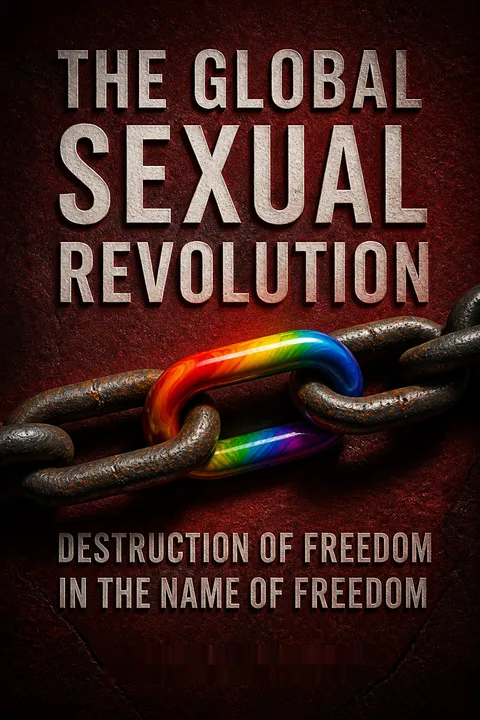

Key Takeaways
1. The "Sexual Revolution" Undermines True Freedom
The sexual revolution has never been about true freedom, but rather, about destroying it.
A deceptive promise. The book argues that the global sexual revolution, while promising absolute freedom and happiness through unfettered sexual license, actually leads to a new form of slavery and societal breakdown. This false vision of freedom, detached from natural or moral limitations, encourages individuals to pursue subjective pleasure, ultimately eroding self-mastery and virtue. The author contends that this process dismantles fundamental standards of human behavior, particularly those related to family and procreation.
Erosion of societal foundations. This revolution prioritizes individual whim over the common good, leading to widespread social problems. Examples include:
- Broken families and single-parent households
- Deep emotional and spiritual wounds in youth
- Pornography addiction and sexual abuse
- Millions of abortions
- Declining birth rates below replacement levels
A new soft totalitarianism. The author suggests that this isn't about traditional political oppression but a deeper attack on humanity's inner moral structure. By dissolving norms and promoting a hedonistic lifestyle, individuals become rootless and easily manipulated, paving the way for a subtle yet pervasive form of totalitarian control that operates under the guise of "freedom" and "progress."
2. Historical Figures Paved the Way for Sexual Anarchy
On today’s thoughts depends what is being lived in the squares and streets of tomorrow.
Intellectual groundwork laid. The book traces the origins of the sexual revolution to influential thinkers and movements from the French Revolution onward, all sharing a common thread: a rejection of traditional morality and the Catholic Church. Figures like the Marquis de Sade, Karl Marx, Friedrich Engels, and Friedrich Nietzsche contributed philosophical ideas that aimed to dismantle existing social and religious structures.
Key trailblazers and their contributions:
- Malthus & Sanger: Advocated population control through contraception and eugenics, targeting "undesirable" populations.
- Kollontai & Reich: Promoted free love, destruction of the family, and sexualization of children as means to achieve a classless society.
- Hirschfeld: Pioneered "sexology" and the idea of abolishing binary gender in favor of individual choice, laying groundwork for gender ideology.
- Freud & Jung: Introduced depth psychology, reinterpreting human consciousness around repressed sexual desires and challenging religious morality.
- Watson & Bernays: Developed behaviorism and propaganda techniques for mass manipulation, seeing humans as malleable objects to be conditioned.
- Kinsey & Money: Conducted "scientific" research (later exposed as fraudulent and abusive) to normalize diverse sexual behaviors, including pedophilia, and promote sex reassignment.
The 1960s breakthrough. These diverse intellectual currents converged during the student rebellions of the late 1960s, fueled by the Frankfurt School's "critical theory" which merged Marxism and Freudian psychoanalysis. This period saw the widespread adoption of "sexual liberation" slogans and the dismantling of traditional sexual norms, leading to a "march on the institutions" by academically trained cadres.
3. Gender Ideology Deconstructs Human Identity
One is not born, but rather becomes, woman.
Beyond equal rights. The book argues that while the initial feminist movement sought legitimate equal rights for women, a radical faction, influenced by figures like Simone de Beauvoir, shifted the goal to deconstructing binary sexual identity itself. This radical feminism, later evolving into gender ideology, aims to abolish "compulsory heterosexuality" and the traditional family structure.
Judith Butler's influence. The author highlights Judith Butler as the chief ideologue of gender theory, whose work "Gender Trouble" proposes that biological sex is irrelevant to identity. Butler asserts that gender is a "fictive" social construct, materialized through language and norms, and therefore can be "subverted" and "deconstructed." This theory posits that identity is fluid and chosen, not biologically determined.
The "gender paradox." Gender ideology seeks to replace the male/female binary with a "diversity of genders of equal value," where individuals can define their own gender and sexual orientation. This is often promoted under the guise of "equality" and "justice," even as it contradicts biological reality and traditional understandings of human nature. The goal is to "use gender to undo gender," ultimately dissolving the very concepts of man and woman.
4. Global Institutions Drive the Sexual Revolution
It is not the governments, but non-state minorities who have played a central role from beginning to end in the revolutionary process.
UN's paradigm shift. The book contends that the United Nations, initially a protector of the family (Universal Declaration of Human Rights, 1948), has become a primary driver of the global sexual revolution. After 1989, the UN adopted a "postmodern ethic" that destabilizes traditional understandings of reality, truth, and human nature, exalting individual arbitrary choice and "sexual diversity."
"Rights by stealth" strategy. The UN, in collaboration with powerful NGOs and foundations, employs a strategy of "rights by stealth" to advance its agenda. This involves:
- Population control: Driven by the US and billionaires like Bill Gates, using "reproductive health" as a Trojan horse for contraception, abortion, and sterilization.
- World conferences: Events like Cairo (1994) and Beijing (1995) are used to establish new global "values" and push for abortion as a "human right," despite lack of international consensus.
- Treaty-monitoring bodies: These unelected committees reinterpret existing human rights treaties to include "sexual and reproductive rights," pressuring member states to adopt new laws.
EU's active role. The European Union actively implements gender mainstreaming, often overriding national sovereignty and the principle of subsidiarity. The EU's Charter of Fundamental Rights (2000) removed "men and women" from the definition of marriage, opening the door for same-sex unions. EU agencies like the Fundamental Rights Agency (FRA) and the European Institute for Gender Equality (EIGE) are heavily funded to monitor and enforce this agenda across member states.
5. The Yogyakarta Principles: A Blueprint for Totalitarianism
The rights they seek to promote are no human rights, but the slogans of a pressure group.
A detailed manual for revolution. The Yogyakarta Principles (YPs), formulated by "renowned human rights experts" without official authorization, serve as a comprehensive guide for implementing gender ideology globally. The book describes them as a "new tool for activists" to revolutionize cultures with different social and legal standards regarding LGBTI issues.
Totalitarian demands: The YPs demand that all countries:
- Embody "sexual orientation" and "gender identity" in national constitutions, defining identity by subjective feeling rather than objective biology.
- Legally recognize "self-defined gender identity," allowing individuals to change their legal gender without medical intervention.
- Grant full equality to homosexual "marriage" and adoption, redefining family beyond biological ties.
- Prioritize "sexual orientation" and "gender identity" over other human rights, such as freedom of religion and conscience.
Methods of enforcement. The YPs outline strategies for global implementation, including:
- Hollowing out national sovereignty through treaty-monitoring bodies and NGOs.
- Securing massive financial resources for LGBTI organizations from the UN, EU, and private foundations.
- Litigating court cases to establish new legal precedents.
- Manipulating public opinion through media influence and school curricula.
- Imposing social and legal sanctions against any opposition, including criminalizing "homophobia" and "hate speech."
6. Language is Corrupted to Manipulate Society
The reality of the word in eminent ways makes existential interaction happen. And so, if the word becomes corrupted, human existence itself will not remain unaffected and untainted.
A tool of power. The book emphasizes that language is not merely a reflection of reality but a tool for shaping it. Political regimes, particularly totalitarian ones, corrupt words to make people submit. The sexual revolution employs this strategy by emptying traditional terms of their meaning, inventing new ones, and stigmatizing dissenting language.
Key terms affected by ideology:
- Values: Stripped of objective meaning, becoming subjective preferences.
- Freedom: Redefined as limitless personal whim, detached from truth and responsibility.
- Tolerance: Used to suppress dissent and eradicate objective truth, rather than to coexist with differing views.
- Justice: Distorted to demand "substantive equality" for unequal realities, such as equating same-sex partnerships with marriage.
- Equality: Applied to objectively different entities, leading to injustice.
- Discrimination: Broadly defined to criminalize any distinction based on sexual orientation, even moral judgment.
- Diversity: Hijacked to legitimize all sexual practices, eliminating the concept of "deviant."
- Sexism: Used to stigmatize any observation of differing gender characteristics or roles.
- Homophobia: A neologism coined to pathologize and criminalize rejection of homosexuality.
- Marriage/Family: Stripped of their traditional meaning as a union of man and woman for procreation.
- Parent 1/Parent 2: Replacing "Mother" and "Father" to erase gendered parental roles.
Feminist linguistic engineering. Feminists and gender activists actively manipulate grammatical structures and vocabulary to enforce their worldview. This "feminist linguistics" aims to make women "visible" while simultaneously deconstructing gender, leading to bizarre and artificial language that stifles genuine communication and critical thought.
7. Pornography's Normalization Leads to Widespread Harm
It is a large, unethical human experiment, and why it goes unhindered is a mystery to me.
A global scourge. The book highlights the alarming rise of pornography, now ubiquitous and easily accessible via the internet and mobile devices, as a major destructive force. What was once taboo is now considered "normal" entertainment, consumed by millions of men and increasingly women and children. This normalization has catastrophic consequences for individuals, relationships, and society.
Addiction and degradation. Pornography is presented as highly addictive, leading to a four-stage process:
- Addiction: Users become hooked, constantly seeking more.
- Escalation: Users require rougher, more explicit, and deviant material.
- Desensitization: Originally shocking content becomes acceptable and commonplace.
- Acting Out: Users increasingly engage in the sexual behaviors viewed, leading to promiscuity, perversion, and even sex crimes.
Devastating consequences: The widespread consumption of pornography leads to:
- Individual harm: Emotional distance, inability to love, reduced libido, mental health issues, and increased risk of sexual violence.
- Marital breakdown: Infidelity, perverse requests, and divorce.
- Child/youth harm: Early sexualization, degrading views of women, increased STDs, depression, suicide, and lower academic achievement.
- Societal decay: Fueling human trafficking, prostitution, and a demographic crisis by detaching sexuality from procreation.
A silent crisis. Despite overwhelming evidence of its destructive effects, pornography remains largely unchallenged by politicians and media. The author questions whether this silence is due to personal involvement or a deliberate strategy to create rootless, manipulated individuals.
8. The Homosexual Movement Reshapes Marriage and Family
Today’s decision usurps the constitutional right of the people to decide whether to keep or alter the traditional understanding of marriage.
A minority's triumph. The book argues that a small minority (1-3% of the population) with non-heterosexual tendencies has successfully made their interests a dominant issue in the global cultural revolution. This is seen as curious because fulfilling these interests often exacerbates societal problems like family disintegration and demographic decline.
The 1973 APA decision. A pivotal moment was the American Psychiatric Association's (APA) decision in 1973 to remove homosexuality from its list of mental illnesses, a move driven by political pressure rather than scientific consensus. This decision, later adopted by the WHO, effectively silenced scientific inquiry into the causes and potential for change in homosexual orientation.
Risks of the homosexual lifestyle. The author cites studies indicating:
- Shorter life expectancy: 8-20 years less for gay and bisexual men compared to heterosexual men.
- Higher rates of physical illness: Significantly increased risk of HIV/AIDS (61-70% of new infections), Hepatitis, syphilis, gonorrhea, and certain cancers.
- Increased mental health issues: Higher rates of depression, anxiety disorders, substance abuse, and suicide attempts, particularly among youth.
- Promiscuity: Studies consistently show that sexual exclusivity is rare in homosexual male relationships, with partners often having numerous concurrent casual encounters.
The battle for "marriage." Despite these risks and the promiscuous nature of many homosexual relationships, the movement aggressively pushes for legal recognition of same-sex "marriage" and adoption rights. This is framed as a "human right," even though it redefines marriage as a genderless institution, detached from procreation, and often against the will of the majority. The author highlights the US Supreme Court's 2015 Obergefell v. Hodges ruling as a major victory for this agenda, imposed by judicial activism.
9. State-Mandated Sex Education Sexualizes Children
Without a well-developed idea of shame, childhood cannot exist.
Controlling the future. The book asserts that state-mandated "comprehensive sex education" (CSE) is a key instrument of the sexual revolution, aiming to sexualize children from birth and dismantle traditional sexual morality. This undermines parental rights and prepares children for a hedonistic, pleasure-oriented sexuality.
From information to indoctrination. CSE, often driven by organizations like International Planned Parenthood Federation (IPPF) and the World Health Organization (WHO), has evolved from providing information to actively indoctrinating children. Key aspects include:
- Early stimulation: Encouraging masturbation and "playing doctor" in kindergartens.
- "Diversity" education: Presenting all forms of sexual orientation and family structures as equal.
- Contraception expertise: Training children in condom use and other birth control methods from elementary school.
- Abortion as a "right": Promoting abortion as a legitimate choice, often without parental consent.
Destructive consequences for youth. The author argues that this sexualization leads to:
- Loss of innocence and shame: Children are exposed to graphic content and coerced into discussing sexual acts.
- Increased health risks: Explosive spread of STDs, teen pregnancies, and health damage from contraceptives.
- Psychological harm: Higher rates of depression, anxiety, and suicide among sexually active youth.
- Lower academic achievement: A negative correlation between early sexual activity and educational success.
- Weakened ability to bond: Promiscuity and early sexual contact impede emotional maturity and the capacity for lasting love.
Undermining parental authority. Despite constitutional protections for parental rights in child-rearing, parents are increasingly forced to expose their children to state-sanctioned sexualization. The author argues that this is an irresponsible experiment on defenseless children, serving the interests of a cultural revolutionary mafia rather than the well-being of the next generation.
10. Christian Values Face Unprecedented Discrimination
For the time will come when people will not tolerate sound doctrine but, following their own desires and insatiable curiosity, will accumulate teachers and will stop listening to the truth and will be diverted to myths.
The Church as a bulwark. The book positions the Catholic Church as the last major institution defending Christian sexual morality, which is seen as indispensable for marriage and family. This stance, rooted in biblical revelation and the "Theology of the Body" by Pope John Paul II, emphasizes human dignity, the complementarity of man and woman, and sexuality's procreative and unitive purposes.
Biblical foundations. Christian teaching, derived from ethical monotheism, views homosexual acts as "intrinsically disordered" and contrary to natural law, closing the sexual act to the gift of life. This is not merely an isolated prohibition but part of an entire "order of creation" that defines humanity as male and female, called to fruitful love.
Internal and external pressures. Despite clear doctrine, the Church faces immense pressure:
- Internal dissent: Some Catholic organizations and theologians promote "sexual formation" aligned with hedonistic sexuality, and homosexual networks within the Church challenge traditional teachings.
- External attacks: The Church is constantly attacked by media and LGBTI activist groups, who accuse it of "homophobia" and "discrimination."
- Legal coercion: Laws in Western countries increasingly force religious institutions to compromise their beliefs, such as requiring Catholic adoption agencies to place children with same-sex couples or forcing Christian employers to hire active homosexuals.
Theological sophistry. The author critiques "theological sophistry" that attempts to reinterpret biblical texts to justify homosexual behavior or trivialize the concept of sin. This "cheap grace," as Dietrich Bonhoeffer called it, undermines Christian morality and the call to holiness, leading to a loss of the Church's transformative power.
11. Resistance to the Revolution is Growing Globally
The only thing necessary for evil to triumph is for good men to do nothing.
Emerging counter-movements. Despite the pervasive influence of the global sexual revolution, the book highlights a growing, successful resistance movement. This pushback is seen at grassroots levels, in referendums, and through the actions of Christian churches, NGOs, and individuals worldwide.
Examples of successful resistance:
- Spain: A strong opposition movement, supported by the Pope, successfully fought against Prime Minister Zapatero's radical gender ideology, leading to the removal of mandatory sex education from schools.
- Hungary: Under Prime Minister Orbán, Hungary adopted a new constitution (2012) that explicitly recognizes God, the nation, marriage as a union of man and woman, and the right to life from conception, sparking international controversy but affirming traditional values.
- France: The "La Manif Pour Tous" movement mobilized millions against same-sex "marriage" and gender ideology in schools, successfully halting new family laws.
- Germany & Switzerland: Citizen initiatives like "Demo für alle" and referendums are challenging state-mandated sexualization of children in schools.
- Croatia: A civic movement successfully pushed for a constitutional amendment defining marriage as between a man and a woman.
- Norway: A popular comedian's documentary, "The Gender Equality Paradox," sparked a national debate and led to reduced funding for gender research.
- European Parliament: Growing resistance led to the rejection of the "Estrela Report," which promoted early sex education and abortion rights. The "One of Us" initiative gathered over 1.7 million signatures against EU funding for embryo-destructive research.
- United States: Record numbers of Americans identify as pro-life, and the "HHS mandate" (forcing employers to cover contraceptives) faced widespread lawsuits and protests from religious organizations.
The Catholic Church's unwavering stance. The Catholic Church remains a leading voice of resistance, with bishops' conferences in several countries issuing strong declarations against gender ideology and the sexualization of children. Pope Benedict XVI explicitly warned against the "anthropological revolution" of gender theory, emphasizing that denying human nature ultimately denies God and human dignity.
12. The Path Leads to a New Totalitarianism
When man stands against God, he stands against His truth, and is therefore not free, but alienated.
The illusion of limitless freedom. The book concludes with a stark warning: the promise of limitless sexual satisfaction and self-creation, detached from truth and responsibility, is a deceptive path to a new form of totalitarianism. This ideology, by reducing individuals to their desires, makes them vulnerable to manipulation and control by powerful elites.
Erosion of moral substance. The author invokes the "Böckenförde dictum," which states that the liberal secular state relies on moral assumptions it cannot itself guarantee. When traditional sources of moral substance—like the Church and family—are undermined, society loses its inner compass. The conscience, once a guide to objective truth, becomes silenced or distorted, leading to a "blindness to guilt."
The consequences of unchecked power. The deregulation of financial markets and sexual norms are presented as parallel processes, both leading to chaos and the concentration of power. A society that trivializes sexuality and denies human nature creates:
- Rootless, dependent, and malleable masses.
- A demographic catastrophe, with declining birth rates and an aging population.
- Social and psychological instability, making people susceptible to new forms of authoritarian control.
A call to action. The book urges readers to recognize the gravity of this "anthropological revolution" and to resist the "slippery slope" by defending fundamental values: life, marriage, family, and religious freedom. It emphasizes that individual action, rooted in conscience and a commitment to truth, is essential to rebuild a civilization based on human dignity and the divine image. The author expresses hope that the looming crises, such as mass migration, will force a return to the "solid ground of human reality."
Review Summary
Reviews of The Global Sexual Revolution are largely positive, averaging 4.3 out of 5. Many readers praise Kuby's thorough research and courage in exposing what they see as a coordinated ideological agenda undermining traditional family structures and religious freedom. Several call it essential reading, particularly for parents. Critics note the book's narrow Catholic perspective, limited engagement with opposing viewpoints, repetitive tone, and stronger relevance to European than American audiences. Even skeptical reviewers acknowledge its value as a reference on gender ideology's institutional spread, particularly regarding the UN and Yogyakarta Principles.
People Also Read





Download PDF
Download EPUB
.epub digital book format is ideal for reading ebooks on phones, tablets, and e-readers.








































