


Plot Summary
Four Castles, Fifteen Days
Carl,1 Donut,2 and Katia3 emerge onto the fifth floor's sand-blasted desert, assigned to bubble 543 — a domed world perched atop a massive ancient tomb called the Necropolis of Anser. The rules are brutal: each bubble contains four quadrants with a castle apiece, and all four must fall before any stairwell opens.
Their air quadrant features a desert bowl, two camel towns, and a gnome fortress called the Wasteland floating thousands of feet overhead, bristling with bombs and aircraft.
Mordecai,4 their manager — now inhabiting a skyfowl body — delivers grim news: they share this bubble with roughly 150 crawlers, almost all underpowered and directionless. Donut2 picks Glass Cannon as her class but fails to gain its constitution bonus. They have fifteen days to accomplish what looks impossible.
Welcome to Hump Town
The dromedarian camel town survives only because it holds a gnome hostage named Wynne in its city hall basement, guaranteeing the Wasteland's commandant won't drop fuel-air bombs on them. The sex workers are changelings — shapeshifters who take the form of clients' desires.
Carl1 scams his way inside, meets the other crawlers in this quadrant — a pair of perpetually drunk Americans named Louis6 and Firas, plus a team of Finnish car salesmen-turned-archers led by Langley — and begins planning.
Through a changeling child's telescope, Carl1 observes the gnome fortress: a floating junkyard kept aloft by colossal magical balloons, bristling with bombers, anti-aircraft weapons, and unstable munitions. Reaching it seems impossible without flight. A neighboring Bactrian town holds similar collateral — a pet pig.
The Collateral Dies
Carl's1 team infiltrates city hall and discovers the camel guards are actually changeling shapeshifters in disguise, led by a principal named Henrik15 pursuing his own agenda. In the basement, Carl1 finds Wynne the gnome chained behind a quadrant barrier — alive but drugged with mushrooms, forced daily to verify his survival to the Commandant via a coded pocket watch.
Before Carl1 can free him, five crawlers from the subterranean quadrant burst through and kill Wynne, mistaking it for their own quest objective. Carl's1 team barely escapes as the building erupts in flames. He tosses a summoned grulke toad decoy to blame the attack on frogs. With the collateral dead, the gnome fortress will bomb Hump Town to ash by morning.
Rockets Against the Buzzsaw Bird
Carl1 and Katia3 engineer the Royal Chariot — a tracked, storable desert vehicle assembled from salvaged parts — and Carl1 builds guided missiles at his sapper's table using reverse-engineered camel rocket propellant.
They test three missiles on Ruckus, a massive cyborg hawk borough boss that terrorizes the land quadrant with a twenty-five-foot spinning buzzsaw. The missiles blow off the bird's wing and send it crashing. They loot the buzzsaw for later use.
A notification announces that Chris Andrews9 — a quiet former ally Carl1 hasn't seen since the third floor — has single-handedly liberated the water quadrant by storming a submarine. But the sub's pumps start flooding the necropolis below. Carl1 recognizes this changes everything. The tomb is filling with water.
The Wasteland Falls
With hours before bombardment, Carl1 executes his boldest con yet. Donut2 resurrects Wynne's mangled corpse using her Second Chance spell while Katia3 simultaneously shapeshifts into the gnome's body, the chair beneath him, and the dromedarian escort — triple duty in one continuous mass.
They convince the gnome ambassador that Wynne needs healing aboard the Wasteland. Once lifted by diplomatic balloon, Langley's archers fire guided missiles at the escort planes. Carl1 fires rockets at the fuel-air Knock-Knock bombs hanging beneath the fortress.
The chain reaction splits the Wasteland apart. The airship crashes in flaming pieces across the landscape while Carl,1 Donut,2 and Katia3 free-fall using Mordecai's4 horrific bouncing potion, slamming into the ground five times each like amorous rock buffaloes.
The AI Throws a Tantrum
The system AI has nursed a fixation since Carl1 stomped a frenzied gerbil on the second floor. Falling Wasteland debris scattered thousands of gerbil-filled ammo balls across the desert. When Carl1 refuses to engage, the AI escalates — an 'acceleration event.'
Gerbils mass into a wave that crashes through Hump Town's damaged walls. The burrowing creatures overwhelm camel defenders. Donut's2 Wall of Fire turns them into screaming, flaming projectiles that ignite camels on contact.
Only after Carl1 relents and stomps dozens of gerbils barefoot does the onslaught cease. The AI grants a grudging achievement. The incident reveals a terrifying precedent: the system will bend its own rules to punish noncompliance with its whims, weaponizing the game environment against a single crawler.
Death by Garbage Disposal
The gnome castle is a regular suburban Texas house attached to a giant balloon. Carl1 and Donut2 fly up using the captured biplane's emergency balloons. Inside, they find Bonnie,13 the Commandant's young daughter, making lemonade beside her father's corpse — killed by his pet goose Denise, actually a feral minor deity.
The boss fight eliminates all magic and physical damage. The house is falling. Three minutes. Carl1 discovers Denise is an 'environmental' — vulnerable only to objects already in the house. Ceramic mugs damage her.
The lemonade is a deliberate misdirection. With seconds left, Carl1 shoves the goose's head into the kitchen garbage disposal and Donut2 flips the switch. The house settles. The air quadrant falls. Carl1 loots the Commandant's mysterious pocket watch.
Watches and a Winding Box
Juice Box,8 the changeling prostitute, reveals the deeper story. Henrik15 and the changeling principals aren't cultists — they're trying to save their people from compression sickness, a degenerative disease causing horrific birth defects each generation.
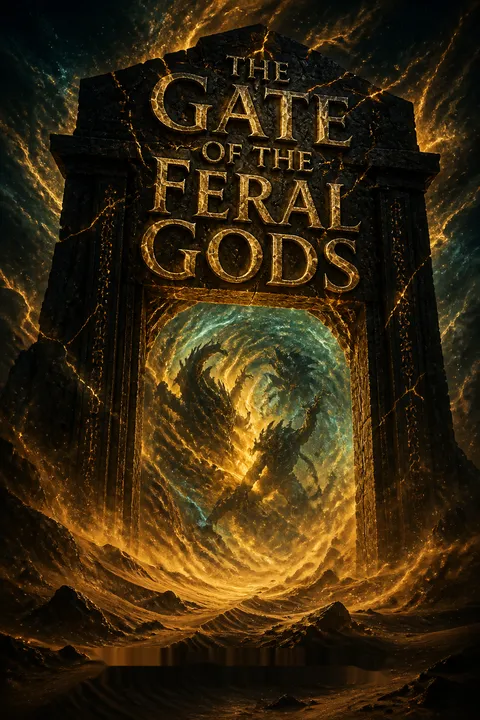
They needed to touch the ghost Quetzalcoatlus for her plant-altering abilities. The Gate of the Feral Gods is a three-piece artifact: two pocket watches and a winding box. When assembled, it opens a one-way portal to any dialed destination.
But when the portal closes, it tears into the Nothing — a prison dimension for banished gods — and something feral escapes through. Carl1 now holds Kane's watch. Henrik15 has the second. The Mad Dune Mage Ghazi possesses the winding box. A quest demands Carl1 collect all three pieces.
The Puppet and the Parasite
Chris Andrews9 appears at the town gates — a seven-foot lava rock monster. But his personality is wrong: cold, detached, declaring family a weakness. Juice Box8 senses something sinister immediately. Carl1 realizes this isn't Chris.9
Maggie My, the widow who'd been hunting Carl1 since the first floor, chose the Infiltrator race — a brain parasite that hijacks living hosts. She's been puppeteering Chris9 for floors, carrying a celestial grenade from the Skull Empire designed to summon a pain god.
Katia3 shoots Chris9 with a special petrifying bolt from an emergency sponsor box. Rather than force Carl1 to execute their friend, Donut2 opens a magical hole beneath the frozen body and drops him into the flooded necropolis. Trapped, but alive. The problem merely deferred.
The Robot Donut Bomb
Admin Loita10 despises humans and threatens Donut2 with Mongo's5 death. During a product-review taping aboard a submarine trailer, Carl1 positions the latest robot Donut toy — whose explosive yield was passively enhanced on his sapper's table — beside Loita10 on a moisture-spraying couch.
When she stands, the heavy toy jumps to follow; its cheap back panel, weakened by residue from an earlier smoke bomb, dislodges and triggers the self-destruct sequence. Loita10 dies in the blast. Carl1 and Donut2 survive behind the trailer's forcefield.
A Syndicate liaison named Orren — himself a Valtay — detains them for five days. He suspects outside help but can't prove intent. The kua-tin government deems Carl1 too profitable to dispose of. He walks free, but five irreplaceable days are gone.
Katia Flies Solo
Left in command, Katia3 rises to the moment. She flies the balloon-lifted house to the land quadrant after Louis6 suggests cutting free the stairwell-bearing top floor. She discovers the sandcastle's magical door activates when lightning strikes twin towers and electrifies its frame.
She fights scorpion men alongside Gwen7 — the tough Canadian fighter leading the land quadrant team — clashing over strategy but accomplishing what seemed impossible. She levels up three times to 41.
When Carl1 and Donut2 return, two quadrants are already cleared, the sand castle is cracked open, and everything is staged for the final assaults. Katia3 has proven to herself and everyone else that she doesn't need Carl1 to survive. That quiet realization changes everything that follows.
The Mage's Sand Wife
During the lightning storm, Carl's1 team enters the crystallized sandcastle. Every surface is glass — transformed when the mage Ghazi botched a summoning spell. He'd tried resurrecting a fictional character as his lover but instead married a sand ooze familiar of the minor deity Psamathe,14 which now consumes him daily.
Carl1 punches Ghazi unconscious, steals the winding box, and sets the ooze's core on fire with homemade gel. The glass castle collapses, burying Carl1 and Donut2 alive. Outside, Gwen7 opens a drainage valve, and pressurized seawater blasts them through the necropolis and into the open ocean. Katia3 kills Ghazi during the escape. The land quadrant is liberated, but Carl1 and Donut2 are now adrift in shark-infested waters.
Inside the Sharktopus
The ghost Quetzalcoatlus awakens Lusca — a building-sized octo-shark city boss — which drags their submarine to the ocean floor and swallows it whole. Live sports announcers begin narrating as a special event.
Inside the creature's mouth, Carl1 deploys a berserking potion that triggers a feeding frenzy among thousands of juvenile octo-sharks, who devour each other. He fires his Protective Shell spell through the shark's maw, peeling back its upper jaw like a car hood popping on the highway.
Katia3 activates the looted giant buzzsaw, and their momentum carries them spinning through Lusca's exposed brain. They crash onto the ocean floor at fifteen hundred meters, alive but stranded, health ticking down from the crushing pressure with no way back up.
Save the Kaiju Puppy
Carl1 uses the Gate to teleport from the ocean floor, but the portal summons Orthrus — a kaiju-sized two-headed wolf puppy from the Nothing. The fire god Emberus appears, melting nearby bubbles while searching for his dead son's pet. Carl1 and Donut2 take the gnomish biplane into the air, healing the whimpering mountain-sized puppy while dodging its playful paw swats.
Quan Ch12 — the dungeon's most selfish top-ten crawler — attacks, trying to kill the dog for the bounty. Carl1 boards the wing, blinds Quan12 with a disco ball smoke bomb, then tackles him midair and rips his entire arm off at the shoulder. Using the Skull Empire's own celestial grenade, Carl1 summons Emberus directly. The god reunites with the puppy and both vanish.
Mongo Eats the Worm
The tomb raider crawlers sacrifice themselves connecting a lightning cable inside the flooded necropolis. Lightning electrocutes Quetzalcoatlus, and the subterranean quadrant falls. The bubble pops. Chris9 and Maggie emerge.
She tries to destroy the winding box, but Carl1 drinks a phase-through-lava-rock potion — brewed from the mysterious yam his pacifist sponsors sent — and reaches directly into Chris's9 stone head. He grasps the squirming Infiltrator parasite and rips it free.
The worm burrows into Carl's1 arm, racing toward his brain, but a double-healing potion expels it through his neck in a spray of blood. Mongo5 snatches the worm from midair and gleefully crunches it, ending Maggie My's months-long campaign of possession. Chris9 wakes, devastated but free.
Fifteen Hundred Through the Gate
With the bubble popped and three days remaining, Carl1 coordinates the largest rescue in dungeon history. Crawlers from eligible bubbles gather at their Desperado Clubs, dial coordinates onto the Gate, and rush through portals to Carl's1 world.
Each evacuated bubble receives a feral god when the portal closes — but inside an empty, sealed bubble, the monster is contained. Over 1,500 crawlers escape certain death across multiple phases. A few gods break free and clash in the lacuna between bubbles, but most dissipate or destroy each other.
Carl1 sends Juice Box8 and the changeling refugees through a separate portal to the sixth floor, fulfilling his promise to protect her people. The operation succeeds beyond expectation, though hundreds of bubbles remain dark.
Katia Walks Her Own Road
Over drinks at the Desperado, Katia3 tells Carl1 she's leaving the party. Not from anger — from purpose. Eva, the treacherous former leader of the Daughters of Silence, is gathering scattered survivors and getting them killed. Katia3 intends to find the vulnerable women first. She's already recruited Louis,6 Firas, Gwen,7 Florin the crocodilian shotgunner, and Bautista.
Carl1 hands her Eva's saber — the Left Fang of the Green Sultan — and tells her to return it to its owner. Donut2 is devastated, but Carl1 understands. Those five days proved Katia3 can lead on her own terms, with her own people, toward her own mission. The party of three becomes two, and the weight of that absence settles onto Carl's1 shoulders like a new kind of armor.
Larracos Drowns in Sharks
Carl's1 loudly-announced plan to drop a feral god on the Skull Empire's army was a feint. The real gate — carried by Katia3 — opens underwater near the submarine wreckage. Pressurized ocean, timed explosives, and frenzied concierge sharks blast through the portal and into the heart of Larracos, the sprawling city on the ninth floor.
The flood destroys faction markets, mercenary halls, and NPC supply shops. The factions lose their ability to purchase magical gear from crawlers. Borant approved the plan because it hurts their competitors, but Carl1 just crippled the entire faction war economy.
He ascends to the number one spot on the leaderboard, stands at the stairwell entrance, and pledges to the watching universe that every hunter who enters the sixth floor will die.
Epilogue
The final scenes pull beyond the dungeon walls. Dr. Hu — secretly Porthus, a former crawler from the cookbook's second edition who now runs Carl's1 pacifist sponsor organization — debates with a colleague whether Carl1 can survive.
On Earth's surface, alien bounty hunters infiltrate post-apocalyptic Seattle, searching for specific survivors to weaponize against popular crawlers. They find Carl's1 ex-girlfriend Bea huddled in a tent camp with a stray cat named Gravy Boat.
When the hunters attack, an operative working for the show host Odette kills one attacker and rescues Bea — revealing that powerful forces beyond the dungeon are quietly positioning pieces for a much larger game. Carl's1 war hasn't just begun inside the crawl. It's spreading outward.
Analysis
The Gate of the Feral Gods interrogates the moral architecture of resistance within systems designed to monetize suffering. Carl's1 evolution from reactive survivor to strategic insurgent mirrors real-world dynamics of institutional oppression: the oppressed must weaponize the oppressor's own mechanisms, even when those mechanisms are designed to channel rebellion into entertainment. The book's central irony — that Carl's1 defiance increases his commercial value, which protects him from punishment — reflects how capitalist structures absorb and commodify dissent, profiting from the very rage directed against them.
This political critique hides beneath escalating absurdist comedy where Carl1 worships a fire god, stomps gerbils to satisfy an AI's fetish, and kills a feral goose via garbage disposal. The tonal dissonance is deliberate: humor is a survival mechanism for characters and readers alike, preventing genuine horror from becoming unbearable. When Carl1 rips Quan's12 arm off in midair while saving a kaiju-sized puppy, the absurdity doesn't diminish the emotional stakes — it makes them bearable enough to process.
The NPC subplot — Juice Box,8 Henrik,15 the changeling children with compression sickness — functions as the book's moral compass. Carl's1 promise to protect NPCs across floors represents his refusal to accept the dungeon's premise that some lives are expendable. His willingness to destroy NPC shopkeepers in Larracos while promising to transport changeling refugees reveals the impossible calculus of wartime leadership: you save who you can reach, and you accept the blood on your hands from those you can't.
Katia's3 arc is the book's quiet masterpiece. Her departure isn't rebellion — it's graduation. She internalized everything the partnership taught her while developing capabilities uniquely her own. Her separation embodies the thesis: genuine strength isn't measured in levels but in willingness to act independently when people need you elsewhere. The epilogue's revelation that Carl's1 sponsor is a former crawler — someone who endured the same horror centuries ago and chose to fight from outside — transforms the narrative from survival story into multi-generational insurgency against an entertainment-industrial complex built on genocide.
Review Summary
The Gate of the Feral Gods receives overwhelmingly positive reviews, with readers praising its humor, character development, and inventive storyline. Many consider it the best in the series so far, highlighting the well-crafted floor challenges, Carl and Donut's evolving relationship, and the expanding universe. Reviewers appreciate the balance of action, comedy, and emotional depth. The epilogue generates excitement for the next installment. Some readers note minor pacing issues, but overall, the book is lauded for its creativity, engaging plot, and ability to keep the series fresh and entertaining.
People Also Read

Characters
Carl
Explosive-minded top crawlerCarl is the protagonist, a former building inspector turned dungeon crawler who relies on explosive expertise, engineering ingenuity, and ruthless pragmatism. Ranked among the top crawlers, he carries accumulated trauma across four floors—dead friends, impossible choices, the growing weight of leadership over strangers. His emotional armor manifests as dark humor and stubbornness, masking a profound sense of responsibility he considers a weakness. He struggles with caring deeply about people while making calculated decisions that cost lives. His relationship with Donut2 grounds him; his adversarial dance with the system AI oscillates between forced compliance and open defiance. He is driven not by survival alone but by a crystallizing desire to make the entire system pay for what it has done.
Donut
Narcissistic cat war magePrincess Donut the Queen Anne Chonk is Carl's1 cat companion—a former show-winning Persian evolved into a devastating magic caster with weaponized charm. Beneath her narcissistic preening and reality-TV obsessions lies a creature of fierce loyalty and surprising emotional intelligence. She often makes the decisions Carl1 can't bring himself to face. Her attachment to Mongo5 reveals her deepest need: to nurture and protect, compensating for a life where she was always the one being kept. Her Glass Cannon class makes her magically devastating but physically fragile, mirroring her architecture—immense power wrapped in vulnerability. Her growing fixation on social media and concern for the captive admin Zev11 hint at an empathy extending well beyond her immediate circle.
Katia
Shapeshifting independent leaderKatia is a doppelganger shapeshifter and the team's third member, whose growth across this floor traces a remarkable trajectory. An Icelandic woman who entered the dungeon alone, she carries psychological scars from her earlier encounter with Eva and the Daughters of Silence. Her shapeshifting abilities have grown exponentially—she can become vehicles, diving bells, triple-role disguises—but her most significant transformation is internal. Her engineering aptitude, strategic mind, and growing confidence reveal a natural leader. She is methodical where Carl1 is impulsive, diplomatic where he provokes. Her unfulfilled desire to adopt children before the collapse drives her protective instincts toward vulnerable crawlers. She watches former allies scatter and struggle, and something in her hardens into resolve.
Mordecai
Gruff alchemist manager eagleCarl's1 manager and guide, a former skyfowl warrior now inhabiting a cleric's eagle body. An alchemist of extraordinary skill, he brews potions from impossible ingredients—bouncing potions, anti-parasite cures, lava-phase elixirs—and provides tactical knowledge spanning multiple dungeon seasons. His gruff pragmatism conceals genuine affection for his team. He serves as the voice of caution against Carl's1 increasingly reckless gambits, though his warnings are rarely heeded.
Mongo
Donut's ferocious pet dinosaurDonut's2 velociraptor-like pet dinosaur, fiercely loyal and increasingly capable in combat. New fang caps grant enhanced speed and strength. He gleefully destroys every robot Donut toy on sight, serves as a frontline fighter via Donut's2 Clockwork Triplicate spell, and provides critical comic relief. Donut's2 bond with him is maternal and unshakeable—his injuries send her into protective panic that sometimes overrides her combat focus.
Louis
Drunk pilot with hidden powerA perpetually intoxicated twenty-seven-year-old from Miami who drove a roofless Chevy Astro into the dungeon. His legendary Cloud of Exhaust spell can incapacitate entire groups, making him far more valuable than his buffoonish persona suggests. Forcibly sobered by Mordecai's4 detox potion, he becomes a surprisingly capable pilot of the flying house. His unexpected romance with Juice Box8 confounds absolutely everyone.
Gwen
Tattooed no-nonsense fighterGwendolyn Duet is a tough, tattooed Canadian fighter of First Nations origin leading the land quadrant assault. Her Boring Ol' Fighter class trades all magic for pure combat prowess—she can vault over scorpion men using her spear as a pole. Blunt, confrontational, and immovable once decided, she clashes repeatedly with Katia3 over strategy but proves essential. Her forehead tattoos and scarred knuckles tell a story written in hard labor and harder living.
Juice Box
Shapeshifter protector of orphansA changeling prostitute in Hump Town whose ditzy persona masks extraordinary power—she can shift between races instantaneously, gaining their abilities. Behind the act lies a fierce protector of changeling children suffering from compression sickness. Her brother Henrik15 leads the changeling principals. Her loyalty to her people and capacity for deception make her a critical ally. She bargains fiercely for her community's survival.
Chris Andrews
Trapped ally, stolen bodyA former maintenance worker and gentle protector who once served alongside Carl's1 allies. He arrives on the fifth floor profoundly changed—cold, detached, declaring family a weakness. His transformation from caring friend to dangerous stranger is one of the book's most disturbing mysteries. Somewhere inside the lava-rock body, the real Chris watches helplessly, representing the most visceral portrait of stolen autonomy in the narrative.
Loita
Xenophobic dungeon administratorA kua-tin administrator who replaces the sympathetic Zev11 as Carl's1 handler. She openly despises human culture, considers crawlers vermin, and threatens Donut2 with harm to Mongo5. Her zealotry for 'True Unity' and 'The Bloom' extends to punishing her own kind who show sympathy toward crawlers. She represents the institutional contempt underlying the dungeon's entertainment facade—hatred dressed as professionalism.
Zev
Sympathetic captive social managerCarl's1 kua-tin social media manager, forcibly re-educated by her government into robotic compliance. Despite her new persona, she secretly feeds the team crucial information. Donut2 remains fiercely protective of her wellbeing.
Quan Ch
Selfish kill-stealing rivalThe dungeon's highest-level crawler, who fights dirty, steals kills, and attacks allies for prizes. His celestial robe grants flight and devastating lightning attacks. Carl's1 most personal rival among fellow crawlers.
Bonnie
Shell-shocked gnome childThe young daughter of the gnome Commandant, found making lemonade beside her father's corpse. Potion-numbed and dilated, she represents the war's youngest and most innocent casualties.
Samantha
Deity trapped in a doll headThe minor deity Psamathe, trapped in a decapitated sex doll head after a botched summoning. She cackles incessantly, threatens everyone's mothers, and provides crucial alchemical knowledge as the team's hired trainer.
Henrik
Desperate changeling leaderLeader of the changeling principals, disguised as a dromedarian elder. He infiltrated the camel leadership to access Wynne's abilities, driven by desperation to cure his people's degenerative birth defects.
Plot Devices
The Gate of the Feral Gods
Three-piece portal artifactComposed of two mysterious pocket watches and a winding box, this ancient artifact opens one-way portals to any dialed location. The devastating catch: when the portal closes at its origin, it tears into the Nothing—a prison dimension for banished gods—and a feral deity escapes. The three pieces are scattered among the fifth floor's warring factions: the gnome Commandant holds one watch, changeling leader Henrik15 the second, and the Mad Dune Mage Ghazi the winding box. Carl1 collects all three across the floor's castles. The artifact becomes both salvation—used to escape the ocean floor and evacuate 1,500 trapped crawlers—and a weapon of unprecedented strategic impact, enabling Carl1 to flood the ninth floor's supply city and reshape the entire faction war economy.
The Royal Chariot
Storable tracked desert vehicleA tracked all-terrain vehicle engineered by Carl1 and Katia3 from salvaged train engine parts, rubber, and fabricated metal. It solves the fundamental problem of traversing sand dunes while being small enough to store in Carl's1 inventory by splitting into two halves. The chariot features a missile launcher mount, swiveling gunner seat, and silent magical engine. It represents Carl's1 core methodology: lacking magical flight or teleportation, he engineers past obstacles using real-world mechanical knowledge augmented by dungeon crafting tables. The vehicle evolves across the floor—gaining anti-aircraft capabilities and reconnaissance functionality—before being largely replaced by the flying house. The system names it with characteristic mockery, calling it the offspring of a moonshine-drunk snowmobile and a hillbilly's ATV.
Robot Donut
Malfunctioning toy turned weaponA Veriluxx RealPet companion toy modeled after Donut2, sent as a sponsor's product sample. Each version speaks in bootleg Garfield quotes, creepily rotates its head, and gets promptly destroyed by Mongo5. The toy contains a self-destruct mechanism preventing tampering with internal components. When placed on Carl's1 sapper's table, the explosive yield is passively enhanced by his skills. This seemingly useless commercial product has explosive potential far beyond its intended purpose. Multiple iterations arrive throughout the floor, each slightly more durable and equally unsettling. The toy's trajectory—from annoying product placement to something far more consequential—mirrors the book's recurring theme that every tool the system gives crawlers can be repurposed against its creators.
Homemade Guided Missiles
Carl's primary aerial weaponBuilt at Carl's1 sapper's table using reverse-engineered dromedarian rocket propellant improved by Mordecai's4 alchemy, these missiles represent Carl's1 signature method of engaging aerial threats. Each uses a surefire targeting chip that locks onto a designated target via the farseer telescope. The warhead packs hobgoblin dynamite enhanced by Carl's1 explosive handling skills. His failed attempt at a two-stage rocket forces reliance on shorter-range single-stage versions, which prove devastating against the Wasteland's escort planes and its fuel-air bombs. The missile system fundamentally shifts the air quadrant's power dynamics—transforming a group of ground-bound crawlers into a credible anti-aircraft force capable of downing a floating fortress.
The Dungeon Anarchist's Cookbook
Secret multi-generational knowledgeA hidden tome that manifests differently for each crawler who receives it, appearing to Carl1 as a book on his nightstand. It contains accumulated wisdom from over twenty editions of former crawlers, including potion recipes, trap designs, dungeon mechanics, and subversive knowledge about the system's vulnerabilities. Carl1 must carefully disguise his use of the cookbook's information, steering conversations so discoveries appear organic. The book warns against exposing it to the marketplace interface and provides crucial knowledge about forcefield mechanics, ghost vulnerabilities, and admin procedures. Its existence is why the Syndicate liaison suspects Carl1 has an outside information source. The cookbook represents the dungeon's hidden resistance network—generations of crawlers passing survival knowledge across centuries despite every mechanism designed to prevent it.
Dungeon Crawler Carl Series
About the Author
Other books by Matt Dinniman


Download PDF
Download EPUB
.epub digital book format is ideal for reading ebooks on phones, tablets, and e-readers.








































