

Key Takeaways
Attraction is a learnable skill, not an inborn gift
The book's founding premise is that seduction can be reverse-engineered. Neil Strauss, a balding, skinny, insecure New York Times journalist who slept with almost no one in college, discovers an online subculture of "pickup artists" who have broken down flirting into repeatable steps anyone can practice.
The AFC-to-PUA journey. Strauss reinvents himself as "Style," studying under a magician named Mystery. Within two years he tops the community's ranking of best seducers. His transformation involves memorizing scripts, changing his wardrobe, shaving his head, getting Lasik, and taking voice, dance, and posture lessons. The message: what looks like charisma is often a stackable set of behaviors. He treats meeting women like learning cello or riding a mechanical bull, a system with rankings you can climb.
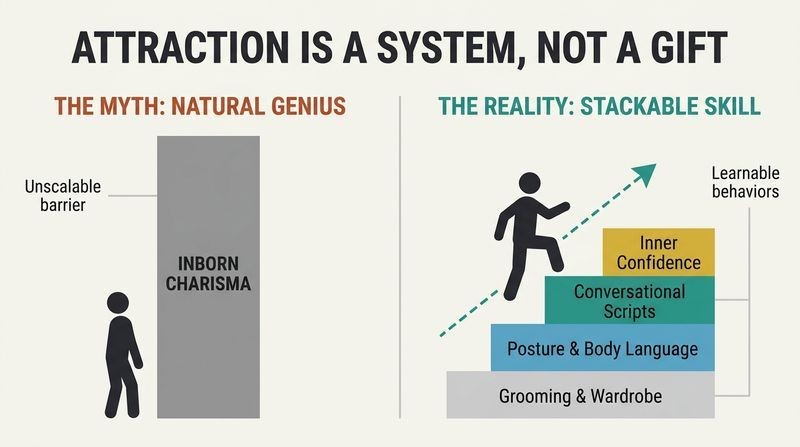
Strauss's central claim echoes deliberate-practice research from psychologist Anders Ericsson: expertise comes from structured repetition, not talent. The framing is empowering for socially anxious men. Yet it contains a hidden trap the book itself later exposes: skills that open relationships (mystery, scarcity, calculated distance) are precisely the ones that poison sustained intimacy. Behavioral science distinguishes "approach" competence from "maintenance" competence, and mastering one guarantees nothing about the other. The book is most valuable read as a cautionary tale about optimizing a metric (getting laid) until it hollows out the thing the metric was supposed to measure (connection).
Ignore the woman you want and win over her friends first
Mystery's core method inverts every man's instinct. Instead of approaching an attractive woman directly, you approach her entire group, charm the friends and any protective males, and pointedly withhold attention from your actual target.
Group theory in action. Strauss watches Mystery steal Scott Baio's date at a Hollywood bar by performing magic tricks for Baio and ignoring the blonde until she begs for attention. The tactic exploits social proof (people want what the group values) and scarcity (the one person not fawning over her becomes intriguing). Beautiful women, the logic goes, are rarely alone and are used to direct male approaches, so indirectness disarms them. The pickup artist must be "the exception to the rule," never doing what every other man does.
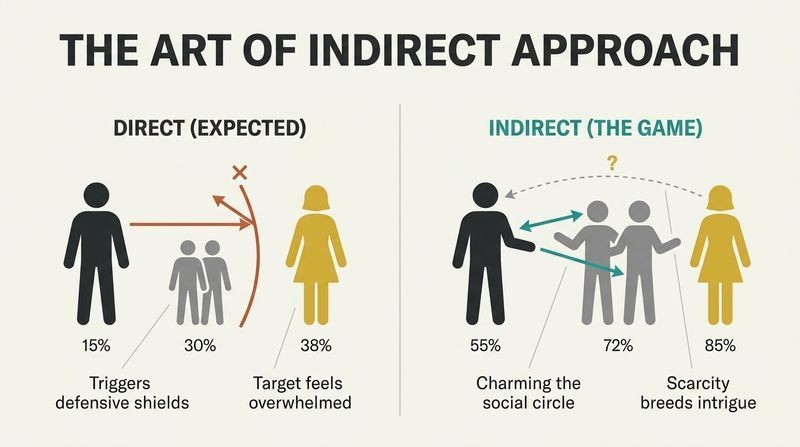
Group theory is essentially applied status signaling. Evolutionary psychologists would note it hijacks a real heuristic: humans infer mate value from third-party endorsement, the same mechanism behind celebrity endorsements and restaurant lines. Robert Cialdini's work on social proof, which Strauss cites reading, underpins it. The uncomfortable question is consent and authenticity: the method manufactures signals rather than earning them. It works partly because bars are low-information environments where snap judgments dominate. In contexts where people have time and repeated interaction, manufactured social proof collapses. The tactic reveals how much of first-impression attraction runs on manipulable shortcuts rather than genuine compatibility.
A backhanded compliment disarms a beautiful woman's defenses
The "neg" is Mystery's signature invention, and arguably the community's most famous concept. It is neither compliment nor insult but something in between: a remark that subtly lowers a very attractive woman's self-esteem while signaling you are unimpressed by her looks.
Examples and logic. Telling a woman she has lipstick on her teeth, offering her gum right after she speaks, or saying "nice nails, are they real?" The neg is aimed only at women accustomed to constant male validation. Strauss stresses you never neg ordinary-looking women or men. The purpose is to make the target work for your approval, flipping the usual dynamic where the man chases. In Miami, Strauss neutralizes two stunning "perfect 10s" by challenging whether their hair and their claimed sisterhood are real.
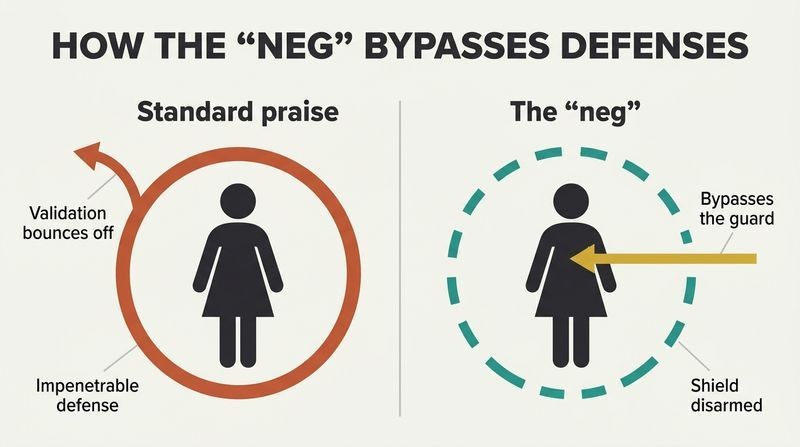
The neg is psychologically sophisticated and ethically slippery. It weaponizes a documented pattern: people who receive constant praise may discount it and prize the rare withholder, a form of intermittent reinforcement that behavioral psychology links to compulsive pursuit. Critics correctly call it emotionally manipulative, engineering insecurity to create dependency. Yet there is a steelman buried inside: the neg partly works because it signals a man is not intimidated, which genuinely differentiates him from supplicating admirers. The healthier extraction is teasing banter between equals, not calculated self-esteem sabotage. The line between playful confidence and covert cruelty is exactly where the technique becomes toxic.
Peacock loudly so women have an excuse to approach you
Peacocking means wearing at least one outrageous, attention-grabbing item, a garish hat, glowing jewelry, sunglasses at night, so that women have a conversation starter and you stand out from every generic guy in the room.
Mystery as a walking sideshow. He wears six-inch platform boots, tiger-striped cowboy hats, and eyeliner, eventually becoming so flamboyant that women open conversations with him unprompted. Strauss, initially embarrassed, buys a purple fur vest and light-up necklaces and finds that a single standout item reliably invites approaches. The theory borrows from biology: just as a peacock's extravagant tail attracts mates by signaling fitness, a flashy human display attracts attention. Mystery also uses it as a filter, repelling conservative women and attracting the "club girls" he prefers.
The peacocking metaphor misreads its own biology in a revealing way. The peacock's tail is a costly, honest signal precisely because it is hard to fake and handicaps the bearer. A rented feather boa costs nothing and signals nothing about genetic fitness, so it functions less as an honest signal than as an attention magnet and icebreaker. That said, the deeper insight holds: visible differentiation lowers the activation energy for strangers to engage you, shifting the burden of approach. Fashion researchers call this "enclothed cognition," where distinctive dress changes both how others treat you and how boldly you behave. The effect is real; the evolutionary gloss is mostly decorative.
Speed Seduction: arouse through hypnotic language, not looks
Ross Jeffries, the community's founding father, built "Speed Seduction" on neuro-linguistic programming (NLP), a fringe blend of hypnosis and psychology. His weapon is language designed to influence the subconscious.
How it works. Strauss watches Jeffries make a waitress blush and give her number in minutes at a pizza restaurant. Jeffries asks her to describe the physical sensation of being attracted, then "anchors" that feeling to a gesture (raising his hand) so that repeating it re-triggers arousal. He even transfers the feeling into a sugar packet she carries away. Techniques include eliciting a woman's "trance words," synesthesia (guided arousal through imagined sensations), and roller-coaster metaphors for excitement. Strauss finds it powerful but uncomfortable, noting he joined "to learn confidence, not mind control."
NLP has been repeatedly debunked as a theory of neuroscience; controlled studies find no support for its core claims about eye movements and representational systems. So why does Jeffries get results? Almost certainly not through subconscious reprogramming but through ordinary mechanisms: confident delivery, novelty, sustained attention, and the fact that describing attraction primes people to feel it, a garden-variety priming effect. Strauss himself half-suspects this, wondering whether the patterns work or whether "most conversations are so boring" that anything intriguing triggers interest. The episode is a case study in how pseudoscientific frameworks can produce real behavioral change through entirely mundane pathways, while their practitioners credit the mysticism.
Follow the linear sequence: open, demonstrate value, connect, escalate
Mystery treats seduction as a predictable, step-by-step algorithm rather than luck. His original model was FMAC (find, meet, attract, close), later expanded into detailed numbered steps.
The stages Strauss internalizes.
1. Open the group with a scripted line, ignoring the target.
2. Demonstrate higher value through stories, magic, or personality.
3. Neg the target to spark interest.
4. Isolate her from the group.
5. Build rapport, defined as "trust plus comfort."
6. Create a physical connection and kiss-close.
He watches for "IOIs" (indicators of interest) like her asking your name, and only escalates after three. Mystery claims a woman can be led from meeting to sex in roughly seven hours of total contact, calling faster wins "fool's mate." The point: remove randomness by planning for every contingency.
The linearity is both the method's strength and its delusion. Framing courtship as a funnel with stages gives anxious beginners a script to follow instead of freezing, which genuinely reduces approach paralysis, the same reason sales training uses pipeline models. But treating humans as state machines that respond identically to identical inputs ignores enormous individual variance and agency. The "seven hours" figure is folk quantification dressed as science. What actually transfers is the meta-lesson: having any structured plan beats improvising while panicking. The danger is that mistaking the map for the territory turns practitioners into robots running scripts, which the book itself later diagnoses as a pathology.
Be the prize she chases, using scarcity and takeaways
The deepest principle running through every technique is inversion of pursuit: act as though you are the desirable one being pursued, not the pursuer.
Cat-string theory and the takeaway. Mystery explains that a cat frantically chases a dangling string but ignores it once it drops within reach. Women, the theory claims, work the same way, so you must remain slightly out of reach. When Strauss chases a girl who pulls away, Mystery scolds him: he should have turned to talk to someone else and let her re-earn his attention. The "false takeaway" is walking away briefly to trigger fear of loss. Mystery wins over a Serbian teenager by pretending to leave for a bath, counting his steps, then giving her a choice to follow or never see him again.
This is the one principle with robust support beyond the subculture. Scarcity and loss aversion are among the most replicated findings in behavioral economics: Kahneman and Tversky showed losses loom roughly twice as large as equivalent gains. The "hard to get" effect, however, is more nuanced in the research literature: studies suggest people are most attracted to those who are selectively available, hard to get for everyone else but interested in you specifically, not globally aloof. Pure indifference reads as rejection. The takeaway works because selective scarcity signals both high value and genuine interest simultaneously. Overplayed, it curdles into the mind games that later wreck the book's relationships.
Mastering seduction can turn you into a hollow social robot
The book's darkest recurring theme is that obsessive practice dehumanizes both the practitioner and the women he pursues. Strauss coins the "social robot": a man who panics without material, sees every other male as a threat to destroy, rates women by number, and derives all self-worth from female reactions.
The cost of the game. Strauss starts seeing women as "crash-test dummies" identifiable only by hair color and rating. He notices that dehumanizing women made him more successful, which disturbs him. Mystery repeatedly breaks down, once ending up in a psychiatric ward. Papa fails out of law school. Sweater, who found a wife through the community, attempts suicide because he pretended to be someone he wasn't. The men bond over women but end up in a house with almost no women and no genuine friendship.
This is where the memoir transcends its how-to origins and becomes genuine social criticism. The pattern Strauss describes maps onto a well-documented psychological phenomenon: instrumentalization, treating people as means, erodes empathy in the treater, not just the treated. Research on objectification shows it impairs the objectifier's own capacity for connection. There is also a Goodhart's Law dimension: when "number of women" becomes the target, it ceases to track the underlying goal of intimacy and belonging. The men optimize the proxy into meaninglessness. The tragedy Strauss captures is that the skills demonstrably work while making their possessors progressively less capable of wanting what the skills deliver.
The men weren't chasing sex; they were chasing acceptance
Beneath the tactics, nearly every pickup artist is driven by childhood wounds and a hunger for validation, not lust. Sex is a proxy for feeling wanted.
Wounded gurus. Mystery was a bullied virgin until twenty-one with an abusive alcoholic father he fantasized about killing; he pursues seduction to win the love his parents never gave. Ross Jeffries was socially crushed and endlessly teased. Strauss admits he sleeps with women "not to get our rocks off" but "to be accepted." When Strauss experiences the "Moby effect" (a club treating him like a celebrity due to mistaken identity), he realizes fame flips the same attraction switches as game. The pioneer Eric Weber tells him the real cure was realizing everyone feels inadequate, at which point the ache dissolves.
Strauss's diagnosis anticipates a large clinical literature linking compulsive sexual pursuit to attachment insecurity and low self-worth rather than high libido. The pattern, chasing external validation to fill an internal void, is the engine behind many addictions, from social media metrics to workaholism. Eric Weber's insight is quietly the book's wisest line: the existential relief comes not from conquering others but from recognizing that inadequacy is universal, which strips it of its power. This reframe echoes both Adlerian psychology and modern shame research by Brené Brown. The uncomfortable implication is that the entire elaborate apparatus of game is an ornate coping mechanism for a feeling a simple realization could dissolve.
Build a life worth entering, don't just collect phone numbers
Strauss's turning point comes on his birthday, when he pulls a woman effortlessly not through any routine but because he was the highest-status person in the room. His epiphany: "Sarging is for losers."
Lifestyle beats tactics. Individual pickups (sarging) build only a skillset and reset every night. A compelling lifestyle, interesting people, experiences, a sense of abundance, is cumulative and makes women come to you. This insight births "Project Hollywood," a mansion Strauss and Mystery rent to live the dream. Ironically, it becomes proof of the opposite lesson: the house fills with needy men and neurotic drama, scaring away the very women it was meant to attract. The lifestyle they built was a hall of mirrors optimized for impressing each other, not for actually living.
The lifestyle insight is where pickup culture quietly concedes its own inadequacy: the best "technique" is to have something better to do than chase women. This aligns with attachment and abundance research, non-neediness is attractive precisely because it signals you are not dependent on any single outcome. But Project Hollywood's collapse illustrates a subtler truth: a lifestyle constructed as bait is not a lifestyle, it is a stage set. Authenticity researchers would note that intrinsically motivated pursuits (genuine hobbies, real friendships) generate the attractive signal as a byproduct, while pursuits faked to generate the signal produce the emptiness the men experienced. You cannot instrumentalize your way to non-instrumental appeal.
To win the game, you have to leave it
Strauss's final arc is falling genuinely in love with Lisa, Courtney Love's guitarist, the one woman on whom none of his techniques work. She is neg-proof, unmoved by his routines, and interested only in the real, balding, nerdy Neil beneath "Style."
The techniques almost cost him. Lisa tells him his too-cool aloofness nearly drove her away; she liked everything about him that predated the community. Sex with Lisa, unlike his mechanical conquests, carries real emotion. Strauss discovers he learned everything about attraction and nothing about sustaining a relationship, which requires far more work but yields far more joy. He empties two envelopes of hundreds of collected phone numbers onto the bed and tells her he chose her, then corrects himself: a man never chooses, he only earns the chance to be chosen.
The ending delivers the book's genuine thesis: the value of the transformation was self-discovery, not conquest. The skills served their purpose only by giving a paralyzed man enough confidence to be himself, then becoming obstacles once that self emerged. This is a familiar developmental arc, scaffolding that must be removed once the structure stands. There is real wisdom in Strauss's closing correction that attraction cannot be seized, only invited, which quietly repudiates the entire ethos of control the community sold. The critical caveat: the book's massive influence spawned an industry that fixated on the manipulative techniques and ignored this deflationary conclusion, proving how easily a cautionary ending gets read as an endorsement.
Analysis
The Game is best understood not as a seduction manual but as a memoir disguised as one, a Trojan horse that smuggles genuine social criticism inside a how-to package. Its structure mirrors addiction narratives: discovery, euphoric mastery, escalating dependence, rock bottom, and partial recovery. Strauss uses the eleven "steps" of a pickup as ironic chapter headings for a story that ultimately argues the steps are a trap.
The book's lasting cultural significance is double-edged. It documented, and accelerated, a genuine subculture that industrialized the commodification of male-female interaction. Its vocabulary (neg, peacocking, AFC) entered popular language. But its reception exposed a reading problem: most who absorbed it extracted the tactics while missing the elegiac conclusion that those tactics hollow out their users. The community it chronicled treated the book as scripture rather than warning, which is itself evidence for Strauss's thesis about the seductive power of systems that promise control.
Intellectually, the material sits at the intersection of legitimate behavioral science (Cialdini's influence principles, loss aversion, social proof) and pseudoscience (NLP, "anchoring" arousal into sugar packets). Strauss, to his credit, repeatedly voices skepticism, wondering aloud whether patterns work or whether novelty alone explains the results. That ambivalence is the book's intellectual honesty.
The deepest theme is instrumentalization and its costs. Every guru is a wounded man converting childhood rejection into a technology of validation, and every one is miserable. Strauss's arc suggests the skills are valuable only as scaffolding for confidence, worthless or corrosive once mastered. The tragedy he captures with real literary skill is that a method demonstrably effective at starting relationships is structurally incapable of sustaining them, because mystery, scarcity, and calculated distance, the engines of attraction, are the solvents of intimacy. To win, you leave.
Review Summary
The Game received mixed reviews, with some praising its entertainment value and insights into human behavior, while others criticized its misogynistic undertones and manipulative tactics. Many readers found the book fascinating but morally questionable, highlighting the emptiness of the pickup artist lifestyle. Some appreciated Strauss's journey of self-discovery and eventual disillusionment with the community. Critics noted the book's potential negative impact on relationships and society. Overall, it sparked discussions about dating, gender dynamics, and self-improvement.
People Also Read







FAQ
What's The Game: Penetrating the Secret Society of Pickup Artists about?
- Exploration of PUAs: The Game by Neil Strauss explores the underground world of pickup artists (PUAs) and their techniques for attracting women. It follows Strauss's transformation from an average frustrated chump (AFC) to a skilled seducer.
- Personal Transformation: The book is a memoir of Strauss's journey, highlighting themes of identity, self-worth, and the psychological aspects of attraction. It includes his interactions with notable PUAs like Mystery.
- Cultural Commentary: It critiques modern dating culture, examining the dynamics between men and women. The narrative is both entertaining and thought-provoking, offering insights into relationships.
Why should I read The Game: Penetrating the Secret Society of Pickup Artists?
- Insight into Male Psychology: The book provides a unique perspective on male insecurities and the lengths some men will go to overcome them, shedding light on societal pressures surrounding masculinity.
- Practical Techniques: Readers can learn various pickup techniques and social dynamics applicable in real-life situations, such as the Mystery Method, offering actionable advice for improving dating lives.
- Engaging Storytelling: Strauss's writing is engaging and often humorous, making the book an enjoyable read. His personal anecdotes create a narrative that is both entertaining and educational.
What are the key takeaways of The Game: Penetrating the Secret Society of Pickup Artists?
- Self-Improvement is Essential: The book emphasizes personal development and confidence as crucial steps in the seduction process, highlighting the importance of self-improvement.
- Understanding Social Dynamics: It underscores the significance of social proof and group interactions, introducing concepts like the three-second rule and demonstrating value to enhance one's approach.
- Emotional Intelligence Matters: Emotional awareness and understanding women's perspectives are vital for successful interactions, encouraging readers to be mindful of their own and others' emotions.
What is the Mystery Method mentioned in The Game: Penetrating the Secret Society of Pickup Artists?
- Structured Approach to Seduction: The Mystery Method is a systematic approach to attracting women, developed by the pickup artist Mystery, involving steps like finding, meeting, attracting, and closing.
- Key Components: It emphasizes social dynamics, such as group theory and using "negs" to lower a woman's self-esteem while demonstrating higher value, creating intrigue and interest.
- Practical Application: Strauss details his experiences applying the Mystery Method in various social settings, showcasing its effectiveness and serving as a foundation for many techniques discussed in the book.
What are some specific techniques discussed in The Game: Penetrating the Secret Society of Pickup Artists?
- Demonstration of Higher Value (DHV): This involves showcasing qualities or experiences that elevate one's status in the eyes of women, increasing attractiveness through unique skills or stories.
- Negging: A controversial technique involving backhanded compliments to lower a woman's self-esteem slightly, making her seek validation from the man.
- Triangular Gazing: This technique creates sexual tension by looking from a woman's eyes to her lips and back, often used just before attempting to kiss her.
What is the significance of the term "AFC" in The Game: Penetrating the Secret Society of Pickup Artists?
- Definition of AFC: AFC stands for "Average Frustrated Chump," describing men who struggle with dating and often feel inadequate, central to the book's exploration of dating challenges.
- Contrast with PUAs: The book contrasts AFCs with pickup artists, who have developed skills and confidence to attract women, serving as a framework for Strauss's journey from AFC to PUA.
- Encouragement for Change: The concept motivates readers to recognize their shortcomings and take steps toward self-improvement, encouraging men to break free from frustration and develop social skills.
How does The Game: Penetrating the Secret Society of Pickup Artists address the concept of emotional intelligence?
- Understanding Emotions: The book emphasizes awareness of one's own emotions and those of others in attraction, portraying emotional intelligence as key in successful interactions with women.
- Building Rapport: Establishing a genuine connection and understanding a woman's feelings can significantly enhance attraction, involving active listening and responding to emotional cues.
- Navigating Rejection: Emotional resilience is crucial when facing rejection, with emotional intelligence helping individuals cope with setbacks and continue pursuing dating goals.
What is the "one-itis" concept in The Game: Penetrating the Secret Society of Pickup Artists?
- Definition of One-Itis: One-itis refers to an unhealthy obsession with a single woman, leading to emotional distress and desperation, characterized by fixation that clouds judgment.
- Consequences of One-Itis: It can prevent men from pursuing other romantic interests, diminishing their chances of success, emphasizing the importance of a broader perspective in dating.
- Overcoming One-Itis: Strauss suggests focusing on self-improvement and diversifying romantic pursuits to combat one-itis, building confidence and reducing emotional weight on any single relationship.
What is the "last-minute resistance" (LMR) concept in The Game: Penetrating the Secret Society of Pickup Artists?
- Understanding LMR: Last-minute resistance refers to hesitation or reluctance a woman may feel just before intimacy, manifesting as verbal objections or physical withdrawal.
- Causes of LMR: It often stems from a woman's desire for security and respect, influenced by societal pressures, personal insecurities, or past experiences.
- Strategies to Overcome LMR: The book suggests building emotional connection and trust beforehand, understanding and addressing a woman's concerns to ease her resistance.
How does The Game: Penetrating the Secret Society of Pickup Artists explore the relationship between men and women?
- Cultural Commentary: The book critiques modern dating culture, examining attraction dynamics and societal pressures faced by both men and women, highlighting relationship complexities.
- Shared Vulnerabilities: Strauss reveals that both men and women experience insecurities and frustrations in dating, fostering empathy and understanding between the sexes.
- Empowerment through Knowledge: Understanding attraction mechanics can empower both men and women, encouraging readers to take control of their dating lives and navigate relationships confidently.
How does Neil Strauss's character evolve throughout The Game: Penetrating the Secret Society of Pickup Artists?
- Transformation from AFC to PUA: Strauss begins as an insecure AFC, learning techniques and gaining confidence to become a successful pickup artist through his PUA community experiences.
- Conflict with Identity: As he becomes entrenched in the PUA lifestyle, Strauss grapples with ethical implications of manipulation and its impact on personal relationships, adding depth to his character.
- Search for Authenticity: By the end, Strauss seeks balance between newfound skills and genuine connections, reflecting a desire for authenticity amidst pickup culture's superficiality.
How does The Game: Penetrating the Secret Society of Pickup Artists conclude?
- Mystery's Departure: The book concludes with Mystery leaving Project Hollywood, symbolizing the end of an era for the community and unraveling relationships and dynamics defining the house.
- Personal Growth: Strauss reflects on his journey and lessons learned, emphasizing self-discovery and moving beyond the PUA lifestyle.
- Hope for the Future: The conclusion suggests true fulfillment comes from genuine connections rather than manipulation, encouraging readers to seek authenticity in relationships.
About the Author



Download PDF
Download EPUB
.epub digital book format is ideal for reading ebooks on phones, tablets, and e-readers.








































