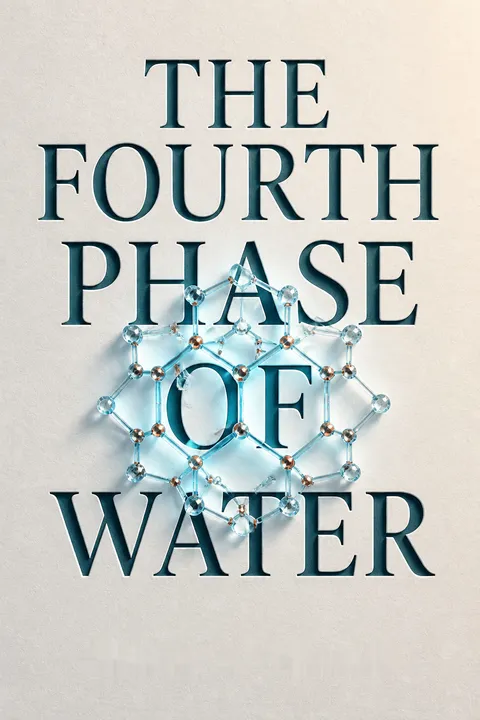

Key Takeaways
1. Water Possesses a Fourth Phase: The Exclusion Zone (EZ)
It appears that EZ water fundamentally differs from bulk water.
Beyond three phases. The book introduces a "fourth phase" of water, the Exclusion Zone (EZ) water, which forms next to hydrophilic (water-loving) surfaces. This phase is distinct from solid, liquid, and vapor, exhibiting unique physical properties that challenge conventional understanding. It's described as a liquid crystal, akin to raw egg white, rather than a simple liquid.
Unique properties. EZ water is characterized by several measurable differences from bulk water. It is more viscous, stable, and ordered, with its molecules arranged in a hexagonal, ice-like lattice. This structured nature leads to a higher refractive index and a distinctive 270 nm absorption peak in UV light. Crucially, EZ water also emits less infrared radiation, appearing "darker" in IR images, indicating restricted charge movement.
Exclusionary nature. The name "Exclusion Zone" stems from its most striking property: it actively excludes solutes and suspended particles, from large microspheres down to small dye molecules. This exclusion is attributed to the tight, ordered lattice structure of EZ water, which acts as a barrier, allowing only the smallest entities, like bare protons, to penetrate.
2. The Exclusion Zone Functions as a Water-Based Battery
The separated charges constitute a battery.
Charge separation. A fundamental discovery is that EZs are typically negatively charged, while the bulk water immediately beyond them accumulates a corresponding positive charge, primarily in the form of hydronium ions (protonated water molecules). This separation of charges creates an electrical potential difference, effectively forming a water-based battery.
Harvestable energy. This EZ battery stores potential energy that can be harvested. Experiments show that placing electrodes in the oppositely charged EZ and bulk water zones generates electrical current. This demonstrates that the separated charges are not merely incidental byproducts but a source of deliverable energy, akin to a conventional battery.
Ubiquitous batteries. These water batteries are pervasive in nature. They exist wherever hydrophilic surfaces interact with water, such as within living cells (packed with charged membranes and proteins), around suspended particles, and even within water containers. This suggests that water itself is a versatile energy transducer, capable of storing and releasing energy in various forms.
3. Radiant Energy is the Primary Fuel for Water's Activity
The fuel comes free.
Light as the energy source. The energy required to build and maintain the EZ, and thus to charge the water battery, comes primarily from radiant electromagnetic energy, particularly infrared (IR) light. This was discovered serendipitously when an EZ was observed to shrink overnight in darkness and expand rapidly upon exposure to a microscope lamp.
Wavelength dependence. Experiments using light-emitting diodes revealed that all wavelengths of light can drive EZ expansion, but infrared light (especially around 3000 nm, where water absorbs most strongly) is by far the most effective. This non-thermal effect means that even in apparent darkness, ambient IR radiation continuously fuels EZ growth and charge separation.
Energy transduction. Water acts as an energy converter, absorbing radiant energy and transforming it into potential energy stored in the EZ's order and separated charges. This stored energy can then be released to do various forms of work, challenging the conventional view of water as a passive, equilibrium system.
4. "Like Likes Like": A Universal Principle of Attraction
The intervening opposite creates the attraction.
Paradoxical attraction. Contrary to the intuitive understanding that like charges always repel, similarly charged particles in water can attract each other. This phenomenon, known for a century and explained by Richard Feynman, occurs because intermediate opposite charges gather between the like-charged entities, mediating the attraction.
EZs mediate attraction. The book provides experimental evidence, building on Norio Ise's work with colloids, that EZs and their associated protons are these "intermediate unlikes." For instance, two negatively charged gel beads attract each other because the positively charged hydronium ions (protons) accumulate between them, drawing the negative EZs of the beads closer.
Broad implications. This "like likes like" mechanism, driven by radiant energy that builds EZs and separates charges, may be a universal principle. It explains phenomena from colloid crystal formation and sandcastle stability to the self-assembly of biomolecules and the clustering of atmospheric clouds, suggesting that attraction is far more prevalent in nature than previously thought.
5. Brownian Motion is Driven by External Energy, Not Just Heat
Brownian motion may be a natural reflection of water’s continuous absorption of electromagnetic energy.
Challenging Einstein. While Einstein's theory attributes Brownian motion to random molecular bombardment driven by internal thermal energy, the book argues this explanation is incomplete. It fails to account for observations like salt-induced jitter, cooperative particle movements, and light-induced changes in particle excursions.
Radiant energy as driver. An alternative hypothesis proposes that absorbed electromagnetic energy drives Brownian motion. This energy builds asymmetric EZs around particles, creating localized charge gradients. These charge asymmetries generate electrostatic forces that push and pull the particles, causing their seemingly random movements.
Out-of-equilibrium dynamics. Since water continuously absorbs radiant energy and transduces it into work, it operates out of equilibrium. Brownian motion can be seen as a mechanism for water to dissipate this continuously absorbed energy, acting as a "relief valve." This perspective fundamentally shifts the understanding of this ubiquitous phenomenon from passive to actively driven.
6. Rethinking Heat and Temperature Through Charge Movement
Radiant emission reflects the intensity of charge movement.
Ambiguity of terms. The terms "heat" and "temperature" are often vaguely defined and can lead to misleading interpretations, especially in non-equilibrium systems like water. The book advocates for a more fundamental approach, focusing on "radiant energy" and "charge movement."
Radiant emission and charge. Radiant energy is generated by the movement of charges. Therefore, the amount of infrared (IR) radiation emitted by water directly reflects the intensity of charge movement within it. Regions with more active charge movement will emit more IR and appear "hotter," while ordered regions with restricted charge movement (like EZs) will emit less IR and appear "cooler."
Explaining paradoxes. This framework helps resolve paradoxes like vortexed water cooling (EZ formation restricts charge movement, reducing IR emission) and the "heat" generated during mixing (EZ buildup releases protons, whose movement generates IR). It suggests that what we perceive as heat or cold is often a manifestation of underlying charge dynamics and radiant energy exchange.
7. Osmosis and Diffusion are Energy-Driven Processes
Osmosis does require energy.
Active, not passive. Contrary to conventional views that osmosis and diffusion are passive processes driven by concentration gradients, the book argues they are actively driven by energy. If Brownian motion requires energy, and these processes are fundamentally linked to molecular movement, then they too must be energy-dependent.
Charge gradients as drivers. The underlying mechanism involves charge gradients created by EZs. In osmosis, hydrophilic membranes develop EZs, leading to an asymmetric distribution of hydronium ions. These ions, driven by electrostatic forces, flow towards regions of lower charge, pulling water along. Similarly, diffusion is influenced by localized charges that "distract" solutes from purely random movement.
Membranes and solutes. Membranes in osmosis are not just passive barriers; they are active participants, nucleating EZs and establishing the charge gradients that drive water flow. Solutes themselves, by forming EZs, create local charge environments that influence their own diffusion and the movement of water around them.
8. Vesicles (Droplets and Bubbles) are EZ-Shelled Entities
Droplets might be the progenitors of bubbles.
Structural similarity. Droplets and bubbles, collectively termed "vesicles," share a fundamental structural similarity: both are enveloped by an EZ shell. This EZ membrane is inferred from their spherical shape, resistance to mechanical disruption, and the presence of the characteristic 270 nm UV absorption peak.
Internal pressure from protons. The EZ shell of a vesicle contains liquid water and hydronium ions. The mutual repulsion of these internal positive charges generates pressure, which maintains the vesicle's spherical shape. This internal pressure is key to understanding vesicle dynamics and transformations.
Droplet-to-bubble transition. The book proposes that droplets are embryonic bubbles. When a droplet absorbs sufficient radiant energy, the internal hydronium ion concentration and pressure increase. If this pressure exceeds a critical threshold, the EZ shell expands, causing the internal liquid water to experience reduced pressure and convert into vapor, thus transforming the droplet into a bubble.
9. Evaporation Occurs as Discrete Puffs of Charged Vesicles
The surface seems to emit vapor puffs one at a time.
Visible vapor is structured. The visible "vapor" rising from warm liquids, like coffee, is not amorphous gas but comprises discrete, light-scattering vesicles. These vesicles self-organize into mosaic-like patterns and tubular structures that emerge from the water surface in successive "puffs," challenging the idea of single-molecule evaporation.
Water mosaics. These vapor patterns originate from corresponding three-dimensional, tubular mosaic structures within the liquid water itself. These water mosaics are composed of aggregated vesicles and EZ material, which are replenished by downward-flowing vesicles as the surface structures rise into the air.
Electrostatic propulsion. The evaporative puffs are propelled upward by electrostatic forces. Vesicles carry a net negative charge, and they are repelled by the earth's negative charge, providing a lifting force. This charge-based mechanism explains why vapor rises in discrete, often charged, clouds, and why phenomena like the Kelvin water dropper demonstrate droplets defying gravity.
10. Water Surfaces are Dynamic, Elastic, EZ-Lined Structures
The clear zone behaved like a cohesive band — a rubber dam — stretching across the water surface.
Stiff surface layer. Water's surface is not merely a thin film of hydrogen-bonded molecules but a robust, elastic, and dynamic EZ mosaic layer. This thick, net-like structure, composed of aggregated vesicles and EZ material, extends significantly downward into the water, explaining water's anomalously high surface tension.
Explaining surface phenomena. This EZ mosaic layer accounts for various phenomena:
- Rock skipping and walking on water: The stiffness and elasticity of the EZ surface allow objects and creatures to be supported.
- Tsunami propagation: The elastic nature of the surface layer facilitates the long-distance propagation of tsunamis and explains the pre-arrival recession of the sea.
- Capillary action: Electrostatic forces from EZs lining capillary walls, both pulling from above and pushing from below (due to proton repulsion), drive water upward, explaining the rise in narrow tubes and in tall trees.
Thixotropic behavior. The surface EZ mosaic exhibits thixotropy, meaning it can behave elastically under gentle stress but flows when a threshold force is applied. This explains why objects can float if placed gently but sink if dropped carelessly, as well as the disruption caused by passing ships.
11. Ice Formation is an EZ-Proton Transition, Not Just Cooling
The EZ was the ice precursor.
EZ-ice linkage. Ice formation is intimately linked to the EZ. Experiments show that EZ water is consistently the first to freeze, well before bulk water, and that melting ice first transitions into EZ water. This suggests that the EZ is an intermediate phase in the water-to-ice transition.
Proton invasion. The transition from EZ to ice involves a massive influx of protons into the negatively charged EZ lattice. These protons insinuate themselves between the EZ's hexagonal planes, neutralizing the negative charge and pushing the planes apart, which accounts for ice's lower density and the energy released during freezing.
Explaining the Mpemba effect. This proton-invasion mechanism resolves the Mpemba effect (warm water freezing faster than cold). Warm water contains more EZ-shelled vesicles and associated protons. When cooled, these abundant protons are readily available to invade the EZs, accelerating the freezing process compared to cold water with fewer such precursors.
12. Four Foundational Principles Unlocking Nature's Mysteries
I believe those foundational concepts can be distilled into four central principles that govern our understanding of water.
Reversing scientific trends. The book advocates for a return to foundational science, questioning established dogmas to uncover simpler, unifying truths, rather than merely accumulating incremental details. This approach is crucial for understanding water, a substance whose complexities have long resisted clear explanation.
The four principles:
- Water has four phases: Solid, liquid-crystalline (EZ), liquid, and vapor.
- Water stores energy: In the form of order and separated charges (the EZ battery).
- Water gets energy from light: Radiant energy, especially infrared, continuously builds EZs and charges the water battery.
- Like-charged entities can attract one another: Mediated by intermediate opposite charges (EZs and protons), this principle explains self-assembly and clustering.
Unveiling secret rules. These principles, previously obscured by historical scientific missteps and intellectual timidity, offer a new framework for understanding countless natural phenomena. From biological processes and atmospheric dynamics to material science and energy generation, they suggest that water is a far more active and energetic participant in the world than conventionally assumed.
Review Summary
The Fourth Phase of Water by Gerald H. Pollack explores a proposed fourth phase of water beyond solid, liquid, and vapor—called EZ (Exclusion Zone) water. This gel-like, negatively charged structure forms near hydrophilic surfaces and absorbs infrared energy. Reviewers praise Pollack's accessible writing and simple experiments that challenge conventional water science, with implications for biology, medicine, and energy. Critics note some claims lack rigorous scientific support and become speculative. Most readers find it fascinating and thought-provoking, though technically dense in places, revolutionizing everyday understanding of water's behavior.
People Also Read




Download PDF
Download EPUB
.epub digital book format is ideal for reading ebooks on phones, tablets, and e-readers.








































