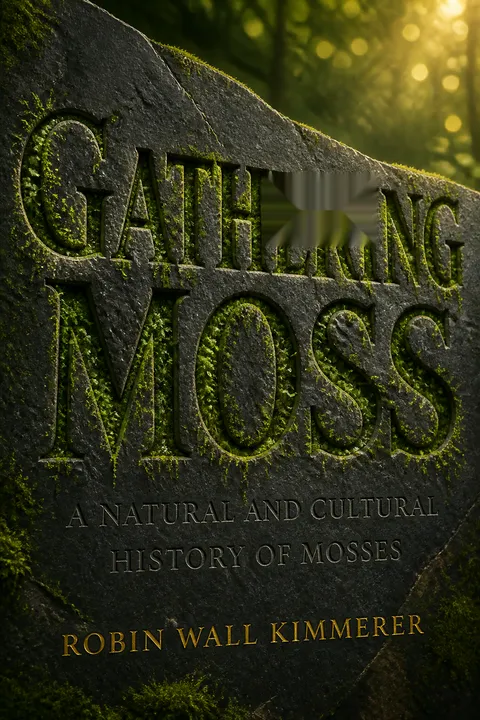

Key Takeaways
1. The Art of Seeing: Unveiling the Unseen World
For the first time, but not the last, I had the sense that there was more to the world than immediately met the eye.
Attentive observation. The author's journey into bryology began with a childhood wonder at snowflakes through a magnifying glass, revealing hidden beauty. This early lesson taught that true understanding comes from deep attention, not just a cursory glance. Learning to see mosses is akin to listening intently, filtering noise to catch subtle nuances.
Blending perspectives. Kimmerer integrates scientific rigor with indigenous Potawatomi ways of knowing, emphasizing that a thing is truly understood only by mind, body, emotion, and spirit. This dual approach enriches perception, allowing for both objective analysis and a relational understanding of plants as teachers. The scientific method, while powerful, is insufficient alone.
Beyond human limits. Our human vision is limited, often blind to the "middle scale" of the unaided eye. Technology extends our sight to the vast and the microscopic, yet we often overlook the intricate beauty at our feet. Attentiveness alone can rival powerful lenses, revealing a universe of detail in a moss, much like discovering starfish in a tidepool after initial blindness.
2. Smallness as Strength: Life in the Boundary Layer
Beautifully adapted for life in miniature, mosses take full advantage of being small, and grow beyond their sphere at their peril.
Leveraging size. Mosses, lacking vascular tissue for support and water transport, remain small, typically only a few centimeters high. This limitation becomes their greatest asset, allowing them to colonize diverse micro-habitats where larger plants cannot thrive, such as sidewalk cracks, tree bark, or rock faces.
Boundary layer mastery. Mosses flourish within the boundary layer, the thin zone of still air directly adjacent to any surface. Here, wind speed is reduced, heat is trapped, and moisture evaporates slowly, creating a stable, humid microclimate. This insulating layer acts like a "floating greenhouse," prolonging opportunities for growth even in harsh conditions.
Enhanced resources. The boundary layer also traps gases, including carbon dioxide released from decaying substrates like logs, which can be ten times higher than ambient air. This provides an enhanced supply of raw material for photosynthesis. To disperse spores, mosses elevate them on stalks (setae) above this protective layer, into the turbulent air currents.
3. Water's Embrace: Mosses' Evolutionary Tether
Mosses must be awash in moisture in order for the alchemy of photosynthesis to occur.
Amphibians of plants. Mosses are the evolutionary bridge between algae and higher land plants, much like amphibians bridge aquatic and terrestrial animal life. Despite adaptations for land, they remain tethered to water for reproduction, requiring a continuous film of water for their swimming sperm to reach the protected egg within the female structure (archegonium).
Poikilohydry's resilience. Many moss species exhibit poikilohydry, meaning their internal water content fluctuates with the environment. They can lose up to 98% of their moisture, shriveling into desiccated forms, and then fully revive within minutes of rewetting. This allows them to survive in water-stressed habitats fatal to most higher plants.
Water-holding architecture. Every aspect of a moss's structure is designed to attract and retain water:
- Dense colonies: Shoots pack tightly, creating a sponge-like network.
- Capillary spaces: Delicate leaves and small stature form spaces for water bridges.
- Porous cells: Sphagnum's dead cells absorb vast amounts of water.
- Leaf morphology: Concave leaves, rolled tips, and surface papillae trap moisture.
4. Pioneers of Healing: Mosses in Ecological Succession
The process of ecological succession is like a positive feedback loop, a magnet of life attracting more life.
Initiating recovery. Mosses are crucial pioneers in ecological succession, especially on disturbed or barren lands like glacial boulders or mine tailings. They colonize harsh, nutrient-poor substrates where other plants cannot survive, initiating the slow process of soil formation and ecosystem recovery.
Creating safe havens. Moss carpets stabilize surfaces, binding loose soil with their rhizoids and preventing erosion. They create microclimates that are cooler, moister, and richer in nutrients than bare ground, providing safe sites for the germination and establishment of seeds from other plants, even "weeds" like hawkweed and clover.
Facilitating diversity. The Intermediate Disturbance Hypothesis, observed on Kickapoo cliffs, shows that species diversity is highest with intermediate disturbance frequency. Mosses like Polytrichum thrive in frequently disturbed areas, while others like Conocephalum dominate stable zones. This dynamic creates a mosaic of habitats, fostering a wide variety of species.
5. Microcosms of Biodiversity: The Moss Forest
The interior of a moss clump can be heavily colonized by algae, making it look like a moss-draped rain forest in miniature.
Miniature ecosystems. A moss clump is a complex, stratified micro-ecosystem, mirroring the structure and function of a tropical rainforest. It supports a diverse community of invertebrates, algae, and other tiny organisms, interconnected in intricate food webs of herbivores, carnivores, and decomposers.
Abundant life. A single gram of moss can harbor hundreds of thousands of protozoa, tardigrades (waterbears), springtails, rotifers, nematodes, and mites. These creatures find shelter, food, and a favorable microclimate within the dense, moist moss mat, which acts as a transitional environment between aquatic and terrestrial life.
Co-evolutionary adaptations. Many invertebrates, like waterbears and rotifers, have co-evolved with mosses, exhibiting remarkable adaptations such as anabiosis (suspended animation) to survive desiccation when the moss dries. This shared resilience highlights the deep interdependencies within the moss microcosm.
6. Adaptive Resilience: Diverse Reproductive Strategies
In this changeable habitat, natural selection favors flexibility rather than commitment to a single reproductive choice.
Flexible reproduction. Mosses exhibit a wide spectrum of reproductive behaviors, from prolific sexual reproduction to various forms of asexual cloning. This flexibility allows them to adapt to unpredictable environments and maximize their chances of survival and dispersal.
Clonal vs. sexual.
- Cloning (gemmae, brood bodies): Produces genetically identical offspring, effective in stable environments, allows rapid colonization of nearby disturbed patches. Tetraphis pellucida uses splash-dispersed gemmae for short-distance colonization.
- Sexual reproduction (spores): Creates genetic variety, advantageous in unpredictable environments, allows long-distance dispersal by wind.
Density-dependent choices. Tetraphis pellucida demonstrates remarkable reproductive plasticity, switching between clonal and sexual strategies based on colony density. In sparse, open patches, it produces gemmae. As crowding increases, it shifts to female shoots, then to male shoots, becoming a sequential hermaphrodite.
7. The Web of Reciprocity: Indigenous Wisdom of Mosses
In indigenous ways of knowing, it is understood that each living being has a particular role to play.
Gifts and responsibilities. Indigenous knowledge systems view all beings as having unique gifts and responsibilities, forming a "web of reciprocity" that connects humans to the natural world. Learning a plant's role comes from patient observation, listening to the land, and understanding its "comings and goings."
Everyday utility. While often overlooked in historical accounts, mosses played crucial, humble roles in traditional human life:
- Insulation: Lining winter boots, mittens, and bedding.
- Hygiene: Used as diapers and sanitary napkins due to high absorbency and antiseptic properties (e.g., Sphagnum).
- Food preparation: Wiping salmon, steaming camas bulbs in pit ovens.
Beyond scientific explanation. Indigenous knowledge often expands the "how" of scientific inquiry to the "why," revealing deeper meanings and relationships. The widespread, unobtrusive presence of mosses suggests their role in daily household needs, a quiet but essential contribution to human well-being.
8. Sphagnum's Alchemy: Engineering Bog Ecosystems
Sphagnum or peat mosses not only flourish in bogs, they create them.
Bog architects. Sphagnum mosses are ecosystem engineers, actively shaping their environment through unique properties. They form vast, quaking mats over water, creating acidic, waterlogged, and nutrient-poor conditions that are hostile to most other plants, thus defining the bog habitat.
Water management. Sphagnum plants are mostly dead cells, which function solely to hold water, absorbing up to twenty times their weight. This immense water-holding capacity saturates the soil, creating anaerobic conditions that inhibit decomposition and tree growth, keeping the bog open and sunny.
Peat formation. The slow decomposition of Sphagnum leads to the accumulation of peat, a deep layer of partially decayed moss that can stretch for meters. This peat preserves organic matter for centuries, records ecological history, and has been traditionally used for fuel, insulation, and even preserving bodies.
9. Forest's Gratitude: Mosses as Hydrological Architects
If forests did offer prayers, I suspect they would send thanks to the mosses.
Water cycle regulators. In temperate rainforests, mosses are integral to the forest's hydrological function. They intercept rainfall, absorbing vast quantities of water and slowly releasing it as "stemflow" down tree trunks and "throughfall" from branches, enriching the soil with nutrients.
Fog catchers. Canopy mosses gather moisture directly from fog and mist, condensing droplets and absorbing water vapor through their pectin-rich cell walls. This continuous drip keeps the forest soil moist, supporting tree growth and the entire ecosystem, even without direct rainfall.
Biodiversity support. Mosses provide critical habitat and microclimates for a wide array of forest life:
- Insects: Shelter for larvae, moist air for metamorphosis.
- Birds: Nesting material for insulation and camouflage (e.g., marbled murrelet).
- Fungi: Insulate logs for decomposers, enhance mycorrhizal associations with tree roots.
10. The Illusion of Ownership: Valuing Wildness
I think you cannot own a thing and love it at the same time.
Commodification of nature. The book critiques the human desire to "own" and control wild nature, exemplified by the wealthy "Owner" who destroys natural mossy cliffs to transplant them to his garden. This act, though well-intentioned, reduces living beings to mere decorative objects, stripping them of their authenticity and ecological context.
Authenticity lost. Wildness cannot be collected or replicated with money and technology; its essence is lost when separated from its origins. The "Designer Moss Sheets" and superglued mosses, despite their aesthetic appeal, are facsimiles, lacking the intricate, time-honored relationships that define true moss communities.
A call for restraint. True love and respect for nature require self-restraint and humility, allowing wild things to flourish outside human possessive embrace. The contrast between the Owner's destructive "restoration" and the resilient mosses thriving under an electric fence in herbicide-treated soil highlights the inherent sovereignty of nature and the limitations of human control.
Review Summary
Gathering Moss is praised for its blend of science, personal anecdotes, and cultural insights about mosses. Readers appreciate Kimmerer's poetic writing style, deep knowledge, and ability to make moss fascinating. Many found the book eye-opening, inspiring them to pay closer attention to nature. Some critics felt the personal reflections overshadowed the moss content. Overall, reviewers were captivated by Kimmerer's unique perspective, combining scientific expertise with Indigenous wisdom to explore the often-overlooked world of mosses.
People Also Read




About the Author
Download PDF
Download EPUB
.epub digital book format is ideal for reading ebooks on phones, tablets, and e-readers.








































