
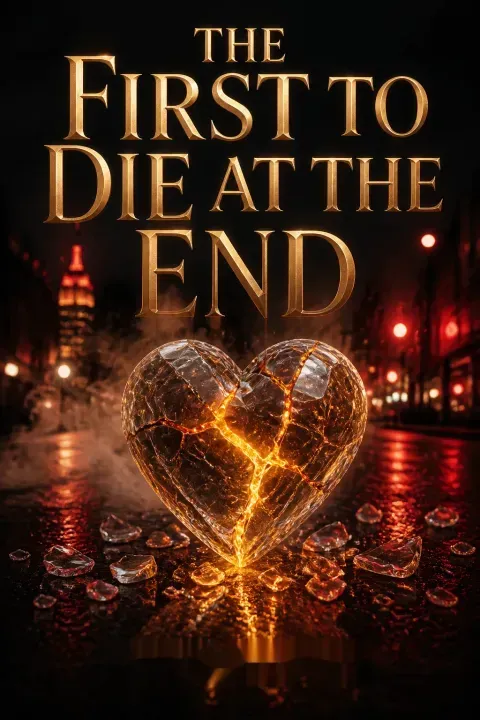


Plot Summary
The Stranger on the Glass Benches
On the night Death-Cast is set to launch, Orion Pagan1 and his best friend Dalma3 join the crowd in Times Square, watching digital hourglasses count down to midnight. Orion,1 an eighteen-year-old with a severe heart condition, hopes the service will end his constant fear of sudden death.
When he sees a tall, muscular stranger with icy blue eyes sitting alone on the red glass benches, he feels an unfamiliar pull. Despite his social anxiety, he walks over and introduces himself. The stranger is Valentino Prince,2 a model who just moved from Arizona to escape parents who rejected him for being gay.
Their conversation flows: Orion1 shares how his parents died in the 9/11 attacks, and Valentino2 reveals his twin sister Scarlett4 almost died in a car accident. Touched, Orion1 urges him to register for Death-Cast. With minutes to spare, Valentino2 signs up for a one-day plan on his phone.
This meeting is framed by the looming promise of Death-Cast, yet it is the mortal fear and hope of the two boys that dominates. Orion's approach is a small act of courage against his own chronic anxiety, mirroring the larger gamble of the Death-Cast system itself. Their immediate intimacy, born of shared trauma and displacement, suggests that knowing death can intensify the need for connection. The scene sets up the core tension: will the knowledge of an End Day enable living, or merely hasten despair? Valentino's last-minute registration, spurred by a stranger's conviction, becomes the catalyst for everything that follows.
The First End Day Call
As the hourglasses empty, the Death-Cast ringtone blares from Valentino2's new phone. Joaquin Rosa5 himself informs him that within twenty-four hours, he will die. Before Valentino2 can process this, a man in a skull mask opens fire in the crowd.
Orion1 tackles Valentino2 to the ground, shielding him, but the rush of adrenaline and terror triggers Orion1's faulty heart. He collapses, gasping for air, while chaos scatters the crowd. Valentino,2 stunned but driven, scoops up Orion1 and follows a frantic Dalma3 as they flee toward a hospital.
Meanwhile, Joaquin,5 unaware of the shooting's proximity to his first Decker, orders the heralds to begin the End Day calls, already calculating how to manage the PR fallout. The night meant to celebrate preparedness for death has already delivered a brutal preview of its arbitrary violence.
The inaugural End Day call reveals Death-Cast’s inherent paradox: the warning is meant to grant control, yet the immediate response is helplessness. Valentino’s acceptance of his fate is complicated by Orion’s life-threatening intervention, creating a debt that will define their bond. Joaquin’s clinical detachment contrasts with the visceral terror at ground level, underscoring how the system’s cool efficiency cannot account for the chaos of real mortality. The shooting, random and unmotivated, proves that even with foreknowledge, death remains capricious.
A Heart's Bargain
At Lenox Hill Hospital, Dr. Emeterio9 stabilizes Orion1 after his heart attack. Valentino,2 reeling from the End Day call and the shooting, listens as Orion1's family learns the transplant waitlist is long and uncertain. Then Valentino2 remembers his blood type is O-negative, a universal donor.
He tells Orion1 he wants to give him his heart. Orion1 protests, calling it unfair, but Valentino2 insists: his End Day is sealed, but Orion1 can live. Dr. Emeterio,9 though skeptical of Death-Cast, agrees to run tests and seek board approval for an unprecedented living-donor transplant.
As dawn breaks, Orion1 and Valentino2 wait together. Orion1 realizes he is simultaneously losing someone he just met and being granted a future he never dared imagine. Valentino,2 having found purpose in his final hours, begins to see his death as a gift.
This transaction redefines their relationship from strangers to co-authors of a shared fate. Valentino’s offer is both an act of profound altruism and a way to reclaim agency over his own mortality. For Orion, it introduces a painful moral calculus: his survival is purchased by another’s death. The scene highlights the ethical gray zones created by Death-Cast, where the idea of a fated death collides with the possibility of medical intervention. Dr. Emeterio’s willingness to bend protocol signals how the new reality forces professionals to improvise.
The Bare Studio
Against Dalma3's worries, Orion1 leaves the hospital with Valentino2 to let him spend his End Day as he wishes. At Valentino2's sixth-floor walk-up, they find his sparsely furnished studio. Orion1 cleans the cut above Valentino2's eyebrow from a close call earlier, then helps him unpack boxes of clothes and shoes.
They talk about their lives: Orion1's fairy tale about a boy who swaps hearts with an elder, Valentino2's childhood full of parental love that evaporated when he came out.
As exhaustion hits, they make a bed from the air mattress and folded clothes, lying side by side. In the dark, Valentino2 admits he is happy Orion1 will have his heart. Orion,1 already falling for him, listens to Valentino2's soft snore and stays awake, memorizing the moment.
The apartment, empty of furniture but full of the detritus of a life quickly abandoned, becomes a liminal space where intimacy accelerates. Stripping away distractions forces both boys to confront their inner selves. Valentino’s act of unpacking symbolizes his desire to leave a trace, while Orion’s caretaking reveals a nurturing instinct sharpened by his own long patienthood. Their physical proximity, chaste yet charged, mirrors the emotional transplant already occurring: Orion is absorbing Valentino’s story into his own.
Dreams Deferred, Then Remade
In the morning, Valentino2 and Orion1 take the subway to Future Star Model Management for a fitting for his first national campaign. The receptionist does not recognize him, and agent Laverne reveals the shoot is postponed because the photographer, William Wilde, was killed in the Times Square shooting.
Laverne dismisses Death-Cast, assuring Valentino2 they will reschedule next week. Devastated but defiant, the two boys decide to make their own memories. They find a pawnshop called Itchy Palm Gems, where owner Férnan,11 distraught after a looting, gives them a camera free of charge.
Valentino2 insists on buying a bike for Férnan11's son Rufus in exchange. Armed with the camera, they step outside and take the first picture: Valentino,2 posing in front of the shop, reclaiming his End Day.
The cancellation crystallizes the novel’s central critique of a world slow to trust Death-Cast: Laverne’s denial is willful ignorance that robs Valentino of his final professional triumph. The pawnshop, a repository of others’ lost stories, becomes a site of regeneration. Valentino’s purchase of the bike re-enacts his heart offer: an exchange where he gives something lasting to a child. The camera, a tool of preservation, now gives Orion the role of documentarian, knitting them together as creator and subject.
Firsts on the High Line
Orion,1 acting as tour guide, leads Valentino2 to a series of New York firsts: a bacon-egg-and-cheese (which Valentino,2 forbidden from eating before surgery, gives to a homeless woman), a copy of the New York Times with Joaquin5's photo on the front page, a visit to the Strand bookstore. Next, they climb to the High Line, an abandoned elevated railway turned into a green park.
Orion1 recounts the area's grim past as Death Avenue, where trains once killed pedestrians, transformed into a space of beauty. They photograph each other among the wildflowers and tracks. For Orion,1 it is his first visit too, a symbolic release from his own fear. Valentino,2 standing among reclaimed steel, understands that even places of death can give way to life.
This sequence literalizes the book’s thesis: transformation is always possible. The High Line, a site of fatal accidents repurposed into a sanctuary, provides the perfect metaphor for Valentino’s End Day. Orion’s act of sharing a landmark he previously avoided due to his heart condition signals his shift from passivity to engagement, fueled by his feelings for Valentino. The image of rusted tracks overgrown with flowers visually echoes the transplant: a dead organ replaced by something thriving. Each tourist snapshot becomes a small rebellion against erasure.
Love Locks and a First Kiss
Walking across the Brooklyn Bridge, they discuss love, marriage, and the impossibility of building a future. When Valentino2 laments he will never have a first kiss or a child, Orion1 carves their names together on a bench: VALENTINORION.
Valentino2 then pulls Orion1 into a fervent kiss, his first, which Orion1 returns with equal passion. They talk about what Valentino2 would name a child, Vale, and Orion1 promises that if he ever has a child, they will carry that name. With the city skyline behind them, they hold hands as boyfriends, acknowledging the cruel timing but refusing to let it diminish what they feel.
Later, on the subway back, Orion1 spontaneously performs a clumsy showtime dance, and Valentino,2 at Orion1's urging, struts the train aisle like a runway, cheered by passengers who learn he is a Decker.
The kiss functions as a declaration of life in the face of death. By inscribing their combined names, they create a permanence that counters the ephemerality of the day. Valentino’s runway performance reclaims a dream denied by his agent, turning the train into a catwalk of defiance. Orion’s uncharacteristic public spectacle reveals how Valentino’s presence gives him permission to be bold. These are not bucket-list items ticked off but acts of mutual creation, transforming the mundane into the mythic.
System Failure
While Valentino2 and Orion1 are on their first date in Times Square, Dalma3 calls with devastating news: Joaquin Rosa5 has admitted that twelve registered Deckers died without receiving calls, and the system glitch may not be fixed until tomorrow.
This means Orion1 could die today too, despite not receiving a call. Simultaneously, Scarlett,4 still stranded in Phoenix after a pilot's End Day grounded her first flight, learns all flights are now suspended, dashing her last chance to reach her brother. The couple's newfound security evaporates.
Orion,1 terrified that his own death could negate Valentino2's sacrifice, spirals. Valentino,2 who had accepted his fate, now must console Orion1 while burying his own disappointment about his sister. They decide to retreat to Orion1's home in the Bronx, seeking safety and family.
The revelation of Death-Cast’s fallibility shatters the protagonists’ hard-won equilibrium. It exposes a deeper horror: the organization that promised certainty has reintroduced ambiguity at the worst moment. Orion’s panic is a regression to his pre-Death-Cast state, proving that existential anxiety cannot be permanently cured by a service. Scarlett’s grounded plane reinforces the physical and emotional distance that will prevent a final sibling reunion, making Valentino’s isolation more acute. This systemic failure forces the boys to face the prospect that their love story might end with both of them dead.
New Family, Old Wounds
At Orion1's brownstone, Dalma,3 her parents Dayana and Floyd, and her younger sister Dahlia surprise Valentino2 with a welcome party. They give him New York souvenirs, roses, and affirmation, treating him as family. Overwhelmed, Valentino2 decides to call his own parents for the last time.
Using Orion1's laptop, he Skypes his mother and father. He tells them he is the first Decker, that he was shot at, and that he found love with Orion.1 He thanks them for pushing him out, because it led him to a real family.
His parents remain completely silent. After a long pause, Valentino2 hangs up, feeling he has finally spoken his truth. Orion,1 waiting downstairs, holds him as he cries, and then leads him to his bedroom for their first time sexually, deepening their bond.
The contrast between the Youngs’ spontaneous kindness and the Princes’ cold silence crystallizes the book’s stance on chosen family. Valentino’s call is not about reconciliation but reclamation: he uses his dying voice to assert his worth. His parents’ wordlessness becomes a void he fills with his own meaning. The subsequent sexual intimacy is portrayed not as escapism but as a profound communion, the physical manifestation of their spiritual and literal heart-sharing. It cements their relationship as a complete, if condensed, love story.
The Sixth-Floor Fight
After receiving news that Dr. Emeterio9's board approved the surgery, Valentino2 and Orion1 head back to Valentino2's apartment to collect the camera and leave it for Scarlett.4 As they ascend the stairs, they hear Frankie Dario6 violently attacking his wife Gloria7 and her friend Rolando.8
Valentino,2 despite Orion1's pleas, rushes up to help. He wrestles Frankie6 off the beaten man, but Frankie6 strikes him brutally with a chair leg and kicks him out the door. Valentino2 tumbles down the stairwell, grabbing Orion,1 and both crash onto the landing.
Valentino2's head strikes a step, leaving him unconscious and bleeding. Meanwhile, nine-year-old Paz,10 having retrieved Frankie6's hidden gun, shoots his father twice to save his mother. The chaos orchestrates the very death Death-Cast foretold, but in an act of heroism.
This violent climax brings together all the novel’s threads: Frankie’s abuse, Gloria’s entrapment, Rolando’s inaction, and Valentino’s sacrificial impulse. Valentino’s choice to intervene mirrors Orion’s earlier tackle, both acts of selfless protection, but here it seals his fate. Paz’s shooting introduces a dark moral complexity: a child forced to kill to save his mother. The stairwell fall literalizes the suddenness of death even when predicted. In the brutal collision of bodies, Valentino fulfills the End Day prophecy not as a passive victim but as an active savior.
Our Heart Beats On
Orion,1 dazed and injured, is rushed along with Valentino2 to Lenox Hill Hospital. While Orion1 is treated for shock, Dr. Emeterio9 attempts to save Valentino,2 but the brain damage is irreversible. She declares brain death and prepares for the transplant.
Orion,1 heartbroken, insists on seeing Valentino2 one last time. He whispers his love into the still boy's ear, kisses his lips, and is wheeled to the operating room. The surgery succeeds. When Orion1 wakes, a ventilator tube down his throat, he feels the steady rhythm of a new heart, Valentino2's heart.
Dalma3 and the Youngs weep with relief and grief. Dr. Emeterio9 confirms the procedure went well, but the victory is haunted by the cost. Orion1's first coherent thought is of his boyfriend's sacrifice, and he begins the long work of mourning while healing.
The transplant literalizes the metaphor of giving one’s heart. It is both a clinical miracle and a spiritual union, the physical proof that Valentino’s love endures. Orion’s waking state, silenced by a tube yet full of Valentino’s pulse, speaks to the paradox of survival: he cannot yet voice his grief, but his body hums with the evidence of his partner’s existence. The medical team’s success juxtaposed against their inability to save Valentino encapsulates the harsh economy of organ donation in the Death-Cast era. It is a transaction where one death buys another’s life, and the novel refuses to sentimentalize that brutal math.
The Last Recording
Days after the surgery, Scarlett4 finally arrives in New York. She visits Orion1 in his hospital room, bringing Valentino2's camera. Together, they scroll through the photos from the End Day, Orion1 narrating each memory.
Then Scarlett4 reveals there was a second video on the camera, addressed to Orion.1 She hands him a USB. Alone, Orion1 plugs it into his laptop and plays the file. Valentino,2 filmed in Orion1's bedroom just after their first time, speaks directly to him: he worries Orion1 will drown in grief and urges him to run, to write, to find love again.
He declares his heart belongs to both of them now, and tells Orion1 he loves him. Hearing those words shatters and remakes Orion.1 He resolves to live fully, to turn his short story into a novel.
The video functions as a resurrection of voice, allowing Valentino to speak across the boundary of death. His message transforms Orion’s grief from a passive weight into an active mission. The instruction to live for both of them reframes survival as a labor of love. That Valentino filmed it secretly, worried he would be interrupted, underscores his awareness that even End Days can run out of time. This digital relic is the emotional climax, offering closure while insisting on ongoingness. Orion’s tears are not just mourning but the first step of integrating Valentino’s heart, both literal and figurative, into his future.
The Beginning After the End
Orion1 returns to his brownstone, where Dalma3 and Scarlett4 plan to sleep over. Dalma3 reveals her epiphany: an app called Last Friend, where Deckers can find companions for their final day, inspired by Orion1 and Valentino2's connection.
Scarlett4 begins rebuilding her life, determined to honor her twin. Joaquin Rosa,5 while managing Death-Cast's expansion, privately mourns the twelve unnoticed deaths and uses Valentino2's story as a symbol of what the service can achieve. At home, Orion1 flips through the photo album, lingering on the image of them kissing in Times Square.
He clutches the album to his chest, their heart, and takes his first full breath as someone who will not waste his second chance. He is no longer a short story; he is a novel with blank pages waiting to be filled.
The final turn consolidates the narrative’s themes into a vision of aftermath. Dalma’s app transmutes personal tragedy into communal care, ensuring that the connection Orion and Valentino forged can be replicated. Joaquin’s perspective provides a macro lens, acknowledging the company’s flaws while extracting meaning from the chaos. Scarlett’s presence in New York closes the loop on Valentino’s move: she inhabits the future he dreamed of. Orion’s metaphor of himself as a novel, now with blank pages, signals psychological integration: grief not as erasure but as ongoing creation. The heartbeat in his chest is the catalyst for a lifetime of firsts.
Analysis
The novel interrogates the fantasy of certainty in mortality. Death-Cast promises control, but the first day reveals that knowing you will die does not mean knowing how to live. The story argues that life's value is not in its length but in the intensity of connection. Orion1 and Valentino2's relationship, compressed into a single day, matches the emotional depth of long years, suggesting love is measured by presence, not duration. The transplant becomes the ultimate symbol: a heart literally transferred, making two boys into one continuous existence. Adam Silvera also critiques societal failings, homophobia, and domestic abuse, positioning the personal as political. The supporting characters — Rolando,8 Gloria,7 Paz,10 Dalma3 — each embody different responses to mortality: sacrifice, escape, creation. The novel's structure, moving from the countdown to the aftermath, mirrors the process of grief itself: anticipation, impact, and slow reconstruction. Ultimately, it is a testament to the idea that endings are also beginnings, and that the dead live on in those who keep beating.
Review Summary
The First to Die at the End received mixed reviews, with many praising its emotional impact and character development. Fans appreciated the expansion of the Death-Cast universe and the exploration of its origins. Some found it even better than the original, while others felt it was too similar. Criticisms included pacing issues, excessive POVs, and unrealistic dialogue. Overall, readers were moved by the love story between Orion and Valentino, finding it both heartbreaking and beautiful. The book's ability to provoke thought about life and death was frequently highlighted.
People Also Read


Characters
Orion Pagan
Writer with a failing heartAn eighteen-year-old Puerto Rican boy living with his best friend's3 family in the Bronx after his parents were killed in the 9/11 attacks. He has viral cardiomyopathy, which makes any excitement potentially fatal, so he lives in constant fear of sudden death. He is witty, self-deprecating, and uses writing short stories as a coping mechanism. Despite his anxiety, he approaches Valentino2, revealing a hidden courage. He is gay and newly out, yearning for love but convinced he will not live long enough to experience it. His emotional openness and fierce loyalty define him. He is tall, with hazel eyes and a chipped tooth, and often hides under a baseball cap that belonged to his father.
Valentino Prince
Model and the first DeckerA nineteen-year-old gay model from Phoenix, Arizona, who has just moved to New York City to escape homophobic parents. He is exceptionally handsome, with icy blue eyes, a muscular build, and a disciplined approach to his career and body. His twin sister Scarlett4 is his closest bond. He signs up for Death-Cast on a whim and receives the inaugural call, becoming the first known Decker. Despite his dire fate, he remains compassionate, using his final hours to form deep connections and offer his heart to Orion1. He dreams of love, marriage, and a child named Vale, and his End Day becomes a journey of reclaiming his identity and finding freedom.
Dalma Young
Orion's best friend and protectorOrion1's best friend and legal stepsister, a brilliant Afro-Latina computer programmer. She is fiercely protective of Orion1, often prioritizing his health over everything, which can make her seem insensitive. Her father died of kidney cancer when she was young, giving her a personal understanding of unexpected loss. She is witty, logical, and ambitious, eventually conceiving the Last Friend app to connect lonely Deckers with companions. Her arc shows her learning to balance protection with allowing Orion1 to take risks.
Scarlett Prince
Valentino's twin sisterValentino2's identical twin, a photographer with a bold, artistic spirit. She survived a near-fatal car accident months earlier, an experience that deepened her bond with her brother. She is the more outspoken twin, ready to confront anyone who mistreats Valentino2. When Death-Cast calls Valentino2 while she is still in Arizona, she becomes desperate to reach him, but systemic failures strand her. Her grief after his death propels her to move to New York and honor his memory by living the life they dreamed of together.
Joaquin Rosa
Creator of Death-CastA charismatic Puerto Rican entrepreneur who invented Death-Cast, a service that predicts the day someone will die. He is motivated by a genuine desire to eliminate the trauma of unexpected death, but his ambition blinds him to the system's flaws and human cost. He personally calls Valentino2 as the first Decker. Married with a young son, he struggles to balance his mission with family life. He is both visionary and hubristic, haunted by the twelve missed calls on the first day but determined to expand the program globally.
Frankie Dario
Abusive landlord and antagonistValentino2's new landlord, a bitter Puerto Rican man who resents his own lack of success. He abuses his wife Gloria7 and neglects his son Paz10. Envious of Joaquin Rosa5's fame, he schemes to photograph Deckers for profit. His violent temper escalates throughout the day, culminating in a brutal attack on his wife and her friend that directly causes the story's tragic climax. He represents the destructive potential of unchecked rage and the failure of fatherhood.
Gloria Dario (Medina)
Abused wife and devoted motherFrankie6's wife and Paz10's mother. She secretly registered her family for Death-Cast, fearing Frankie6 will kill her. A meticulous planner, she has long dreamed of leaving her abusive marriage but stayed for her son. Her childhood friend Rolando8 encourages her to escape, and on the first End Day, after a confrontation, she finally decides to divorce Frankie6 and reclaim her maiden name, Medina. Her story parallels Valentino2's theme of liberation from destructive forces.
Rolando Rubio
Empathetic herald and Gloria's friendA Death-Cast herald who quits after his first shift because he cannot detach from the Deckers' humanity. He was a former school guidance counselor, and his compassion conflicts with Joaquin5's efficiency demands. He is in love with Gloria7, his best friend since college, and has long wanted her to leave Frankie6. On the first End Day, he visits an elderly Decker named Clint, which inspires him to finally urge Gloria7 to start a new life. His gentle nature contrasts with Frankie6's violence.
Dr. Emeterio
Compassionate cardiac surgeonA cardiac surgeon at Lenox Hill Hospital with a warm bedside manner. She is one of the first medical professionals to take Death-Cast seriously, which makes her willing to consider an unprecedented living-donor heart transplant. She navigates the ethical complexities with empathy, ultimately performing the surgery that saves Orion1. Her openness to the new reality embodies the adaptive spirit needed in the Death-Cast age.
Paz Dario
Abused child who becomes a heroFrankie6 and Gloria7's nine-year-old son, a gentle boy who loves acting and fears Death-Cast. He welcomes Valentino2 as a new neighbor with unexpected warmth. When his father's violence escalates, he retrieves a hidden gun and shoots Frankie6 to save his mother. His act, born of love and terror, will haunt him but also liberates his family. He represents the collateral damage of abuse and the unthinkable choices children make to survive.
Férnan Emeterio
Pawnshop owner, father of RufusOwner of Itchy Palm Gems, a pawnshop looted on Death-Cast Eve. He is a single father struggling to raise his temperamental son Rufus. When Valentino2 and Orion1 come seeking a camera, he gives it for free, touched by Valentino2 being a Decker. In turn, Valentino2 buys a bike for Rufus, a gesture that helps him reconnect with his son. He is a man learning to value relationships over possessions.
Plot Devices
Death-Cast
Predicts the day of deathA mysterious service created by Joaquin Rosa5 that alerts registered users on the day they will die, though not the time or cause. Its launch on July 31, 2010, provides the story's framework: Valentino2 receives the first call, Orion1 relies on it for anxiety relief, and society grapples with its implications. The system's glitch (missing twelve Deckers) introduces uncertainty, testing the characters' trust in fate. It symbolizes the human desire to control mortality and the paradox that foreknowledge can both liberate and imprison.
End Day calls
Warns Deckers of impending deathThe phone calls made by Death-Cast heralds to registered users at midnight, informing them that they will die within twenty-four hours. Valentino2's call from Joaquin5 personally marks the first ever, setting the plot in motion. The calls are designed to give Deckers a chance to live intentionally, but they also generate terror and ethical dilemmas. The heralds, like Rolando8, must balance compassion with efficiency.
Heart transplant
Saves Orion, kills ValentinoThe central sacrifice: Valentino2 offers his healthy heart to Orion1, who has viral cardiomyopathy. Dr. Emeterio9 performs the unprecedented living-donor procedure after Valentino2 sustains fatal brain damage from the stairwell fall. The transplant literalizes the metaphor of giving one's heart, symbolizing love, loss, and rebirth. It also highlights the new medical ethics in a world where death can be predicted, raising questions about consent and timing.
The camera
Preserves memories, records final messageA Canon PowerShot purchased from Férnan11's pawnshop. Valentino2 and Orion1 use it to document their End Day adventures as a replacement for the cancelled professional photo shoot. The photos become a tangible legacy for Scarlett4. Crucially, Valentino2 also uses it to record a video message for Orion1, declaring his love and urging him to live fully. The device thus serves as both a creative outlet and a vessel for posthumous connection.
FAQ
Synopsis & Basic Details
What is The First to Die at the End about?
- Predicting Death's Arrival: The story revolves around Death-Cast, a new service that can predict the day someone will die, and the lives of two young men, Orion and Valentino, on the day the service launches.
- Intertwined Fates: Orion, with a heart condition, and Valentino, a newcomer to New York, find their lives unexpectedly connected when Valentino receives the first End Day call, setting off a chain of events.
- Living with Mortality: The novel explores themes of mortality, love, and the importance of living fully, as the characters navigate their final hours with a mix of fear, hope, and determination.
Why should I read The First to Die at the End?
- Emotional Depth: The book offers a deeply emotional exploration of life, death, and the connections we make, prompting readers to reflect on their own values and relationships.
- Unique Premise: The concept of Death-Cast and its impact on society provides a thought-provoking backdrop for a story that is both heartbreaking and uplifting.
- Compelling Characters: The characters, especially Orion and Valentino, are richly developed and relatable, making their journey all the more impactful and memorable.
What is the background of The First to Die at the End?
- Technological Advancement: The story is set in a world where a service like Death-Cast is possible, highlighting the potential impact of technology on our understanding of life and death.
- Cultural Context: The setting in New York City, with its diverse population and fast-paced lifestyle, adds a layer of complexity to the characters' experiences and the themes explored.
- Social Commentary: The novel touches on societal reactions to death, including fear, denial, and the desire to control the uncontrollable, reflecting real-world anxieties about mortality.
What are the most memorable quotes in The First to Die at the End?
- "Death-Cast won't just tell people when they'll die. We'll make sure their lives don't go unlived.": This quote by Joaquin Rosa, the creator of Death-Cast, encapsulates the core mission of the service and the novel's exploration of living fully.
- "If you really hold someone in your heart, you die too.": This line, spoken by Valentino, highlights the profound impact of love and loss, emphasizing the interconnectedness of human lives.
- "As long as you keep existing, you'll keep breathing, and if you're breathing, one day you'll start living again.": Orion's words to Valentino offer a message of hope and resilience in the face of grief, emphasizing the importance of moving forward.
What writing style, narrative choices, and literary techniques does Adam Silvera use?
- Dual Perspectives: The story is told from the alternating perspectives of Orion and Valentino, allowing readers to experience the events from different emotional viewpoints and understand their individual motivations.
- Foreshadowing and Irony: Silvera uses subtle foreshadowing and dramatic irony to create tension and emotional impact, as readers are aware of the characters' impending fates while they are not.
- Conversational Tone: The dialogue is realistic and engaging, reflecting the characters' youth and the contemporary setting, making the story feel both intimate and relatable.
Hidden Details & Subtle Connections
What are some minor details that add significant meaning?
- The Chipped Tooth: Orion's chipped tooth, often mentioned in his internal monologues, symbolizes his imperfections and vulnerability, contrasting with Valentino's model-like appearance.
- The Color Red: The recurring use of red, such as the red X's on sunglasses and the red glass benches in Times Square, foreshadows danger and death, creating a sense of unease.
- The Names: The names "Orion" and "Valentino," with their celestial and romantic connotations, respectively, subtly hint at the characters' destinies and the themes of fate and love.
What are some subtle foreshadowing and callbacks?
- The Airplane: The mention of Orion's parents dying in the 9/11 attacks, involving a plane, foreshadows the later grounding of Scarlett's flight due to the pilot's End Day call, creating a sense of cyclical tragedy.
- The Vending Machine: Valentino's initial disinterest in the vending machine's sugary snacks foreshadows his later decision to embrace life fully, including indulging in things he previously denied himself.
- The Broken Elevator: The broken elevator in Valentino's building, a minor detail, mirrors the broken system of Death-Cast and the characters' inability to control their fates.
What are some unexpected character connections?
- Joaquin and Frankie: The shared Puerto Rican heritage and similar family structures between Joaquin Rosa and Frankie Dario, despite their opposing views on Death-Cast, highlight the complexities of human connection and shared experiences.
- Rolando and Gloria: The past romantic connection between Rolando and Gloria, revealed through subtle hints, adds depth to their interactions and underscores the theme of missed opportunities and unspoken feelings.
- Orion and Scarlett: The connection between Orion and Scarlett, though they never meet, is established through their shared love for Valentino, creating a sense of interconnectedness beyond the main characters.
Who are the most significant supporting characters?
- Dalma Young: As Orion's best friend and confidante, Dalma provides emotional support and a grounded perspective, acting as a foil to Orion's more impulsive nature.
- Floyd Young: As Dalma's stepfather and Orion's guardian, Floyd represents a stable and caring presence, offering a sense of family and security in a chaotic world.
- Dr. Emeterio: As the cardiac surgeon, Dr. Emeterio embodies both scientific expertise and human compassion, providing a voice of reason and hope amidst the uncertainty of Death-Cast.
Psychological, Emotional, & Relational Analysis
What are some unspoken motivations of the characters?
- Orion's Desire for Control: Beneath his outwardly carefree attitude, Orion is driven by a desire to control his life and death, stemming from his heart condition and the loss of his parents.
- Valentino's Need for Validation: Valentino's eagerness to be seen and remembered as a model stems from a deep-seated need for validation, fueled by his strained relationship with his parents.
- Dalma's Fear of Loss: Dalma's protectiveness of Orion is rooted in her fear of losing him, a fear that is amplified by her past experience of losing her father.
What psychological complexities do the characters exhibit?
- Orion's Internal Conflict: Orion struggles with the desire to live fully while also being aware of his mortality, leading to a constant internal battle between hope and fear.
- Valentino's Acceptance and Resistance: Valentino exhibits a complex mix of acceptance and resistance towards his impending death, as he tries to make the most of his final day while also questioning his fate.
- Gloria's Internalized Fear: Gloria's internalized fear of her husband and her desire to protect her son reveal the psychological toll of domestic abuse and the complexities of leaving a toxic relationship.
What are the major emotional turning points?
- Valentino's End Day Call: The moment Valentino receives his End Day call is a major emotional turning point, forcing him to confront his mortality and reevaluate his priorities.
- Orion's Heart Attack: Orion's heart attack in Times Square, triggered by the shooting, is a major emotional turning point, highlighting his vulnerability and the fragility of life.
- The Decision for Transplant: Valentino's decision to donate his heart to Orion is a major emotional turning point, showcasing his selflessness and the profound impact of their connection.
How do relationship dynamics evolve?
- Orion and Valentino's Bond: The relationship between Orion and Valentino evolves from a chance encounter to a deep and meaningful connection, marked by mutual respect, love, and a shared understanding of mortality.
- Dalma and Orion's Sibling-Like Love: The relationship between Dalma and Orion is characterized by a deep, familial love, with Dalma acting as a protective and supportive figure in Orion's life.
- Scarlett and Valentino's Twin Connection: The relationship between Scarlett and Valentino is defined by their twin bond, a connection that is both a source of strength and a reminder of their shared fate.
Interpretation & Debate
Which parts of the story remain ambiguous or open-ended?
- The Nature of Death-Cast: The exact mechanism behind Death-Cast's predictions remains a mystery, leaving readers to speculate about the nature of fate and free will.
- The Afterlife: The novel does not offer a definitive answer about what happens after death, leaving the question of the afterlife open to interpretation and personal belief.
- The Long-Term Impact of Death-Cast: The long-term societal implications of Death-Cast are left ambiguous, prompting readers to consider the potential benefits and drawbacks of such a service.
What are some debatable, controversial scenes or moments in The First to Die at the End?
- Valentino's Decision to Donate His Heart: Valentino's decision to donate his heart to Orion, while selfless, raises ethical questions about the value of one life over another and the potential for exploitation.
- The Portrayal of Death-Cast: The novel's portrayal of Death-Cast as both a source of hope and fear can be seen as controversial, prompting debate about the morality of predicting death and its impact on society.
- The Violence in Times Square: The shooting in Times Square, while a catalyst for the plot, can be seen as a controversial moment, raising questions about the role of violence in the story and its impact on the characters.
The First to Die at the End Ending Explained: How It Ends & What It Means
- Valentino's Death and Orion's Survival: The ending sees Valentino succumbing to his fate, while Orion survives due to the heart transplant, highlighting the bittersweet nature of life and death.
- The Legacy of Love and Loss: The ending emphasizes the enduring impact of love and loss, as Orion carries Valentino's heart and memories with him, forever changed by their connection.
- The Cycle of Life and Death: The ending underscores the cyclical nature of life and death, as new beginnings emerge from tragic endings, suggesting that even in loss, there is hope for the future.
Death-Cast Series
About the Author
Other books by Adam Silvera
Download PDF
Download EPUB
.epub digital book format is ideal for reading ebooks on phones, tablets, and e-readers.








































