
Summary Unavailable
This book is not suitable for a summary (it may be a textbook, workbook, cookbook, reference book, or collection). However, you can still explore the FAQs, about author, and other metadata below!
Plot Summary
Shadows Over Ancestral Walls
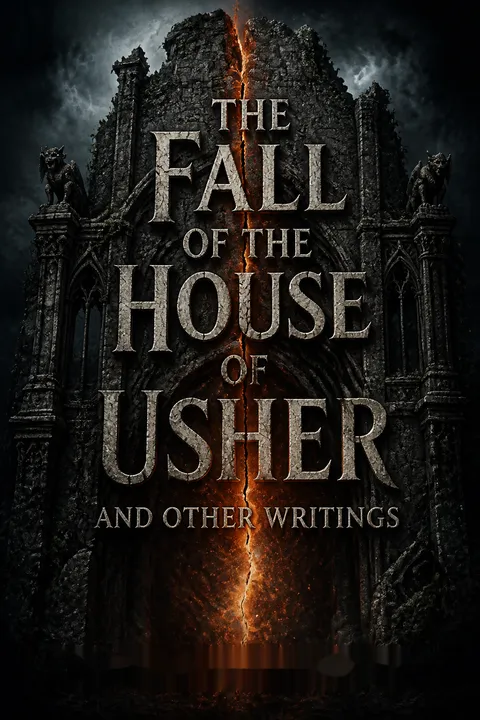
The story opens with a solitary narrator arriving at the House of Usher, summoned by his childhood friend Roderick Usher. The mansion looms, oppressive and decayed, its reflection in the tarn as unsettling as the house itself. Roderick, tormented by a mysterious malady and acute sensitivity, is bound to his twin sister Madeline, who suffers from cataleptic trances. The siblings' isolation and the house's crumbling state mirror each other, suggesting a hereditary curse. As Madeline seemingly dies and is entombed in the family vault, the house's atmosphere grows more suffocating. The narrator witnesses Roderick's descent into terror, culminating in Madeline's return from the grave and the literal collapse of the house, symbolizing the end of the Usher line and the inescapable grip of ancestral doom.
The Will That Defies Death
In "Ligeia," Poe explores the power of the human will to transcend death. The narrator, obsessed with his enigmatic and learned wife Ligeia, is devastated by her untimely death. He remarries the fragile Lady Rowena, but his grief and opium-fueled visions keep Ligeia's memory alive. As Rowena succumbs to illness, supernatural events unfold: Rowena's corpse revives, only to transform into Ligeia herself. The tale blurs the line between reality and hallucination, suggesting that the force of Ligeia's will—and the narrator's own longing—can conquer mortality. Poe's lush, hypnotic prose immerses the reader in a world where love, death, and the supernatural are inextricably entwined.
Double Lives, Shattered Selves
"William Wilson" and other tales probe the theme of the divided self. William Wilson, tormented by a mysterious double who thwarts his every vice, spirals into paranoia and ruin. The double, sharing his name and appearance, acts as his conscience, ultimately confronting him in a fatal duel. The revelation that he has slain himself—his better nature—underscores Poe's fascination with identity, guilt, and the inescapable shadow of the self. This motif recurs throughout Poe's work, reflecting his own struggles with inner demons and the universal fear of losing control over one's mind.
The Logic of Terror
Poe's detective stories, especially "The Murders in the Rue Morgue," introduce C. Auguste Dupin, whose analytical prowess solves crimes that baffle the police. Dupin's method—combining observation, imagination, and logic—unmasks the true culprit: not a human, but an escaped orangutan. The story juxtaposes the rational mind against the chaos of violence and the grotesque. Poe's innovation lies in making terror intelligible, showing that even the most inexplicable horrors can be unraveled by reason, yet leaving a residue of the uncanny that logic cannot dispel.
The Abyss Beckons
In "A Descent into the Maelström," a fisherman recounts his harrowing survival after being sucked into a colossal whirlpool. Facing certain death, he observes the patterns of objects in the vortex and escapes by clinging to a barrel. The story is a meditation on the sublime terror of nature and the thin line between reason and madness. Poe's vivid descriptions evoke awe and dread, while the protagonist's analytical detachment in the face of doom echoes the tension between intellect and primal fear that pervades Poe's fiction.
Love and Loss Beyond the Grave
Poe's poetry—"Annabel Lee," "The Raven," "Lenore," and others—returns obsessively to the death of beautiful women and the agony of the bereaved lover. These poems blend musicality, melancholy, and supernatural longing, as the narrators seek solace or reunion with the lost beloved. The boundary between life and death blurs; memory becomes both a torment and a refuge. Poe's lyricism transforms personal grief into universal myth, making the dead beloved an emblem of unattainable beauty and eternal yearning.
Masks, Masquerades, and Madness
Stories like "The Masque of the Red Death," "Hop-Frog," and "The Cask of Amontillado" use masquerade and carnival as settings for horror and retribution. In "The Masque of the Red Death," Prince Prospero's attempt to escape plague through revelry ends in the arrival of Death itself. "Hop-Frog" enacts a dwarf's fiery revenge on his tormentors during a masquerade, while "The Cask of Amontillado" follows a meticulously planned murder beneath the guise of friendship and festivity. Poe's use of masks and performance exposes the thin veneer of civilization, revealing the violence and madness lurking beneath.
The Music of Melancholy
Poe's essays and poems articulate his theory of poetry as the pursuit of beauty, best expressed through melancholy and musicality. In "The Philosophy of Composition" and "The Poetic Principle," he argues that the highest poetry evokes an "elevating excitement of the soul," often through the contemplation of loss and the unattainable. Poems like "To Helen" and "Ulalume" exemplify this ideal, their rhythms and imagery designed to induce a trance-like state. For Poe, beauty and sorrow are inseparable, and poetry's power lies in its ability to transport the reader beyond the mundane.
The Art of the Short Story
Poe's critical writings revolutionize the short story, insisting on unity of effect and the meticulous construction of narrative. In reviews and essays, he champions the tale as a form superior to the novel for its ability to produce a single, intense impression. His own stories—whether tales of ratiocination, horror, or the grotesque—are crafted with precision, each detail contributing to the overall mood. Poe's influence shapes the modern short story, emphasizing economy, structure, and the psychological impact of fiction.
The Science of the Strange
Poe's fascination with puzzles, codes, and the boundaries of knowledge animates stories like "The Gold-Bug," "The Purloined Letter," and "The Facts in the Case of M. Valdemar." Characters pursue hidden meanings, secret messages, and forbidden experiments, often at the cost of their sanity or morality. Poe's blend of scientific curiosity and gothic atmosphere anticipates both detective fiction and science fiction, exploring the dangers and seductions of the unknown. The stories question whether reason can truly master the irrational, or whether some mysteries are best left unsolved.
The Poetic Principle
Poe's essays on poetry and art—"The Poetic Principle," "The Philosophy of Composition," and others—define his aesthetic creed. He rejects didacticism and moralizing, insisting that poetry's true aim is the creation of beauty and emotional elevation. The artist, for Poe, is a visionary who glimpses the ideal and strives to evoke it through language, music, and imagery. This principle underlies all his work, from the structure of his tales to the haunting refrains of his poems, and sets him apart as a theorist of art as well as a practitioner.
The Uncanny and the Unseen
Poe's stories often center on the terror of being buried alive ("The Premature Burial," "The Fall of the House of Usher"), the mysteries of the mind ("The Black Cat," "The Tell-Tale Heart"), and the boundaries between life and death ("The Facts in the Case of M. Valdemar"). These tales exploit primal fears and the limits of perception, using unreliable narrators and ambiguous realities to unsettle the reader. The uncanny arises from the familiar made strange, the ordinary invaded by the inexplicable.
The Burden of Memory
Many of Poe's narrators are haunted by guilt and compelled to confess their crimes, as in "The Tell-Tale Heart" and "The Black Cat." The act of narration becomes an exorcism, but also a trap, as the past cannot be undone. Memory is both a source of torment and a means of self-destruction. Poe's exploration of psychological horror anticipates modern understandings of trauma and the compulsion to repeat or reveal what one most wishes to forget.
The Dance of Vengeance
Vengeance is a recurring motif, from the calculated murder in "The Cask of Amontillado" to the fiery retribution of "Hop-Frog." Poe's avengers are often driven by perceived slights or deep wounds, their actions both meticulously planned and disturbingly disproportionate. The stories question the possibility of justice and the corrosive effects of revenge, often ending in madness, death, or the collapse of order. The dance of vengeance is both a personal and societal drama, exposing the darkness at the heart of human relations.
The Limits of Reason
While Poe's detectives and rationalists seek to impose order on chaos, many of his characters succumb to obsession, delusion, or insanity. The line between reason and madness is perilously thin, and the very faculties that enable insight can also lead to destruction. Poe's work interrogates the Enlightenment faith in reason, suggesting that the mind is as much a source of terror as of understanding. The stories dramatize the struggle to distinguish reality from hallucination, self from other, sanity from madness.
The Allure of the Beautiful
Beauty in Poe's universe is both transcendent and dangerous. The artist's pursuit of the ideal, as in "The Oval Portrait," can become an obsession that destroys its object. The beautiful woman, often dead or dying, is the ultimate muse and the ultimate loss. Poe's aestheticism is tinged with morbidity, as the desire for perfection leads to isolation, despair, or death. Yet beauty remains the highest value, the source of poetry's power and the artist's inspiration.
The Descent Into Obsession
Poe's own struggles with addiction and mental anguish find expression in stories of compulsion and decline. Characters are driven by irresistible urges—to drink, to kill, to confess, to solve, to love beyond death. The spiral of obsession is both a personal and artistic theme, as the pursuit of forbidden knowledge or forbidden pleasure leads to ruin. Poe's work is a study in the psychology of obsession, its pleasures and its perils.
The Enduring Shadow
The final chapter reflects on Poe's lasting impact on literature and culture. His innovations in the short story, detective fiction, and poetry have shaped generations of writers. The themes of terror, beauty, and the uncanny continue to resonate, as does his exploration of the mind's darkest recesses. Poe's shadow endures, a testament to the power of art to confront and transform the fears that haunt us all.
Analysis
Poe's collected writings, as exemplified in "The Fall of the House of Usher and Other Writings," represent a foundational moment in the evolution of modern literature. His relentless pursuit of beauty, unity, and psychological depth set new standards for both poetry and prose. Poe's tales probe the darkest corners of the human mind, exposing the fragility of reason, the power of obsession, and the terror of the unknown. His innovations in narrative structure, the unreliable narrator, and the detective story have influenced countless writers, from Baudelaire and Dostoevsky to modern horror and crime fiction. At the heart of Poe's work is a tension between the rational and the irrational, the beautiful and the grotesque, the longing for transcendence and the inevitability of decay. His art is both a mirror and a labyrinth, inviting readers to confront their own fears, desires, and contradictions. The lessons Poe imparts are as relevant today as in his own time: the necessity of confronting the self, the dangers of unchecked passion, and the redemptive, if perilous, power of imagination. In Poe's universe, terror is not merely a genre but a mode of understanding, and beauty is inseparable from loss. His enduring shadow reminds us that literature's greatest gift is its ability to make us feel, question, and dream beyond the limits of the known.
Last updated:
Report IssueReview Summary
People Also Read

Characters
Roderick Usher
Roderick Usher is the last male heir of the Usher family, living in a crumbling mansion that mirrors his own psychological and physical deterioration. He is hypersensitive, artistic, and tormented by a hereditary malady that blurs the line between sanity and madness. His intense bond with his twin sister Madeline suggests both deep affection and a morbid, possibly incestuous, connection. Roderick's fears and obsessions drive the narrative toward catastrophe, as his inability to escape the family curse leads to the destruction of both house and lineage. He represents the fragility of the mind and the inescapable weight of the past.
Ligeia
Ligeia is the narrator's first wife in the eponymous tale, a woman of extraordinary intellect, beauty, and willpower. Her presence is ethereal yet commanding, and her death leaves the narrator consumed by grief and obsession. Ligeia's will is so powerful that it appears to conquer death itself, as she returns in the body of the narrator's second wife, Rowena. She embodies Poe's ideal of the beautiful, doomed woman and the notion that love and will can transcend mortal limits. Ligeia's character blurs the boundaries between reality and the supernatural, reason and madness.
C. Auguste Dupin
Dupin is Poe's archetypal detective, introduced in "The Murders in the Rue Morgue." He is brilliant, eccentric, and reclusive, delighting in puzzles and the exercise of ratiocination. Dupin's method combines keen observation, imaginative empathy, and logical deduction, allowing him to solve mysteries that confound the authorities. He represents the triumph of intellect over chaos, yet his detachment and fascination with the macabre hint at the thin line between genius and obsession. Dupin's legacy endures in the detective fiction tradition, influencing characters from Sherlock Holmes to modern sleuths.
William Wilson
William Wilson is both protagonist and antagonist in his story, pursued by a double who shares his name and appearance. The double acts as a moral check, intervening whenever Wilson succumbs to vice or cruelty. The psychological torment culminates in a fatal confrontation, revealing that Wilson's enemy is his own conscience. The character dramatizes the struggle between desire and restraint, self and shadow, and the destructive consequences of denying one's better nature. Wilson's fate is a cautionary tale about the dangers of unchecked ego and the inescapability of guilt.
The Narrator (Various Tales)
Poe's narrators are often unnamed, unreliable, and psychologically unstable. Whether confessing to murder ("The Tell-Tale Heart," "The Black Cat"), mourning a lost love ("The Raven," "Annabel Lee"), or recounting supernatural events ("Ligeia," "Usher"), they draw the reader into their subjective realities. Their obsessions, delusions, and compulsions drive the plots, blurring the line between truth and madness. Through these narrators, Poe explores the depths of human consciousness, the power of memory, and the terror of losing control over one's mind.
Madeline Usher
Madeline is Roderick Usher's twin sister, afflicted by mysterious cataleptic trances. Her presence is ghostly and passive, yet she exerts a powerful influence over her brother and the house. Her premature burial and return from the tomb are the story's climactic horrors, embodying fears of death, entrapment, and the uncanny. Madeline's fate is inseparable from Roderick's, and her final appearance precipitates the collapse of both family and mansion. She represents the repressed, the unspoken, and the inescapable return of the past.
Montresor
Montresor, the narrator of "The Cask of Amontillado," is a model of cold, methodical vengeance. Insulted by Fortunato, he plots and executes a perfect crime, luring his victim into the catacombs and immuring him alive. Montresor's rationality and composure mask a deep-seated malice, and his confession, years later, suggests lingering guilt or pride. He embodies the dark side of reason, the capacity for cruelty beneath civility, and the dangers of unchecked resentment.
Fortunato
Fortunato is Montresor's target, a man whose pride in his connoisseurship and obliviousness to danger lead to his doom. Dressed as a jester during carnival, he is both comic and tragic, his trust and arrogance exploited by Montresor. Fortunato's fate is a warning about the perils of pride, the blindness of self-assurance, and the vulnerability of those who fail to see the malice in others.
Hop-Frog
Hop-Frog is a dwarf and court jester, physically deformed and emotionally wounded by the cruelty of the king and his ministers. Pushed to the brink by humiliation and the abuse of his friend Trippetta, Hop-Frog devises a spectacular revenge, burning his tormentors alive during a masquerade. He is both victim and avenger, using his outsider status and ingenuity to turn the tables on his oppressors. Hop-Frog's story is a meditation on power, justice, and the explosive potential of the marginalized.
The Beautiful Dead Woman
Across Poe's work, the figure of the beautiful, deceased woman recurs as the ultimate object of love, loss, and artistic inspiration. Whether named Ligeia, Lenore, Annabel Lee, or Madeline, she embodies unattainable beauty, purity, and the pain of separation. Her death is both a personal tragedy and a poetic ideal, fueling the narrator's longing and the creation of art. She is at once a symbol of the sublime and a reminder of mortality, the intersection of eros and thanatos in Poe's imagination.
Plot Devices
Unity of Effect
Poe's stories and poems are crafted with the principle of unity of effect, meaning every element—plot, setting, character, diction—serves to produce a single, intense emotional response in the reader. This device is articulated in his critical essays and realized in his fiction, where atmosphere, pacing, and imagery are orchestrated to evoke terror, melancholy, or awe. The unity of effect distinguishes Poe's work from the sprawling narratives of his contemporaries, making his tales models of concision and psychological depth.
Unreliable Narrator
Many of Poe's stories employ first-person narrators whose credibility is questionable, either due to madness, obsession, or deliberate deceit. This device creates ambiguity, draws the reader into the narrator's distorted perspective, and heightens suspense. The unreliable narrator blurs the boundary between reality and hallucination, inviting the reader to question the truth of the narrative and to experience the protagonist's psychological turmoil.
Doubling and the Doppelgänger
The motif of the double recurs in stories like "William Wilson" and "Usher," symbolizing the divided self, conscience, and the struggle between opposing impulses. Doubling serves as both a plot mechanism and a psychological metaphor, dramatizing the conflict between desire and restraint, reason and madness. The device often leads to self-destruction, as the protagonist is unable to reconcile the warring parts of his identity.
Premature Burial and Entrapment
Poe exploits the fear of being buried alive or trapped, both literally and metaphorically, in stories like "The Fall of the House of Usher," "The Black Cat," and "The Pit and the Pendulum." These plot devices evoke primal terror, symbolize psychological repression, and serve as metaphors for the inescapability of guilt, memory, or fate. The motif of entrapment intensifies suspense and underscores the characters' helplessness before forces beyond their control.
Cryptography and Puzzles
Poe's fascination with cryptography appears in stories like "The Gold-Bug" and "The Purloined Letter," where the solution of puzzles drives the plot. These devices reflect Poe's interest in the interplay between reason and mystery, the thrill of discovery, and the dangers of obsession. The use of codes and riddles also serves as a metaphor for the act of reading itself, inviting the audience to become detectives and interpreters.
Foreshadowing and Symbolism
Poe's stories are rich in foreshadowing and symbolic detail, from the fissure in the House of Usher to the raven's repeated "Nevermore." These devices create a sense of inevitability, deepen the emotional resonance, and invite multiple interpretations. Symbolism allows Poe to explore abstract themes—death, beauty, madness—through concrete images, enhancing the unity of effect and the haunting quality of his work.
About the Author
Edgar Allan Poe was a versatile American writer born in 1809 to traveling actors in Boston. After his parents' death, he was raised by a wealthy merchant in Richmond. Poe is renowned for his tales of terror, detective stories, and haunting poetry, including works like "The Tell-Tale Heart" and "The Raven." Despite his reputation as a morbid figure, much of this image stems from a defamatory biography. Poe's literary career began in 1827, and he became America's first great literary critic. He aspired to be a writer from a young age, inspired by Lord Byron, despite his adoptive father's wishes for him to pursue business.
Other books by Edgar Allan Poe
Download PDF
Download EPUB
.epub digital book format is ideal for reading ebooks on phones, tablets, and e-readers.








































