
Summary Unavailable
This book is not suitable for a summary (it may be a textbook, workbook, cookbook, reference book, or collection). However, you can still explore the FAQs, about author, and other metadata below!
Plot Summary
Mirrors and Infinite Worlds
In a Buenos Aires study, a chance encounter with a mysterious encyclopedia entry leads to the discovery of Uqbar, a fictional land, and Tlön, an invented planet. As the narrator and his friend unravel the layers of this fabricated reality, they find that the boundaries between fiction and the real world blur. The secret society behind Tlön's creation demonstrates the power of collective imagination, as the world begins to adopt the customs, language, and metaphysics of this invented place. The story becomes a meditation on the nature of reality, the seductive order of invented worlds, and the labyrinthine interplay between creation and discovery.
The Forking Paths of Fate
During World War I, a Chinese spy named Yu Tsun races against time to deliver a secret to his German masters. Pursued by the relentless Captain Madden, Yu Tsun's journey leads him to the home of Stephen Albert, a sinologist who reveals the secret of Yu Tsun's ancestor's labyrinthine novel—a book where every possible outcome occurs, creating a garden of forking paths. In a desperate act, Yu Tsun murders Albert, using the act as a coded message. The story explores the infinite possibilities of time, the burden of choice, and the tragic consequences of actions that ripple through countless parallel realities.
Chance and the Company
In Babylon, the lottery is not just a game but the foundation of society. The narrator recounts how the lottery evolved from a simple gamble to a system that determines every aspect of life—wealth, punishment, even fate itself. The mysterious Company orchestrates these outcomes, blurring the line between chance and design. As the lottery's influence grows, reality itself becomes a labyrinth of possibilities, where every event is both random and inevitable. The story questions the nature of free will, the role of institutions, and the human need to find meaning in chaos.
Rewriting the Past
Pierre Menard, a twentieth-century writer, sets out not to imitate but to recreate Cervantes' Don Quixote, word for word, as his own work. The narrator marvels at the richness of Menard's identical text, arguing that context and authorship change meaning. This playful meditation on authorship, originality, and interpretation reveals that every act of reading is an act of rewriting, and that the past is continually reimagined by the present. The story becomes a labyrinth of literary mirrors, where every text is both itself and something new.
Dreamers and Their Creations
A nameless magician arrives at a ruined temple, determined to dream a man into existence. Through painstaking effort, he constructs his dream-child, only to realize that he himself is the product of another's dream. The boundaries between creator and creation dissolve, raising questions about the nature of reality, the power of imagination, and the infinite regress of dreamers dreaming dreamers. The story is a haunting meditation on authorship, identity, and the fragile line between the real and the imagined.
The Infinite Library
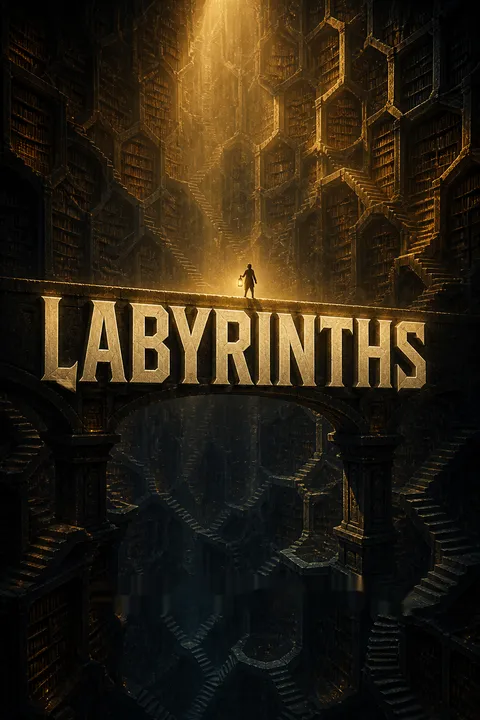
The narrator describes a universe composed of endless hexagonal galleries, each filled with books containing every possible combination of letters. Amidst this infinite library, librarians search for meaning, order, and the elusive Book of Books. The story explores the paradox of infinite knowledge and infinite ignorance, the futility of seeking certainty, and the beauty and terror of a cosmos where every possibility exists. The library becomes a metaphor for the universe, language, and the human quest for understanding.
Memory's Burden
Ireneo Funes, after an accident, acquires the ability to remember every detail of his life with absolute clarity. While others see this as a gift, Funes is overwhelmed by the endless flood of memories, unable to generalize or forget. His world is paralyzed by detail, and he is incapable of abstract thought. The story reflects on the limits of human cognition, the necessity of forgetting, and the tragedy of a mind that cannot escape the labyrinth of its own memory.
Betrayal and Identity
In a remote province, the narrator meets an Englishman with a mysterious scar. Over drinks, the Englishman confesses that he is Vincent Moon, a traitor who betrayed his comrade during the Irish struggle for independence. Haunted by guilt, he carries the mark of his betrayal on his face. The story delves into the complexities of identity, the inescapability of the past, and the ways in which confession can both reveal and obscure the truth.
Patterns of Treason and Heroism
In a fictionalized Ireland, Ryan investigates the assassination of the national hero Kilpatrick. As he uncovers the layers of conspiracy, he realizes that the events mirror those of Julius Caesar's death, and that the hero was both traitor and martyr. The story suggests that history is a labyrinth of recurring patterns, where betrayal and heroism are intertwined, and where the roles of victim and perpetrator are never fixed.
Labyrinths of Reason
Detective Lönnrot investigates a series of murders that seem to follow a mystical pattern. Obsessed with finding order, he is lured into a trap by his nemesis, Scharlach, who constructs a labyrinth of clues based on the Tetragrammaton. Lönnrot's faith in reason becomes his undoing, as he is killed in the final, symmetrical murder. The story is a meditation on the dangers of overreliance on logic, the seductive power of patterns, and the fatal consequences of seeking meaning in chaos.
Miracles and Time's Suspension
Jaromir Hladik, a writer condemned to death by the Nazis, prays for time to finish his play. As the firing squad prepares to execute him, time freezes, and he is granted a year within a single instant to complete his work. When the year ends, the bullets fly and he dies. The story explores the nature of time, the power of art, and the possibility of redemption through creation, even in the face of death.
Heresy and Redemption
Nils Runeberg, a theologian, reinterprets the story of Judas Iscariot, arguing that Judas's betrayal was a necessary sacrifice, even a form of asceticism or divinity. Runeberg's radical ideas lead to his isolation and death, but his vision of redemption through infamy challenges conventional notions of good and evil. The story probes the boundaries of faith, the paradoxes of salvation, and the heretical potential of interpretation.
The Secret Brotherhood
The sect of the Phoenix is a secret society whose members are found in every culture and era. Their only unifying feature is a mysterious, trivial rite passed down through generations. The story suggests that beneath the surface of history, there is a hidden unity, a shared secret that transcends language, nation, and time. The Phoenix becomes a symbol of eternal recurrence, transformation, and the enigmatic bonds that connect all people.
Immortality's Curse
A Roman soldier seeks the City of the Immortals and, after a harrowing journey, finds it inhabited by apathetic, almost inhuman beings. Immortality has stripped them of purpose, memory, and individuality. The narrator eventually regains mortality and realizes that the value of life lies in its transience. The story is a profound meditation on time, identity, and the meaninglessness of existence without death.
Theological Labyrinths
In a time of religious turmoil, two theologians, Aurelian and John of Pannonia, become rivals as they debate heresies about time and the nature of the soul. Their intellectual duel leads to betrayal, persecution, and ultimately, a revelation that in the eyes of the divine, all distinctions are illusory. The story explores the labyrinthine nature of theological debate, the futility of dogma, and the unity of opposites.
Transformation and Captivity
Through two parallel stories—a Lombard warrior who defends the city he once attacked, and an Englishwoman who becomes an Indian chieftain's wife—Borges examines the transformative power of culture and circumstance. Both characters are swept by forces beyond their understanding, abandoning their origins to embrace new identities. The stories reflect on the fluidity of belonging, the arbitrariness of loyalty, and the mysterious impulses that shape destiny.
Vengeance and Justice
Emma Zunz, a young woman, seeks revenge for her father's death by killing his former employer, Loewenthal. To create an alibi, she endures a personal violation, ensuring her story will be believed. The narrative blurs the lines between truth and falsehood, justice and crime, as Emma's actions are both righteous and morally ambiguous. The story is a powerful exploration of trauma, agency, and the cost of vengeance.
The Minotaur's Solitude
Asterion, the Minotaur, narrates his life within an endless house, awaiting his redeemer. He perceives himself as unique, misunderstood, and even benevolent, delivering visitors from evil. When Theseus arrives, Asterion's death is swift and unresisting. The story inverts the myth, inviting empathy for the monster and questioning the nature of monstrosity, isolation, and redemption.
Evil and the New Order
Otto Dietrich zur Linde, a Nazi war criminal, reflects on his life and crimes before execution. He justifies his actions as part of a larger historical and metaphysical order, embracing violence as a means to remake the world. The narrative exposes the seductive logic of evil, the dangers of ideology, and the self-deceptions that allow individuals to become instruments of atrocity.
The Search for Meaning
Averroes, the great Islamic philosopher, struggles to understand Aristotle's concepts of tragedy and comedy, which have no equivalent in his world. Despite his erudition, he is unable to grasp the essence of drama, illustrating the limits of translation, the isolation of cultures, and the tragic impossibility of complete understanding. The story is a subtle reflection on the boundaries of knowledge and the ironies of intellectual pursuit.
Obsession and the Zahir
After receiving a coin known as the Zahir, the narrator becomes obsessed, unable to think of anything else. The Zahir, which has taken many forms throughout history, is an object that overwhelms the mind, leading to madness or enlightenment. The story explores the nature of obsession, the power of symbols, and the thin line between fixation and transcendence.
Waiting for Retribution
A man living under an assumed name waits in exile, haunted by the certainty that his enemies will find him. His days are marked by routine and anxiety, and his dreams replay the moment of his anticipated death. When his fate finally arrives, he turns away, unable to face it directly. The story is a meditation on guilt, inevitability, and the psychological prison of waiting.
The Divine Script
Tzinacán, a Mayan priest imprisoned by conquistadors, seeks the divine script that will grant him ultimate power. Through years of contemplation and suffering, he glimpses the unity of all things and the secret formula, but upon achieving enlightenment, he loses his sense of self and chooses silence. The story contemplates the limits of knowledge, the price of revelation, and the dissolution of individuality in the face of the infinite.
The Writer's Tradition
Borges reflects on the question of what constitutes an Argentine tradition in literature. Rejecting narrow definitions based on local color or national themes, he argues that writers inherit the entire Western tradition and should embrace universality. The essay challenges the constraints of nationalism, celebrates the freedom of creation, and affirms the writer's right to all cultures and histories.
The Wall and the Infinite
The first Emperor of China, Shih Huang Ti, builds the Great Wall and burns all books predating his reign. These acts of construction and destruction are examined as attempts to control history, memory, and mortality. The essay meditates on the paradoxes of power, the futility of erasing the past, and the enduring tension between order and chaos.
Reflections and Refutations
In a series of essays and parables, Borges explores the nature of time, the unreliability of memory, and the instability of identity. Through philosophical argument and literary invention, he challenges the existence of a stable self, the linearity of history, and the possibility of objective reality. The collection concludes with the recognition that all things are mirrors, all stories are labyrinths, and that the search for meaning is itself an endless, beautiful maze.
Analysis
Borges's Labyrinths is a masterwork of literary invention, philosophical inquiry, and emotional resonance. Through a mosaic of stories, essays, and parables, Borges constructs a universe where reality and fiction, order and chaos, self and other, are inextricably intertwined. The collection challenges readers to question the nature of reality, the reliability of perception, and the limits of knowledge. Borges's use of labyrinths, mirrors, and infinite regress serves as both metaphor and method, inviting us to wander through the mazes of language, memory, and imagination. The stories probe the paradoxes of time, the instability of identity, and the seductive power of creation, while the essays reflect on the responsibilities and freedoms of the writer. In a world increasingly fragmented and uncertain, Labyrinths offers both a warning and a consolation: that meaning is not given but made, that every act of reading is an act of rewriting, and that the search for understanding is itself a beautiful, endless maze. The lessons of the book—skepticism, humility, wonder, and the embrace of ambiguity—remain as vital today as when they were first written, inviting us to become, like Borges, both the dreamers and the dreamed.
Last updated:
Report IssueReview Summary
Labyrinths is a highly regarded collection of Borges' short stories, essays, and parables. Readers praise his imaginative and philosophical writing style, exploring themes of infinity, time, and reality. Many consider it a masterpiece of Latin American literature. The stories are described as complex, labyrinthine, and mind-bending, requiring multiple readings. While some find the writing challenging, most reviewers appreciate Borges' intellectual depth and unique approach to storytelling. The book is seen as influential, inspiring later authors and leaving a lasting impact on literature.
People Also Read
Characters
Borges (The Narrator)
Borges appears throughout the collection as both narrator and character, often blurring the line between author and creation. He is a seeker, a skeptic, and a lover of paradoxes, fascinated by the infinite, the circular, and the impossible. Borges's persona is marked by intellectual curiosity, melancholy, and a sense of playful irony. He is both the dreamer and the dreamed, the detective and the deceived, embodying the book's central themes of identity, authorship, and the limits of knowledge.
Yu Tsun
A Chinese professor and German spy in "The Garden of Forking Paths," Yu Tsun is driven by fear, loyalty, and the need to prove his worth. His journey is marked by anxiety and moral conflict, culminating in a murder that is both a message and a betrayal. Yu Tsun's character embodies the tension between individual agency and the larger forces of history, as well as the tragic consequences of choices made under pressure.
Pierre Menard
Menard is a twentieth-century author who sets out to rewrite Don Quixote, not as imitation but as original creation. His project is both absurd and profound, highlighting the ways in which context, intention, and interpretation shape meaning. Menard's character is a meditation on the nature of authorship, the impossibility of originality, and the endless dialogue between past and present.
Ireneo Funes
Funes, after a debilitating accident, acquires perfect memory, able to recall every detail of his experience. This gift becomes a curse, as he is overwhelmed by the flood of sensations and unable to think abstractly. Funes's character explores the limits of human cognition, the necessity of forgetting, and the tragedy of a mind trapped in the labyrinth of its own memory.
Emma Zunz
Emma is a young woman driven by the need to avenge her father's death. Her meticulous plan for revenge requires her to endure personal violation and to manipulate the truth. Emma's character is marked by determination, resilience, and a profound sense of justice, but also by the moral ambiguity of her actions. She embodies the complexities of agency, victimhood, and the cost of vengeance.
Asterion (The Minotaur)
Asterion narrates his own story from within the labyrinth, perceiving himself as unique, misunderstood, and even benevolent. His innocence and longing for redemption invite empathy, challenging traditional notions of monstrosity. Asterion's character is a meditation on isolation, otherness, and the search for meaning in confinement.
Otto Dietrich zur Linde
Otto is a Nazi war criminal who reflects on his life and crimes with chilling detachment. He justifies his actions as part of a larger historical and metaphysical order, embracing violence as a means to transcendence. Otto's character exposes the dangers of ideology, the seductions of power, and the self-deceptions that enable atrocity.
Tzinacán
A Mayan priest imprisoned by conquistadors, Tzinacán dedicates himself to deciphering the divine script that will grant him power. His journey leads to enlightenment and the dissolution of self, as he chooses silence over omnipotence. Tzinacán's character explores the limits of knowledge, the price of revelation, and the transcendence of individuality.
Nils Runeberg
Runeberg is a religious scholar who reinterprets the story of Judas, arguing for redemption through betrayal. His radical ideas isolate him from his peers and lead to his downfall. Runeberg's character embodies the dangers and possibilities of interpretation, the paradoxes of faith, and the thin line between heresy and revelation.
Averroes
Averroes, the great Islamic thinker, struggles to understand Aristotle's concepts of tragedy and comedy, which have no equivalent in his culture. His intellectual isolation and ultimate failure highlight the limits of language, the barriers between cultures, and the tragic impossibility of complete understanding.
Plot Devices
Labyrinths and Infinite Regress
Borges employs labyrinths—physical, conceptual, and narrative—as central metaphors for the complexity and ambiguity of reality. Whether in the form of literal mazes, infinite libraries, or recursive stories, these structures embody the endless search for meaning, the impossibility of total understanding, and the beauty of the unresolved. The labyrinth becomes a symbol of both the universe and the self, inviting readers to wander, question, and marvel.
Mirrors and Doubles
Mirrors recur throughout the collection as symbols of self-reflection, duplication, and the instability of identity. Characters encounter their own doubles, stories reflect other stories, and texts mirror other texts. This device underscores the fluidity of the self, the interplay between reality and fiction, and the endless possibilities of interpretation.
Circular and Nonlinear Time
Borges frequently disrupts linear chronology, presenting time as a series of forking paths, infinite loops, or simultaneous possibilities. Stories like "The Garden of Forking Paths" and "The Immortal" challenge conventional notions of past, present, and future, suggesting that all moments coexist and that every choice creates new realities. This device invites readers to reconsider the nature of causality, destiny, and free will.
Metafiction and Self-Reference
Many of Borges's tales are explicitly about the act of writing, reading, or interpreting. Characters become authors, readers become characters, and texts comment on their own creation. This metafictional approach blurs the boundaries between fiction and reality, inviting readers to participate in the construction of meaning and to question the authority of the text.
Paradox and Irony
Borges delights in paradoxes—statements or situations that defy logic or contain their own negation. Whether through philosophical argument, narrative structure, or character motivation, these contradictions expose the limitations of reason and the richness of ambiguity. Irony pervades the collection, challenging readers to embrace uncertainty and to find meaning in the unresolved.
Secret Societies and Hidden Orders
Several stories feature secret organizations—the creators of Tlön, the Company in Babylon, the sect of the Phoenix—that manipulate events from behind the scenes. These groups represent the hidden structures that govern society, history, and even the universe itself. Their presence raises questions about agency, fate, and the possibility of true knowledge.
Foreshadowing and Circular Endings
Borges often employs foreshadowing, embedding hints of future events or revelations within the narrative. Many stories end where they began, or reveal that the journey was circular all along. This structural device reinforces the themes of recurrence, inevitability, and the inescapability of the labyrinth.
About the Author
Jorge Luis Borges was an Argentine writer known for his short stories, essays, and poems. His most famous works, Ficciones and El Aleph, explore themes like dreams, labyrinths, and infinity. Borges significantly influenced 20th-century literature, particularly the magic realist movement. Born in Buenos Aires, he spent time in Europe before returning to Argentina. Borges worked as a librarian and professor, becoming completely blind by age 55. His work gained international recognition in the 1960s, earning him prestigious literary prizes. Fluent in multiple languages, Borges was praised for renovating the language of fiction and inspiring a generation of Spanish-American novelists.
Other books by Jorge Luis Borges
Download PDF
Download EPUB
.epub digital book format is ideal for reading ebooks on phones, tablets, and e-readers.








































