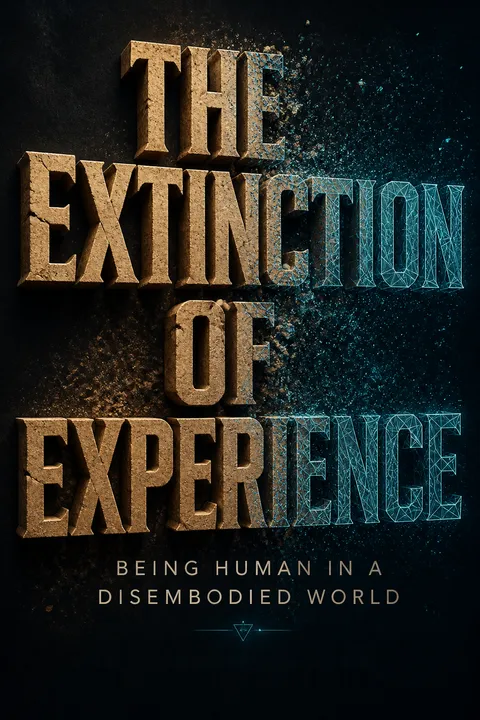

Key Takeaways
1. Technology is eroding direct human experience and a shared sense of reality.
More and more people create their own realities rather than live in the world around them.
Disappearing experiences. Our daily lives are increasingly mediated by technology—smartphones, smart speakers, algorithms, and virtual realities—blurring the lines between the "virtual" and the "real." This constant mediation leads to a profound confusion and mistrust of everyday experience, with individuals crafting personalized realities rather than engaging with a consensus reality. Extreme examples, like QAnon conspiracy theorists, illustrate how online realms can reshape real-world actions.
Pseudo-reality reigns. What once passed for authentic experience is now often vicarious and virtual, a "pseudo-reality" governed by algorithms. This wasn't a deliberate plot but an unintended consequence of embracing the internet's convenience and fun. However, this "slow bleed of reality" has become a culture-wide destabilizing force, with ambitious projects like the Metaverse promising entirely online lives, where we are "Users" meant to prefer engineered "User Experiences" to human reality.
Mistrusting our senses. Technology, initially an extension of our senses, now trains us to mistrust them, placing us in the role of spectators rather than navigators. The very language we use to describe human experiences is co-opted; "sensorium," once describing our physiological and cultural interpretation of sensory input, is now a digital entertainment company promising to move "real-life experiences" to the virtual world, freeing us from "earthly limitations."
2. Face-to-face interaction, a primal human skill, is deteriorating.
If you don’t regularly exercise your ability to connect face to face, you’ll eventually find yourself lacking some of the basic biological capacity to do so.
Primal connection. Humans are biologically wired for face-to-face interaction, a skill developed over millions of years to read emotions and intentions through subtle gestures, movements, and facial expressions. Intense eye contact, for instance, triggers physiological responses like increased heart rate and neurotransmitter release, crucial for connection and empathy. This "empathy engine" deteriorates without regular use.
Mediated communication's impact. The shift to screen-mediated communication alters our behavior, making us less adept at assessing trustworthiness and fostering "motivational enhancement effects" that make people more skilled at deception. Studies show that in-person requests for help are significantly more successful, and face-to-face conversations lead to "deeper and smoother social engagement" compared to online chats, which often involve more self-reference and fewer questions about others.
Civil disengagement. Personal technologies, especially smartphones, drain "civil attention" in public spaces. Instead of civil inattention—a brief acknowledgment of others—we engage in "civil disengagement," focusing on screens and ignoring those around us. This leads to a decline in common courtesy and social skills, as seen in automated airport experiences or self-checkout kiosks, where human interaction is systematically replaced by technology.
3. Hands-on skills like handwriting and drawing are disappearing, impacting cognition.
Handwriting is important for the early recruitment in letter processing of brain regions known to underlie successful reading.
The disappearing trace. Handwriting, once a fundamental skill, is rapidly disappearing, replaced by typing and swiping. This loss isn't just nostalgic; it impacts measurable cognitive skills. Research shows that handwriting, unlike typing or tracing, primes the brain for learning to read and enhances word recognition, memory, and the ability to express ideas, particularly in children.
Cognitive benefits. Studies reveal that students taking notes by hand perform better on conceptual questions than those using laptops. The slower pace of handwriting forces summarization and deeper processing of information, whereas typing often leads to verbatim transcription, hindering learning. This shift from pen to keyboard is a subtle but significant change in how we understand and interact with our world.
Loss of craft. Beyond handwriting, other embodied skills like drawing are also in decline, even in professions like architecture. While computer-assisted design (CAD) offers precision and efficiency, it can lead to "false precision" and a loss of the "fertile territory of the subliminal accident" that hand-drawing provides. Working with our hands fosters virtues like patience, perseverance, and diligence, which are often overlooked in our fast-paced, technology-driven age.
4. Our capacity for patience and coping with boredom is rapidly diminishing.
Our ability to mute our hard-wired reactions by pausing is what differentiates us from animals.
The war against waiting. We live in a "Disneyfied" world where every waiting experience is designed to prevent us from experiencing the real passage of time. From theme park FastPasses to instant loading web pages, technology has cultivated an expectation of "nowness," where even milliseconds of delay are deemed unacceptable. This relentless acceleration changes our expectations about what is worth waiting for.
Impatience's consequences. This diminishing patience has tangible social consequences, from road rage incidents—often queuing disputes played out at high speed—to a growing sense of entitlement that allows people to buy or cheat their way out of waiting. Our habituation to speed makes us more impatient in daily interactions, sacrificing attention and care for expediency, and leading to a "poverty of attention" and self-regulation.
The purpose of boredom. Unmediated interstitial time, once filled with daydreaming and reflection, is going extinct, replaced by constant digital distraction. While boredom is often seen as negative, it can be a catalyst for creativity and self-awareness. By outsourcing our attention to devices, we eliminate boredom without learning to cope with it, losing valuable "fallow moments" that are central to human experience and the development of virtues like patience and anticipation.
5. Emotional expression and empathy are increasingly mediated and deskilled.
If things are happening too fast, you may not ever fully experience emotions about other people’s psychological states.
Emotional punctuation. Memes and emojis are creative attempts to translate complex emotional lives to screens, but they also highlight our struggle to reconcile human emotions with technological limitations. While they offer a form of "emotional punctuation," they can also "leach meaning from strong expressions of emotion," fostering a "low emotional risk" communication style that replaces genuine connection with superficial "lovefests."
Empathy erosion. Spending more time in mediated environments undermines our ability to read others' emotions and intentions, leading to assumptions of the worst about motives. Studies show a significant decline in empathy among college students, coinciding with increased smartphone adoption. Online platforms, designed to maximize engagement, often favor heightened emotions like anger, contributing to a "self-promotion–envy spiral" and "digilante" justice.
Outsourcing awareness. Technology companies are developing "emotionally aware machines" and sensors that track our physiological and emotional states, promising to reveal our true feelings and even "engineer our lives." While marketed as tools for self-awareness, these "persuasive technologies" risk creating "mass emotional deskilling," where we outsource emotional reflection and become less capable of dealing with the uncontrollable aspects of human experience.
6. Pleasure is becoming delethalized, commodified, and vicarious.
Unnaturally strong explosions of strong synthetic experience and sensation and pleasure evoke unnaturally strong desires of habituation.
Sanitized adventures. Travel, once a source of disorientation and unexpected thrills, is now often "delethalized" and mediated by technology, offering convenience, safety, and a "false sense of security." This leads to a relentless self-documentation of experiences, where "photograph-trophies" and social media posts replace genuine immersion, and the "image of the thing received more attention than the thing itself."
Datafied desires. Our pleasures—food, sex, art, music—are increasingly filtered through devices and software, becoming data points that form a "digital portrait of human urges." This new "pleasure principle" is governed by the pleasure of technology use itself and the feelings it fosters, leading to a "reality disappointment" where the mediated image seems more satisfying than the unpredictable, inconvenient real thing.
Vicarious consumption. We are increasingly consuming vicarious pleasures, from mukbang videos to fantasy football lounges, and even "sex doll brothels." This shift, while offering efficiency and streamlined performance, risks "carnal alienation" and an erosion of empathy. The more we rely on technology to mediate our pleasures, the more we risk losing the "fleeting whispers of pleasure" from unmediated, tactile experiences.
7. Sense of place and serendipity are being replaced by engineered spaces and algorithms.
Space is transformed into place as it acquires definition and meaning.
From place to space. Civil society has historically been rooted in physical "places"—taverns, plazas, neighborhoods—that foster community and face-to-face interaction. However, technology has made "place" seem irrelevant, replacing it with boundless "spaces" like cyberspace. Smartphones enable "place-shifting" and constant connection, but also ubiquitous location tracking, making "where we are" less important than "how we present ourselves online."
Engineered serendipity. Technology companies aim to "calculate" and "produce" serendipity electronically, replacing organic discovery with algorithmic recommendations. This "industrialization of the ineffable" creates "smart cities" designed around data rather than people, where unexpected encounters diminish, and public spaces become homogenized and predictable, often colonized by technology users "doing their best to be nowhere."
Uprootedness and isolation. This technology-enabled "uprootedness" contributes to social isolation, with fewer people knowing their neighbors and a preference for online relationships over in-person interactions. While virtual communities offer a sense of belonging with limited commitment, they lack the "leveling influence" and "pure sociability" of traditional "third places," which are crucial for civic engagement and fostering genuine human connection.
8. The "User Experience" prioritizes efficiency over the richness of the "Human Condition."
What kind of person is formed in an increasingly digitized, mediated, hyperconnected, surveilled, and algorithmically governed world?
Human vs. User. The book posits a fundamental shift from understanding the "Human Condition"—embodied, fragile, toggling between mediated and unmediated, requiring private spaces, and finite—to the "User Experience"—disembodied, digital, trackable, databased, lacking privacy, and promising no limits. This transformation prioritizes efficiency, predictability, and convenience, often at the expense of deeper human values.
Technological virtues. Our culture increasingly values the "technological virtues" of speed, efficiency, and seamlessness, leading us to mimic these traits in our personal lives. This attitude encourages us to act like "technicians of our private lives," believing that efficiency in human interactions is inherently superior, even if it means sacrificing pleasantries or the time needed for genuine connection.
The cost of seamlessness. While technology promises an "automatic, effortless, and seamless" life, this pursuit of comfort and convenience makes the unavoidable limitations and challenges of our own and others' bodies harder to bear. By eliminating "inefficiencies" and mediating nearly every experience, we risk undermining our own humanity and becoming more machinelike ourselves, prioritizing control over the messy, unpredictable richness of human existence.
9. Reclaiming unmediated experiences is crucial for a flourishing human future.
Defending reality is not a privilege; it’s crucial to ensuring a flourishing human future.
Beyond "Reality Privilege." The idea that most people should embrace virtual existences because their real lives are "reality deprived" is a dystopian vision that severely curtails human choice and well-being. Total immersion in virtual worlds or pervasive "Experience Pill" technologies threaten mental and physical health, leading to unfree societies where choices are limited by surveillance and algorithmic nudges.
Reintroducing friction. To liberate ourselves from technology's unhealthy influence, we must reintroduce "friction" into our seamless lives. This involves actively choosing more face-to-face interactions, cultivating smartphone-free spaces, curbing instant gratification, and understanding the opportunity costs of excessive online time. It means reviving virtues and practices that foster healthier communities, like the Amish's robust skepticism towards new devices.
Cultivating skepticism. We need to hold technology companies accountable, questioning their mercenary self-interest cloaked in "gauzy claims about connecting people." This includes demanding regulations, especially concerning children's online exposure, and recognizing that technology is ambivalent—an instrument of both liberation and repression. By consciously choosing to engage with the physical world and its inherent complexities, we can reclaim our embodied, quirky, contradictory, and resilient humanity.
People Also Read





Download PDF
Download EPUB
.epub digital book format is ideal for reading ebooks on phones, tablets, and e-readers.








































