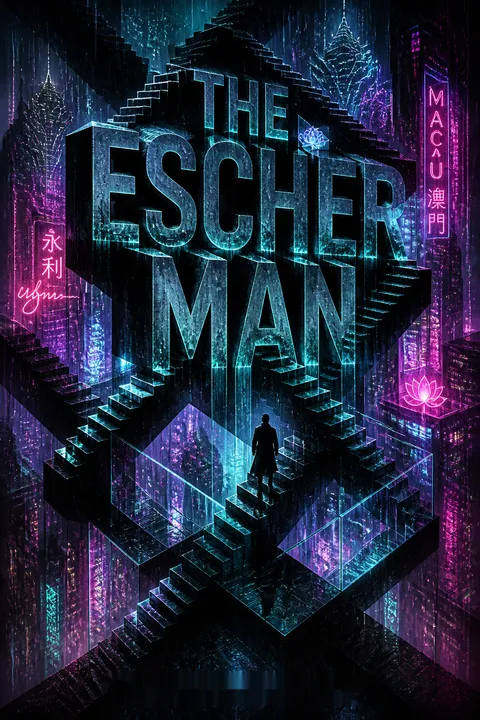

Plot Summary
Macau's Violent Calligrapher
Endel Ebbinghaus, a hardened enforcer, stalks the rain-soaked, neon-lit streets of Macau, executing a hit with cold precision. He reflects on the three ways people face death—bribery, begging, or denial—before dispatching his target, Fred Bartlett, with ruthless efficiency. Endel's world is one of violence, where memory is both a weapon and a curse. The city's casinos pulse with life, but for Endel, each job is another step into moral numbness. His only solace is the ritual of violence, the fleeting satisfaction of a job done, and the knowledge that in Macau, nothing and no one is remembered for long. The city swallows all, leaving only ghosts behind.
Ghosts of Family and Memory
Endel's private pain is revealed as he watches his ex-wife Jian and their daughter Kylie from afar, aching for a family he's lost to his own violence. The city's relentless rain mirrors his internal desolation. Despite his longing, Endel knows he can never reclaim what he's lost; his nature as a violent man has exiled him from love. The brief, bittersweet glimpses of his daughter and the life he might have had are all that remain, memories that both sustain and torment him. The past is a wound that never heals, and Endel is left to ride through the city's chaos, his pain hidden behind a mirrored visor.
Syndicate Deals and Memory Pins
Endel meets with his employer, Mister Long, and the deadly Chrome Linh Phu, navigating the treacherous politics of the Macau underworld. Memory pins—devices that record and alter memories—are exchanged and updated, blurring the line between reality and fabrication. Endel's sense of self is eroded by these manipulations, as he drinks to numb the confusion and loss. The Syndicate's power is built on controlling not just the city, but the very minds of its enforcers. Endel's reflection in the bar mirror is that of a stranger, his identity slipping away with every new memory upload.
The Drunk's Repetition
Endel's life spirals through cycles of drinking, gambling, and violence. Haunted by dreams of betrayal and loss, he lashes out in bars, seeking oblivion in alcohol and fights. His memories are unreliable, shifting with each replay on his memory pin. Friends like Wangaratta and Ha try to anchor him, but Endel is adrift, unable to distinguish between real and implanted memories. The city's indifference is mirrored in his own, as he drifts from one violent episode to the next, each one erasing a little more of who he once was.
Shadows of the Past
Endel's encounters with Jian reveal the depth of his memory loss and the pain it causes both of them. He seeks answers from the Omissioner, a memory specialist, who explains the epidemic of memory decline and the dangers of memory pins. The artificial memories implanted by the Syndicate are indistinguishable from reality, leaving Endel uncertain of his own past and culpability. The Omissioner warns that without authentic memory, Endel is becoming a "recall drone," an instrument of others' will, his soul eroded by technology and manipulation.
Omissioner's Truths
The Omissioner details how society's addiction to instant information and memory technology has atrophied natural memory. Memory pins, once a solution, have become a tool for control, allowing anyone with access to rewrite a person's history. Endel's use of memorybane, a drug that induces amnesia, makes him even more vulnerable to manipulation. The Omissioner's story of a fabricated childhood memory illustrates how easily reality can be rewritten. Endel is left with the chilling realization that he may never know what is real, even in his own mind.
The Memorybane Revelation
The Omissioner explains that while artificial memories lack emotional depth, natural memories are rich with feeling and meaning. Endel's substance abuse is a desperate attempt to feel something real. The only hope for authenticity lies in haptic and olfactory memories—touch and smell—that might trigger genuine recollection. But even these are fading. The Omissioner urges Endel to stop using memorybane, protect his pin, and consider escape. Memory, she insists, is civilization itself; without it, humanity is lost.
The Price of Forgetting
Endel's world collapses as he is framed for murder, hunted by the police, and betrayed by those he once trusted. His dreams reveal the truth of his violence—he has hurt those he loves, perhaps even his own daughter. The only way to protect his family is to run, to disappear into the city's shadows. The past is a labyrinth of pain and regret, and Endel is left with nothing but the certainty that he must flee or die.
Escape from the Black Maw
Endel's escape from Macau is fraught with danger. He is pursued by the Syndicate, forced into brutal confrontations with former friends and deadly enemies like Chrome Linh Phu. In a cemetery showdown, he is forced to kill Wangaratta, his closest ally, and barely survives an ambush by Linh. Wounded and desperate, Endel flees to his old apartment, clinging to the hope of saving his family. The city's indifference is absolute; only violence and memory remain.
The Cemetery's Reckoning
The confrontation in the cemetery is a crucible for Endel. Betrayed by false memories and manipulated by the Syndicate, he is forced to confront the reality of his actions and the depth of his loss. Chrome Linh Phu's taunts reveal the extent of his memory tampering—he has forgotten his own daughter, his family erased by design. The only way forward is through violence, but each act takes him further from the man he once was.
Transactional Memories
Endel, wounded and on the run, is reunited with Jian and their daughters. Through the sharing of memory pins, he confronts the truth of his past—his violence, Jian's betrayal, and the pain they have both endured. Transactional memory, the merging of their experiences, offers a path to healing. Endel is forced to accept responsibility for his actions, but also finds hope in the possibility of forgiveness and a new beginning. The family flees together, seeking safety and a future beyond the reach of the Syndicate.
Fugitives in the Ghost City
Endel and his family become fugitives, moving from city to city, always looking over their shoulders. The world outside Macau is a wasteland of abandoned cities and broken dreams. Endel's memories, both his own and Jian's, begin to merge, blurring the boundaries of identity. The threat of the Syndicate is ever-present, and Endel is forced to confront the reality that he may never escape the violence that defines him.
The Diamond-Headed Frog
In a Vietnamese prison, Endel meets Kien, a local who shares a story of a diamond-headed frog—a memory that is not his alone, but shared by others in the town. The revelation that memories can be implanted en masse, erasing individuality and history, is a chilling confirmation of the Syndicate's power. Endel realizes that reality itself is being rewritten, and that he is trapped in a dream not of his own making.
Memory Town's Mirage
Endel is drawn into the heart of Xuan Tang, a resort town that is a façade for the Syndicate's experiments in memory control. The town's inhabitants are sleepwalkers, their histories fabricated, their lives hollow. Endel's investigation reveals a conspiracy to erase and rewrite the memories of entire populations, turning people into docile consumers and slaves. The line between dream and reality blurs, and Endel is left questioning whether he is the dreamer or the dream.
The Dreamer or the Dream
Endel uncovers the Syndicate's ultimate crime: the creation of digital simulations of the dead, used to cover up murders and steal assets. The living are replaced by ghosts, their online presences maintained by AI. Endel's own sense of self is eroded by the constant manipulation of his memories. The only constants are violence and loss. The world is revealed as a series of loops, dreams within dreams, with no escape.
The Syndicate's Endgame
Endel and Linh rise to power within the Syndicate, orchestrating a coup against Mister Long. The war for control of memory technology becomes a war for the soul of humanity. Betrayals abound, and the cost of victory is the loss of self. Endel's memories are weaponized, his identity rewritten again and again. The final confrontation with Long is a battle not just for survival, but for the right to remember, to be human.
The Escher Man's Loop
In the aftermath, Endel is left adrift, his memories wiped, his identity uncertain. Linh ascends to power, but the world is unchanged—money and violence remain the only gods. Endel's final act is to choose obscurity, to step off the endless staircase of violence and memory manipulation. The world continues, a loop without end, as the Escher Man walks the infinite stairs, forever seeking a self that can never be found.
Analysis
A cyberpunk meditation on memory, identity, and powerThe Escher Man is a haunting exploration of what it means to be human in a world where memory is commodified, manipulated, and weaponized. T.R. Napper's near-future Macau is a microcosm of a society addicted to forgetting, where technology offers the illusion of control but delivers only alienation and loss. The novel interrogates the nature of selfhood—if our memories can be rewritten, what remains of the soul? Through Endel's journey, Napper examines the cost of violence, the fragility of love, and the possibility of redemption. The book warns of the dangers of surrendering our histories to corporate and political interests, suggesting that without memory, civilization itself is at risk. Ultimately, The Escher Man is a cautionary tale for the digital age, urging us to cherish the imperfect, painful, and beautiful memories that make us who we are.
Review Summary
The Escher Man receives strong praise (3.89/5) as a gritty cyberpunk thriller exploring memory manipulation and identity. Set in near-future Macau, it follows enforcer Endel "Endgame" Ebbinghaus, whose memories are regularly wiped by his crime boss. Reviewers applaud the fast-paced action, complex characters, and philosophical depth examining how memory shapes identity. Many compare it favorably to Blade Runner, Memento, and Altered Carbon. The Australian-flavored prose and authentic Asian setting stand out. Critics note excessive violence, repetitive elements, and reliance on familiar tropes, though most find it compelling. Fans of cyberpunk and psychological thrillers highly recommend this visceral, thought-provoking novel.
People Also Read




Characters
Endel Ebbinghaus ("Endgame")
Endel is the protagonist, a hitman whose life is defined by violence, addiction, and the gradual erosion of his identity. His relationships—with Jian, his daughters, and his friends—are haunted by loss and regret. Endel's psyche is fractured by the constant manipulation of his memories through technology and drugs, leaving him uncertain of what is real. He is both victim and perpetrator, seeking redemption but trapped in cycles of violence. His journey is one of self-discovery, as he confronts the cost of forgetting and the possibility of forgiveness. Endel's development is marked by moments of clarity and despair, ultimately choosing to step away from the endless loop of violence.
Jian
Jian is Endel's ex-wife, a strong, intelligent woman who represents both the possibility of redemption and the pain of loss. Her relationship with Endel is complex—marked by love, betrayal, and shared trauma. Jian's memories become a lifeline for Endel, offering him a chance to reconnect with his humanity. She is both victim and survivor, navigating the dangers of the Syndicate's world to protect her daughters. Jian's presence is a reminder of what Endel has lost, but also of what he might regain.
Chrome Linh Phu
Linh is Endel's partner in the Syndicate, a deadly enforcer whose loyalty is to power and ambition. She is both ally and antagonist, pushing Endel deeper into the world of violence and memory manipulation. Linh's psychology is shaped by rage and a desire for control; she views memory as a chain to be broken, morality as a weakness. Her relationship with Endel is fraught with tension, attraction, and betrayal. Linh's development is a descent into sociopathy, culminating in her ascension to power and the loss of her own humanity.
Mister Long
Long is the enigmatic boss of the Macau Syndicate, a master manipulator who uses memory technology to control his empire. His ageless, emotionless exterior hides a mind of ancient cruelty. Long's relationship with Endel is one of dominance and exploitation; he is both creator and destroyer, erasing and rewriting the lives of those who serve him. Long's downfall is a result of his own hubris, but his legacy is the world of forgetting he leaves behind.
Wangaratta Nguyen
Wangaratta is Endel's closest ally, an Australian expatriate whose strength and loyalty are ultimately turned against him by the Syndicate's manipulations. His relationship with Endel is one of camaraderie and shared history, but false memories drive them to a tragic confrontation. Wangaratta's fate is a testament to the destructive power of memory tampering and the fragility of trust.
Ha ("Fourhands")
Ha is Wangaratta's partner, a sharp-witted performer who offers Endel counsel and friendship. Her death, orchestrated through false memories, is a turning point for Endel, forcing him to confront the reality of his own actions and the depth of the Syndicate's cruelty. Ha represents the possibility of a different life, one not defined by violence, and her loss is deeply felt.
The Omissioner (Aletheia Milas)
The Omissioner is a memory specialist who serves as both confessor and guide for Endel. She provides the scientific and philosophical framework for the novel's exploration of memory, warning of the dangers of artificial manipulation. Her own fate—murdered for knowing too much—underscores the peril of seeking truth in a world built on lies. The Omissioner's role is that of the tragic Cassandra, her insights ignored until it is too late.
Kien
Kien is a Vietnamese revolutionary who helps Endel uncover the Syndicate's experiments in memory control. His story of the diamond-headed frog reveals the collective nature of memory manipulation. Kien's relationship with Endel is one of mutual recognition—both are victims of a system that erases individuality. Kien's struggle is for the soul of his people, and his alliance with Endel is a desperate bid for freedom.
Happy Jhun
Jhun is a Filipino gangster who becomes both ally and adversary to Endel. His easy charm masks a ruthless pragmatism; he is always calculating, always looking for the angle. Jhun's relationship with Endel is marked by mutual respect and betrayal, as both men navigate the shifting allegiances of the underworld. Jhun's fate is a reminder that in a world of forgetting, loyalty is always provisional.
Professor Samuel Kam Ching
The Professor is an outsider drawn into the Syndicate's web by the disappearance of his friend. His investigation into Xuan Tang's mysteries provides a civilian perspective on the horrors of memory manipulation. The Professor's fate—murdered and replaced by a digital ghost—serves as a warning of the ultimate cost of erasing the past.
Plot Devices
Memory Pins and Artificial Memory
The central plot device is the memory pin, a technology that records, alters, and erases memories. This device allows for the manipulation of identity, the rewriting of history, and the control of entire populations. The narrative structure is fragmented, mirroring Endel's fractured psyche, with dreams, flashbacks, and replayed memories blurring the line between reality and fabrication. Foreshadowing is achieved through recurring motifs—mirrors, rain, and the endless staircase—signaling the inescapable loops of violence and forgetting. The use of transactional memory, where characters share and merge memories, offers both the possibility of healing and the danger of losing oneself entirely. The novel's structure is itself an Escher-like loop, with characters trapped in cycles of violence, loss, and erasure.
Download PDF
Download EPUB
.epub digital book format is ideal for reading ebooks on phones, tablets, and e-readers.








































