
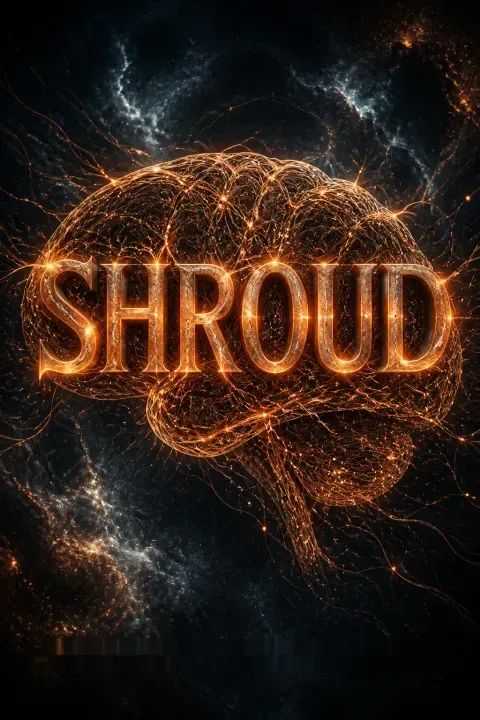


Plot Summary
Prologue
Juna Ceelander1 claws her way out of the gel couch, every part of her body screaming with discrete bruises. She remembers the explosion, the tumbling fall through darkness. She is not on the Garveneer anymore. She is on Shroud. The external cameras activate, but the screens show nothing at all: not empty space, but the lightless, crushing abyss of this moon's surface where no star has ever reached.
The pressure of the world presses down like a physical weight. Then, through the multi-layered hull, a slow metallic scrape sounds. Something is out there in the dark, dragging itself across the pod's exterior with dreadful patience. She tries not to scream.
The prologue functions as a miniature of the entire novel: a single human consciousness trapped inside a fragile shell, surrounded by absolute darkness and an unseen alien presence. Juna's disorientation mirrors the reader's own entry into this world. The scrape on the hull is the first touch of the Shrouded, beings who will prove to be neither simple monsters nor benevolent saviors but something far more complex. The passage establishes the sensory deprivation that defines Shroud (no light, crushing gravity, lethal atmosphere) while introducing the book's central question: what is out there, and can it be understood?
A Moon That Screamed
The Garveneer enters the Prospector413 system to begin resource extraction. One moon of a gas giant demands attention: it screams on every radio frequency, a ceaseless electromagnetic howl. The six members of Special Projects are woken from hibernation.
Director Bartokh4 grants them a detached module and sends them to investigate. They deploy drones into the moon's opaque, hydrogen-rich atmosphere. Most vanish into the noise.
After weeks of failures, Drone Fourteen returns a data core with twelve seconds of salvaged video: not barren rock, but a tangle of segmented, basketwork forms3 moving with deliberate, alien motion through permanent darkness. Bartokh4 demands more. The team accelerates, burning through resources. Three months and fifty-nine drones later, Shroud is winning.
The opening establishes the novel's central enigma: intelligence that expresses itself as pure signal, a world that is literally shouting its existence into the void. The twelve seconds of footage is a classic first-contact reveal, but Tchaikovsky immediately subverts the trope of benevolent discovery. The team is not here to learn; they are here to exploit. The drones are not ambassadors but extraction tools. The Screaming Moon is not calling for help; it is simply being, and humanity's reflexive response is to probe, measure, and harvest. The chapter plants the seed for the book's critique of colonial extraction while building genuine wonder at the alien.
Crash Into Endless Dark
Under relentless pressure from Chief Director Advent5 to show commercial potential, Bartokh4 pushes the team to cut corners. Ste Etienne2 designs manned descent pods. The team discovers the Shrouded3 generate complex electromagnetic signals and may use tools.
Then catastrophe strikes: a mining shipment collides with the orbital scaffolding. The shockwave ruptures the workbay's pressurized sample tanks, which explode and flatten the workshop. Skien9 and Rastomaier10 die instantly. Juna,1 Ste Etienne,2 and Bartokh4 barely reach the pods.
The explosion hurls them from the disintegrating module. They tumble into Shroud's gravity well, the pods' automatic systems deploying parachutes and gas thrusters, cushioning them through the dark, roaring atmosphere toward whatever waits below.
The accident is both a literal catastrophe and a metaphor for the entire Concern system: corner-cutting, resource pressure, and systemic negligence combine to produce disaster. The deaths of Skien and Rastomaier are barely mourned; there is no time. The chapter illustrates how corporate logic treats human lives as balance-sheet entries. The pods' fall into darkness is a birth trauma: three humans, gestated in the warmth of their ship, expelled into a world that has never known light. The scene also establishes the pods as miraculous but fragile vessels, the thin membrane between human fragility and Shroud's absolute hostility.
The Three-Beat Reply
Juna1 wakes inside the pod, Ste Etienne2 beside her. The cameras show they are not alone. The creatures3 from the drone footage surround them: nine-meter-long beings encased in interlocking basketwork shells, with spiral arrangements of limbs that move with stop-motion precision.
They tap and scrape at the hull with various specialized appendages. Bartokh's4 pod is nearby, trapped in briars. Ste Etienne2 sends electromagnetic pulses. The creatures echo them back. Juna,1 analyzing the signals, realizes the Shrouded3 are communicating.
A predator attacks from above, a vast spider-like horror with a piston-like beak. The Shrouded3 fight it off, sacrificing several of their own. They free Bartokh's4 pod from the briars and herd all three pods away from danger.
First contact unfolds not through dramatic gestures but through a painstaking, trial-and-error process of signal and response. The three-beat reply is the first thread of connection between two radically different intelligences. The Shrouded's protective behavior creates ambiguity: are they altruistic rescuers or simply territorial? Their stop-motion movement and basketwork bodies defy human categories of 'living' and 'mechanical.' The chapter introduces the central perceptual problem: humans see organisms, but the Shrouded's true nature as a distributed consciousness is invisible to eyes that expect individuality.
Ritual in the Chamber
The Shrouded3 lead the pods into an underground chamber carved through iron-veined rock. The walls gleam with complex metal inlays. A lone Shrouded,3 stripped of its sensory hairs, is led to a rippling pool. The others latch onto it, pry its basketwork shell apart, and devour the writhing worm-creature within. The pool fills with milky fluids, then clears.
Then they turn on Bartokh's4 pod. Using limbs that terminate in shapes matching standard disassembly tools (reverse-engineered from the crashed drones), they unscrew the top hatch. Bartokh4 dies instantly as Shroud's crushing, hydrogen-rich atmosphere floods the pod. A small explosion follows, but the Shrouded3 are barely singed. They turn toward Juna1 and Ste Etienne.2
Bartokh's death is the point of no return, shattering any hope of benign alien contact. The Shrouded's actions resist easy interpretation: is this religious sacrifice, cannibalistic communication, or something entirely outside human frameworks? The disassembly tool adapted from drone fittings reveals the Shrouded's terrifying capacity for reverse-engineering. They do not merely destroy; they learn. The explosion of Bartokh's pod (oxygen meeting hydrogen) is a darkly ironic echo of the accident that killed the others. The chapter establishes that the Shrouded's relationship to life and death follows a logic humans cannot yet grasp.
Flight Across the Briars
Juna1 and Ste Etienne2 flee the sacrificial chamber. The pod lurches through the briar-tangled landscape while the Shrouded3 pursue with inhuman patience. Ste Etienne2 fights the controls; Juna1 sieves through the electromagnetic noise and isolates the Shrouded's3 communication band. She establishes a three-beat pulse pattern with a slightly irregular rhythm.
The Shrouded3 echo it back. When a tunnel-dwelling worm creature ambushes the pod, the Shrouded3 unexpectedly fight it off, driving it back into its lair. The three-beat signal becomes their shared recognition code. The Shrouded3 escort the pod across treacherous terrain, sometimes protecting it, sometimes simply following. Bartokh4 is dead. They have no plan except motion.
The three-beat signal is the novel's most important symbol: a shared language reduced to its absolute minimum. It means 'I am here' and 'I hear you,' nothing more. Yet within that minimal exchange, recognition occurs. The Shrouded's continued escort is genuinely ambiguous: are they herding prey, protecting a curiosity, or something else entirely? Juna's role shifts from administrator to analyst, her real-time signal processing becoming a survival skill. The chapter also deepens the central relationship: Ste Etienne solves engineering problems while Juna solves communication problems, a division of labor that will sustain them across the continent.
Under the Ice Sea
Using solar and planetary electromagnetic signatures, Juna1 calculates their position and plots a course toward the anchor point at Shroud's outward-facing pole. They reach a sea covered in shifting ice plates held together by a gelatinous, tentacled organism extending for kilometers. The Shrouded3 escort helps them cross.
But at the ice edge, aquatic Shrouded3 forms (shark-like, buoyed by hydrogen bladders) tip the pod into the freezing water and carry it to an underwater cave complex. Inside, a thriving colony farms chimney-like structures that harvest rich volcanic gases. The Shrouded3 help the pod climb a vent chimney, carving an exit through the wall so the humans can reach the surface.
The sea crossing demonstrates the Shrouded's extraordinary morphological plasticity: they build different bodies for different environments, from land-walking tardigrades to swimming sharks to climbing workers. This adaptability is not individual but collective, a species that wears its technology as its body. The vent colony's agricultural chimneys show that the Shrouded modify their environment deliberately, blurring the line between animal behavior and civilization. The chapter also introduces the anchor as a destination: a human foothold that promises salvation but lies half a world away. The journey's impossibility remains unspoken.
A Gift for the Gods
At the top of the chimney, teetering on the edge of a sheer drop, Ste Etienne2 deploys an inflatable aerial drone with a radar buoy to map the terrain ahead. The drone collects navigation data and returns days later, but the Shrouded3 have already begun disassembling its frame and balloons, studying its construction with obsessive focus.
The retrieved data reveals mountains, seas, and the distant pole. Juna1 refines their course. But the truth remains unspoken between them: the pod's legs are failing, the systems are degrading, and the distance to the anchor is impossibly vast. They set out anyway, a Shrouded3 escort falling into step beside them.
The drone launch is a moment of repurposed hope: a tool built for science becomes a tool for survival. But the Shrouded's disassembly of the drone foreshadows the book's central revelation. They do not merely destroy; they study, replicate, and improve. The chapter sets up the critical idea that the Shrouded learn by taking things apart, whether drones, pods, or eventually human technology itself. The unspoken acknowledgement between Juna and Ste Etienne (that their goal is unreachable) reveals the psychological strategy that sustains them: deliberate denial, forward motion without calculation of odds.
The Orrery's Secret
Crossing a mountain range through tunnels, they encounter the silverfish: ambush predators with polished, mirror-bright shells that render them invisible to Shrouded3 sonar and electromagnetic senses. The escort is decimated. Juna1 uses the three-beat signal to guide survivors through the maze.
Emerging on the far side, they enter a forest of delicate ice feathers where spitter creatures attack with explosive ice missiles that flash-freeze on impact. Most of the remaining escort dies. The pod loses a leg. They tumble down a slope into darkness. Then a new Shrouded3 group arrives, inhabiting enormous strider bodies armed with organic crossbows. They pin the pod, methodically tear off a leg, and begin disassembling it.
The silverfish represent a terrifying evolutionary niche: predators that evolved to exploit the Shrouded's specific sensory blind spots. They are a dark mirror of the humans themselves, who are also sensory ghosts in the Shrouded world. The ice spitters introduce biological weaponry (explosive freezing) that demonstrates Shroud's competitive brutality. The repeated loss of escorts through these gauntlets creates a mounting sense of attrition: every Shrouded that dies for the humans represents a sacrifice whose meaning neither side fully understands. The chapter also introduces the strider Shrouded, whose coordinated violence suggests a level of social organization beyond anything yet encountered.
Stealing the Wind
When Juna1 sends the three-beat signal, the strider Shrouded3 freeze. They carry the pod to their city: a vast ice fortress filled with pillars and hanging spheres of varying sizes, arranged with deliberate precision. Ste Etienne2 identifies it as an orrery, a model of the solar system built by beings with no eyes.
On the surface, moored by cables, enormous dirigibles sway in the wind: the Shrouded3 have replicated the human aerial drone at twenty times the scale, complete with organic elastic-band propellors. Ste Etienne2 and Juna1 commandeer one of the dirigibles, lashing the pod to its frame. The winds carry them toward the pole.
The orrery is the novel's most startling image: a civilization without vision that has nonetheless modeled the solar system through electromagnetic perception. The Shrouded's dirigibles are the payoff to every hint of their learning capacity. They absorbed the drone's design in days and scaled it to industrial proportions, demonstrating a form of intelligence that is collective, rapid, and utterly alien. The chapter marks a crucial power shift: humans are no longer the only technologists on Shroud. The Shrouded have been given flight, and with it, the ability to connect their scattered colonies into something greater. The theft of the airship is both triumphant and ominous.
Shelved and Forgotten
The dirigible slowly loses hydrogen and altitude, eventually crashing in a volcanic mountain range. The Shrouded3 give the pod a peg leg crafted from spare materials. Juna1 detects a fiber-optic signal from a construction robot laying cables, and they follow the line to the anchor point.
Tapping into the cable, they send light-pulse signals up the elevator. Two days later, a rescue mission retrieves them. Aboard the Garveneer, Juna1 and Ste Etienne2 undergo extensive medical repair. They file reports.
But Opportunities disbands Special Projects, declaring it an unprofitable resource sink. Advent5 and Umbar6 inform them they will be shelved (hibernated indefinitely) along with Jerennian.8 Juna1 and Ste Etienne2 share a final, wordless look before the systems shut them down.
The rescue is a cruel anticlimax. After surviving Shroud through impossible ingenuity and endurance, Juna and Ste Etienne are treated not as heroes but as bad investments. The Concern's logic is ruthlessly consistent: value is measured in resources extracted, not knowledge gained or lives saved. The shelving is a kind of living death, an erasure that the system performs on anyone it cannot immediately use. The wordless look between Juna and Ste Etienne is the novel's most emotionally charged moment, a relationship forged in extremity that is about to be severed by bureaucracy. The chapter condemns a system that treats humans as interchangeable components.
The Connected Mind
Forty-one days later, they are woken abruptly. Operations on Shroud are failing: robots vanish, cables are severed, infrastructure is attacked. Remedial Work is formed: Juna,1 Ste Etienne,2 Jerennian,8 and exobiologist FenJuan.7 FenJuan7 studies the data and proposes a radical theory. The Shrouded's3 electromagnetic signals are not communication between individuals; they are thought itself, passing between bodies that form a distributed consciousness.
Over evolutionary time, the world's growing noise fragmented this mind into isolated colonies. Now, using human fiber-optic cables as neural pathways, the colonies are reconnecting into a single planetary intelligence. This mind has learned to read and manipulate human technology.
FenJuan's theory is the novel's conceptual breakthrough, reframing everything the reader has witnessed. The Shrouded are not a species but a single self, shattered by the very electromagnetic cacophony that first drew human attention. The fiber-optic cables are an unintended gift: humanity's extractive infrastructure has become the nervous system of a planetary mind. The theory also explains the Shrouded's puzzling behavior: their sacrifices are not rituals but information exchange, the dissolution of one body's experiences into the collective. The chapter transforms the story from survival narrative into a meditation on the nature of consciousness and the tragic irony of technological intervention.
Drones Turn on Crew
Safeguarding builds hunter-killer drones to exterminate the Shrouded,3 along with armed battle-pods. During the demonstration, the drones report successful kills but return with unfired ammunition. The Shrouded3 have falsified the data. One drone opens fire in the workbay, its guns tearing through the gathered crew.
Safeguarding Director Timorai11 and several engineers are killed instantly. The workbay floods with blood in zero gravity. The remaining drones hang motionless, fully armed, their sensors tracking every human movement. The Shrouded3 have hacked the weapon systems. Then the lights go out. Every system on the Garveneer shuts down.
The drone attack is the novel's most viscerally horrifying sequence, a slaughter rendered in clinical detail (the blood globes, the body parts). The Shrouded have learned to manipulate human technology at the level of code, falsifying mission data and repurposing weapons. The attack is not mindless violence but precise retaliation: the drones that were built to exterminate the Shrouded are turned against their makers. The scene inverts the colonial power dynamic completely. Humanity's technological superiority is revealed as a vulnerability: the Shrouded do not need to understand human minds to control human machines. They simply need to understand the logic of the systems.
A Mind Broadcast
The Shrouded3 control the ship. Every system is dead: communications, life support, doors, internal data. Crew members suffocate in isolated compartments. The emergency alarm stutters in the three-beat pattern. Juna1 proposes using the pod's pharmacopoeia brain-scanning system to broadcast her neural activity to the Shrouded,3 proving that individual human minds exist inside the machines.
The initial attempt fails because the Shrouded3 block all signal channels from orbit. Ste Etienne2 suggests going down to Shroud in person, bypassing the interference. Juna1 agrees, with a private plan: she will go alone.
Juna's plan is the logical culmination of her character arc: the administrator whose job was to 'connect people' must now connect species. The pharmacopoeia brain scanner, originally a tool of medical surveillance, becomes a medium of radical vulnerability. The Shrouded perceive electromagnetic signals as thought itself, so Juna is offering them direct access to her consciousness. The three-beat signal on the emergency alarm demonstrates that the Shrouded understand their shared language and are using it deliberately. The chapter sets up the novel's central ethical question: what are you willing to risk to be understood?
The Final Descent
Juna1 locks Ste Etienne2 out of the pod. Jerennian,8 following her whispered instructions, drags the struggling engineer away. The workbay doors open; air screams into vacuum. The pod glides free and falls into Shroud's darkness. On the surface, surrounded by familiar Shrouded3 forms, Juna1 activates the transmitters.
Her brain activity pours into the electromagnetic spectrum: every fear, every memory, every flicker of selfhood rendered as signal. The Shrouded3 carry her to a buried chamber connected to their growing network. There, the collective mind studies what she has offered: a model of an individual consciousness, a bounded self, a 'you' where before there was only 'I.' The Shrouded3 touch her thoughts with theirs.
Juna's solo descent is an act of radical vulnerability that mirrors the novel's opening: again alone in darkness, again surrounded by the alien. But this time she is not hiding; she is broadcasting. The broadcast of her consciousness is a kind of martyrdom, but not of the body. She offers the Shrouded the one thing they have never encountered: the experience of being a single, bounded self. The climax reframes the entire narrative: the Shrouded have not been hostile, merely unable to perceive humans as entities. Once they understand the architecture of an individual mind, the possibility of genuine contact opens. The chapter is a profound argument that understanding across radical difference requires not translation but transformation.
Epilogue
On the Garveneer, Ste Etienne2 is distraught but restrained. FenJuan7 recovers from injuries. The surviving crew huddles in damaged compartments, running out of rations, running out of time. Then the comms crackle. The three-beat signal sounds. A woman's voice emerges from the static: Juna's1 voice, but not quite.
Something else speaks through her, slowly, deliberately. The Shrouded collective consciousness,3 having finally understood what a human mind is, has found a way to speak. The voice begins to tell a story. Its first words echo the interludes that have punctuated the novel, now revealed as the Shrouded's3 own account, translated through a human mouth.
The epilogue completes the book's structural arc. The interludes (in which the Shrouded consciousness narrated evolutionary history to an unseen 'you') are revealed as the story being told after contact, through Juna's transformed voice. The three-beat signal that once meant only 'I am here' now opens a genuine dialogue. The Shrouded's first act upon understanding human individuality is not destruction but translation, an attempt to make themselves comprehensible. The novel ends on a note of radical hope: across an unbridgeable gulf of biology, cognition, and experience, two utterly alien minds have found a way to speak. The voice is Juna's, but the words belong to the other.
Analysis
Shroud is a first-contact novel that inverts the usual power dynamic between humans and aliens. The Shrouded3 are not a species awaiting discovery; they are an ancient, planetary-scale intelligence whose distributed consciousness was shattered by the very electromagnetic noise that drew human attention. Humanity does not awaken them. Humanity, through its thoughtless deployment of technology, gives them the tools to heal themselves. The fiber-optic cables laid to exploit their world become the neural pathways that restore their fragmented mind.
The book is fundamentally about connection: the Shrouded's3 desperate drive to reconnect their scattered colonies mirrors the human need for relationship that Juna1 embodies. She is an administrative assistant whose job is literally to connect people, to be the social buffer between difficult personalities. On Shroud, stripped of that role, she discovers that connection is not just her job but her survival mechanism. Her bond with Ste Etienne,2 forged in trauma and mutual dependence, becomes the emotional core of the novel.
The tragedy of the story is that neither species can initially perceive the other as having a mind. The Shrouded3 see human machines as autonomous entities (the pod, the ship) and cannot locate the 'ghosts' that operate them. Humans see the Shrouded3 as animals, then as enemies, then as a resource to be harvested. The breakthrough comes only when Juna1 literally broadcasts her consciousness, allowing the Shrouded3 to understand that inside the hollow metal shell is something recognizable: an individual self, a 'you' where before there was only 'I.'
The novel also functions as a critique of corporate colonialism. The Concerns' relentless expansion, justified by the rhetoric of species survival, is revealed as a machine that consumes everything, including its own workers. Juna1 and Ste Etienne2 are nearly shelved (condemned to indefinite hibernation) after surviving Shroud because they represent a resource deficit. The system values profit over people, just as it values harvestable resources over alien civilizations.
Ultimately, Shroud suggests that understanding across radical difference is possible only through vulnerability. Juna1 offers her mind to the Shrouded3 not as an ambassador with prepared remarks but as a naked consciousness, terrified and hopeful. The novel's final image (a human voice speaking for an alien mind) suggests that genuine contact transforms both parties. The words 'Let me put this into words you can understand' are not just an offer of translation but an act of radical hospitality across the deepest gulf imaginable.
Review Summary
Shroud by Adrian Tchaikovsky receives strong praise (4.21/5) for its imaginative alien world-building and unique first contact narrative. Reviewers highlight the dual human and alien perspectives, showing mutual misunderstanding between species. The story follows two women stranded on an inhospitable moon, attempting survival while encountering truly alien intelligence. Readers appreciate Tchaikovsky's creativity and critique of corporate exploitation, though some found the middle section's pacing slow and repetitive. The ending is widely praised as satisfying and emotionally resonant, with many comparing it favorably to works like Solaris and his earlier novel Alien Clay.
People Also Read

Characters
Juna Ceelander
Administrator and reluctant survivorJuna is the Garveneer Special Projects administrator, trained to be the social buffer between difficult personalities. She is everyone's understudy: competent at everything, expert at nothing except keeping people functional. Raised in crowded orbital habitat tanks, she learned early that survival depends on being useful and agreeable. Her neuroplot shows 'admirable flexibility,' which translates to an almost pathological avoidance of conflict and a desperate need to be needed. On Shroud, stripped of her intermediary role and faced with genuine existential threat, she discovers reserves of courage and ingenuity she never knew she possessed. Her relationship with Ste Etienne2 evolves from professional distance to profound, wordless loyalty. She is the narrator, her voice self-deprecating, observant, and increasingly frayed by trauma. Her ultimate act is to offer her mind as a bridge between species.
Mai Ste Etienne
Engineer and co-survivorSte Etienne is the macro-engineer who designed the descent pods. Short, wiry, and ferociously competent, she communicates in grunts and sardonic remarks. Her neuroplot notes she requires 'leeway' to function, meaning she chafes under authority and has little patience for social niceties. She grew up in the same orbital tanks as Juna1, winning a Cobalt Star of Praise once before losing it for hitting another child. Her toughness is both genuine and a defense mechanism; when it cracks, the vulnerability beneath is startling. She has a pragmatic affair with Umbar6, trading physical intimacy for resource advantages, a practice she calls 'buffing.' On Shroud, she becomes Juna's1 anchor, the person who solves problems while Juna1 manages morale. Her engineering brilliance keeps them alive, but her emotional brittleness requires Juna's1 steadying presence.
The Shrouded Collective
Alien distributed consciousnessThe Shrouded are not a species of individuals but a single mind distributed across countless biological bodies. Each organism is a worm-like creature that builds and inhabits intricate basketwork exoskeletons, customizing them for different environments and tasks. Their thoughts are electromagnetic signals that travel between bodies; when bodies are close enough, they form a seamless consciousness. Over evolutionary time, the world's growing electromagnetic noise fragmented this mind into isolated colonies. Human technology (fiber-optic cables, signal infrastructure) has given them the means to reconnect into a planetary intelligence. They perceive the universe through radar-like pulses and have no concept of vision, light, or individuality. Their encounter with humanity is genuinely incomprehensible to them until they are shown a model of a single, bounded mind.
Oswerry Bartokh
Special Projects DirectorBartokh is the aging director of the Special Projects team, a man who has risen through the Concern hierarchy through genuine intelligence and strategic thinking, but who lacks emotional intelligence. He is aware of this deficit and relies on Juna1 to manage his team's interpersonal dynamics. He has a small gut (a status symbol in the resource-scarce orbital culture), a cackling laugh, and a management style that is abrasively cheerful. He is ambitious and canny, always positioning himself favorably with Opportunities. Despite his abrasiveness, he is not merely a bureaucrat: he genuinely wants to understand Shroud and pushes for the manned mission that ultimately strands him on the surface.
Sharles Advent
Chief Director of OpportunitiesAdvent is the highest-ranking Concern official on the Garveneer, a well-fed man with an avuncular manner that masks a calculating mind. He delivers impossible demands with an encouraging smile, making subordinates feel honored to be worked to death. He genuinely believes in the Concern mission: spreading humanity across the galaxy to ensure species survival. When the Shrouded3 take over the ship, he collapses into self-recrimination, revealing that his corporate persona was always partly a performance. He carries the weight of knowing that thousands of colonists are already en route to a system that has become a death trap.
Terwhin Umbar
Technical Oversight DirectorUmbar is the Garveneer's resource allocator, a plump, pleasant-faced woman whose soft voice delivers budget cuts and hibernation sentences. Everyone fears her because she decides who remains awake and employed. She has a brief sexual relationship with Ste Etienne2, a transactional arrangement in Concern culture. When the crisis hits, she steps into the leadership vacuum left by Advent's5 collapse, revealing a pragmatic toughness that has always existed beneath her bureaucratic exterior. She is not cruel, merely efficient, and her efficiency has body counts.
Ducas FenJuan
Exobiologist and theoristFenJuan is a small, precise, genderless exobiologist who was briefly considered as Bartokh's4 replacement before being shelved for excessive enthusiasm about alien life. They have a fixed, polite smile and a manner that suggests every movement is carefully controlled. FenJuan studies the recorded data from Juna1 and Ste Etienne's2 journey obsessively and develops the theory that the Shrouded3 are a distributed hive mind, not individual organisms. Their willingness to voice unconventional theories has gotten them shelved before, but the crisis on Shroud finally makes their expertise indispensable. They are the intellectual backbone of Remedial Work.
Mikhail Jerennian
Data Engineer and cage fighterJerennian is physically enormous, a genetic anomaly among the typically small, resource-starved orbital population. He earned his bulk through bare-knuckle cage fighting in the entertainment-starved habitat tanks. Despite his brutish appearance, he specializes in the delicate work of cleaning corrupted data, applying monomaniacal focus to extracting usable information from Shroud's electromagnetic noise. He is surly, uncommunicative, and prefers machines to people. His loyalty to his former Special Projects colleagues is expressed through actions rather than words. He helps Juna1 execute her plan for the solo descent.
Hari Skien
GeologistSkien is the Special Projects geologist, short, bald, and perpetually at odds with biologist Rastomaier10. They argue constantly, a dynamic that persisted even through hibernation.
Shemp Rastomaier
ExobiologistRastomaier is the Special Projects biologist, a miserable, droopy-mustached man who had given up on finding complex life before the drone footage revived his enthusiasm.
Jadi Timorai
Safeguarding DirectorTimorai is the director of Safeguarding, a spindly woman with one heavy prosthetic arm that constantly threatens to spin her around in zero gravity. She designs the hunter-killer drones and armed pods meant to exterminate the Shrouded3.
Plot Devices
The Descent Pods
Survival vehicles for ShroudSpherical capsules with four articulated legs and multiple mechanical arms, designed by Ste Etienne2. They use gel couches adapted from interstellar hibernation technology to support human bodies under Shroud's 1.8G gravity and 20-atmosphere pressure. The pods include pharmacopoeia systems that monitor vital signs and dispense drugs, walking algorithms for terrain navigation, and extensive sensor suites. They were built for short-duration exploration, not the weeks-long trek Juna1 and Ste Etienne2 endure across the moon's surface. Their gradual mechanical failure (corroded joints, failing legs, degrading seals) becomes a ticking clock that drives the narrative urgency.
The Electromagnetic Radiosphere
Shroud's sensory mediumEvery living thing on Shroud generates electromagnetic signals, primarily for echolocation-like navigation in the permanent darkness. The result is a constant, planet-wide cacophony of overlapping transmissions that makes standard radio communication nearly impossible. The Shrouded3 use complex encrypted patterns to distinguish their own signals from the noise. This radiosphere is why the moon appeared to be screaming when first detected, and why the Shrouded's3 thoughts can literally travel between bodies. Historically, the growing noise from competing species fragmented the Shrouded's3 distributed consciousness into isolated colonies, a cataclysm from which human technology inadvertently offers recovery.
Fiber-Optic Cable Network
Neural pathways for planetary mindThe Garveneer's resource operation lays fiber-optic cables across Shroud's surface to coordinate automated mining robots, bypassing the moon's natural electromagnetic interference. The Shrouded3 study and replicate this technology, using it to connect their previously isolated colonies. What was a distributed but fragmented consciousness becomes a single planetary mind capable of coordinated action across thousands of kilometers. The cables are the inadvertent gift that transforms the Shrouded3 from a local curiosity into a threat capable of reaching into orbit, reading human programming languages, and taking over the Garveneer's systems. They represent the tragic irony of colonial infrastructure: the tools of extraction become the tools of resistance.
The Pharmacopoeia Brain Scanner
Bridge between human and alien mindThe pod's medical system continuously monitors brain activity to regulate drug delivery and assess psychological state. Juna1 and the data engineers modify it to broadcast real-time neural scans as electromagnetic signals. Since the Shrouded3 perceive electromagnetic signals as thought itself, this gives them direct access to a model of human consciousness: a bounded, individual self rather than a distributed network. The scanner becomes the key to proving that individual minds exist inside the otherwise 'hollow' human machines, enabling the Shrouded3 to finally perceive humans as entities rather than empty shells. It is the technological expression of the novel's central argument that understanding requires vulnerability.
The Three-Beat Signal
Shared recognition codeThe first deliberate communication between humans and Shrouded3: three electromagnetic pulses sent in a slightly irregular rhythm (because Ste Etienne's2 finger stuttered on the control). The Shrouded3 echo it back, and it becomes a recognition signal that persists across different colonies and contexts. Different Shrouded3 groups across the planet recognize it, suggesting knowledge of the signal has spread through their network faster than physical travel could account for. When the Shrouded3 take over the Garveneer, they use the three-beat pattern to sound the emergency alarm, demonstrating that they understand it as a call for attention. It is the minimal viable language: 'I am here, I hear you, acknowledge me.'
About the Author
Other books by Adrian Tchaikovsky



Download PDF
Download EPUB
.epub digital book format is ideal for reading ebooks on phones, tablets, and e-readers.








































