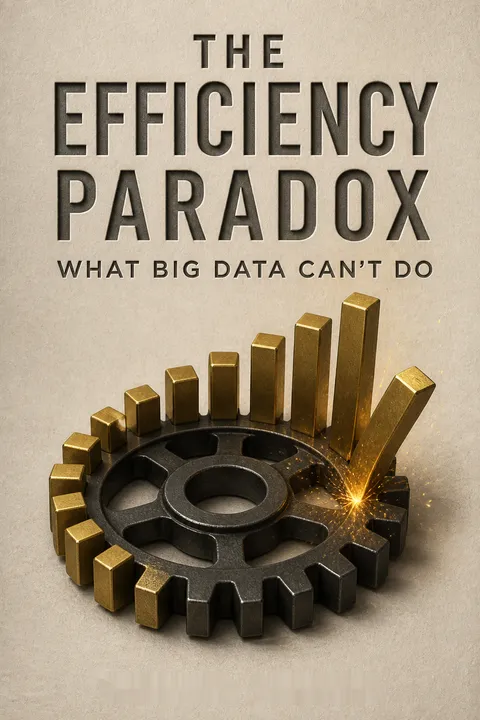

Key Takeaways
1. The Efficiency Paradox: More Efficiency Can Lead to Less Overall Effectiveness
Efficiency is mostly good but, like all good things, can be carried too far; even an excess of water can be lethal.
Efficiency's double edge. While efficiency aims to minimize waste and maximize output, an excessive pursuit of it can paradoxically reduce overall effectiveness and long-term gains. This concept, termed "inspired inefficiency," suggests that some degree of deliberate waste or "friction" is essential for true innovation and resilience. The book critiques a single-minded drive for a "friction-free" world, arguing that it can lead to undesirable consequences and missed opportunities across various domains.
Seven "sins" of efficiency. The author identifies seven ways hyper-efficiency can backfire:
- Counterserendipity: Reduces beneficial chance encounters.
- Hyperfocus: Narrows perspective, missing broader patterns.
- Self-amplifying cascades: Small initial biases become self-fulfilling.
- Skill erosion: Over-reliance on automation degrades human capabilities.
- Perverse feedback: Metrics satisfy criteria but frustrate real outcomes.
- Data deluge: Overwhelming data increases costs and false positives.
- Monoculture: Multiplies successful formulas to the point of inflexibility.
Balancing act. The core message is not to abandon efficiency but to cultivate inefficient behaviors that, in the long run, make technology more effective and genuinely efficient. This involves finding the right blend of algorithmic precision and human intuition, recognizing that progress often emerges from seemingly wasteful experimentation and a willingness to embrace complexity rather than constantly simplify.
2. Platform Economy's Hidden Costs: Digital Convenience Creates New Frictions
The problem of platform efficiency, I will suggest in the first chapter, is that it promotes what the originator of the concept of disruptive innovation, Clayton Christensen, calls business process innovation.
New efficiency model. The 21st-century platform economy, exemplified by companies like Amazon, Google, and Facebook, represents a new kind of efficiency based on gathering, analyzing, and exchanging data to match buyers and sellers. Unlike the 19th-century "continuous process" efficiency focused on mass production of goods, platform companies thrive on reducing transaction costs through automated software and user-generated content. This model has led to immense profitability for investors with relatively few employees.
Friction-free, but not. While platforms promise "friction-free commerce," they introduce new complexities and hidden costs. For consumers, this can mean:
- Navigating dynamic pricing and competing vendor algorithms.
- Evaluating unreliable customer reviews, often influenced by "social influence bias."
- Dealing with the environmental impact of rapid, individualized shipping.
- Facing "shadow work" where users perform tasks previously done by paid employees.
Economic paradoxes. The rise of platform efficiency has also coincided with paradoxical economic trends. Despite technological advancements, the financial sector's share of GDP has increased, not decreased, due to high-frequency trading. Furthermore, while platforms are highly profitable, they often focus on "efficiency innovation" (making existing things cheaper) rather than "market-creating innovation" (generating new industries and jobs), potentially diverting capital and talent from more transformative projects.
3. Information Overload: Algorithms Narrow Perspective and Undermine Quality
The efficiency of search using PageRank and similar algorithms has not necessarily been synonymous with effectiveness—giving searchers the best possible result.
Search's double-edged sword. Google's PageRank algorithm, a populist adaptation of scientific citation indexing, revolutionized information access by ranking web pages based on links. While efficient at finding information, it doesn't guarantee the "best" results, as users often don't look beyond the first page or possess the background knowledge to critically evaluate sources. This can lead to a "curse of knowledge" for experts and a false sense of understanding for novices.
Erosion of journalistic quality. The efficiency of social media and platform advertising has severely impacted traditional journalism. Platforms like Google and Facebook have siphoned off advertising revenue, forcing news organizations to:
- Lay off staff, particularly local reporters.
- Focus on "engagement metrics" and "clickbait" over in-depth reporting.
- Employ staff to "game" algorithms for visibility, diverting resources from actual journalism.
- Grapple with the rapid spread of "fake news" and the resulting erosion of public trust.
Science's narrowing focus. Even in science, electronic publication and citation metrics like the "impact factor" have unintended consequences. Researchers, pressured for quantity and high-impact publications, may engage in "salami slicing" (dividing results into multiple papers) and focus on popular, recent work, leading to a "narrowing of science" and a "replication crisis" where many findings cannot be reproduced. This "Matthew effect" amplifies early advantages, potentially stifling truly groundbreaking but initially unpopular ideas.
4. Education's Enduring Slog: Technology Fails to Efficiently Replace Human Teaching
The efficiency of data acquisition has brought a quiet crisis to biomedical research in particular.
A century of unfulfilled promises. From Thomas Edison's "100% efficient" classroom films in the 1920s to B.F. Skinner's "teaching machines" and modern MOOCs, educational technology has consistently promised to revolutionize learning, reduce costs, and replace teachers. Yet, despite significant investment and technological advancements, education remains a labor-intensive process with little measurable improvement in most test scores.
The "curse of knowledge" and cost disease. Developing effective educational technology is inherently inefficient and expensive. Experts often struggle to convey knowledge to novices due to the "curse of knowledge," requiring extensive, costly development for adaptive learning systems. Furthermore, the "cost disease" of services means that while technology can augment teaching, it rarely reduces the overall human labor or expense, often increasing it through:
- High development costs for quality online content.
- Increased administrative burdens for teachers.
- Rising textbook prices due to integrated digital resources.
Desirable difficulty and analog's value. Research suggests that "desirable difficulty" enhances learning. Inefficient methods, like taking handwritten notes (which forces paraphrasing and deeper processing) or reading slightly harder-to-read fonts, lead to better comprehension and retention than their "efficient" digital counterparts. Students, despite being "digital natives," often prefer print textbooks for conceptual understanding, recognizing the value of paper as a "terrain" for learning.
5. Navigational Deskilling: GPS Erodes Innate Spatial Awareness and Critical Judgment
The efficiency of the GPS can induce uncritical obedience to its directions.
Ubiquitous guidance. The widespread availability of accurate GPS in smartphones has revolutionized navigation, offering unprecedented precision and real-time routing. This geographic efficiency provides instant itineraries, identifies nearby amenities, and aids emergency services, making travel seemingly effortless.
The cost of convenience. However, over-reliance on GPS can lead to "deskilling," eroding human spatial awareness and wayfinding abilities. Studies show that following turn-by-turn directions, while efficient in the short term, hinders the development of mental maps and a holistic understanding of surroundings. This "uncritical obedience" can be hazardous, leading to:
- Drivers overlooking contradictory road signs or dangerous terrain.
- "Death by GPS" incidents where users are led into perilous situations.
- Pilots and mariners losing proficiency in manual navigation, risking disaster when automated systems fail.
Beyond the direct route. Traditional wayfinding, practiced by Polynesians, Inuit, or London taxi drivers ("the Knowledge"), involves a rich, multi-sensory engagement with the environment, building dynamic mental models. While seemingly inefficient, this deep understanding fosters resilience and serendipitous discovery. The "lost art of getting lost" allows for unexpected encounters and a richer experience of place, something hyper-efficient, turn-by-turn navigation often precludes.
6. Medical Efficiency's Perils: Data-Driven Care Risks Overdiagnosis and Alarm Fatigue
The efficiency of medical equipment in notifying doctors and nurses of potential problems predictably makes care less efficient.
The managed body. The drive for efficiency in medicine, fueled by information technology, has led to the rise of electronic medical records (EMRs), evidence-based medicine (EBM), precision medicine, and self-monitoring devices. While promising improved care and reduced costs, these advancements often introduce new forms of inefficiency and unintended consequences.
EMRs and physician burden. EMRs, intended to streamline communication and reduce errors, have paradoxically increased administrative workload for physicians. Doctors spend significantly more time on computer work and paperwork than with patients, contributing to burnout. The proliferation of detailed, standardized codes (like ICD-10) adds complexity, and incentives can lead to "upcoding" for higher reimbursement, further distorting care.
Overdiagnosis and alarm fatigue. The efficiency and sensitivity of modern medical technology lead to:
- False positives and overdiagnosis: Advanced tests and imaging detect "abnormalities" (incidentalomas) that may be harmless, leading to unnecessary further testing, patient anxiety ("toxic uncertainty," "cyberchondria"), and overtreatment.
- Alarm fatigue: Hospitals are inundated with millions of alerts from monitoring devices, causing staff to become desensitized, ignore critical warnings, and increasing the risk of medical errors and patient harm. This "Swiss cheese effect" highlights how multiple safeguards can align to create disaster.
Limits of data-driven care. While "big data" can identify drug interactions or rare diseases, it often interprets rather than predicts, and its quality can be compromised. Precision medicine, based on genomics, faces immense complexity from multiple genes, epigenetics, and the microbiome, with limited clinical success so far. Self-monitoring wearables, while popular, may reduce intrinsic motivation for healthy behaviors and raise privacy concerns.
7. The Power of Inspired Inefficiency: Embracing Deliberate Difficulty for Deeper Learning
If real efficiency is the ability not just to plug variables into equations but to solve unfamiliar problems creatively, then apparently inefficient methods may actually be most effective.
Beyond immediate gains. True efficiency, defined as the ability to solve unfamiliar problems creatively, often requires embracing methods that appear inefficient in the short term. This "inspired inefficiency" involves recognizing that some processes, like learning or innovation, benefit from deliberate difficulty, creative waste, and a balance between digital tools and analog engagement.
Cultivating human skills. Instead of outsourcing all cognitive tasks to algorithms, we must nurture uniquely human capabilities:
- Tacit knowledge: The vast, unprogrammable understanding gained from social interactions and real-world experience.
- Intuition: A flexible capacity for unconscious understanding that complements machine logic.
- Critical judgment: The ability to evaluate information, question assumptions, and adapt to unexpected challenges.
Strategies for balance. Achieving this balance involves several key strategies:
- Perfect 5 automation: Optimal systems involve human operators with significant control, correcting inevitable algorithmic flaws.
- Physical presence: Face-to-face interaction, tangible objects (like paper maps or books), and engagement with physical environments convey nuances and foster deeper understanding.
- Creative waste: Allowing for experimentation, trial-and-error, and even "waylosing" (productive disorientation) can lead to unexpected discoveries and innovation.
- Analog serendipity: Browsing physical collections or engaging with less structured information can spark insights that hyper-personalized algorithms might miss.
- Desirable difficulty: Deliberately making tasks slightly harder (e.g., handwritten notes, slower search) can enhance learning and retention.
- Cognitive bootstrapping: Developing skilled search techniques and learning to expand one's knowledge base step-by-step, rather than relying on instant, superficial answers.
The human advantage. The goal is not to reject technology but to use it wisely, recognizing its limits and leveraging its strengths to augment, rather than replace, human intelligence and creativity. By embracing inspired inefficiency, we can foster a society that is not just faster, but wiser, more adaptable, and truly effective.
Review Summary
The Efficiency Paradox receives mixed reviews (3.28/5), with readers appreciating its central thesis that efficiency can create paradoxical inefficiencies, but criticizing execution. Many found the writing verbose, unfocused, and lacking cohesion between chapters. Positive reviews valued examples of "desirable difficulty," "productive boredom," and "waylosing," praising insights on how technology impacts learning, navigation, and medicine. Critics noted insufficient data, repetitive arguments, and misleading marketing about big data. Several reviewers felt the book reads like a literature review with interesting concepts but shallow analysis and excessive filler content diluting key points.
People Also Read









Download PDF
Download EPUB
.epub digital book format is ideal for reading ebooks on phones, tablets, and e-readers.








































