

Key Takeaways
Alcohol addiction is a confidence trick, not a disease or willpower failure
The core reframe. Allen Carr, a former thirty-year heavy drinker and chain-smoker, argues that the establishment view (championed by AA and much of medicine) that alcoholism is an incurable disease requiring lifelong willpower is simply wrong. He calls it a fallacy dressed up as science. In his telling, addiction works like a combination lock: spend years fumbling and you stay imprisoned, but get the right sequence and the door opens instantly.
The method removes desire first. His Easyway approach does not ask you to grit your teeth against craving. Instead, it dismantles the beliefs that make alcohol seem valuable, so that when you stop, there is nothing to give up and no sacrifice to mourn. He claims over 90 percent success at his clinics, and insists the reader keep drinking until the book is finished, question every claim, and stay skeptical throughout.
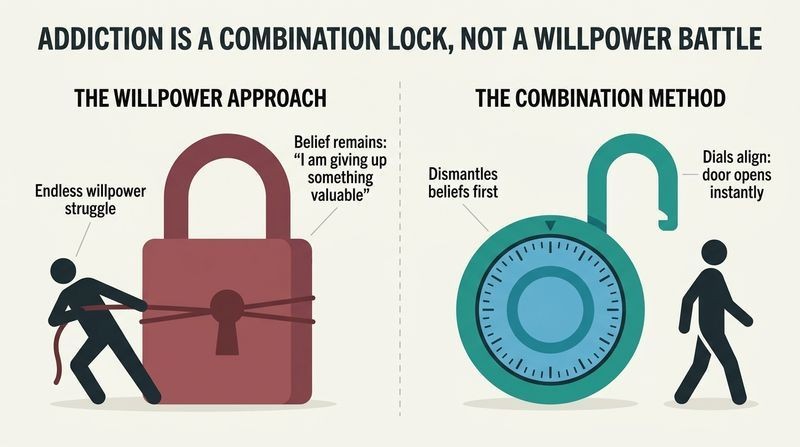
What's striking is how Carr weaponizes doubt as a tool rather than an obstacle. His claim that addiction is purely psychological overstates the case: alcohol produces genuine physiological dependence, and abrupt cessation in severe cases can cause seizures and delirium tremens that require medical supervision. Yet cognitive science partly vindicates him. Modern approaches like cognitive behavioral therapy and relapse-prevention work precisely by restructuring beliefs and expectancies about a substance's benefits. Carr intuited, decades before it was fashionable, that expectation drives much of the perceived reward. His contribution is treating belief, not chemistry, as the lever.
You were never in control, like a fly gorging inside a pitcher plant
The pitcher plant trap. A pitcher plant lures insects with sweet nectar down a gentle, hair-lined slope. The fly feasts, feeling free to leave anytime, until it is too bloated and stuck to escape. Carr's key point: the fly was never in control. It was captured the moment it smelled the nectar. Drinkers imagine they lost control at some identifiable moment (the crashed car, the ruined marriage), but he argues control was always an illusion.
Redefining the alcoholic. Rather than defining an alcoholic as someone who has lost control, Carr redefines the term as a drinker who realizes they were never in control. This flips the usual shame narrative. If nobody chooses their slide, then a person seeking help is not weak or defective. They are simply further down the same slope every drinker occupies, from the grandmother sipping one Christmas sherry to the chronic drinker on skid row.
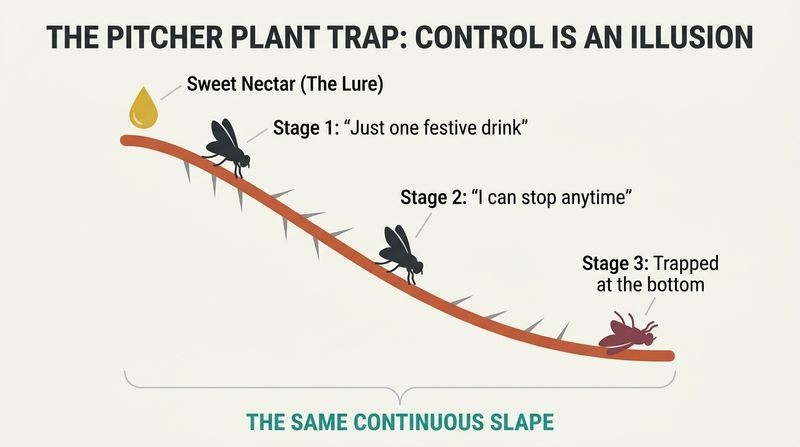
The pitcher plant is a vivid, testable metaphor, and it maps neatly onto the concept of the hedonic treadmill in psychology: escalating consumption yields diminishing returns while feeling like sustained choice. Carr's insistence that everyone is on one continuous spectrum rather than divided into diseased alcoholics and healthy normal drinkers anticipates the modern clinical shift toward alcohol use disorder as a dimensional, not categorical, condition. The weakness is determinism. Framing all drinkers as trapped flies risks stripping agency entirely, which sits uneasily beside his simultaneous demand that readers actively choose freedom.
Alcohol manufactures the very thirst and craving it pretends to quench
Two effects create every illusion. Carr strips alcohol down to two undesirable actions: it dehydrates you and it inebriates you. Beer is over 80 percent water, so a pint briefly eases thirst, but the alcohol content leaves you parched, which is why you wake at 3am with a throat like a dry riverbed. The drink does not satisfy thirst; it creates a little monster inside the body with an insatiable appetite for more.
Inebriation is not relaxation. Deadening your senses is not the same as feeling calm. If being knocked out counted as relaxation, a blow to the head would do the job faster. Carr argues that alcohol never quenches, never relaxes, never satisfies. It merely generates a low-grade discomfort that the next drink temporarily relieves, tricking the brain into crediting alcohol with a benefit it invented.
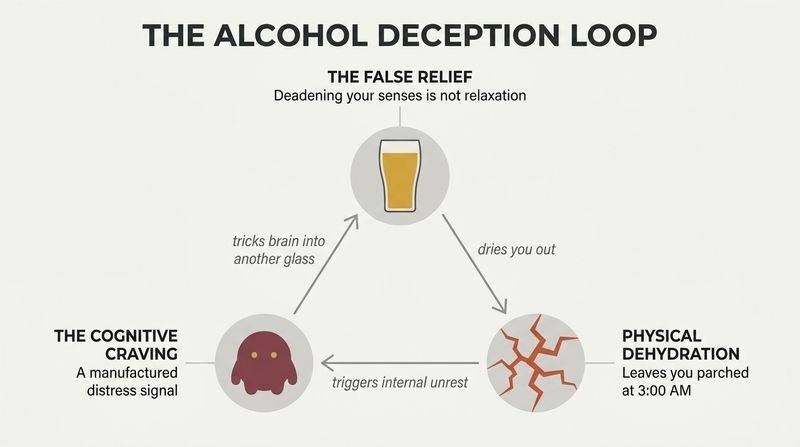
The physiology holds up. Alcohol suppresses vasopressin, the antidiuretic hormone, so the body sheds more fluid than the drink provides, producing genuine dehydration. Carr's deeper insight is about misattribution: the relief of ending a self-inflicted deficit gets misread as positive pleasure. This is the same mechanism behind nicotine and caffeine dependence, where users chase a baseline they have artificially lowered. Neuroscience calls this opponent-process theory, where the brain counteracts a drug's effect, leaving withdrawal as the true motivator. Carr articulated the felt experience of this loop without the jargon, which is partly why the explanation lands so intuitively.
Willpower fails because it leaves the craving alive and fighting you
The tug-of-war problem. Carr calls addiction a kind of schizophrenia: one part of your brain wants a drink, another part wishes it didn't. The willpower method (which he defines as any approach except his own) tells you to make a solemn vow and then endure indefinite deprivation, hoping one day the desire vanishes. But it never does, because the underlying belief that alcohol is a pleasure remains intact.
Why abstinence backfires. The longer you resist, the more precious the forbidden thing feels, exactly as crash dieting makes food obsessive rather than optional. Meanwhile, the reasons you quit (health, money, relationships) fade as they improve, weakening your resolve. Carr endured six months of misery this way before relapsing. His conclusion: even success by willpower is a lifelong sentence of resisting temptation, never true freedom.
This aligns with what researchers call ego depletion and the ironic-process theory: actively suppressing a thought (do not think about drinking) tends to amplify it, much like being told not to picture a pink elephant. Carr's diagnosis of why white-knuckle sobriety feels precarious is psychologically sharp. The counterpoint is that millions do achieve durable recovery through willpower-based and fellowship-based routes, and relapse rates for his method are self-reported rather than independently audited. Still, his central claim, that removing desire beats resisting it, is echoed in acceptance-based therapies that reduce a craving's grip by changing one's relationship to it rather than fighting it head-on.
Alcohol gives no courage; it just buries your fear like an ostrich
Courage versus removing fear. Bravery means surmounting fear, so anything that lowers fear reduces the courage required, it does not add courage. Someone terrified of flying who gets drunk to board a plane does not feel brave; they feel numbed. Carr uses the ostrich supposedly burying its head in sand: hiding from danger does not remove the danger, it removes your ability to respond to it, leaving you defenseless.
Inhibitions are protection, not defects. The removal of inhibitions is sold as a social gift but is actually dangerous. It is why cheerful parties erupt into violence, why drivers feel invincible, why a normally cautious person says or does something regrettable. Fear, shyness, and stress are Mother Nature's warning lights, like a car's oil lamp. Alcohol does not fix the engine; it just unscrews the bulb so you stop seeing the warning.
The warning-light framing is a genuinely useful mental model, resonant with evolutionary accounts of emotion as adaptive signaling. Fear, anxiety, and social inhibition evolved to keep organisms alive and integrated in groups, not as malfunctions to be chemically silenced. Carr rightly notes the term Dutch courage betrays that even drinkers know it is not real bravery. Where he overreaches is in denying any situational value to disinhibition; moderate social lubrication demonstrably lowers cortisol and eases bonding for some people. His stronger point stands: outsourcing courage to a depressant guarantees the underlying fear is never addressed, only postponed and amplified.
Loving the taste is just immunity to poison, dressed up as connoisseurship
Acquiring a taste means adapting to something foul. Almost nobody enjoys their first beer or neat spirit; the body screams poison, sometimes triggering vomiting, which Carr calls a life-saving warning. We persist anyway because 90 percent of adults model it, and the body dutifully builds immunity, gradually dulling the disgust until we announce we love the taste of bitter, a phrase whose dictionary meaning is a foul, unpleasant flavor.
Every reason is an excuse. Ask a new student why they drink and they say they enjoy it while wincing at each sip. Carr insists all drinkers give excuses, not reasons, and lie to themselves as self-protection. His skewering of wine ritual (swirling, sniffing, paying hundreds for fermented, decaying vegetable matter) echoes The Emperor's New Clothes: an elaborate performance nobody dares question, when experts blindfolded often cannot even distinguish whisky from iced tea.
Blind-tasting research lends Carr real support. Studies have shown that price labels and packaging shift reported enjoyment and even brain activity in reward regions, and that untrained and sometimes trained tasters struggle to rank wines they praise. The point that acquired tastes cluster around drugs (alcohol, coffee, tobacco) is provocative and largely fair. The nuance he skips is that acquired appreciation is real in food culture too, from chili heat to aged cheese, without addiction. So acquisition alone does not prove a substance is poison. But his core move, separating genuine liking from adaptation and social signaling, is a bracing act of demystification.
There is no addictive personality; blame the drug, not your character
The myth dismantled. Carr rejects both the congenital chemical flaw theory and the addictive personality theory. If a physical defect caused alcoholism, a blood or genetic test could detect it, and you would become addicted on the first drink, not after two to sixty years. If you truly had an addictive personality, you would be hooked on everything. He notes the only people claiming such a personality are already addicts, using it as an explanation after the fact.
Quicksand, not defective sinkers. Picture people on a beach; a few sink into quicksand while others walk free. Nobody blames a personality flaw in the sinkers; the answer lies in the quicksand itself. The heavier you are (the more you panic and reach for the very poison you fear) the faster you sink. So-called normal drinkers are not a different species; they are simply at an earlier, more comfortable stage of the identical trap.
Carr is half right in a way genetics research now clarifies. Twin and adoption studies suggest heritability of alcohol dependence around 50 percent, so predisposition is real, contradicting his flat denial. But he is correct that no single gene or personality type determines outcome, and that labeling oneself an addictive personality can become a self-fulfilling identity that licenses continued use, a phenomenon behavioral scientists link to fixed mindsets. His quicksand image also usefully reframes stigma: locating the danger in the substance and its social normalization, rather than in a person's defective soul, reduces shame, which itself is a documented driver of relapse.
Cutting down is the trap, not the escape; only total freedom works
Moderation makes it worse. Trying to control intake keeps the little monster alive and, crucially, ingrains the belief that alcohol is precious. When you ration something, each portion feels more valuable, so you spend your life either wanting a drink you won't allow or having one while wishing you could have more. Being dominated by thoughts of your next drink is the opposite of being in control, even though it masquerades as discipline.
All or nothing. Because any drug's nature is to demand escalating amounts, cutting down is never a stable resting point; willpower eventually runs out and you drink more than before. Carr compares it to being a bit pregnant or going over Niagara Falls but only three feet. The genuinely easy way to control drinking, he argues, is to be completely free of it, which ends the internal war entirely.
The moderation debate is live and contested. Programs like Moderation Management and pharmacological approaches such as the Sinclair Method show that some drinkers, particularly less severe cases, do sustain controlled use, complicating Carr's absolutism. His claim is strongest for those already deep in dependence, where research on abstinence violation and priming effects supports the idea that a single drink can reactivate full-blown craving. The behavioral-economics concept of scarcity also backs him: restricting a desired good raises its subjective value. For heavy drinkers, his all-or-nothing stance may be pragmatically wiser than psychologically universal.
Quit rejoicing that you're free, never mourning a friend you lost
Frame of mind is everything. The willpower quitter grieves, treating alcohol like a dead friend and feeling deprived. Carr insists you are killing an enemy, so celebrate from the first moment. His instructions include: never doubt the decision, do not try to avoid thinking about drinking, expect a few days of the fading little monster, use no substitutes, and do not change your social life or avoid bars, because you must prove immediately that life is better without it.
The final drink ritual. He recommends a last drink of your most foul-tasting spirit, taken deliberately to cement how vile the poison is and to mark the exact instant of freedom. From then on, whenever the thought of a drink arises, reverse it into celebration. There is no such thing as just one drink; that thought is the trap resetting, so serious alarm bells should ring the moment it appears.
The reframing from loss to liberation reflects a real principle in emotion regulation: cognitive reappraisal reliably alters the felt intensity of an experience. Carr's insistence on not avoiding triggers diverges sharply from mainstream relapse-prevention advice, which often recommends restructuring one's environment away from cues. Cue-exposure research is mixed, so his confrontational stance is bold and possibly risky for the most vulnerable. Yet his instruction to never entertain just one drink dovetails perfectly with the abstinence-violation literature. The final-drink ritual is clever behavioral theater, creating a clean psychological boundary, an identity pivot that self-change research shows can make new behavior stick.
The human body is an incredible machine that alcohol slowly sabotages
Reclaiming natural strength. Carr argues the deepest brainwashing is convincing us we are fragile creatures needing chemical crutches to enjoy life or cope with stress. In reality the body is the most sophisticated survival machine on the planet, equipped by nature with its own adrenaline, immune defenses, and warning systems. Children scream with delight at parties on a pure high, no drug required. That capacity never leaves us; alcohol just buries it.
Feeling great versus not feeling ill. He describes waking at seventy with more energy than he had at forty-six, when booze and cigarettes left him dragging himself from bed after ten hours' sleep. The gap between merely not feeling ill and positively feeling alive is enormous, and daily poisoning had erased it for decades. The largest unexpected reward of quitting, he says, was not health or money but rediscovered courage, confidence, and sheer joie de vivre.
This is Carr at his most philosophical and his most motivational. The framing that modern life invents fragility and then sells crutches for it resonates with critiques of medicalization and the wellness-industrial complex. His observation that chronic low-grade poisoning becomes an invisible baseline (because each day feels like the last) mirrors research on hedonic adaptation, where slow decline escapes notice until a sharp comparison reveals it. The romanticism about the body's self-sufficiency understates real medical need, and survivorship bias colors his personal testimony. But as a reframe, positioning sobriety as reclaiming a birthright rather than accepting a deprivation, it offers exactly the motivational fuel abstinence usually lacks.
Analysis
Allen Carr's book is best understood as applied persuasion rather than clinical medicine. Its genre is self-help built on a single reframing engine: convince the reader that alcohol's benefits are entirely illusory, and the desire to drink collapses, taking the difficulty of quitting with it. Structurally it is repetitive by design, circling the same thesis through fresh analogies (the pitcher plant, quicksand, the ostrich, the emperor's clothes, the incredible machine) because Carr treats belief change as a wearing-down process, not a single argument.
His genuine innovation, shared across his smoking and drinking work, is the distinction between the little monster (mild physical withdrawal) and the big monster (the psychological belief in a benefit). By insisting the mental component is the whole game, he prefigured contemporary emphasis on expectancy, appraisal, and identity in behavior change. This is also his greatest vulnerability. He flatly denies meaningful physical dependence, genetic predisposition (heritability is roughly 50 percent), and the real dangers of unsupervised withdrawal in severe cases, which can be fatal. A responsible reader treats his psychology as illuminating and his medicine as incomplete.
His contempt for AA is rhetorically vivid but analytically one-sided; he attacks the disease-and-no-cure doctrine while acknowledging AA has saved millions, a tension he never fully resolves. Yet his critique of moderation, grounded in scarcity and priming effects, is sturdier than it first appears for heavy drinkers.
The method's power lies in mood engineering: replacing deprivation with celebration. Modern reappraisal research supports this. The book's limitation is its universalism, presenting a 90 percent self-reported clinic figure as proof that one psychological key fits every lock. For mild-to-moderate drinkers seeking a mindset shift, it is genuinely liberating; for those with severe dependence, it belongs alongside, not instead of, medical care.
Review Summary
The Easy Way to Stop Drinking receives mostly positive reviews, with readers praising its effectiveness in helping them quit alcohol. Many find Carr's approach refreshing and empowering, as it focuses on changing one's mindset rather than relying on willpower. Critics note the book's repetitive nature and dogmatic tone, while some question its scientific accuracy. Several reviewers report successful long-term sobriety after reading, though others remain skeptical. The book's impact varies, with some finding it life-changing and others less convinced by its arguments.
People Also Read



FAQ
What's The Easy Way to Stop Drinking about?
- Revolutionary Approach: The book introduces Allen Carr's method for quitting drinking, focusing on understanding psychological traps rather than relying on willpower.
- Dispelling Misconceptions: Carr challenges common beliefs about alcohol, such as its necessity for enjoyment or socializing, and aims to dispel these myths.
- Permanent Solution: The method offers an immediate and lasting solution to stop drinking without withdrawal symptoms or feelings of deprivation.
Why should I read The Easy Way to Stop Drinking?
- Proven Methodology: Carr's approach has successfully helped millions quit smoking and drinking, making it a reliable resource for those struggling with alcohol.
- Empowerment Through Knowledge: The book provides insights into addiction and the psychological tricks that keep individuals trapped in drinking.
- Positive Outlook: Unlike traditional methods, Carr promotes a positive perspective on quitting, highlighting the benefits of a sober life.
What are the key takeaways of The Easy Way to Stop Drinking?
- Alcohol as Poison: Carr describes alcohol as a harmful substance that offers no genuine benefits, challenging the belief that it enhances enjoyment or relaxation.
- Illusion of Control: The book explains how drinkers often think they are in control, but are actually trapped by addiction and societal brainwashing.
- Courage and Inhibition: Carr argues that alcohol doesn't provide courage but removes inhibitions, leading to irrational behavior and poor decisions.
What are the best quotes from The Easy Way to Stop Drinking and what do they mean?
- “Alcohol is a powerful poison.”: This quote underscores the harmful nature of alcohol, countering the misconception that it is a harmless social tool.
- “You are not the guilty party.”: Carr reassures readers that they are victims of addiction, not morally flawed, helping to alleviate shame and guilt.
- “Eureka! I’m free!”: This phrase captures the moment of realization and relief when one understands they are no longer bound by alcohol addiction.
How does Allen Carr’s method work in The Easy Way to Stop Drinking?
- Understanding the Trap: Carr's method involves recognizing psychological traps and misconceptions about alcohol, allowing individuals to see it for what it truly is.
- Removing Desire: The approach aims to eliminate the need and desire for alcohol before quitting, making the process easier and more enjoyable.
- Focus on Positivity: Carr encourages focusing on the benefits of sobriety, such as improved health and happiness, rather than viewing quitting as a sacrifice.
What is the significance of the "pitcher plant" analogy in The Easy Way to Stop Drinking?
- Illustration of the Trap: The analogy represents how individuals are lured into drinking, similar to how flies are attracted to the pitcher plant, unaware of the danger.
- Gradual Descent: Just as the fly slides deeper into the pitcher, drinkers often gradually descend into addiction, losing control without realizing it.
- Awareness and Escape: The analogy emphasizes the need for awareness and understanding to escape the trap of addiction.
How does The Easy Way to Stop Drinking address the concept of willpower?
- Ineffectiveness of Willpower: Carr argues that relying on willpower to quit drinking is ineffective and often leads to failure due to a sense of deprivation.
- Focus on Understanding: The method encourages understanding the reasons behind drinking and addressing those misconceptions instead of fighting cravings.
- Empowerment Through Knowledge: By removing the need for willpower, readers can approach quitting with empowerment and clarity.
What are the common misconceptions about alcohol that The Easy Way to Stop Drinking addresses?
- Social Necessity: Carr challenges the belief that alcohol is essential for socializing, arguing that it actually hinders genuine connections.
- Belief in Benefits: The book dispels the myth that alcohol provides relaxation or courage, emphasizing that it creates stress and anxiety.
- Illusion of Control: Carr highlights that many drinkers believe they can control their intake, but are often trapped by their addiction.
How does The Easy Way to Stop Drinking redefine the concept of an "alcoholic"?
- Focus on Control: Carr defines an alcoholic as someone who has lost control over their drinking, rather than someone with a moral failing or disease.
- Empowerment in Self-Identification: This redefinition allows individuals to see themselves as capable of change, rather than as victims of an incurable condition.
- Encouragement to Seek Help: By redefining alcoholism, Carr encourages readers to seek help and take action without the stigma often associated with the label.
What role does mindset play in The Easy Way to Stop Drinking?
- Open Mind Importance: Carr emphasizes the need to keep an open mind throughout the process of understanding and quitting drinking.
- Positive Thinking: A positive mindset is crucial for success, helping individuals focus on the benefits of sobriety rather than the sacrifices.
- Empowerment Through Perspective: By changing their perspective on alcohol and quitting, readers can approach the process with confidence and enthusiasm.
What should I do before quitting alcohol according to The Easy Way to Stop Drinking?
- Read Sober: It is crucial to read the book while sober to fully grasp the concepts and prepare mentally for quitting.
- Cultivate Positivity: Approach the decision to quit with excitement about the freedom from alcohol rather than viewing it as a loss.
- Final Drink Ritual: Carr suggests having a final drink as a ritual to mark the end of alcohol consumption, reinforcing the decision to quit.
How can I maintain my sobriety after reading The Easy Way to Stop Drinking?
- Avoid Triggers: Carr advises being mindful of situations that may trigger cravings and avoiding them initially to reinforce sobriety.
- Positive Reinforcement: Focus on the benefits of being sober, such as improved health, finances, and relationships, to maintain motivation.
- Support System: Engage with supportive friends or groups who understand the journey of sobriety and can provide encouragement and accountability.
About the Author
Other books by Allen Carr

Download PDF
Download EPUB
.epub digital book format is ideal for reading ebooks on phones, tablets, and e-readers.








































