

Key Takeaways
Emotional eating is an addiction, not a willpower failure
The core reframe: Carr insists that comfort eating is not a character flaw, a discipline problem, or a personality defect. It is a genuine addiction that hijacks the brain the same way nicotine or heroin does. The opening quiz asks whether you reward yourself with food, eat when stressed, or keep eating when full. Yes to any signals a distorted relationship with food.
Why it matters: If the problem is addiction rather than weakness, then the solution is not trying harder but seeing through an illusion. Carr, a former 100-a-day smoker who quit overnight in 1983, built his Easyway method on this single insight and applied it to sugar, alcohol, gambling, and food. The book is explicitly not a diet book and rejects guilt, scare tactics, and calorie counting as counterproductive.
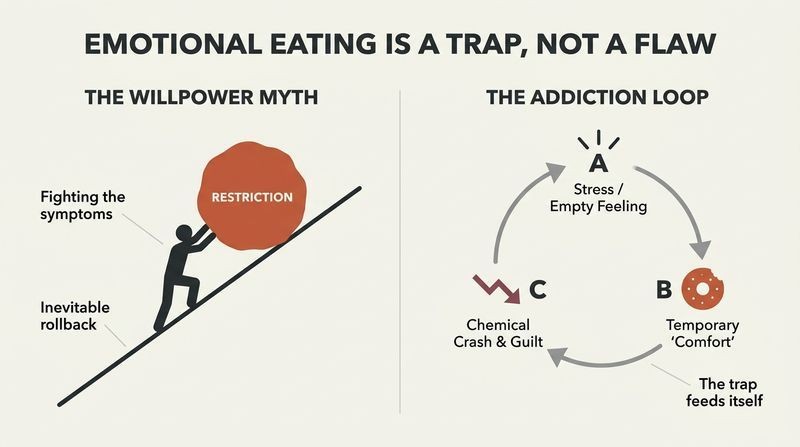
What's striking is how Carr flips the moral framing that dominates diet culture. Mainstream weight-loss advice treats overeating as a lapse of virtue, which research on shame consistently shows backfires: self-criticism predicts more binge eating, not less. Carr's addiction model aligns loosely with modern food-reward neuroscience, though critics note that classifying ordinary comfort eating as clinical addiction risks over-pathologizing. The book wisely flags that bulimia and anorexia are serious illnesses requiring medical help, keeping its scope to the milder, more universal trap of using food to manage feelings.
You wear tight shoes just to feel the relief of removing them
The addiction mechanism: Carr's signature analogy explains why junk food feels good. An addict is like someone who wears painfully tight shoes all day just to enjoy the moment of taking them off. Junk food does not deliver pleasure. It briefly relieves the discomfort that the previous mouthful created. The relief masquerades as reward.
The cycle: Each fix partially soothes the withdrawal caused by the last fix, then creates fresh withdrawal. Sugar spikes blood glucose, then crashes it, so you reach for more sugar to fix a low that sugar itself caused. Carr compares this to cocaine users who drink alcohol to come down, then take more cocaine to counter the alcohol. The addict eats to feel momentarily normal, like a non-addict feels all the time.
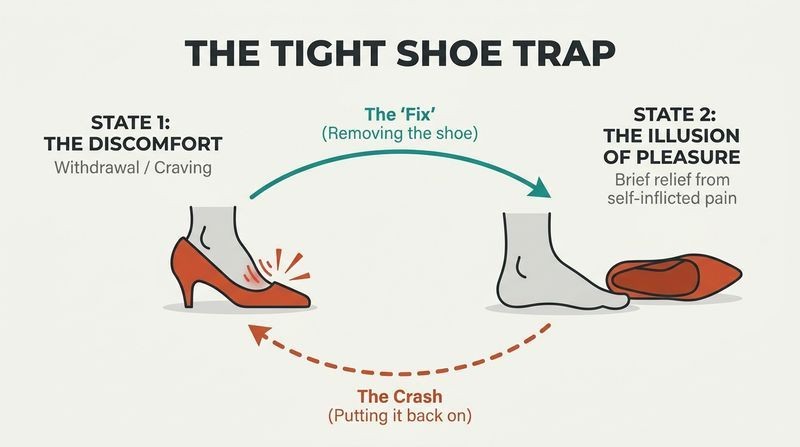
The tight-shoes image is genuinely useful because it names something dopamine researchers describe more technically as the shift from liking to wanting. Robert Sapolsky and others note that dopamine tracks anticipation and relief more than actual enjoyment, which is why the fifth cookie tastes worse than the first yet still gets eaten. One caveat: not all eating fits this bleak-and-plug model. Genuinely hungry people eating nutritious food do experience real satisfaction, and Carr concedes this. The analogy works best for the compulsive, joyless bingeing it targets, less well for occasional indulgence.
Willpower keeps you trapped because it never removes the desire
Why diets fail: The willpower method treats quitting as a battle to resist temptation until it fades. But if you still believe junk food is a pleasure, abstaining feels like sacrifice, which breeds a sense of deprivation and eventually a reward binge. Carr argues that strong-willed people often struggle most, because they keep pushing on the hinged side of the door rather than switching sides.
The stories: Mel lost five stone with a trainer through sheer discipline, then celebrated with a cream cake and regained it all within three months. Nick abstained for a full year, only to gorge on New Year's Eve and vomit, then eat to punish himself. Both had willpower in abundance. What they lacked was a change of mind that erased the wanting itself.
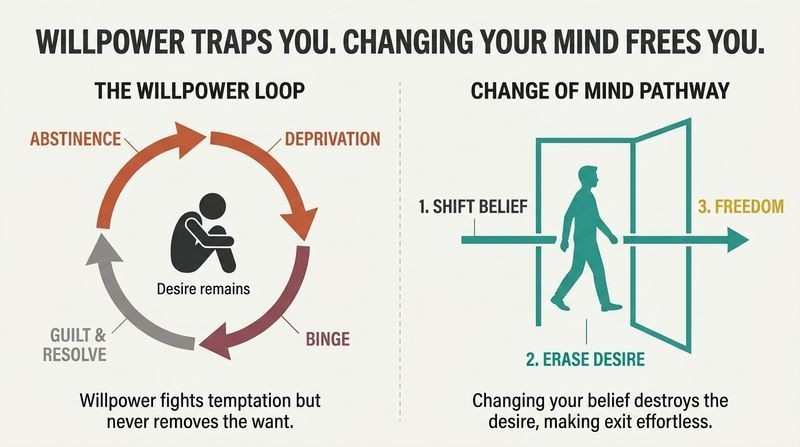
This is Carr's most counterintuitive and empirically interesting claim. It anticipates the ego-depletion debate in psychology: the idea that willpower is a finite resource that drains with use. Roy Baumeister's original depletion findings have faced replication trouble, but the practical lesson survives, that relying on constant restraint is fragile. Behavioral economists would add that Carr is essentially arguing for preference change over impulse control, which is far more durable. The weakness is that Carr offers cognitive reframing as a total substitute for structure, when evidence suggests environment design and habit change also matter enormously.
Kill the Big Monster and the Little Monster starves
Two monsters: Carr splits addiction into two forces. The Little Monster is the faint physical craving, the barely perceptible itch of sugar withdrawal. The Big Monster is the psychological beast built by a lifetime of brainwashing, which interprets that itch as I need junk food and drives you to feed it.
The strategy: You cannot fight the Little Monster with restraint, because feeding it is what keeps it alive. Instead you kill the Big Monster by dismantling the belief that junk food gives pleasure or comfort. Once the mental craving is dead, the physical craving becomes a trivial sensation you can actually enjoy, picturing the parasite weakening as you starve it. Carr reframes withdrawal from an ordeal into a satisfying sign of victory.
Separating the physical from the psychological is clinically sound. Addiction medicine distinguishes acute withdrawal, which is usually short, from psychological craving, which can persist for years and drives most relapse. Carr's insight that the mental component dominates (he pegs it at 99 percent) tracks with why relapse rates stay high long after any chemical has cleared the body. The monster framing is a form of cognitive defusion, a technique in Acceptance and Commitment Therapy where you externalize an urge to reduce its grip. Naming the craving as a separate creature makes it observable rather than identity-defining, which genuinely weakens its authority.
Your fake friend was stealing from your own bank account
The con analogy: Carr tells of a generous new friend who insists on buying you lavish after-work drinks every week. You feel gratitude and joy until you check your bank statement and discover she was secretly withdrawing 100 pounds of your own money each time, spending half on drinks and pocketing the rest. Those wonderful nights instantly curdle into betrayal.
The point: Every high you got from emotional eating was fake in exactly this way, a confidence trick built on your own suffering. The pleasure was never real, so once you understand the mechanism, even the illusion of enjoyment collapses. This is why it matters that the boost is fake. A pleasure you would feel disgusted by if you saw its true source was never a pleasure at all.
The bank-account parable is a clever piece of persuasion because it engages the reader's sense of fairness and betrayal, emotions far more motivating than health warnings. Behavioral science supports this: loss and deception framing move people more than distant risk. What's philosophically interesting is Carr's claim that knowing a pleasure is fake retroactively destroys it. This is contestable. Hedonic experience is arguably real in the moment regardless of source. But Carr's deeper point holds: reframing the source changes future craving. If the ice cream is a thief rather than a treat, the wanting itself dissolves, which is the whole game.
Trust your senses; junk food is bland, brown, and odorless
The sense test: Carr urges you to examine junk food with fresh attention. Close your eyes and smell a cake, a biscuit, a crisp. Notice how little there is to excite the senses: mostly beige, faintly aromatic, soft stodge. Compare that to a fresh apple with its taut shiny skin, fruity smell, and crisp juicy bite. Wild animals choose the apple. We choose the cake because intellect overrides instinct.
Why we get fooled: Refined sugar mimics the natural sugar in fruit, tricking taste buds into registering favorite food while delivering none of the nutrients. We wolf junk down rather than savoring it, proof that we eat it for the sugar hit, not the flavor. If taste were the point, you would chew and spit it out rather than swallow the badness.
Carr's appeal to trusting instinct over intellect is rhetorically powerful but scientifically rough. The claim that we are naturally frugivores who would instinctively reject processed food ignores that humans evolved as flexible omnivores and that our sweet and fat preferences are themselves ancient instincts, not modern corruptions. Sugar and fat were rare and calorically precious for most of human history, so craving them is adaptive, not aberrant. That said, the practical exercise, slowing down and paying genuine sensory attention, overlaps strongly with mindful eating research, which shows attentive eating reduces intake and increases satisfaction. The method is better than its evolutionary just-so story.
Eat only when truly hungry, on a fuel gauge from zero to twenty
The hunger gauge: Carr offers a mental fuel gauge from 0 (empty) to 20 (stuffed and bloated), where 10 means satisfied. True hunger sits between 3 and 7, and that is the window to eat. Slight hunger (7 to 10) is often imperceptible; eating then robs food of its pleasure. Hunger, he stresses, is not starvation. It is a mild, pleasant signal that makes food taste better the longer you wait.
Real versus false hunger: Addiction manufactures false hunger. Distinguish it by three questions:
1. How fast did it come on? False hunger arrives suddenly; real hunger builds slowly.
2. What do you crave? Real hunger wants food in general; false hunger fixates on specific sugary or salty items.
3. Is it proportionate? Panic to eat while your gauge is high signals the monsters, not your body.
The gauge is a practical distillation of interoception, the skill of reading internal body signals, which is measurably impaired in chronic dieters and emotional eaters. Intuitive-eating research, notably work by Tribole and Resch and validation studies on the Intuitive Eating Scale, supports the core move: relearning hunger and fullness cues predicts better psychological and metabolic outcomes than restriction. Carr's three-question triage for real versus false hunger is genuinely actionable. One nuance: habitual routine eating and social eating are also legitimate and pleasurable, and a gauge that treats all non-hunger eating as pathology could tip vulnerable readers toward rigidity, the very control-restriction trap Carr elsewhere warns against.
There is no addictive personality, only the wrong method
Debunking the excuse: Many people explain repeated failure by claiming a genetic addictive personality. Carr calls this a convenient myth that only deepens the trap by making escape seem hopeless. His statistical rebuttal is elegant: in 1940s Britain over 80 percent of adult men smoked; today under 20 percent do. If addiction were a fixed genetic trait, that proportion could not collapse by 60 points in seventy years, nor could smoking rates plummet in the West while soaring in the East.
What actually varies: Why does one person nibble a single biscuit while another devours the packet? Not personality but circumstance: upbringing, stress levels, time, money, and above all the strength of the belief that junk delivers comfort. Karen's story shows the pattern, hooked in sequence on cigarettes, alcohol, and sweets, until she realized the common thread was brainwashing, not a broken gene.
Carr overstates for effect, but the epidemiological argument is legitimately strong. Population-level shifts in smoking clearly reflect price, regulation, and social norms, not gene pools, which change far too slowly. Where he oversimplifies: twin and adoption studies do show meaningful heritability in addiction vulnerability, roughly 40 to 60 percent for many substances. The reconciliation is that genes load the gun while environment pulls the trigger. Carr's practical point survives the nuance intact: treating addiction as an immutable identity is disempowering and self-fulfilling, whereas treating it as a learned belief that any brain can unlearn restores agency. For motivation, his framing beats fatalism.
Quit instantly and completely; cutting down makes cravings worse
No gradual taper: Standard advice says wean yourself off slowly. Carr argues the opposite. Cutting down is counterproductive for two reasons: it inflates the value of each rationed fix, and it keeps you in a permanent state of longing that erodes resolve. The longer you endure a craving before relenting, the more intense the illusory pleasure of relief, which is like buying tighter and tighter shoes.
No substitutes either: Methadone, patches, sweeteners, and their equivalents perpetuate the myth that withdrawal is an ordeal and keep the Big Monster alive by sustaining a sense of deprivation. Carr ritualizes the moment of quitting as the Final Feast: you eat a former favorite one last time while paying full, disenchanted attention to its blandness, then vow never again to eat for comfort. Freedom begins immediately, not after some waiting period.
The abrupt-cessation stance is contested in addiction treatment, where tapering and replacement therapies have strong evidence for opioids and nicotine. Carr's method is essentially psychological rather than pharmacological, and for a substance as mild in physical dependence as sugar, cold-turkey is far more defensible than it would be for alcohol or benzodiazepines, where abrupt withdrawal can be dangerous. The Final Feast ritual is smart behavioral design: rituals create clean psychological boundaries, and a decisive break avoids the negotiation fatigue that gradualism invites. The deeper wisdom is that ambivalence, not chemistry, drives most relapse, and a firm line eliminates the daily internal debate.
You are not giving anything up; you are escaping a prison
Reframe the loss: The final and most important mindset shift is realizing there is no sacrifice. People who quit by willpower mourn junk food like a lost friend, feeling a permanent void. Carr insists you are losing only a tormentor. The correct emotional stance is not grim resignation but elation, the same feeling as walking out of a cell whose door has swung open.
Handling life afterward: Expect good days and bad days; they have nothing to do with quitting. When the thought of junk arises, do not suppress it (tell someone not to think of elephants and they think only of elephants). Instead greet it with relief: I am free, I do not have to do that anymore. Carr promises the payoff is real, not fake: more time, more money, better sleep, restored self-respect, and genuine enjoyment of food again.
Ending on reframing rather than restriction is what distinguishes Carr's approach from every diet that precedes it, and it maps neatly onto cognitive reappraisal, one of the most robustly effective emotion-regulation strategies in psychology. Framing sobriety as gain rather than loss measurably improves adherence across addictions. The elephant instruction is also sound: thought suppression produces ironic rebound, a well-documented effect from Daniel Wegner's research, so Carr's advice to welcome and defuse the thought rather than banish it is exactly right. The honest limitation is that Carr's method addresses the food relationship but explicitly cannot fix the underlying loneliness, stress, or grief that drove the eating. Those still need their own attention.
Analysis
This is a self-help book with a single thesis relentlessly repeated: emotional eating is an addiction sustained by illusion, and escape comes from dismantling belief rather than exerting willpower. Structurally it is a persuasion machine disguised as a book. Carr front-loads mindset instructions (follow all instructions, open your mind, begin with elation) and withholds the practical Final Feast until the reader's frame of mind has been thoroughly reconditioned. The repetition is deliberate, not padding. It functions as counter-brainwashing, mirroring the mechanism Carr blames for the addiction in the first place.
The intellectual lineage matters. This is the Allen Carr Easyway smoking method, transposed onto food after his death by John Dicey, who frames every update in Carr's voice. That transposition is both the book's strength and its stress point. Nicotine addiction has a clean structure: one substance, total abstinence, no biological need. Food cannot be quit, only renegotiated, which forces Carr into a more complex position. He must separate junk (refined sugar and starchy carbs, his Bad Sugar) from nourishing food, and permit continued eating while forbidding emotional eating. He handles this with the three-part model of emotional-eating addiction (control not to binge, loss of control, and sugar addiction) and the hunger gauge, both genuine additions beyond the smoking template.
The science is a mix of the sound and the loose. His dopamine and withdrawal account broadly aligns with reward-learning research, and he cites Robert West accurately. His evolutionary claim that humans are natural frugivores corrupted by intellect is shakier. Where the book excels is psychology: the reframing of sacrifice as escape, the externalization of craving, the rejection of shame, and the insistence on decisive action all anticipate techniques validated in ACT and cognitive reappraisal research. Its greatest ethical strength is repeatedly directing readers with serious eating disorders toward medical help while keeping its own promise modest and specific.
Review Summary
Allen Carr's Easy Way to Quit Emotional Eating receives mixed reviews. Some readers find it life-changing, praising its approach to breaking food addiction and promoting mindful eating. Others criticize its repetitive nature and oversimplification of emotional eating issues. The book applies Carr's "Easy Way" method to food addiction, emphasizing mindset changes and challenging psychological conditioning. While some readers report significant improvements in their relationship with food, others find the advice impractical or too extreme. The book's effectiveness seems to vary greatly depending on individual circumstances and expectations.
People Also Read

FAQ
What's "Allen Carr's Easy Way to Quit Emotional Eating" about?
- Purpose of the book: The book aims to help readers overcome emotional eating by using Allen Carr's Easyway method, which has been successful in addressing various addictions.
- Focus on psychological aspects: It emphasizes understanding the psychological causes of emotional eating rather than focusing on dieting or willpower.
- Methodology: The book provides a structured, easy-to-follow method to help readers change their mindset and remove the desire to eat for emotional reasons.
- Broader application: While it specifically targets emotional eating, the principles can be applied to other addictive behaviors.
Why should I read "Allen Carr's Easy Way to Quit Emotional Eating"?
- Effective method: The Easyway method has a proven track record of helping people overcome various addictions, including smoking and emotional eating.
- No willpower needed: Unlike traditional methods, it doesn't rely on willpower, making it easier to follow and more sustainable.
- Holistic approach: The book addresses both the psychological and physical aspects of emotional eating, offering a comprehensive solution.
- Positive mindset: It encourages a positive attitude towards quitting, focusing on the benefits of freedom from emotional eating.
What are the key takeaways of "Allen Carr's Easy Way to Quit Emotional Eating"?
- Understanding addiction: Emotional eating is a form of addiction driven by psychological factors and brainwashing.
- Illusion of pleasure: Junk food does not provide genuine pleasure or comfort; it only temporarily relieves withdrawal symptoms.
- Mindset change: The key to quitting is changing your mindset and removing the desire to eat for emotional reasons.
- Freedom from control: By following the Easyway method, you can regain control over your eating habits and enjoy a healthier, happier life.
How does Allen Carr's Easyway method work for emotional eating?
- Counter-brainwashing: The method helps unravel the brainwashing that convinces you junk food provides pleasure or comfort.
- No willpower required: It removes the need for willpower by eliminating the desire to eat for emotional reasons.
- Structured approach: The book provides step-by-step instructions to guide you through the process of quitting.
- Focus on mindset: It emphasizes changing your mindset to see the truth about emotional eating and its effects.
What are the common misconceptions about emotional eating addressed in the book?
- Pleasure and comfort: The book debunks the myth that junk food provides genuine pleasure or comfort.
- Willpower myth: It challenges the belief that quitting requires immense willpower, showing that mindset change is more effective.
- Addictive personality: The book argues against the idea of an addictive personality, suggesting that anyone can overcome emotional eating.
- Withdrawal fears: It addresses the fear of withdrawal, explaining that the symptoms are mild and manageable.
What is the "Big Monster" and "Little Monster" concept in the book?
- Big Monster: Represents the psychological craving and brainwashing that convinces you junk food provides pleasure or comfort.
- Little Monster: Refers to the physical craving and withdrawal symptoms that occur when you stop eating junk food.
- Killing the monsters: The book teaches you how to kill the Big Monster by changing your mindset and ignoring the Little Monster's cries.
- Freedom from monsters: Once both monsters are dealt with, you can enjoy life free from emotional eating.
How does the book suggest dealing with withdrawal symptoms?
- Understanding withdrawal: Withdrawal symptoms are mild and mainly psychological, caused by the fear of missing out on junk food.
- Enjoy the process: The book encourages you to enjoy the withdrawal process as a sign of the Little Monster dying.
- No panic needed: It reassures readers that withdrawal is not painful and can be managed with the right mindset.
- Focus on freedom: Emphasizes the feeling of freedom and control that comes with overcoming withdrawal.
What role does hunger play in overcoming emotional eating according to the book?
- Natural fuel gauge: Hunger is a natural signal that tells you when to eat and when to stop, ensuring you eat only when necessary.
- Avoid mindless eating: The book advises against eating out of routine or emotional need, focusing instead on true hunger.
- Satisfaction from nutrients: Eating nutritious foods leads to satisfaction, helping you avoid overeating.
- Reconnect with hunger: By paying attention to your hunger signals, you can enjoy eating and avoid emotional triggers.
What are the best quotes from "Allen Carr's Easy Way to Quit Emotional Eating" and what do they mean?
- "The only way to quit an addiction is to stop doing it." - Emphasizes the simplicity of quitting by removing the desire to engage in the addictive behavior.
- "You are not giving anything up." - Highlights the idea that quitting emotional eating is not a sacrifice but a gain in freedom and happiness.
- "Junk food does absolutely nothing for you at all." - Reinforces the message that junk food provides no real benefits, only temporary relief from withdrawal.
- "You are trading the constant battle for control and loss of control over your eating for total control." - Illustrates the shift from being controlled by food to having control over your eating habits.
How does the book address the fear of failure and success in quitting emotional eating?
- Fear of failure: The book explains that fear of failure is based on the wrong method and that Easyway offers a proven solution.
- Fear of success: It addresses the fear of life without junk food, showing that freedom from emotional eating leads to greater happiness.
- Winning the tug-of-war: By removing both fears, you can win the mental tug-of-war and quit successfully.
- Positive mindset: Encourages a positive attitude towards quitting, focusing on the benefits rather than the challenges.
What is the "Final Feast" ritual in the book?
- Marking the occasion: The Final Feast is a ritual to mark the moment you commit to quitting emotional eating for good.
- Proving the point: It involves eating your favorite junk food one last time to prove to yourself that it provides no real pleasure or comfort.
- Solemn vow: After the feast, you make a vow never to seek pleasure or comfort from junk food again.
- Celebrating freedom: The ritual is a celebration of your newfound freedom and control over your eating habits.
How can "Allen Carr's Easy Way to Quit Emotional Eating" help with other addictions?
- Universal principles: The Easyway method is based on principles that can be applied to various addictions, not just emotional eating.
- Focus on mindset: By changing your mindset and removing the desire for the addictive behavior, you can overcome other addictions.
- Proven success: The method has been successful in helping people quit smoking, drinking, and other addictive behaviors.
- Comprehensive approach: It addresses both the psychological and physical aspects of addiction, offering a holistic solution.
About the Author
Other books by Allen Carr

Download PDF
Download EPUB
.epub digital book format is ideal for reading ebooks on phones, tablets, and e-readers.








































