

Key Takeaways
Fill your five buckets in order: knowledge, skills, network, resources, reputation
Bartlett argues your professional potential is the sum of five buckets, filled left to right: what you know, what you can do, who you know, what you have, and what the world thinks of you. Knowledge applied becomes skill, which attracts a network, which unlocks resources, which earns reputation. The rookie error is letting ego skip the first two for a bigger salary or shinier title.
A talented 21-year-old named Richard left Bartlett's firm to become a CEO in New York for double the pay. Eighteen months later the company collapsed and he returned, unemployed, seeking a junior role. A 'professional earthquake' can steal your network, money, and reputation, but never your knowledge or skills. Those two buckets are the only theft-proof foundation.
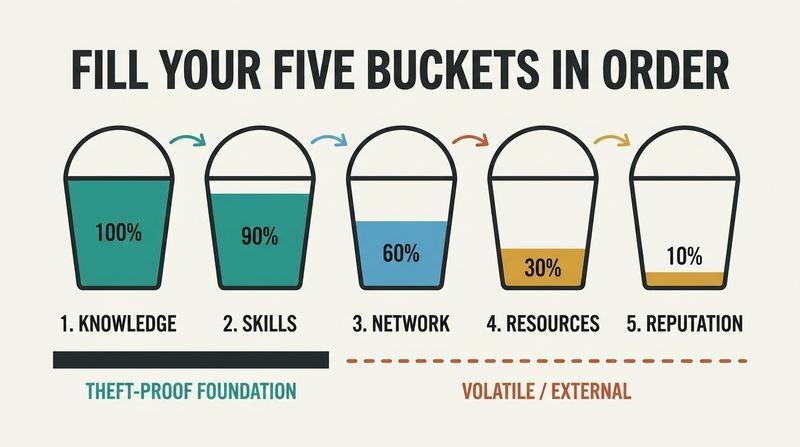
The framework echoes human capital theory, but Bartlett's ordering insight is the useful part: compensation is a lagging indicator of the first two buckets. There is a tension worth naming. His Law 26 argues the same skill earns ten to thirty times more simply by relocating it to a market that prizes it (a graphic designer moving from Manchester nightclub flyers to Dubai luxury brands). So knowledge and skills are necessary but not sufficient; context sets the price. Reputation, meanwhile, increasingly compounds faster than the model implies in an era of personal brands, where bucket five can front-run the rest. Sequence matters, but so does where you pour.
To truly master something, commit publicly to teaching it
At 21, Bartlett promised himself he would publish one idea online every single day. That daily obligation, not talent, transformed him from a mute, terrified teenager frozen by stage fright into someone sharing stages with Barack Obama. The mechanism is 'skin in the game': a public audience gives you something to lose, and loss aversion (our stronger drive to avoid losses than chase gains) forces consistency.
He pairs this with a revised Feynman technique, named after the Nobel physicist who insisted that if you cannot explain something at a freshman level, you do not truly understand it. The steps: learn it, write it as if for a child, share it where you will get feedback, then review and repeat. Compressing an idea into a tweet-length essence both builds and proves understanding.
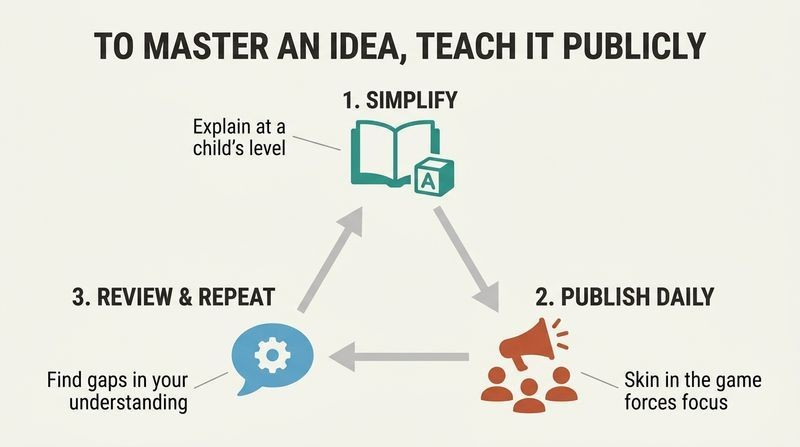
The 'protege effect' has solid empirical backing: students who learn material expecting to teach it outperform those learning for a test, because teaching demands retrieval, organization, and gap-detection. Bartlett's addition is public consistency as an accountability engine, which aligns with commitment-device research in behavioral economics. One caveat: public performance can also incentivize polish over accuracy, rewarding confident simplification even when nuance is lost. The Feynman ideal guards against this only if feedback loops are honest. Broadcasting daily to an audience that rewards certainty can quietly train a communicator to oversimplify. Mastery through teaching works best when the audience can genuinely push back.
Never begin a rebuttal with 'I disagree' or 'You're wrong'
Neuroscientist Tali Sharot scanned pairs of people valuing real estate. When they agreed, their brains lit up, receptive and open. When they disagreed, brains effectively froze, discounting the other's opinion entirely. Opening with disagreement slams the door before your logic, evidence, or eloquence can enter.
Bartlett learned this the hard way, replaying his parents' marathon arguments in his own relationship until he found himself locked in a wardrobe at 5am. The fix: lead with common ground, shared motives, and the parts of the other's view you understand, then introduce your rebuttal. This is why the people most able to change our minds are those we agree with on 98 percent of things. Being right is worthless if the other brain has already shut down.
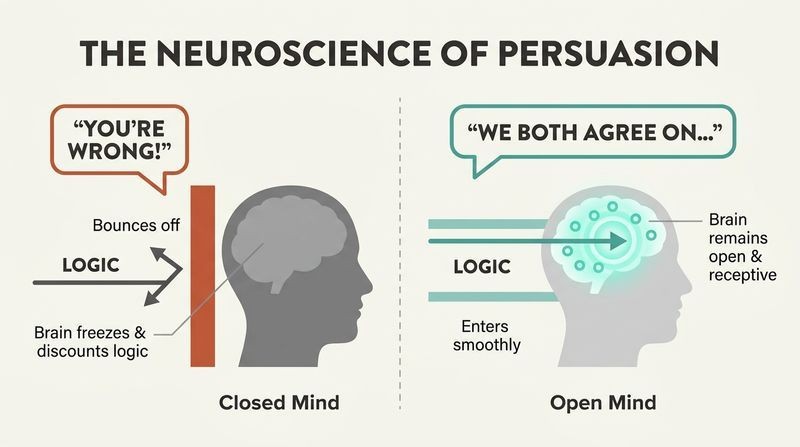
This dovetails with negotiation research from Fisher and Ury and with motivational interviewing in clinical psychology, where 'rolling with resistance' outperforms confrontation for changing entrenched behavior. Sharot's brain-imaging adds a mechanistic layer to what rhetoricians have known since Aristotle's appeal to shared premises. The honest limitation: agreement-first can shade into manipulation or false flattery, and sophisticated listeners detect it. There is also a moral hazard in a world that already avoids hard truths. The goal is not to never state disagreement but to sequence it, earning cognitive access before delivering the challenge. Bridge first, then cross.
You cannot choose beliefs; you can only feed yourself new evidence
Bartlett's thought experiment: a terrorist demands you genuinely believe he is Jesus Christ or your loved one dies. You could lie, but you could not force the belief. In his survey, 85.7 percent thought they choose their beliefs, yet 98 percent admitted they could not choose that one. Beliefs are built from evidence we subjectively trust, which is why arguing with a flat-earther or reciting affirmations rarely works.
The same logic governs your 'self-story,' the internal narrative of what you are capable of. Grit researcher Angela Duckworth found that at West Point, cadets one point higher on the grit scale were 60 percent more likely to survive brutal Beast Barracks, outweighing strength or intelligence. To change a belief, don't attack it; supply new first-party evidence, ideally framed as good news, and interrogate the details of limiting beliefs to weaken them.
The claim that we don't choose beliefs is philosophically defensible (doxastic involuntarism) and pairs with Kahneman's observation that confidence rests more on story coherence than evidence quality. The practical payload is strong: exposure therapy works precisely by generating disconfirming first-party evidence, which is why Bartlett's stage fright dissolved through repeated speaking, not pep talks. The 'good news bias' he cites (people update fast toward flattering evidence, slowly toward threatening evidence) is well documented and sobering, because it means truth alone loses to comfort. His technique of asking people to explain their beliefs in mechanical detail draws on the 'illusion of explanatory depth,' a genuinely underused persuasion tool.
When an idea threatens or confuses you, lean in harder
A music-store CEO who scoffed that people would always want CDs went bankrupt; iTunes gave people what they actually wanted, which was music without the trip. A fashion brand's marketing director mocked social media as too dangerous in 2012 and filed for bankruptcy in 2019. Bartlett calls the failure mode 'leaning out': being so sure you are right that you stop listening.
The culprit is cognitive dissonance, the discomfort when new facts clash with our identity. Because admitting we are wrong is painful, we attack the disruptor instead. Bartlett flips this into a signal: passionate criticism of a new technology often marks its potential, which is why he leaned into crypto and social media early. The remedy is holding two conflicting ideas at once and asking honestly, am I dismissing this only because I don't understand it?
Festinger's dissonance theory and Christensen's disruption research converge here: incumbents rarely fail from stupidity but from rational defense of existing commitments. Bartlett's heuristic (criticism signals opportunity) is seductive but risky as stated, because most criticized ideas are simply bad, and survivorship bias makes crypto and social media look inevitable in hindsight. Plenty of loudly hyped, loudly attacked technologies deserved the skepticism. The stronger version is his Shimon Peres move: tolerate the discomfort of unresolved contradiction rather than collapsing prematurely into acceptance or rejection. Curiosity as a discipline, not contrarianism as a reflex, is what actually protects against being left behind.
To spark action, ask a binary yes-or-no question instead of giving orders
In 1980 Reagan trailed Carter by eight points. Rather than reciting economic statistics, he asked voters one question: are you better off than you were four years ago? Days later he won in a landslide. Questions, unlike statements, force an active mental response.
Bartlett calls this the question/behaviour effect. Reviewing 100-plus studies across 40 years, researchers found that asking 'Will you recycle?' beats a sign reading 'Please recycle,' and the influence can persist up to six months. It works best with yes/no questions starting with 'will,' aimed at behavior tied to who someone wants to become. A 'yes' creates positive cognitive dissonance between your aspiration and your action, and binary framing leaves no wiggle room for the elaborate excuses a vague intention permits.
This is a clean application of self-perception theory and commitment consistency (Cialdini): once we voice an intention aloud, we feel pressure to align behavior with the self-image we just declared. The specificity of the finding (that 'will' outperforms 'can' or 'would') reflects how framing cues agency versus ability. A fair critique is durability: field replications of the mere-measurement effect are mixed, and the six-month figure likely applies to low-friction behaviors more than hard ones. Asking yourself 'Will I go to the gym?' helps at the margin, but structural friction still dominates. Still, as a free, one-second nudge for yourself or others, it is unusually high-leverage.
Don't wrestle bad habits into submission; swap out their reward
Bartlett's father smoked for 40 years, only ever in his car. After accidentally reading a book on habit loops (cue, routine, reward), the father replaced the cigarettes in his car door with lollipops and never smoked again. The cue and routine stayed; only the reward changed. Fighting a habit backfires because the brain is wired for action, not inaction, and suppression triggers rebound: smokers told not to think about smoking think about it more.
Two supports make new habits stick. First, sleep and low stress, because willpower behaves like a depletable muscle (Muraven's radish-and-cookie study showed people who resisted cookies quit an impossible puzzle in half the time). Second, attempt only one habit at a time; piling on unrealistic resolutions guarantees rebound.
Duhigg's habit-loop model and Wegner's ironic-process theory (the harder you suppress a thought, the more it intrudes) both underpin this, and the reframe from subtraction to substitution is genuinely more effective than willpower-based abstinence. Worth flagging: ego-depletion, the willpower-as-muscle finding, has faced serious replication trouble since 2016, so lean on it lightly. The sleep argument is on firmer ground, with robust links between deprivation, elevated ghrelin, and impaired self-regulation. The deepest point is behavioral, not physiological: design determines outcome. Change the environment so the old cue meets a new, less harmful routine, and you spend far less scarce self-control.
Absurdity and five-second hooks win the attention that competence cannot
Bartlett's agency never had a sales team; it had a 13,000-pound blue slide and ball pool. Journalists photographed it obsessively, and that single absurd object generated more press than any campaign, screaming 'this company is different.' Tesla spends nothing on ads but names driving modes 'Ludicrous' and installs fart sounds. The most absurd thing about a brand ends up saying everything about it.
Underneath is habituation: the brain tunes out repetition, turning overused phrases into 'wallpaper.' Say a word enough and it loses meaning (semantic satiation). This is why 'please like and subscribe' failed for Bartlett until he opened with a jarring, specific stat, lifting his subscriber rate 430 percent. The rule extends to openings: like MrBeast, you must earn attention in the first five seconds with a bold promise, not a warm introduction.
Rory Sutherland's costly-signaling logic drives the absurdity thesis: irrational, expensive, useless gestures are credible precisely because they cannot be faked cheaply, echoing Zahavi's handicap principle in evolutionary biology. Habituation and the mere-exposure effect create a real tension the book handles well, since audiences want novelty and familiarity at once, hence the 'optimal exposure' sweet spot. The shakier extension is Law 12's 'you must piss people off,' which conflates emotional salience with deliberate polarization. Provocation reliably buys attention but can burn trust and brand equity, and the swearing-book-cover trend already shows diminishing returns as the tactic itself becomes wallpaper. Distinctiveness has a half-life.
Reshape perception before reality with cheap psychological moonshots
Bartlett's hairdresser makes clients feel he is meticulous with a fake final snip that cuts no hair. Rory Sutherland's term for this is a 'psychological moonshot': a tiny, often free change that dramatically improves perception. It is usually cheaper to invest in perception than reality. Uber's in-house scientists exploited the peak-end rule, idleness aversion, and operational transparency (the moving-car map) to cut cancellations 11 percent.
Related levers all bend perceived value without changing the product:
1. Friction can add value: Betty Crocker cake mix flopped until customers had to add an egg, restoring a sense of contribution.
2. Framing beats substance: '90 percent lean' outsells '10 percent fat'; Tesla calls plastic seats 'vegan leather.'
3. Goldilocks anchoring: flank your target option with a cheaper and a pricier one so it looks like the safe middle.
4. The endowment effect: let people touch and hold a product (Apple's open stores) and they value it more.
This cluster is behavioral economics applied with unusual candor, and it is the book's most operationally useful section. The peak-end rule (Kahneman and Redelmeier), endowment effect (Thaler), and anchoring (Tversky and Kahneman) are among the most replicated findings in the field. The ethical fault line is real and Bartlett waves it away with 'all is fair in psychological moonshots.' There is a meaningful difference between reducing genuine uncertainty (Domino's tracker) and manufacturing false control (elevator close buttons that do nothing). The former respects the customer; the latter engineers a placebo. Practitioners should ask whether the perception they are shaping points toward a truer experience or merely a more profitable illusion.
Compound 1% daily gains and out-fail your competition on purpose
Toyota's kaizen philosophy (continuous improvement) treats innovation as millions of tiny suggestions from every worker, not heroic leaps. When Toyota reopened a disastrous GM plant with the same workers and equipment, defects dropped from twelve per car to one within a year. Improve 1 percent daily and 100 pounds becomes over 3,700 in a year; decline 1 percent and it nearly vanishes. Tiger Woods rebuilt his swing from scratch, winning nothing for 18 months, then dominated.
The partner discipline is failing faster. IBM's Watson refused to fire a man whose mistake cost 600,000 dollars, saying he had just paid for the training. Amazon and Booking.com run tens of thousands of experiments; Bezos distinguishes reversible 'two-way door' decisions (make them fast) from irreversible ones. Bartlett watched a son out-fail his father tenfold and overtake a billion-dollar brand. Pre-empt disaster by asking 'why will this fail?' before you start.
The synthesis of kaizen with a pro-failure experimentation culture is the book's philosophical spine, and it is well chosen because the two ideas cover both incremental optimization and discontinuous bets. The compounding math is arithmetically true but rhetorically misleading: real gains are not independent daily multipliers and hit ceilings, so treat 37x as motivation, not forecast. The pre-mortem (Gary Klein) is the standout practical tool, leveraging 'prospective hindsight' to boost reason-generation by roughly 30 percent and neutralizing optimism bias, confirmation bias, and groupthink. The subtle risk in a fail-fast gospel is that it flatters recklessness; Bezos's reversibility test is the essential governor that keeps 'out-fail everyone' from meaning 'bet the company.'
Burn your Plan B and treat every pressure as a privilege
Trapped in the Andes after a 1972 crash, Nando Parrado chose to climb toward almost certain death rather than eat his mother's and sister's bodies, surviving a ten-day trek because, as he put it, the only way forward was that he could not go back. Research backs the intuition: across studies of 500 students, those given no backup plan solved more puzzles and were more motivated. A Plan B quietly lowers your drive for Plan A by removing the fear of failure.
Pressure, meanwhile, is not the enemy. In a study of 30,000 adults, high stress raised death risk 43 percent only among those who believed stress was harmful; believers in beneficial stress had the lowest risk of all. Reframing anxiety as energizing kept blood vessels relaxed. Add a clear-eyed look at mortality (Bartlett counts his remaining days), and pressure becomes fuel rather than threat.
The Plan-B finding (Shin and Milkman) is real but narrowly scoped: it holds when success depends heavily on effort and the backup is salient, and it says nothing about catastrophic downside, which is why Bartlett rightly separates risk from recklessness. Total commitment maximizes motivation and ruin simultaneously, so the advice suits those with a societal safety net more than those without. The stress-mindset work (Crum, McGonigal) is genuinely paradigm-shifting: appraisal, not the stressor, drives the physiology, echoing Stoic and CBT traditions that locate suffering in interpretation. Memento mori as a focusing device is ancient and evidence-backed, reliably increasing gratitude, generosity, and prioritization when confronted rather than avoided.
Great teams come from hiring who-not-how, guarding culture, and fueling progress
Dyslexic Richard Branson could not tell net from gross profit at 50, yet built a 24-billion-dollar empire by trusting brilliant people. The elite founder's question is not 'how do I do this?' but 'who is best placed to do it for me?' Every company is really a recruitment company. Your first ten hires each set 10 percent of the culture, so early teams should feel almost cult-like in devotion.
Protecting that culture means acting on the 'bad apple.' A Harvard study found misconduct spreads with a 1.59 social multiplier, and one toxic member outweighs several good ones. Sir Alex Ferguson sold star players at their peak to defend United's culture. Bartlett's 'three bars' test: would this person raise, maintain, or lower the average? Finally, David Brailsford's British Cycling proved that the feeling of progress, not size of win, drives motivation, so celebrate small wins loudly and treat each teammate as a different-shaped puzzle piece rather than applying one uniform leadership style.
This pillar braids four robust ideas: delegation as leverage, culture as the multiplier, negativity's asymmetric contagion (Felps and Mitchell's bad-apple research), and Amabile's progress principle, which found that the single strongest daily motivator is a sense of forward movement in meaningful work. The 'be an inconsistent leader' insight is the freshest, aligning with situational leadership theory: tailoring approach to the individual beats fairness-as-uniformity. Two cautions. 'Cult mentality' is a dangerous metaphor even when hedged, since the very devotion that fuels startups also suppresses the dissent that prevents catastrophe. And rapid firing of 'bar-lowerers' can mask managerial failure to develop people or misread neurodivergence and dissent as toxicity.
Analysis
The Diary of a CEO is best understood not as a business-strategy book but as an applied-psychology anthology dressed in entrepreneurial memoir. Bartlett's real thesis, stated in his introduction, is that durable success rests on timeless laws rooted in cognitive science rather than on strategy, which he dismisses as seasonal. This framing is both the book's strength and its vulnerability. The strength: it imports genuinely powerful findings (loss aversion, cognitive dissonance, the peak-end rule, the progress principle, stress-mindset research) into accessible, story-driven prose, and Bartlett's willingness to name mechanisms distinguishes him from motivational peers. The vulnerability: like most trade psychology, it leans on individual studies as if they were settled law, occasionally citing findings (ego depletion, some question/behaviour durability claims) that have wobbled under the replication crisis. Readers should treat the science as directional, not gospel.
Structurally, the four pillars (Self, Story, Philosophy, Team) map cleanly onto a founder's journey from self-mastery to persuasion to resilience to leadership, and the book is most original in its middle sections on attention and perception, where Rory Sutherland's influence is heavy but well-deployed. The recurring intellectual thread is that humans are irrational, evidence-driven, comfort-avoiding creatures, and that leverage comes from working with this wiring rather than against it: replace rewards instead of fighting habits, supply evidence instead of arguing, shape perception instead of only improving reality.
The ethical dimension is underexamined. Bartlett's 'all is fair in psychological moonshots' and 'you must piss people off' treat persuasion techniques as morally neutral tools, when several shade into manipulation. Similarly, 'cult mentality' and rapid firing of culture-misfits carry organizational risks he underweights. The book is at its wisest when synthesizing (kaizen plus fail-fast, pressure plus mortality) and at its most quotable when oversimplifying. Read it as a high-density prompt for behavioral experiments on yourself, verify the science, and supply your own ethical guardrails.
Review Summary
The Diary of a CEO receives mixed reviews, with an overall rating of 4.19/5. Positive reviewers praise its valuable insights, concise writing, and inspirational content, particularly for young professionals. Critics find it repetitive, superficial, and lacking depth for older readers. Some appreciate the psychology discussions and business advice, while others criticize the author's perceived ego and reliance on other people's ideas. The book's structure and presentation style are debated, with some enjoying the podcast-like format and others finding it disjointed.
People Also Read






Glossary
The Five Buckets
Knowledge, skills, network, resources, reputationBartlett's model of professional potential: five assets filled in order from left to right. Knowledge applied becomes skill, which grows your network, which unlocks resources, which builds reputation. The first two (knowledge and skills) are the theft-proof foundation that no 'professional earthquake' can take away, so investing in them yields the highest long-term return.
Skin in the game
Having something real to loseA psychological stake (money, public commitment, reputation) that raises the cost of quitting and accelerates learning. Because humans are more motivated to avoid losses than to chase gains (loss aversion), deliberately giving yourself something to lose, like a public daily posting habit, enforces the consistency required for mastery.
Question/behaviour effect
Questions drive action better than statementsThe finding, drawn from 100-plus studies, that asking someone a question about a future behavior ('Will you recycle?') makes them more likely to do it than telling them to ('Please recycle'). It works best with yes/no questions beginning with 'will,' aimed at behaviors tied to a person's aspirations, and can influence action for up to six months.
Self-story
Your internal narrative of capabilityBartlett's term for the self-concept: the evidence-based story you hold about who you are and what you can endure. Built largely from first-party evidence gathered through your own choices under pressure, it is the primary source of mental toughness and grit, and it can be rewritten by deliberately generating new evidence of perseverance.
Psychological moonshot
Cheap change that transforms perceptionA term from Rory Sutherland for a small, often free investment that dramatically improves how something is perceived without improving its underlying reality, such as Uber's live map, Domino's pizza tracker, or a hairdresser's fake final snip. The principle: it is usually cheaper and more effective to shape perception than to change reality.
Wallpaper (habituation)
Overused messaging the brain ignoresBartlett's label for language, phrases, or stimuli so repeated that the brain tunes them out via habituation. Related is semantic satiation, where a word repeated enough loses its meaning. To be heard, communicators must avoid default phrasing and use unexpected, specific, unsaturated language that bypasses the brain's attention filter.
Kaizen
Continuous small incremental improvementThe Japanese philosophy central to Toyota's production system, meaning innovation happens through countless tiny improvements suggested by all employees daily, not through occasional big leaps. Compounded over time, marginal 1 percent gains produce dramatic results, and the approach is more sustainable and inclusive than pursuing rare breakthroughs.
Pre-mortem method
Imagining failure before you startA decision technique from Gary Klein in which a team imagines a project has already failed and works backward to explain why. By asking 'why will this fail?' upfront, it counters optimism bias, confirmation bias, and groupthink, and research shows it improves the ability to identify real risks by roughly 30 percent.
Type 1 and Type 2 decisions
Irreversible versus reversible choicesJeff Bezos's distinction adopted by Bartlett. Type 1 decisions are consequential and nearly irreversible ('one-way doors') and deserve slow deliberation. Type 2 decisions are reversible ('two-way doors') and should be made quickly by small empowered teams, because treating reversible choices as if they were irreversible causes slowness and stifles experimentation.
Plan-A thinking
Commit fully, abandon the backupBartlett's principle that having a Plan B lowers your drive to achieve Plan A by removing the motivating fear of failure. Research on students showed those denied a backup plan performed better on effort-dependent tasks. He distinguishes this focused commitment from recklessness, noting practicality and dependents still matter.
Three bars framework
Raise, maintain, or lower averageBartlett's hiring, firing, and promotion test: ask whether, if everyone in the organization shared this person's cultural values, attitude, and talent, the average bar would be raised, maintained, or lowered. Bar-raisers get promoted; bar-lowerers get removed quickly, because research shows one toxic 'bad apple' outweighs several strong performers.
The discipline equation
Goal value plus reward minus costBartlett's formula: Discipline = the perceived value of the goal + the reward of the pursuit - the cost of the pursuit. To sustain discipline independent of fluctuating motivation, clarify why the goal matters, make the process enjoyable and engaging (via gamification and accountability), and remove friction and psychological cost from pursuing it.
FAQ
What's The Diary of a CEO: The 33 Laws of Business and Life about?
- Intersection of Business and Personal Growth: The book explores how personal development and business success are intertwined, focusing on self-mastery and understanding one's narrative.
- Four Pillars of Greatness: Steven Bartlett introduces four essential pillars—The Self, The Story, The Philosophy, and The Team—that are crucial for achieving success in life and business.
- Timeless Laws: It presents 33 laws based on psychology and science, applicable across various industries and timeless in their relevance.
Why should I read The Diary of a CEO by Steven Bartlett?
- Practical Wisdom: The book combines Bartlett's entrepreneurial experiences with insights from interviews with top leaders, offering actionable advice.
- Modern Leadership Approach: It challenges traditional leadership notions, promoting vulnerability, curiosity, and self-improvement as key traits for modern CEOs.
- Inspiration for Aspiring Leaders: Readers seeking to redefine success and reach their potential will find valuable lessons and encouragement.
What are the key takeaways of The Diary of a CEO?
- Self-Mastery is Crucial: Mastering oneself is foundational for success in any life or business aspect, as highlighted in the first pillar.
- Storytelling Matters: The ability to tell compelling stories is essential for influencing others and building a brand.
- Continuous Improvement: The philosophy of kaizen emphasizes that small, incremental changes can lead to significant long-term success.
What are the best quotes from The Diary of a CEO and what do they mean?
- “You cannot pour from empty buckets.”: Highlights the importance of self-care and personal fulfillment before helping others.
- “Pressure is a privilege.”: Reflects the idea that challenges and pressures can lead to growth and opportunities.
- “You must become a Plan-A thinker.”: Encourages full commitment to primary goals without relying on backup plans, fostering determination and focus.
How does The Diary of a CEO define the concept of psychological moonshots?
- Small Investments, Big Perception: Psychological moonshots refer to minor changes that drastically enhance perceived value.
- Focus on Perception: Investing in perception can be more effective than focusing solely on actual attributes.
- Real-World Examples: Companies like Uber and Build-A-Bear use psychological moonshots to improve customer satisfaction without significant cost increases.
What is the endowment effect mentioned in The Diary of a CEO?
- Psychological Ownership: The endowment effect is a cognitive bias where individuals overvalue items simply because they own them.
- Influence on Decision-Making: This effect impacts consumer behavior, making it crucial for marketers to create ownership experiences.
- Practical Application: Brands like Apple leverage this effect by allowing customers to interact with products, enhancing perceived value.
What is the kaizen philosophy in The Diary of a CEO?
- Continuous Improvement Concept: Kaizen is a Japanese term meaning "change for better," focusing on small, incremental improvements.
- Application in Life and Business: Bartlett illustrates how this philosophy applies to personal relationships and professional endeavors.
- Long-Term Success: Consistent, minor adjustments can lead to significant long-term results, making it a powerful growth strategy.
How does The Diary of a CEO suggest handling failure?
- Embrace Failure as Feedback: View failure as a learning opportunity rather than a setback, promoting a growth mindset.
- Experimentation Culture: Foster a culture that accepts and learns from failure, as seen in successful companies like Amazon.
- Pre-Mortem Analysis: Analyze potential failures before they occur, allowing for proactive adjustments and strategies.
What is the discipline equation in The Diary of a CEO?
- Components of Discipline: Defined as: Discipline = The Value of the Goal + The Reward of the Pursuit - The Cost of the Pursuit.
- Understanding Motivation: Helps readers maintain discipline by recognizing the importance of goal value and pursuit rewards.
- Practical Application: Analyzing these components can lead to greater consistency and commitment in pursuits.
How does The Diary of a CEO emphasize the importance of sweating the small stuff?
- Attention to Detail: Success is often defined by a relentless focus on small details that others might overlook.
- Cumulative Impact: Small improvements, when consistently applied, can lead to significant advancements over time.
- Cultural Shift: Companies prioritizing small details create a culture of excellence and continuous improvement.
What role does progress play in motivation according to The Diary of a CEO?
- Power of Small Wins: Feeling a sense of progress, even through small wins, significantly boosts motivation and engagement.
- Psychological Impact: Perceived progress leads to positive emotions and increased drive, essential for team dynamics.
- Creating a Culture of Progress: Leaders are encouraged to celebrate small achievements to foster forward momentum.
How can I apply the laws from The Diary of a CEO in my life?
- Identify Relevant Laws: Start by identifying which laws resonate most with your current challenges or goals.
- Set Actionable Goals: Break down the laws into specific, actionable steps for your daily routine.
- Reflect and Adjust: Regularly assess your progress and adapt your approach based on what you learn.
About the Author
Other books by Steven Bartlett

Download PDF
Download EPUB
.epub digital book format is ideal for reading ebooks on phones, tablets, and e-readers.








































