
Key Takeaways
1. The Republican Party's Quarter-Century War on Truth
Republicans have become an authoritarian faction fighting democracy.
Fabricating narratives. The Republican Party initiated a systematic assault on truth, beginning with the Vince Foster suicide in 1993. Despite multiple independent investigations confirming suicide, figures like Newt Gingrich and his allies promoted baseless conspiracy theories, suggesting murder and cover-ups. This established a prototype: embrace fringe allegations, amplify them through allied media, and convince millions to believe a lie, regardless of evidence.
Escalating deception. This strategy evolved from minor fabrications to justifying major government actions. The Bush administration, for instance, systematically exaggerated and invented facts to build a case for the Iraq War, claiming Saddam Hussein was linked to 9/11 and on the verge of acquiring nuclear weapons, despite contradictory intelligence. This deliberate misleading of the public eroded trust in government and set a dangerous precedent for using disinformation to achieve political ends.
Post-truth reality. By the Obama years, the party's relationship with truth had deteriorated further, with leaders actively inventing and embracing outlandish claims like "death panels" in Obamacare and "Birtherism" about President Obama's birthplace. This constant diet of falsehoods, amplified by Fox News and talk radio, conditioned the Republican electorate to distrust mainstream sources and accept "alternative facts," paving the way for a political landscape where objective truth held little sway.
2. The Rise of Personal Destruction and Dehumanizing Rhetoric
He shoved aside the genial cordiality of an earlier generation of leaders and replaced it with the slashing, personal, bitter language we routinely hear from political figures today.
Gingrich's legacy. Newt Gingrich fundamentally altered the language of American politics, replacing civility with a "slashing, personal, bitter" style. His GOPAC memo, "Language: A Key Mechanism of Control," explicitly instructed Republican candidates to use derogatory terms like "traitors," "sick," and "corrupt" against Democrats, fostering an "us versus them" mentality. This shift from policy debate to personal attacks became a defining characteristic of the new Republican Party.
Impeachment as weapon. The impeachment of Bill Clinton exemplified this new politics of personal destruction. Ken Starr's explicit report, detailing Clinton's sexual affair, served not a legal purpose but to humiliate a political opponent. Republican leaders, including Tom DeLay, mobilized to oust Clinton, demonstrating a willingness to use any means, no matter how vulgar or intrusive, to demonize and destroy their adversaries.
Enduring animosity. This culture of personal destruction persisted and intensified. Rush Limbaugh's crude attacks on Hillary Clinton and Chelsea Clinton, and later Sarah Palin's "shuck-and-jive" comments about Obama, became commonplace. This rhetoric fostered deep-seated animosity, transforming political disagreement into visceral hatred, making genuine compromise and good-faith participation in the democratic process increasingly impossible.
3. Sabotaging Government Institutions for Partisan Gain
The architect of our dysfunction was Gingrich.
Congress made ungovernable. Newt Gingrich deliberately undermined the functioning of Congress, leading to a dramatic decline in legislative productivity and an increase in partisan gridlock. He shortened the workweek, decimated staff expertise, and centralized power, turning committees into rubber stamps. This intentional disruption, aimed at delegitimizing the institution, set a precedent for future obstruction and dysfunction.
Hostage-taking politics. The Bush and Obama years saw the escalation of "hostage-taking" tactics, where Republicans held government functions hostage to achieve partisan demands. Examples include:
- The 2008 financial rescue plan, initially blocked by Republicans.
- The 2011 debt limit standoff, where Republicans risked default to force spending cuts.
- The 2013 government shutdown, orchestrated by Ted Cruz to defund Obamacare.
This strategy, often driven by extreme factions like the Tea Party, prioritized partisan wins over national stability, leading to economic uncertainty and a further erosion of public trust.
Trump's systemic assault. Donald Trump's presidency marked a sustained attack on democratic institutions, from the Justice Department and FBI to the State Department and military. He:
- Fired officials investigating him (e.g., James Comey).
- Ignored subpoenas and obstructed congressional oversight.
- Used federal agencies to target political opponents.
- Raided Pentagon funds for his border wall.
This systemic sabotage, often enabled by congressional Republicans, demonstrated a profound disregard for the rule of law and the separation of powers, leaving the government vulnerable to autocratic impulses.
4. Exploiting Racial Resentment and White Grievance
White grievance and white fear drive Republican identity more than any other factor—and drive the tribalism and dysfunction in the U.S. political system.
Southern Strategy's evolution. The Republican Party's "Southern Strategy," initiated by Richard Nixon, evolved into overt appeals to white racial resentment. This strategy, which saw white Southerners shift from the Democratic to the Republican Party after the Civil Rights Act, intensified with figures like Lee Atwater's "Willie Horton" ad. By the 1990s, Gingrich's campaign tactics explicitly targeted "rural southern prejudice," using racialized language to gain votes.
Obama's racial backlash. The election of Barack Obama, a Black president, triggered a significant racist backlash, which the Republican Party largely embraced. The "Birther" movement, questioning Obama's American citizenship, was amplified by figures like Donald Trump and Sarah Palin. The Tea Party, while ostensibly anti-tax, became a vehicle for anti-Obama sentiment, with rallies featuring racist signs and chants, further solidifying the GOP's identity as the party of white grievance.
Mainstreaming white nationalism. Trump's presidency brought white nationalism from the fringes into the mainstream. His "very fine people on both sides" comment after Charlottesville, his attacks on Mexican immigrants as "rapists," and his "shithole countries" remark normalized bigotry. This rhetoric, combined with the party's opposition to immigration reform and its embrace of "critical race theory" as a phantom threat, cemented the GOP's alignment with white identity politics, alienating minority voters and exacerbating racial divisions.
5. The Weaponization of Disinformation and Conservative Media
The new media created by Limbaugh, Drudge, and Murdoch needed content, and Gingrich recognized that by providing it, he could make these new outlets the house organs of his revolution.
Echo chamber creation. The rise of conservative talk radio (Rush Limbaugh) and Fox News (Rupert Murdoch) provided a powerful platform for disinformation. Gingrich recognized this, using these outlets as "house organs" for his political revolution, feeding them wild, often unsubstantiated allegations. This created an echo chamber where Republican voters were consistently exposed to a partisan narrative, making them increasingly impervious to external facts and critical analysis.
Trump-Fox symbiosis. Donald Trump's political ascent was inextricably linked to Fox News, which gave him a weekly platform and amplified his conspiracy theories, particularly "Birtherism." This symbiotic relationship meant that Fox personalities often echoed Trump's claims, and Trump, in turn, would tweet out Fox's narratives. This created a powerful feedback loop that solidified his base's belief in "alternative facts" and distrust of mainstream media.
Lethal consequences. The weaponization of disinformation had tangible, often lethal, consequences. During the Covid-19 pandemic, Trump and Fox News personalities like Tucker Carlson spread false information about the virus's severity, treatments (e.g., hydroxychloroquine, ivermectin), and vaccines. This discouraged vaccination among Republicans, leading to higher death rates in pro-Trump counties and demonstrating how political disinformation could directly impact public health and safety.
6. Eroding Democratic Safeguards: Money, Votes, and the Courts
The highest court in the land had become another political branch of government—and Republicans in the Senate would go to any length to keep it in GOP hands.
Unleashing dark money. The Supreme Court's Citizens United decision (2010) and subsequent rulings effectively eliminated meaningful limits on corporate and billionaire spending in politics, ushering in the era of "super PACs" and "dark money." This allowed wealthy donors and special interests to exert outsized influence, weakening traditional party structures and making it easier for extreme candidates, insulated by unlimited funds, to bypass party gatekeepers and win primaries.
Voter suppression tactics. Following the Supreme Court's gutting of the Voting Rights Act in 2013, Republican-controlled states enacted numerous laws designed to restrict voting, disproportionately impacting minority communities. These tactics included:
- Strict photo ID requirements.
- Cutbacks in early voting and registration.
- Purging voter rolls.
- Closing polling places in minority areas.
These efforts, often justified by unsubstantiated claims of voter fraud, aimed to suppress Democratic turnout and secure Republican majorities even when they lost the popular vote.
Politicizing the judiciary. The Supreme Court itself became a partisan battleground. The Bush v. Gore decision (2000) set a precedent for judicial intervention in elections. Mitch McConnell's unprecedented blockade of Merrick Garland's nomination in 2016, followed by the rapid confirmation of Neil Gorsuch and Amy Coney Barrett, transformed the Court into a tool for partisan power. This erosion of judicial impartiality further undermined public confidence in the fairness and legitimacy of democratic processes.
7. The Normalization of Political Violence and Authoritarianism
The Republican Party, corrupted by its taste of the authoritarian, had passed the point of no return.
Inciting rage. Republican leaders, particularly during the Obama years, increasingly embraced and amplified antigovernment rage, often with violent undertones. Sarah Palin's "Don't Retreat, Reload!" rhetoric, complete with rifle crosshairs on a map of Democratic districts, directly preceded threats and acts of violence against lawmakers. This deliberate fanning of extremist sentiment, from the Tea Party to the militia movement, normalized aggressive and confrontational behavior in politics.
Trump's embrace of violence. Donald Trump openly cultivated an atmosphere of intimidation and violence. He:
- Praised a congressman for assaulting a journalist.
- Encouraged supporters to "knock the crap" out of protesters.
- Taunted racial justice demonstrators with "When the looting starts, the shooting starts."
- Told the Proud Boys to "stand back and stand by."
This rhetoric, combined with his admiration for autocrats and his musings about serving beyond term limits, signaled a clear authoritarian bent, which Republican leaders largely condoned or imitated.
The January 6 insurrection. The culmination of decades of escalating rhetoric and the erosion of democratic norms was the January 6, 2021, attack on the U.S. Capitol. Incited by Trump's "Big Lie" about election fraud and calls for "trial by combat" from Rudy Giuliani, a mob stormed the Capitol, seeking to overturn a legitimate election. Even after this violent assault on democracy, a significant portion of the Republican Party, including congressional leaders, continued to defend Trump and his lies, demonstrating a profound shift towards authoritarianism and a willingness to abandon the rule of law.
8. Donald Trump: A Symptom, Not the Cause, of GOP's Decline
Whatever else he is, Trump is a brilliant opportunist; he saw the direction the Republican Party was heading in, and the former pro-choice advocate of universal health care reinvented himself to give Republicans what they wanted.
Exploiting existing pathologies. Donald Trump did not create the pathologies within the Republican Party; he was a "brilliant opportunist" who expertly exploited them. The party's long-standing war on truth, its embrace of personal destruction, its sabotage of government institutions, and its cultivation of racial resentment had already conditioned the electorate to be receptive to his brand of politics. Trump simply "reinvented himself to give Republicans what they wanted."
A reflection of the sickness. Trump's success was a direct reflection of the "sickness in the GOP" that had been building for a quarter-century. His mendacity, bigotry, and disdain for democratic norms resonated with a base already primed by years of disinformation and tribal hatred. He held up a mirror to Republicans, reflecting back their deepest fears and angers, and they embraced him because he articulated what they already believed or wanted to hear.
Trumpism endures. Even after Trump's departure, "Trumpism endured" because the underlying conditions that allowed his rise remained. Republican leaders, having enabled his conspiracy theories, white nationalism, and autocratic tendencies, found it "impossible to shake" these habits. The party's continued embrace of the "Big Lie," its purging of dissenters, and its ongoing efforts to suppress voting demonstrate that Trump was a manifestation of a deeper, systemic problem within the GOP, rather than an isolated anomaly.
Review Summary
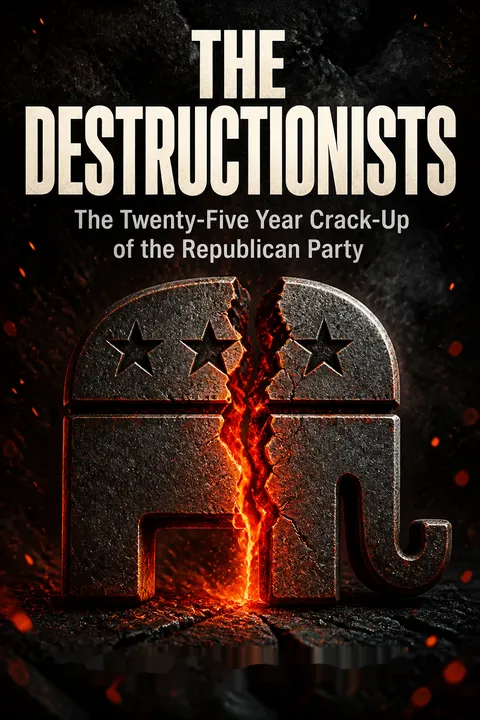
The Destructionists receives strong praise from readers, averaging 4.21 out of 5. Most reviewers commend Milbank's thorough research and compelling narrative tracing Republican dysfunction from Newt Gingrich's rise in the 1990s to Trump's presidency. Readers appreciate how the book connects historical dots, though some note repetitiveness in the latter half and wish for deeper analysis. Many found it essential, eye-opening, and emotionally difficult to read, describing it as both maddening and indispensable for understanding modern American political deterioration.
People Also Read







Download PDF
Download EPUB
.epub digital book format is ideal for reading ebooks on phones, tablets, and e-readers.








































