
Key Takeaways
1. The Republican Party's Core Values Were a Lie.
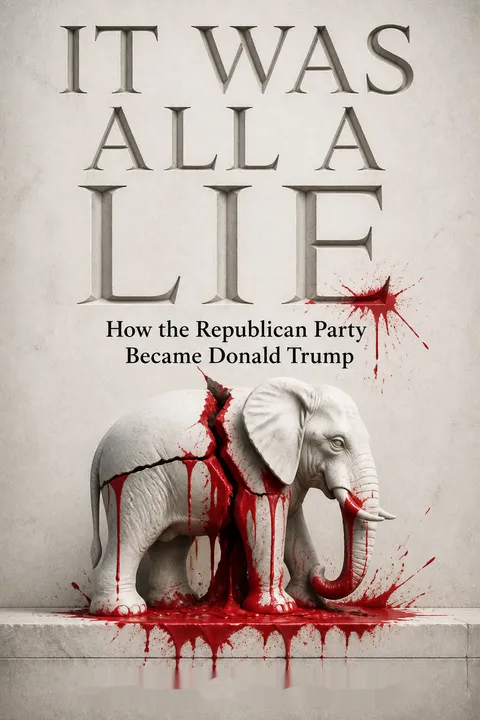
What I missed was one simple reality: it was all a lie.
A personal reckoning. The author, a lifelong Republican strategist with a stellar win-loss record, confronts the painful truth that the party's espoused principles—character, personal responsibility, fiscal conservatism, strong foreign policy, and inclusive immigration—were mere marketing slogans. This realization, coming at age sixty-five, reveals a profound sense of betrayal and sadness, not bitterness. He acknowledges his own complicity in perpetuating these myths, having been paid to win races for a party he now sees as fundamentally dishonest.
Trump as a symptom. Donald Trump is not an anomaly or a "black swan" event but the "logical conclusion" of the Republican Party's evolution over the past fifty years. He is a "natural product of the seeds of race, self-deception, and anger" that became the party's essence. The author admits to ignoring warning signs for decades, choosing to believe the party was more than just a "white grievance party" and that "the other guys were worse."
The mirror of truth. Holding Trump up to the mirror reveals the "bulging, grotesque orange face" of today's Republican Party. The author's initial prediction that Trump would not win stemmed from a refusal to believe the depressing reality about Republicans and himself. This book, written out of necessity, aims to bear witness to this truth, not to settle scores, but to call for collective accountability for the party's egregious failure to represent its claimed principles.
2. Race: The Party's Foundational Sin and Enduring Strategy.
Race was the key in which much of American politics and certainly all of southern politics was played.
The Southern Strategy. From his very first campaign in 1978, the author stumbled upon the immutable truth that race was central to American politics. The Republican Party, post-1964, learned that appealing to white voters was their path to victory, especially after Barry Goldwater's opposition to the Civil Rights Act caused black support to plummet. This led to the "southern strategy," a deliberate focus on white voters, treating non-white voters with "benign neglect."
Coded racism. The party's problems with black voters were never about "how" they communicated but "what" they did once elected. Coded language, like Ronald Reagan's "welfare queen" narrative, weaponized race and deceit, making clear racial appeals to white voters while maintaining plausible deniability. This "genteel prejudice" of Reagan is a direct precursor to Donald Trump's overt white nationalism.
- Reagan's "welfare queen" story: exaggerated claims of fraud by a black woman in Chicago.
- Goldwater's "go hunting where the ducks are" quote: explicitly targeting white voters.
- Trump's "sons of bitches" comment about NFL protesters: a perfect racial pitch in Alabama.
A moral failure. While Democrats have also engaged in racial politics, the author argues a crucial difference: the modern Democratic Party has fought for civil rights and believes in government's role in racial equality, whereas the modern Republican Party has largely opposed civil rights and is hesitant to assert government's role in equality. The party's "color blind" assertion, while sounding anti-racist, is deeply racist in practice, ignoring the systemic impact of race in America.
3. "Family Values" as a Weapon, Not a Moral Compass.
"Family values" was never a set of morals or values that the Republican Party really desired to live by; instead, "family values" was useful in attacking and defining Democrats.
Hypocrisy exposed. The author's early career, marked by a client's scandalous arrests for "indecent behavior," revealed the inherent hypocrisy of the "family values" party. This platform was primarily a tool to attack and "otherize" Democrats, defining them as outside the mythical American mainstream. It was a weaponized blend of racial prejudice and politically conservative Christianity, celebrating a nostalgic, idealized 1950s America that never truly existed.
The Christian right's true agenda. The professional politicization of Christianity was always more about acquiring power than genuine commitment to Christian values. The author points to the long list of disgraced evangelical figures as proof of the "essential truth of the Moral Majority." Donald Trump, with his multiple marriages and scandals, is seen as the "ultimate white megachurch preacher," whose flaws are accepted by a congregation conditioned to overlook the moral failings of their leaders.
- Jerry Falwell Jr. on Trump: "I can't imagine him doing anything that's not good for the country."
- Robert Jeffress on Trump's affair: "totally irrelevant for our support of him."
- 81% of evangelicals supported Trump in 2016, a higher percentage than for born-again Christian George W. Bush.
Decency abandoned. The embrace of Trump by evangelicals signals a profound shift: decency, kindness, humility, and compassion—touchstones of Christian faith—now hold no value in the Republican Party. Trump's view of these as weaknesses has become the party's view. This alliance provides "religious cover for moral squalor," validating anger, racism, and fear of the future, and revealing that the party's moral claims were "all a lie."
4. The Fiscal Responsibility "Long Con" and Debt Addiction.
The Republican Party claims to be a party that understands the need to run government efficiently, managing debt and balancing a budget. In truth the modern Republican Party is the equivalent of Donald Trump: addicted to debt and selling a false image of success.
A false image. The Republican Party's self-proclaimed fiscal conservatism is a "scam" akin to Donald Trump's fabricated business success. Despite decades of platform pledges to reduce national debt and balance budgets, Republicans, when in full control of government, have overseen skyrocketing federal debt. Trump, who promised to balance the budget in eight years, instead added $2 trillion in just over two years.
Hypocrisy in action. The party's actions under Speaker Paul Ryan, who once passionately decried the national debt, further exposed this fundamental falsehood. Republicans consistently rail against federal spending in "red" states, yet these same states are often the most dependent on federal aid.
- Mississippi receives over $3 back for every $1 paid in federal taxes.
- West Virginia receives over $2 back for every $1 paid in federal taxes.
- The 2014 Thad Cochran campaign successfully campaigned on bringing federal dollars to Mississippi, despite the party's anti-spending rhetoric.
Corporate welfare vs. social welfare. Republicans fiercely advocate for cutting social welfare programs, often with means-testing, while simultaneously defending massive corporate welfare, farm subsidies for wealthy farmers, and inflated defense budgets without question. This selective outrage highlights a deep-seated hypocrisy, where "welfare" is for the poor, but "grants," "tax breaks," and "incentives" are for businesses and the wealthy. The party's "spiritual" attachment to tax cuts, particularly for the rich, overrides any genuine concern for fiscal solvency.
5. From Intellectualism to the "Stupid Party" and Conspiracy.
Today the intellectual leaders of the Republican Party are the paranoids, kooks, know-nothings, and bigots who once could be heard only on late-night talk shows.
Decline of intellect. The conservative movement, once rooted in serious intellectual works by figures like F. A. Hayek and Edmund Burke, has devolved into anti-intellectualism. The National Review, initially a bastion of conservative thought, began with a "well-educated-racist" defense of segregation, setting a precedent for later racial appeals. Today, the party's intellectual leaders are figures like James Woods and Paul Watson, promoted by Trump, signaling a complete abandonment of erudition.
Embracing stupidity. In the Trump era, it has become a "political crime" to appear well-educated, leading intelligent figures like Senators Josh Hawley and Ted Cruz to denounce "elites" despite their Ivy League backgrounds. This embrace of "idiotocracy" is exemplified by William Bennett, author of The Book of Virtues, who contradicted his life's work by supporting Trump, dismissing critics as having "moral superiority."
- Senator Josh Hawley (Stanford, Yale Law) tweets about "unelected progressive elites."
- Senator Ted Cruz (Princeton, Harvard Law) denounces "coastal elites."
- William Bennett, once a champion of character, now supports a president he would have condemned.
Conspiracy as doctrine. Donald Trump's presidency is defined by a constant stream of conspiracy theories, from "Deep State" cabals to voter fraud and the JFK assassination. This reflects a "partisan penumbra" where radical, anti-government Republicans align with conspiracist claims, rarely speaking out against them. This "new conspiracism" is not the last resort of losers but the "first resort of winners," fostering a disdain for political opposition and democratic norms.
6. The Industrialized Machinery of Deception.
Republicans have built a political ecosphere that thrives on deceit and lies. It is an industrialized sort of deceit that is unique to the Republican Party.
A separate reality. The Republican Party operates within a "dystopian Shangri-La," a self-reinforcing bubble disconnected from objective truth. This "machinery of deception" has been decades in the making, culminating in an "industrialized sort of deceit" unique to the GOP. Research shows a "radicalization of roughly a third of the American media system" on the right, lacking the symmetry and shared reality of other media.
Fox News and its origins. Fox News, often seen as the "in-house propaganda arm," is not an isolated phenomenon but the accelerant of a long-standing trend. Its roots trace back to Human Events, a 1944 pamphlet that positioned itself as the only "true and honest media," dedicated to publishing "facts" other outlets overlooked while promoting a distinct, biased viewpoint.
- Human Events distinguished between "objectivity" and "impartiality," allowing for "bias" as a journalistic value.
- The 1987 repeal of the FCC's fairness doctrine supercharged conservative media, removing the need for balanced reporting.
- Rush Limbaugh's radio show, launched in 1988, cultivated "dittoheads" who mindlessly echoed his prejudices.
Truth as the enemy. This ecosystem thrives on discrediting "mainstream media" as "fake news" and promoting alternative truths. The "birther" conspiracy, for instance, provided a "factual basis for bigotry," attempting to "prove" a lie to validate the "feeling" that a black president couldn't be truly American. Trump's constant denial of verifiable facts, like his "I never called Meghan Markle 'nasty'" claim, mirrors Orwell's 1984, where "the party told you to reject the evidence of your eyes and ears."
7. Cowardice and Opportunism Defined the Trump Era GOP.
The most distinguishing characteristic of the current national Republican Party is cowardice.
A moral collapse. The Republican Party's defining trait under Trump is "cowardice," demanding "dishonesty as a trait of membership." The vast majority of elected officials, knowing Trump is unfit, pretend otherwise, engaging in a "gradual process of surrendering little bits of your soul and values." This isn't courage, but a pathetic effort to please, reminiscent of Franz von Papen enabling Hitler.
Attacking law enforcement. The party, once self-defined as "law-and-order," now routinely attacks the FBI, Justice Department, and judiciary, echoing the tactics of criminals. This precedent was set decades ago by the National Rifle Association (NRA), whose extreme rhetoric against federal agents led George H. W. Bush to resign his lifetime membership in fury.
- NRA's Wayne LaPierre called federal agents "jack-booted government thugs" in 1995.
- George H. W. Bush's scathing resignation letter condemned LaPierre's "vicious slander."
- Trump calls criminals who tell the truth "rats" and attacks law enforcement for doing their jobs.
The "Flight 93 Election" mentality. The "Flight 93 Election" essay, a plea for conservatives to support Trump despite his flaws, epitomized the desperate rationalization for abandoning principles. It framed the election as an existential threat from "Third World foreigners" and a "Left" seeking "permanent victory," justifying any means to "charge the cockpit." This "apocalyptic construct" is a "grad school version of the racism" seen in Charlottesville.
8. Fear of a Changing America Drives Voter Suppression.
The Trump obsession with immigrants from Mexico and Central America is motivated by his own racism, but it also reflects the knowledge that every new nonwhite voter in America is a threat to the existence of the Republican Party.
Demographic threat. A deep fear of the future, particularly of a less white America, drives the Republican Party's actions. Demographic projections show a significant decline in the white electorate and a rise in non-white voters, posing an "existential choice" for the party. Instead of expanding its appeal, the GOP has chosen to "balance the electoral equation by making it harder for nonwhite voters" to participate.
Systematic disenfranchisement. Voter suppression efforts, while not overtly race-based to avoid illegality, disproportionately target non-white, poorer, and younger voters who are less likely to vote Republican.
- Wisconsin's strict voter-ID law, passed in 2011, led to a plummet in black voting rates in Milwaukee County in 2016.
- Florida's law requiring former felons to pay all fines and fees before voting is akin to a modern poll tax, disproportionately affecting black voters.
- Republicans oppose automatic voter registration, citing "individual responsibility" and "privacy concerns," masking an anti-democratic instinct.
Hate for California. The party's intense "hate" for California is revealing. Once a Republican stronghold, California's demographic shift (from 66% white in 1980 to 40% white in 2010) has made it a symbol of the "otherness" Republicans fear. Pete Wilson's 1994 anti-immigrant campaign and Proposition 187, though successful in his reelection, alienated Hispanic voters, mirroring Trump's rhetoric.
9. The Lasting Damage and Path to Redemption.
Without moral legitimacy, a center-right party becomes a soufflé of grievances and anger that exists to settle scores, not solve problems.
A profound betrayal. The Republican Party's embrace of Donald Trump represents a profound betrayal of its stated values and a "moral collapse." The author expresses sadness and disgust for the many elected officials he helped put in power, who now "disgrace themselves by breaking every principle they swore they so deeply believed in." Their rationalizations for supporting Trump—from "personal quirks" to a "Necessary Monster" saving the party—are "amnesia, self-deceit, and desperation."
Erosion of democratic norms. The party's actions under Trump have normalized behaviors that threaten the foundations of American democracy:
- Rejection of democratic rules (obstruction of justice, using office for personal gain).
- Denial of opponents' legitimacy (Obama's birth certificate, "rigged election").
- Tolerance and encouragement of violence ("beat the crap out of" protesters, praising a congressman for assault).
- Willingness to curtail civil liberties (attacking media as "enemy of the people," ignorance of the Bill of Rights).
The future of conservatism. The Republican Party has legitimized bigotry and hate as an organizing principle, transforming from the "party of Lincoln" to one that endorses Roy Moore and celebrates figures like Sebastian Gorka and Stephen Miller. This "soufflé of grievances and anger" lacks any coherent purpose beyond acquiring and maintaining power. Redemption, the author believes, will only come through "defeat and desperation," forcing the party to adapt to a changing America rather than clinging to its identity as a "white party."
Review Summary
Reviews of It Was All a Lie are overwhelmingly positive, averaging 4.12 out of 5. Most readers praise Stevens' candid self-reckoning and thorough indictment of the Republican Party, appreciating his insider perspective as lending unique credibility. Many note the book confirms longstanding Democratic observations about GOP racism, hypocrisy, and prioritization of power over principles. Common criticisms include repetitiveness and the likelihood that those most needing to read it won't. Several reviewers highlight Stevens' core argument: Trump was not an aberration but the GOP's inevitable culmination.
People Also Read


Download PDF
Download EPUB
.epub digital book format is ideal for reading ebooks on phones, tablets, and e-readers.








































