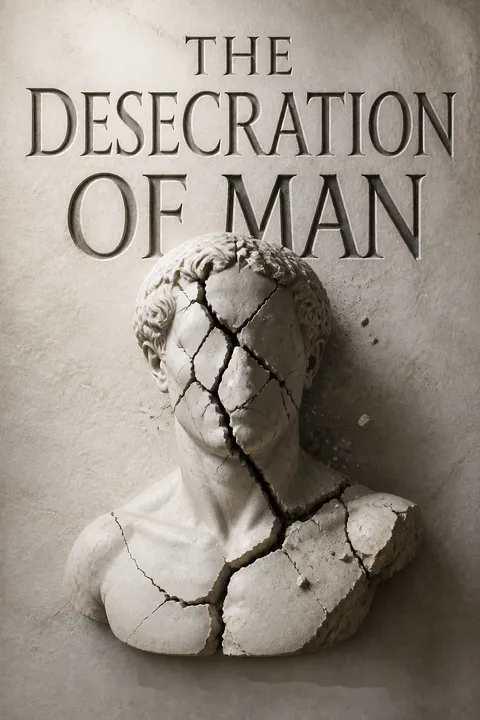

Key Takeaways
1. Modernity's Core Crisis: The Desecration of Man
To the question “What is man?” our world has apparently given the answer: the one who transgresses what was formerly considered sacred and thereby demonstrates his own godlike status.
Anthropological confusion. Modern Western culture faces a profound crisis of identity, struggling to answer the fundamental question, "What is man?" This isn't merely a confluence of unrelated issues but a deep anthropological conundrum. Historically, the West understood man as a creature made in God's image, with inherent limits, obligations, and teleological purposes.
Beyond disenchantment. The prevailing interpretation of our culture as "disenchanted" due to industrialization and bureaucracy is inadequate. Instead, our age is marked by an "ecstatic destruction of all that was once considered sacred," a revelry in transgression. This isn't a passive loss of belief but an active, exhilarating repudiation of traditional boundaries, making us feel godlike.
Defining desecration. Desecration implies the intentional abuse or destruction of something holy, something of more than ordinary significance. From a Christian perspective, human beings, made in God's image, possess a moral structure tailored for communion with God. To deny these God-given limits, obligations, and ends is to desecrate both man and God, a core pathology of modern culture.
2. The "Death of God" Paved the Way for Self-Deification
What was holiest and mightiest of all that the world has yet owned has bled to death under our knives: who will wipe this blood off us?
Nietzsche's prophecy. Friedrich Nietzsche's "Madman" parable in The Gay Science vividly describes the "death of God" as a metaphysical deicide committed by Enlightenment philosophers. This wasn't just disproving God's existence but metaphorically killing Him, an act with far-reaching implications for morality and meaning. The Madman declared he came too early, as the full cultural significance would take time to manifest.
Shifting social imaginary. The rapid and enthusiastic desecration of traditional values stems from a profound transformation in the "social imaginary"—how ordinary people intuitively understand themselves and the world. This shift wasn't driven by philosophy books but by a broader set of cultural considerations, making the popular imagination receptive to radical ideas.
From fixed to fluid. Medieval society offered a fixed identity:
- Social: Born a peasant, died a peasant; fixed family and communal networks.
- Geographical: Limited travel, local world.
- Temporal: Rhythms of seasons and liturgical calendar.
This stability made Christian authority plausible. Modernity, however, brought flux, making identity a matter of personal choice and self-creation.
3. Technology and Expressive Individualism Fuel Transgression
All that is solid melts into air, all that is holy is profaned, and man is at last compelled to face with sober senses, his real conditions of life, and his relations with his kind.
Technological liquefaction. Technology has profoundly destabilized the world, transforming our perception of time, space, and human limits. From the printing press to the internet, innovations disrupt social conditions, making constant, convulsive change the norm. This "social acceleration" disorients individuals, making the question "Who am I?" more chaotic than ever.
Enframing humanity. Martin Heidegger argued that technology's real threat isn't destructive machines, but "Enframing"—the mindset that sees nature (and eventually humans) as raw material to be exploited. When human limits are viewed as problems to be overcome, rather than defining boundaries, humanity risks becoming mere "stuff" to be manipulated for extraneous ends.
Transgression as virtue. Expressive individualism, which places inner feelings and self-creation at the core of identity, combines with technological power to foster an iconoclastic attitude. The "transgressor as hero" emerges, exemplified by figures like Oscar Wilde. Art becomes "deathworks," subverting the sacred. Critical theory, with its aim to dismantle categories that maintain the status quo, embodies this spirit of negation, making "permanent revolution" the cultural default.
4. The Sexual Revolution: From Sacred Union to Objectifying Recreation
The sexual revolution has not only destroyed traditional, sacred sexual codes but has also objectified us all.
Shattering the sacred. Sex, traditionally imbued with sacred importance across Judaism, Christianity, and Islam, was linked to life's creation, ritual purity, and marital union. The sexual revolution, gaining momentum from the 1940s and exploding in the 1960s, fundamentally revised this, detaching sex from its unitive and procreative purposes, transforming it into primarily recreational activity and a core component of personal identity.
Technology's role. The advent of effective contraception, antibiotics, and legalized abortion liberated sex from its natural consequences, making it "safe and sterile." Pop culture amplified messages of sexual self-expression, turning sex from a communal, sacred act into a private, pleasurable recreation. This shift made sexual desire and behavior the most prominent forms of expressive individualism.
Objectification and contradiction. When sex becomes solely about personal satisfaction, the other person is instrumentalized, reduced to an object for gratification. Pornography is the logical extreme, detaching sex from relationships and turning individuals into commodities. This creates a paradox: the promise of liberation through sexual self-expression leads to a world where individuals are treated as objects, undermining the very self-worth they seek to affirm.
5. Mechanical Reproduction Turns Life into a Commodity
The imaginative impulse in a world of IVF and surrogacy is surely toward seeing children as objects, as things purchased rather than given.
Desacralizing creation. Just as mechanical reproduction transformed art from sacred creations into commodities (Walter Benjamin's "aura"), reproductive technologies like IVF and surrogacy are desacralizing human life. Conception, once a mysterious, godlike act beyond full human control, becomes a technical process, formally separable from sexual union and relational unity.
Children as commodities. IVF and surrogacy reinforce the idea that personhood is detached from life itself (as seen in Peter Singer's arguments for abortion/infanticide). Surplus embryos are destroyed or frozen, and children can be "ordered" or "returned" if defective, as in the Baby Gammy case. This transforms the parent-child bond from a natural obligation into a contractual arrangement, treating children as products.
Eugenics and the body. The inherent logic of IVF, with its screening and selection of "best" embryos, contains an incipient eugenics. Gene editing further blurs the line between restoring natural function and transforming human nature according to desired specifications. This technological mastery over reproduction, coupled with the expressive individualist desire to transcend bodily limits, undermines the teleology of the sexed human body, contributing to the plausibility of transgender ideology.
6. Death: The Final Enemy We Deny, Trivialise, or Control
In the midst of life we are in death: of whom may we seek for succour, but of thee, O Lord, who for our sins art justly displeased?
The unbearable reality. Death, historically a sacred and central preoccupation of religions, is now paradoxically denied, trivialized, or medicalized in modern Western culture. Its inevitability and uncontrollability disturb the pursuit of psychological happiness, leading us to hide it in hospitals or trivialize it in entertainment.
Ignoring mortality. The cult of youth, cosmetic surgery, and pervasive entertainment serve as distractions from our own mortality. Blaise Pascal observed that humans seek diversion to avoid contemplating death. Today, the entertainment and healthcare industries thrive by pushing death to the margins, offering the illusion of control or endless youth.
Managerial death culture. The rise of assisted suicide and euthanasia, exemplified by Canada's high rates, transforms death into a routine medical procedure. This "death with dignity" rhetoric, rooted in expressive individualism's emphasis on autonomy, asserts the individual's right to control their own demise. This managerial approach to death, coupled with eugenic attitudes from reproductive technologies, extends to the disabled, ill, and elderly, reducing lives to problems to be solved.
7. "Nihilism Repackaged": Cultural Christianity is Insufficient
What does nihilism mean? That the highest values devaluate themselves. The aim is lacking; “why?” finds no answer.
Inadequate responses. The current revival of interest in Christianity among intellectuals (e.g., Richard Dawkins, Roger Scruton) is a response to modernity's chaos. However, these approaches often seek the cultural benefits of Christianity without embracing its truth claims. Dawkins, for instance, champions "cultural Christianity" while rejecting its scientific "absurdities," particularly regarding gender.
Nietzsche's critique of nihilism. Nietzsche defined nihilism not as the absence of values, but as the embrace of grandiose visions built on discredited foundations. He criticized Enlightenment thinkers like Kant for killing God but then smuggling back Christian morality without its theological basis. Similarly, Dawkins and Scruton, by seeking Christian "fruits" without the "roots," are repackaging nihilism.
The problem of teleology. Dawkins struggles to justify biological norms for gender when his Darwinian framework denies final causes or inherent purposes. If science can overcome other human limitations, why not biological sex? Scruton, while appreciating Christianity's aesthetic and cultural depth, ultimately viewed it through a Kantian lens, failing to commit to its dogmatic truth claims. Both approaches offer a solution built on sand, lacking the foundational truth necessary for genuine consecration.
8. True Consecration Requires Christian Creed, Cult, and Code
The obvious answer is that if the church does not find her hearers antecedently inhabiting a narratable world, then the church must herself be that world.
The answer: Consecration. The pervasive desecration of man demands nothing less than consecration. This isn't a sentimental feeling or a vague "re-enchantment," but a reshaping of our imaginations through the distinct dogmatic, cultic, and moral shape of Christianity. It requires accepting Christianity on its own terms, not as a convenient cultural tool.
Creed, Cult, and Code. Christianity offers a comprehensive framework:
- Creed: The objective truth claims about God's existence, actions, and humanity's nature and destiny (e.g., Nicene Creed, Apostles' Creed). This must be confidently proclaimed and taught, especially a robust theological anthropology.
- Cult: The worship practices and liturgy of the church (e.g., prayer, communal singing, sacraments). These embody and reinforce the creed, cultivating dependence, community, and a teleological understanding of life.
- Code: The moral habits and practices expected of Christians (e.g., honesty, work ethic, hospitality). This extends the creed and cult into daily life, treating others as persons made in God's image.
The church as the narratable world. Robert Jenson argued that in a postmodern world lacking a coherent story, the church must be that story. It's the place where humanity, made in God's image, is truly realized. This means embracing a liturgy that is "dramatic density, sensual actuality, and brutal realism," cultivating limits, dialogue with God, and a teleology that points beyond the immanent. This holistic approach, starting with local communities and acts of kindness, is the path to genuine human consecration.
Review Summary
Reviewers widely praise The Desecration of Man as a sharp, urgent, and clarifying cultural critique. Trueman argues that rejecting God's image in humanity leads not to liberation but to self-destruction — desecration. Drawing on Nietzsche, he traces how expressive individualism, the sexual revolution, reproductive technology, and attitudes toward death reflect a deeper anthropological crisis. His proposed remedy — consecration through creed, cult, and code within the local church — resonates strongly, though some find the book underdeveloped in practical application. Most consider it essential reading for understanding contemporary Western culture.
People Also Read

Download PDF
Download EPUB
.epub digital book format is ideal for reading ebooks on phones, tablets, and e-readers.








































