

Key Takeaways
The Federal Reserve is a private banking cartel wearing a government mask
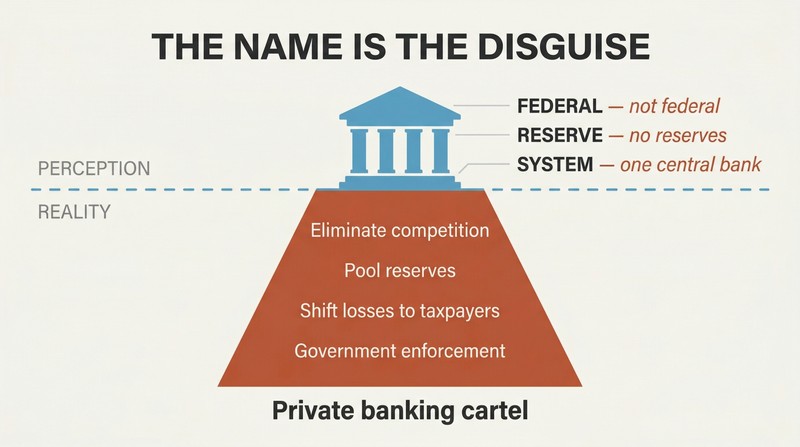
Griffin's seven charges against the Fed. The Federal Reserve System, created in 1913, is widely perceived as a government agency that stabilizes the economy. Griffin argues it is a banking cartel — competing banks that joined forces to eliminate competition, pool reserves, shift losses to taxpayers, and use government enforcement to maintain the arrangement. The word "Federal" suggests government; "Reserve" implies backing; "System" disguises its function as a single central bank.
Since its creation, the Fed has presided over the crashes of 1921 and 1929, the Great Depression, multiple recessions, and inflation that destroyed over 90% of the dollar's purchasing power. Griffin contends these are not failures of execution but inevitable outcomes of a system designed to serve insiders. Its seven sins: it cannot accomplish its stated goals, operates against the public interest, institutionalizes usury, generates the most unfair tax, encourages war, destabilizes the economy, and enables totalitarianism.
The Fed was designed in secrecy by the very bankers it supposedly regulates
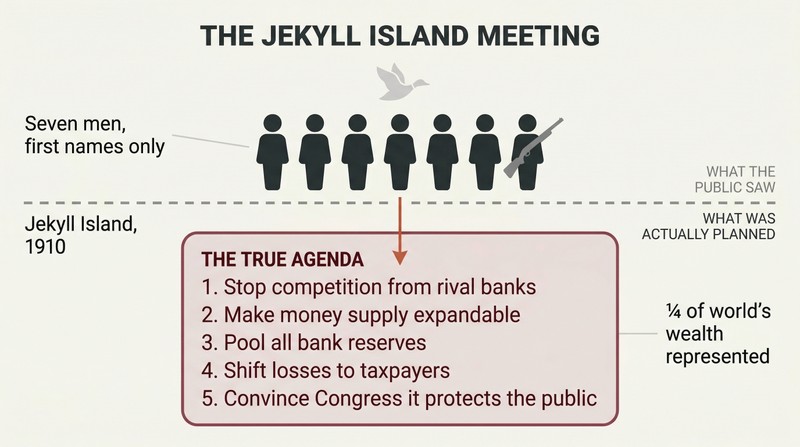
The duck-hunting cover story. In November 1910, seven men boarded Senator Nelson Aldrich's private railcar under strict secrecy. They used first names only and traveled 800 miles to Jekyll Island, Georgia — J.P. Morgan's private resort. Paul Warburg even borrowed a shotgun to pose as a duck hunter despite never having fired one. Together, these men represented the Morgan, Rockefeller, Rothschild, Warburg, and Kuhn-Loeb banking dynasties — an estimated one-fourth of the world's total wealth.
A cartel with five objectives. For nine days they drafted what became the Federal Reserve Act:
1. Stop competition from smaller rival banks
2. Make the money supply expandable at will
3. Pool all bank reserves into one system
4. Shift inevitable losses to taxpayers
5. Convince Congress the scheme protected the public
As one participant later admitted, had the public known these rivals had joined together, the bill would have had no chance of passage.
Every dollar in existence was created as someone's debt to a bank
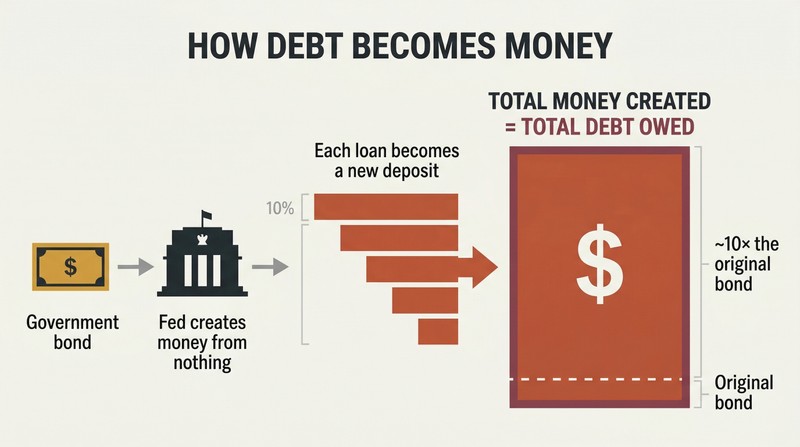
The Mandrake Mechanism at work. Griffin names the Fed's money-creation process after a 1940s comic-strip magician who conjured things from nothing. The government issues bonds. The Fed "buys" them by writing a check with no money behind it, creating a deposit. When this money lands in commercial banks, they hold roughly 10% as reserves and lend the remaining 90% — which is brand new money. Each new deposit repeats the cycle approximately 28 times, multiplying the original amount by roughly nine.
Debt is money; money is debt. Total fiat money created equals approximately ten times the underlying government bonds. If all debts were repaid, every dollar would vanish. This means the national debt can never be paid off without collapsing the currency. The Fed itself acknowledges this: "Debt — public and private — is here to stay. It plays an essential role in economic processes."
Inflation is a hidden tax that punishes the thrifty and the poor most
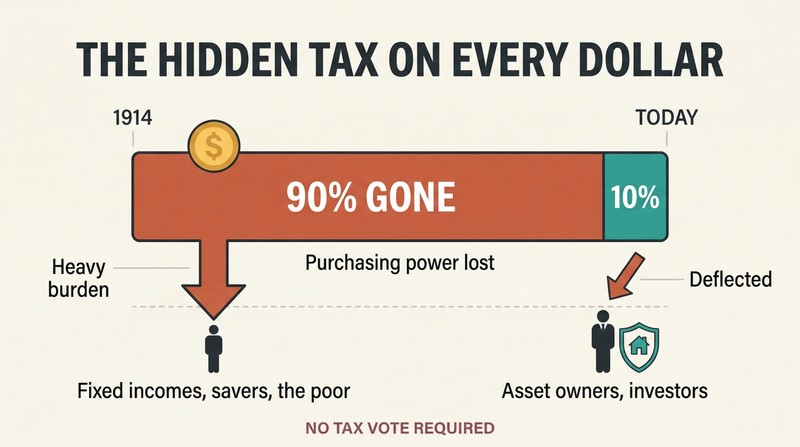
The invisible 90% confiscation. When the Fed creates money to purchase government bonds, new dollars flood the economy without any corresponding increase in goods or services. Each existing dollar buys less. Since 1914, this process has destroyed over 90% of the dollar's purchasing power. By 1990, an annual income of $10,000 was required to buy what only $1,000 purchased in 1914. This wealth was quietly transferred to the government without a single tax vote.
A regressive mechanism by design. Inflation falls hardest on those with fixed incomes and savings — the elderly, the frugal, wage earners. The wealthy protect themselves through tangible assets and investments that rise with inflation. Thomas Jefferson recognized this: he called it "the most oppressive of all" taxes "because the most unequal of all." Fiat money makes this confiscation possible; a gold standard makes it impossible.
'Too big to fail' means taxpayers insure banks' reckless gambling
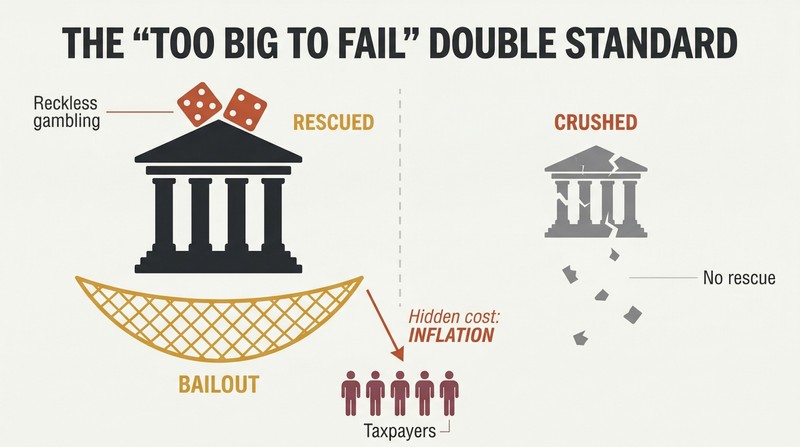
The bailout playbook repeats identically. When a major bank faces collapse, its executives tell Congress that failure would devastate the economy. Congress pledges taxpayer money. The Fed creates fresh dollars through the Mandrake Mechanism. Interest payments to the bank resume. Griffin documents this pattern across Penn Central (1970), Lockheed (1970), New York City (1975), Chrysler (1978), Continental Illinois (1984), and the 2008 subprime meltdown that exceeded $7 trillion.
Small banks get crushed. The same week the FDIC rescued Continental Illinois with billions, it shut down the tiny Bledsoe County Bank of Pikeville, Tennessee. During the first half of 1984, forty-three smaller banks failed without bailout. The FDIC creates what insurers call "moral hazard" — reckless banks pay the same premiums as cautious ones, so prudence is penalized and gambling rewarded. This was one of the original Jekyll Island objectives: eliminate competition from smaller banks.
Without central-bank money machines, most modern wars could not be financed
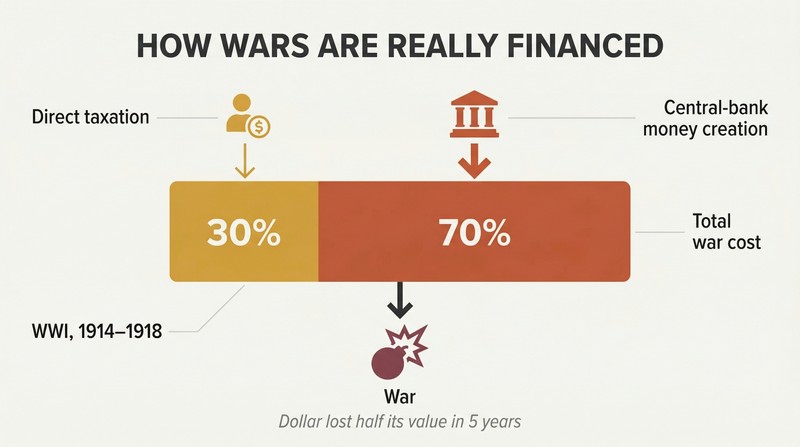
Wars need money that taxes can't provide. Citizens rarely tolerate taxation high enough to fund full-scale war. Since the Bank of England was created in 1694, the solution has been central-bank money creation. Between 1689 and 1815, England was at war 63 out of 126 years — financed by fiat. During WWI, 70% of the cost was paid through inflation rather than taxes, orchestrated by the Federal Reserve. Within five years, the money supply doubled and the dollar lost half its value.
The Lusitania as case study. J.P. Morgan served as purchasing agent for Britain and France, earning commissions on $3 billion in war materials. When Germany's U-boats threatened Allied defeat — and Morgan's loans — the Lusitania, loaded with munitions and American passengers, was sent into hostile waters with its destroyer escort withdrawn. Its sinking inflamed opinion and brought the U.S. into the war, rescuing Morgan's investment.
Gold held prices stable for two millennia; no central bank can match that
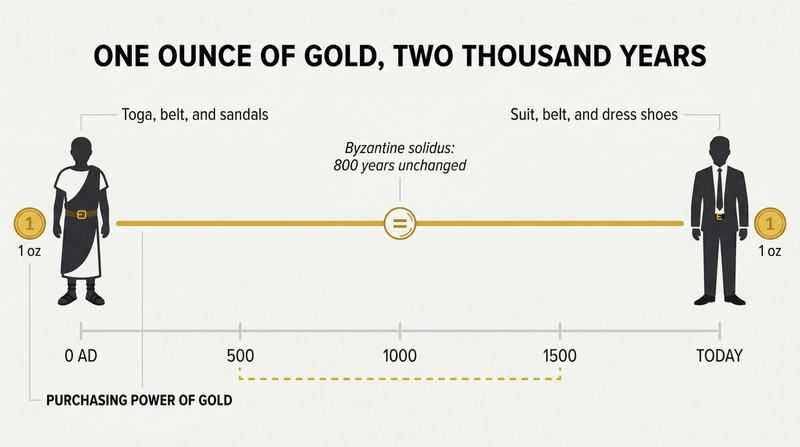
A 2,000-year track record. In ancient Rome, a finely made toga, belt, and sandals cost one ounce of gold. Today, a hand-crafted suit, belt, and dress shoes cost roughly the same. At London's Savoy Hotel, one gold sovereign still buys dinner for three — as it did in 1913. The Byzantine Empire maintained identical gold content in its solidus coin for eight hundred years without falling into bankruptcy or even debt.
Any quantity of gold works. The common objection that there isn't enough gold for modern commerce misunderstands money's function. Money measures value; it doesn't create it. If gold is scarce, each unit simply represents more purchasing power — people use smaller coins. The free market adjusts automatically through supply and demand, a process no committee of monetary experts can replicate. When gold was used as money and governments didn't intervene, long-term price stability was the dependable result.
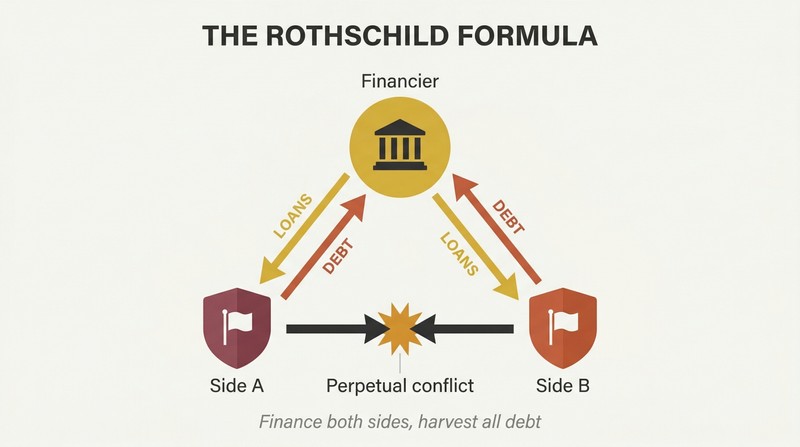
Recognize the Rothschild Formula: finance both sides, harvest all debt
The five directives of war profiteering. Griffin distills a pattern he attributes to international financiers:
1. War forces governments to borrow — ensure it continues
2. If enemies lack military strength, fund their buildup
3. If no enemy exists, finance the rise of a hostile regime
4. Never let one side achieve decisive victory
5. Maintain "balance of power" for perpetual conflict and interest
Funding every horse in the race. Nathan Rothschild smuggled gold to Wellington through Napoleon's own France, then used advance knowledge of Waterloo to deceive London bond traders into panic selling — buying England's entire government debt at pennies on the dollar. During WWI, partners at Kuhn, Loeb funded opposing political candidates while Morgan simultaneously bankrolled both the Bolsheviks and their opponents in Russia.
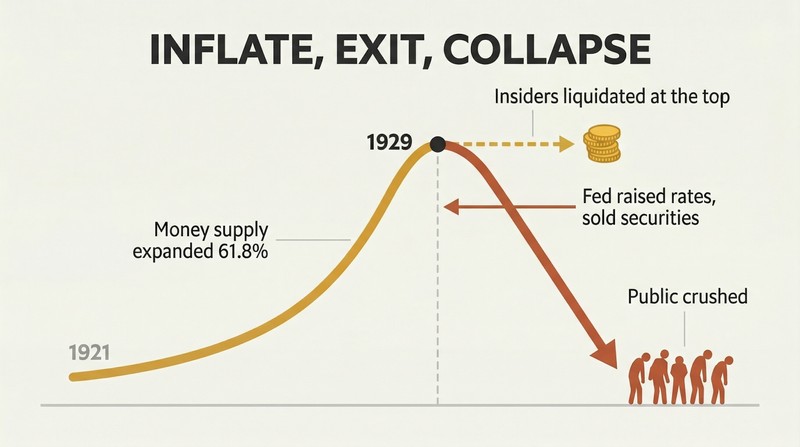
The Fed inflated the 1920s to help Britain — then America crashed
Inflation exported to save the pound. After WWI, Britain's socialist welfare state crippled its economy. Benjamin Strong of the New York Fed conspired with Montagu Norman of the Bank of England to inflate the American money supply and depress interest rates, driving gold to London. From 1921 to 1929, the U.S. money supply expanded by 61.8%. Easy credit fueled reckless speculation — stocks selling at 100 times earnings, margin loans at just 10% down.
Insiders escaped; the public was crushed. In February 1929, the Fed held secret meetings with Norman. Warnings went to preferred clients: Rockefeller, Morgan, Kennedy, Baruch — all liquidated before the crash. On August 9, the Fed raised rates and sold securities, contracting the money supply. On October 29, $3 billion vanished in a single day. The Depression that followed lasted a decade, prolonged not by the crash but by government interventions that prevented natural recovery.
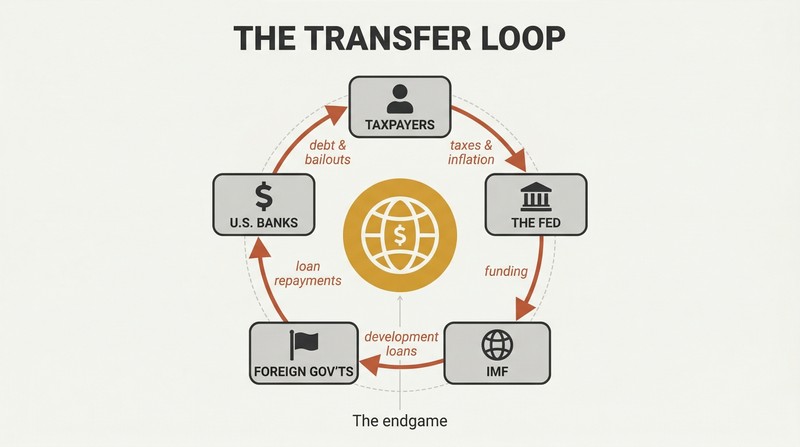
The endgame: merge all nations under one central bank, one fiat currency
From Bretton Woods to world currency. In 1944, the IMF and World Bank were created by Fabian Socialist John Maynard Keynes and Harry Dexter White — later exposed as a Communist spy. Their stated goal: stabilize exchange rates. Their actual goal, per Griffin: eliminate gold from international finance and build infrastructure for a world central bank issuing fiat currency. The IMF's Special Drawing Rights, created in 1970, were the prototype — bookkeeping money backed by nothing.
Weakening the strong to absorb the weak. "Development" loans from the World Bank flow to socialist governments, expand state power, and create dependency. Industrialized nations are drained through foreign aid and inflation. Griffin argues the strategy is deliberate: no strong nation surrenders sovereignty voluntarily, so the plan requires impoverishing them first. The transfer mechanism flows from American taxpayers through the Fed to the IMF to foreign governments to American banks — completing the circle.
Analysis
Griffin's Creature from Jekyll Island occupies a unique position in American political literature: too meticulously sourced to dismiss as mere conspiracy theory, yet too sweeping in its causal claims to satisfy academic economists. First published in 1994 with over thirty subsequent printings, it has become the foundational text of populist central-bank criticism, influencing movements from Ron Paul's 'End the Fed' campaign to contemporary cryptocurrency advocacy.
The book's most durable contribution is pedagogical. The Mandrake Mechanism remains one of the clearest explanations of fractional-reserve money creation for non-specialists. Griffin correctly identifies that most citizens fundamentally misunderstand where money comes from, and his four-part taxonomy — commodity, receipt, fiat, and fractional money — is genuinely illuminating.
Methodologically, Griffin excels at primary-source documentation. The Jekyll Island meeting is established through participants' own memoirs. The bailout patterns are traced through Congressional records. Where he falters is in the leap from documented behavior to attributed intentionality. The Rothschild Formula describes a real pattern of war profiteering, but Griffin presents it as a conscious multigenerational strategy rather than an emergent property of capital seeking returns within a system that rewards such behavior. The distinction between systemic dysfunction and coordinated conspiracy is crucial but often blurred.
From an economic perspective, Griffin's gold-standard advocacy faces legitimate challenges regarding deflation and flexibility. However, his core observation — that central banks exist primarily to enable deficit spending and socialize banking losses — gained mainstream validation after 2008, when bailouts unfolded almost exactly as he predicted fourteen years earlier. His analysis of moral hazard, too-big-to-fail dynamics, and the merger of banking and state power proved remarkably prescient.
The book's weakness is also its strength: it tells a story so coherent that messy reality gets squeezed into a narrative that may be too tidy. But the questions Griffin raises — who controls money creation, who benefits, and who pays — remain among the most important a citizen can ask.
Review Summary
The Creature from Jekyll Island receives mixed reviews. Many praise it as eye-opening and informative about the Federal Reserve's history and monetary policy, while others criticize it as conspiracy theory. Supporters find it well-researched and enlightening about banking practices and economic manipulation. Critics argue it misrepresents facts and promotes unfounded theories. The book's detailed historical accounts and explanations of complex financial concepts are generally appreciated, though some find the author's conclusions extreme. Overall, it's seen as a thought-provoking, if controversial, examination of the U.S. financial system.
People Also Read
Glossary
Mandrake Mechanism
Fed's money-from-nothing processGriffin's name for the process by which the Federal Reserve creates money. Named after Mandrake the Magician, a 1940s comic character who conjured things from nothing. The Fed buys government bonds with checks backed by nothing, creating deposits that become bank 'reserves,' which commercial banks then multiply roughly ninefold through fractional-reserve lending. Total money created equals approximately ten times the underlying government debt.
Rothschild Formula
War-profiteering through dual financingGriffin's term for a strategy he attributes to international financiers: propel governments into war by creating or maintaining credible enemies, fund both sides of every conflict, and profit from the resulting debt. Key principles include never allowing one side a decisive victory and maintaining a 'balance of power' that ensures perpetual conflict and perpetual interest payments. Named for the Rothschild banking dynasty's historical pattern of financing opposing nations.
The Creature
Metaphor for the Federal ReserveGriffin's central metaphor for the Federal Reserve System—a predatory entity conceived at Jekyll Island in 1910 and 'hatched' by Congress in 1913. The metaphor captures both its monstrous appetite for wealth extraction and its ability to grow beyond its creators' control. The creature feeds on debt, grows through inflation, and devours citizens' purchasing power while appearing to serve them.
Bailout (the game called Bailout)
Pattern of socializing bank lossesGriffin's framework describing the repeating cycle by which losses from bad bank loans are transferred to taxpayers. The 'game' follows specific 'plays': the perpetual-debt play (rolling over loans), the up-the-ante play (lending more to cover old interest), the rescheduling play (extending terms), and the protect-the-public play (convincing Congress that failure would harm ordinary citizens). The final move always involves the Fed creating new money through the Mandrake Mechanism, with costs passed to the public through inflation.
Lender of last resort
Central bank creating emergency fiatStandard economic term that Griffin redefines as 'banker language meaning the central bank stands ready to create money out of nothing and immediately lend it to any bank in trouble.' Rather than a stabilizing safety net, Griffin argues this function enables fractional-reserve banks to operate with dangerously thin reserves, knowing they will be rescued when depositors demand their money back. It socializes the risks of banking while privatizing the profits.
Natural Laws (of economics)
Five monetary behavior principlesFive principles Griffin derives from centuries of monetary history and presents as universal laws of human behavior. They cover: (1) gold-based price stability without government interference, (2) government manipulation always causing inflation and chaos, (3) fiat money dooming nations to hardship, (4) fractional money always degenerating into fiat money, and (5) men entrusted with money-supply control inevitably confiscating neighbors' wealth. Each is presented with a lesson drawn from historical evidence followed by a formal law statement.
The Cabal
Banker-politician power partnershipGriffin's term for the partnership between monetary scientists (bankers) and political scientists (politicians) that has existed since the Bank of England was founded in 1694. Politicians receive spendable money without raising taxes; bankers collect interest on money created from nothing. The arrangement is sustained because the public does not understand the mechanism. Griffin traces this partnership through the Bank of England, three earlier American central banks, and the Federal Reserve.
FAQ
What's The Creature from Jekyll Island about?
- Focus on the Federal Reserve: The book examines the Federal Reserve System, portraying it as a banking cartel rather than a government entity. It challenges the conventional understanding of the Federal Reserve's role in the economy.
- Historical Context: G. Edward Griffin details the secretive 1910 meeting on Jekyll Island, where influential bankers planned the creation of a central bank in the U.S. This event is depicted as crucial in forming a banking cartel.
- Critique of Monetary Policy: The book critiques the Federal Reserve's role in economic instability, inflation, and war, suggesting it operates against public interest.
Why should I read The Creature from Jekyll Island?
- Understanding Economic Systems: The book provides insights into the complexities of the U.S. monetary system and central banking's impact on society.
- Historical Revelations: It uncovers historical events and figures that shaped modern banking, helping readers understand the roots of current financial issues.
- Critical Perspective: Griffin presents a critical view of the Federal Reserve, encouraging readers to consider alternative viewpoints on economic policy and governance.
What are the key takeaways of The Creature from Jekyll Island?
- Federal Reserve as a Cartel: The book argues that the Federal Reserve prioritizes the interests of its members over the public, undermining its role as a stabilizing economic force.
- Inflation and Economic Control: Griffin claims that the Federal Reserve's money creation leads to inflation, eroding purchasing power and acting as a hidden tax on the public.
- Historical Patterns of Failure: The book outlines recurring financial crises and bailouts, suggesting that the Federal Reserve's policies contribute to economic instability.
What are the best quotes from The Creature from Jekyll Island and what do they mean?
- "The Federal Reserve System should be abolished...": This quote encapsulates Griffin's argument that the Federal Reserve is fundamentally flawed and incapable of achieving its objectives.
- "It is incapable of accomplishing its stated objectives.": Griffin challenges the effectiveness of the Federal Reserve, suggesting it fails to stabilize the economy.
- "The Creature moved into its final lair in 1913...": This metaphor refers to the establishment of the Federal Reserve and its influence on American financial systems.
What is the significance of the Jekyll Island meeting in The Creature from Jekyll Island?
- Conception of the Federal Reserve: The meeting is portrayed as the birthplace of the Federal Reserve, where key bankers and politicians secretly planned to control the U.S. monetary system.
- Formation of a Banking Cartel: Griffin argues that the meeting resulted in a cartel designed to protect its members' interests, limiting competition and public benefit.
- Historical Implications: The meeting's outcomes are linked to ongoing economic issues, suggesting lasting effects on American financial stability and governance.
How does The Creature from Jekyll Island explain the concept of money?
- Definition of Money: Griffin defines money as "anything accepted as a medium of exchange," categorizing it into commodity, receipt, fiat, and fractional money.
- Evolution of Money: The book traces the historical evolution from barter to fiat money, reflecting changes in economic systems and government roles.
- Critique of Current Systems: Griffin argues that creating money out of nothing leads to inflation and instability, emphasizing the need to understand these concepts.
What is the "Mandrake Mechanism" mentioned in The Creature from Jekyll Island?
- Definition of the Mandrake Mechanism: Griffin describes it as the process by which banks create money out of nothing through lending practices.
- Impact on Inflation: This mechanism is linked to inflation, as money creation without value decreases purchasing power, acting as a hidden tax.
- Critique of Banking Practices: Griffin uses the Mandrake Mechanism to illustrate deceptive banking practices, prioritizing profit over citizen well-being.
How does The Creature from Jekyll Island connect the Federal Reserve to war?
- Funding Wars: Griffin argues that the Federal Reserve's money creation enables governments to finance wars without public support or taxation.
- Economic Consequences: The book suggests that the Federal Reserve's financial mechanisms contribute to economic instability, leading to social unrest and conflict.
- Historical Examples: Griffin provides examples of central banking facilitating war financing, linking the Federal Reserve to broader geopolitical consequences.
What are the implications of the Federal Reserve's actions on the average citizen, according to The Creature from Jekyll Island?
- Erosion of Purchasing Power: Griffin argues that the Federal Reserve's policies lead to inflation, eroding purchasing power and disproportionately affecting those with fixed incomes.
- Dependence on Government: The book suggests that the Federal Reserve's actions create a cycle of dependence on government intervention, undermining individual responsibility.
- Loss of Economic Freedom: Griffin posits that the Federal Reserve's control over the money supply limits economic freedom and choice for individuals.
How does The Creature from Jekyll Island address the concept of totalitarianism?
- Federal Reserve as a Tool: Griffin argues that the Federal Reserve concentrates financial power, undermining democratic principles and increasing government control.
- Historical Context: The book draws parallels between the Federal Reserve's actions and the rise of totalitarian regimes, suggesting central banking erodes freedoms.
- Call for Abolition: Griffin advocates for abolishing the Federal Reserve to restore economic freedom and prevent totalitarianism, emphasizing sound money principles.
What role did the Rothschild family play in the establishment of the Federal Reserve according to Griffin?
- Influence on American Banking: Griffin suggests the Rothschilds significantly influenced American financial institutions and shaped banking policies.
- Connection to J.P. Morgan: The book details a partnership between J.P. Morgan's firm and the Rothschilds, indicating collaboration beyond competition.
- Global Financial Control: Griffin posits that the Rothschilds aimed to establish a global financial system, with the Federal Reserve as a key component.
How does Griffin propose to address the issues raised in The Creature from Jekyll Island?
- Abolish the Federal Reserve: Griffin advocates dismantling the Federal Reserve System and returning to sound money principles, like a gold standard.
- Educate the Public: He stresses the need for widespread education on monetary policy to empower citizens to demand change.
- Promote Financial Independence: Griffin encourages seeking alternatives to fiat currency and supporting local economies with sound financial practices.

Download PDF
Download EPUB
.epub digital book format is ideal for reading ebooks on phones, tablets, and e-readers.








































