

Key Takeaways
Every laugh grows from the same seed: truth plus pain
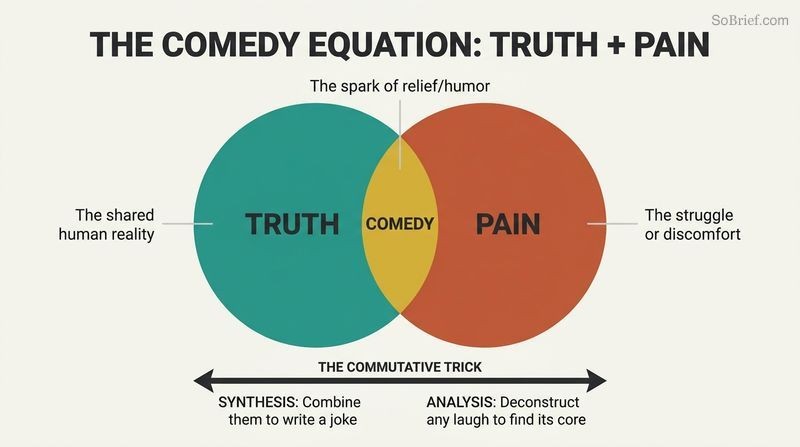
Comedy is truth and pain. Vorhaus's central formula holds that a thing is funny because it exposes a shared truth about human experience and the pain of living with that truth. A clown catching a pie in the face makes us laugh because we recognize the humiliation could be ours. Traveling-salesman jokes work because the salesman wants something (truth) and will never get it (pain). Dirty jokes, death jokes, and religious jokes all mine areas where beliefs run hot.
The commutative trick. Since truth plus pain equals comedy, the equation runs backward too: pick any situation, name its truth and its pain, and you have found the theme of a potential joke. Studying for an exam? Truth: passing matters. Pain: you are unprepared. The joke writes itself.
What's striking is how this echoes evolutionary and psychological theories of humor. The "benign violation" theory from researchers Peter McGraw and Caleb Warren argues laughter arises when something threatens our sense of how the world should be, yet remains safe. Vorhaus's "truth and pain" is a folk version of the same idea: pain supplies the violation, and the shared human truth makes it benign enough to enjoy. One caveat worth adding: proximity matters enormously. The same painful truth that draws laughs at safe distance draws only winces up close, which is why timing after tragedy is so treacherous.
Your inner censor kills more jokes than bad material ever will
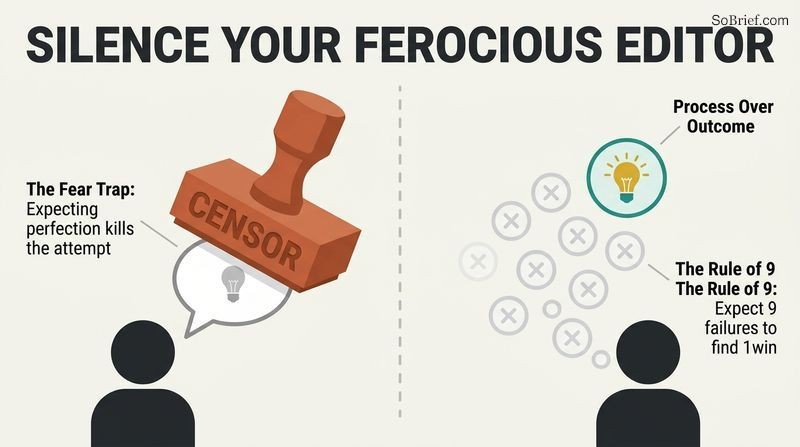
Kill your ferocious editor. Vorhaus argues most people are not unfunny; they simply lack the will to risk. Behind every unsaid joke lurks a chain of bogus thinking: it won't work, they won't like it, therefore they won't like me, therefore I am worthless. He calls the internal voice enforcing this the ferocious editor. Its false assumptions overestimate the penalty for failure and underestimate the odds of success.
Weapons against fear. He offers tools to silence it:
1. The rule of nine: expect nine of ten jokes to flop, which removes the toxic expectation of always winning.
2. Lower your sights: attack the need for success, not just fear of failure.
3. Concentrate on the task at hand: process, not product.
Applaud small victories, and larger ones grow.
This maps neatly onto modern creativity research. Teresa Amabile's work at Harvard found that intrinsic motivation and psychological safety, not pressure, drive creative output. Vorhaus intuited the same decades earlier. His "rule of nine" also parallels how prolific creators actually operate: Dean Simonton's studies of eminent scientists and artists show that quality is a probabilistic function of sheer quantity. The most celebrated works come from those who simply produced the most, failures included. The one tension: some performers thrive under high stakes. Fear can sharpen as well as paralyze. Vorhaus's advice suits beginners best, when the editor's veto is loudest.
Comedy lives in the gap between real reality and comic reality
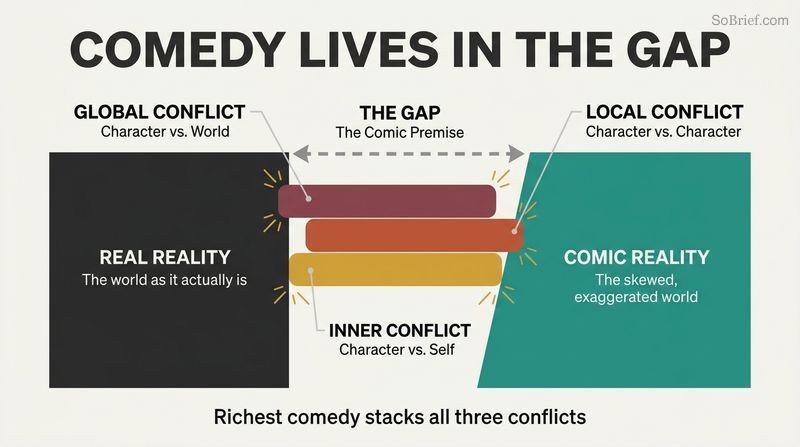
The comic premise is a gap. Vorhaus defines the comic premise as the distance between the world as it actually is and the skewed world a comic voice presents. In Back to the Future, the gap is between a teenager's 1980s knowledge and the 1950s around him. In Peanuts, Snoopy is really a dog but imagines himself a flying ace. Even a pun lives in the gap between how a word should behave and how it suddenly does.
Three types of conflict widen the gap.
1. Global: a person versus their whole world (Bill Murray versus the Army).
2. Local: people who care about each other clashing (Felix and Oscar).
3. Inner: a character at war with himself (Hamlet, Tootsie's Michael Dorsey).
The richest comedy stacks all three at once.
The "gap" framing is a useful generalization of incongruity theory, which dates to Kant and Schopenhauer: humor emerges when expectation and outcome fail to match. Vorhaus's contribution is making it generative rather than merely descriptive. By insisting the premise be stated in a single sentence, he borrows a discipline from screenwriting's "logline" tradition and from Occam's razor: if you cannot compress it, you do not yet understand it. The claim that inner conflict is always richest is defensible but not universal. Plenty of beloved slapstick and sketch comedy thrives on pure external gaps, with no interior struggle whatsoever.
Build comic characters from four parts, then crank the dial to eleven
A repeatable assembly line. Vorhaus claims anyone can manufacture comic characters in minutes using four elements:
1. Comic perspective: a strong, unique worldview at odds with normal reality (Jack Benny's tightwad worldview makes "your money or your life" produce "I'm thinking").
2. Flaws: failings that create emotional distance so we can laugh at the character rather than pity them.
3. Humanity: positive qualities that build a bridge of sympathy so we care.
4. Exaggeration: the force that stretches all three until the gap is wide enough to be funny.
The physics of balance. For every flaw there must be an equal and opposite humanity. Hannibal Lecter works as a comic construct because his monstrousness is counterweighted by wit, poise, and iron will. Distance makes us laugh; humanity makes us stay.
The flaw-plus-humanity balance is essentially a theory of characterization that predates and parallels academic screenwriting orthodoxy. It resembles what psychologists call the "pratfall effect": Elliot Aronson's 1966 experiment showed competent people become more likable after a minor blunder, because flaws humanize. Vorhaus weaponizes this for comedy. The exaggeration mandate connects to caricature research in visual perception: cartoonists exaggerate distinctive features because the brain recognizes and rewards amplified difference faster than accuracy. One limitation: the formula can produce mechanical, interchangeable characters if the writer stops at the four checkboxes. The best comic figures, as Vorhaus himself concedes, carry contradictions the assembly line cannot fully script.
Turn ugly "jokoids" into jokes; never demand brilliance on draft one
Embrace the jokoid. A jokoid looks and smells like a joke but is not funny yet. Rather than a flaw, Vorhaus treats it as an essential interim step: it holds the place on the page where a real joke will go. Rewriting a not-quite-joke is corrective surgery under local anesthetic, far easier than carving a perfect gag from nothing. Often the fix is small, like swapping the wording so the reader becomes the Amish person instead of merely observing one.
Rewriting is where comedy is made. He insists the real work happens in revision: mining raw material onto the page, then refining it. Good is the enemy of the great. The "myth of the last great idea" (the fear that you cannot top what you just wrote) keeps writers clinging to mediocre lines.
This reframes failure as scaffolding, which aligns with how software and design actually iterate: ship a rough version, gather feedback, refine. Vorhaus even borrows "beta tester" from software development to describe trusted early readers. His "good is the enemy of the great" predates Jim Collins's famous business variant and shares DNA with Anne Lamott's "shitty first drafts." The deeper cognitive point is that editing and generating use different mental modes, and separating them prevents the critical brain from strangling the creative one. The risk: perpetual revision can become procrastination in disguise. Vorhaus wisely pairs this with a "hit the wall" stopping rule to prevent infinite polishing.
The more your hero suffers, the harder the audience laughs
Jeopardy fuels comedy. Vorhaus argues a direct causal link: the greater the danger, the bigger the laugh. This works through tension and release. A gambler betting two dollars generates no tension and no laugh. Make it his last two thousand, owed to a leg-breaker named Fingers, with his daughter's surgery riding on it, and the audience is practically begging to laugh just to discharge the pressure.
Raise stakes two ways.
1. Increase the price of failure (what the hero loses).
2. Increase the prize for success (what the hero hopes to win).
Always aim at the emotional core, not just physical threat. Make the robber and the ex-wife the same person. And favor story dynamic over story logic: audiences want wonder ("I can't believe that") not disdain ("I don't buy that").
The tension-release mechanism has genuine physiological grounding. Laughter functions as a release valve, and studies of nervous laughter show people laugh hardest when anxiety suddenly resolves. This is why roller coasters end in giggles. Vorhaus's insistence on emotional over physical stakes anticipates what narrative psychologists call "identification": audiences invest in outcomes proportional to how much they care about the character, not the spectacle. The bolder claim, that logic should yield to dynamism, is contestable. Comedies that flagrantly break their own rules can alienate audiences who feel cheated. The resolution lies in his own later principle: consistency of world matters, but plausibility of individual events does not.
Trade the vague question "what's funny?" for a smaller, answerable one
Shrink the problem. Vorhaus's meta-method runs through the whole book: creativity is problem-solving, and vague problems are unsolvable. Asking "what's funny?" leaves the mind lost in amorphous goo. Asking "what's a conflict between a normal character and a comic character?" or "what's the comic opposite of a scrooge?" moves you instantly toward specifics.
Categories as ladders. He offers types of comic stories precisely so writers can swap one giant question for many small ones: center and eccentrics (an everyman among kooks, like Taxi), fish out of water (Splash, Big), character comedy (comic opposites locked together, like The Odd Couple), powers (magic premises), ensemble, slapstick, and satire and parody. Rules do not confine, they define. The tighter the question, the freer the answer.
This is arguably the book's most transferable insight, extending well beyond comedy. It mirrors what design theorists call "constraint-driven creativity": limitations paradoxically expand output because they give the mind traction. Studies by Patricia Stokes on creative constraint show that self-imposed restrictions reliably increase originality, not diminish it. Composers writing in strict forms, poets bound by sonnet structure, and improvisers working within rules all report the same liberation. Vorhaus's framing of creativity as a sequence of ever-narrowing questions also anticipates modern problem-decomposition methods used in engineering and machine learning. The insight quietly undermines the romantic myth that structure and inspiration are enemies.
Master the small tools: the rule of three, defeated expectations, and twisted clichés
Local tactics that reliably spark laughs. Vorhaus catalogs portable joke mechanics:
1. The rule of three: two items establish a pattern, the third violates it (Gertrude Stein, Joyce Carol Oates, and Dear Abby). Two points define a line; the third breaks it.
2. The doorbell effect: give a character a firm expectation, make the audience believe it, then rudely defeat it.
3. Twist the cliché: finish a familiar phrase the wrong way, which both dodges the tired line and defeats expectation.
Positioning the payoff. Put the funny word last. "If the universe is expanding, why can't I find a place to park?" dies if "park" comes early, because the answer arrives before the question. Save critical setup information, then detonate.
These tactics are the grammar of joke construction, and they hold up under scrutiny. The rule of three appears across rhetoric, music, and memory research: three is the smallest number that establishes a pattern, making the break maximally efficient. Cognitive load theory explains why: two setups give just enough information to form an expectation without draining tension through redundancy. Positioning the payoff last reflects how sentence processing works; the brain resolves meaning at the point of the operative word, so placing it terminally maximizes surprise and prevents the laugh from drowning subsequent words. These are not mere tricks but exploitations of how attention and prediction actually function.
Structure your story on displaced loyalty and an authentic happy ending
The Comic Throughline. Vorhaus reduces any story to a ten-beat spine: who is the hero, what does he want (an outer need he thinks he wants and an inner need he truly wants), the door opens, the hero takes control, a monkey wrench is thrown, things fall apart, the hero hits bottom, the hero risks all, and what does the hero get.
The engine is displaced loyalty. The monkey wrench is usually love. The hero starts loyal only to himself and his goal, then displaces that loyalty onto someone else, creating two mutually exclusive desires. At the bottom, he must choose. He risks everything for the displaced loyalty, often by coming clean, and paradoxically wins both goals. Comic endings are double wins because that sacrifice is the only authentic path to the reward.
The outer-need versus inner-need distinction is now standard screenwriting vocabulary, but Vorhaus's framing of the climax as "displaced loyalty" is unusually precise. It captures why comic and dramatic climaxes feel earned: the hero must surrender the very thing he chased to receive what he actually needed. This is the structure of moral growth itself, echoing Joseph Campbell's "atonement" and even therapeutic models of maturation, where clinging to a false goal must be released. His defense of the happy ending as "organic" rather than pandering is philosophically interesting: he argues stories instruct, and a comedy that punishes its hero forfeits its accumulated goodwill. The claim is strong, though it arguably underrates bittersweet comedy.
Disarm the fraud police by confessing your fear before anyone finds it
Name the fear to defuse it. Vorhaus describes the fraud police as the primal dread that someone will discover you have no business doing what you are doing, that you will be exposed as a phony and hauled off to fake-teacher's prison. Creative people feel it constantly because they always seek challenges bigger than what they have mastered, meaning they are perpetually swimming in strange waters.
The counterintuitive fix. Confess it out loud. When he told his first class he feared the fraud police, he got a laugh, released the room's shared tension, and became their hero. If you reveal your secret, no one can find it out. Telling a nervous audience "be gentle, it's my first time" converts anxiety into allegiance. Invite the fraud police in and they lose all power.
The fraud police is a vivid folk name for impostor syndrome, first described by psychologists Pauline Clance and Suzanne Imes in 1978. Research confirms it is nearly universal among high achievers and correlates with, not against, competence. Vorhaus's remedy anticipates modern vulnerability research: Brené Brown's work shows that naming shame drains its power, precisely because concealment is what feeds it. The mechanism is also social. Confessed fear signals honesty and lowers the audience's guard, triggering reciprocal warmth. The limitation is dosage: strategic vulnerability builds connection, but constant self-deprecation reads as fishing for reassurance. The confession works because it is brief, then followed by actual performance.
Success is talent plus drive plus time, and only drive is scarce
The equation that actually matters. Vorhaus's closing formula: talent plus drive plus time equals success. He argues talent is not the bottleneck; everyone has enough, since the gift of creation is part of the human package. Time is abundant too, twenty-four hours daily, though it is the one non-renewable resource. The scarce ingredient is drive: the stubbornness to keep writing, drawing, or performing through years of rejection and dry spells.
Journey, not destination. He sustains drive by focusing not on reaching the road's end but on getting farther from the start with every step, which grants a small win daily. He invokes the Wade Boggs paradigm: baseball's best hitter still took batting practice every day, so amateurs certainly must. Practice relentlessly, because the moment you stop, your skills fade.
The claim that drive, not talent, separates achievers finds strong empirical backing in Angela Duckworth's research on grit, which shows perseverance predicts success across domains better than raw ability. Anders Ericsson's deliberate practice work reinforces the batting-practice point: elite performers are distinguished by sustained, effortful practice, not innate gifts. Vorhaus's "journey not destination" reframe is also a practical antidote to what psychologists call the "arrival fallacy," the discovery that reaching goals rarely delivers expected happiness. By relocating reward into the daily process, he makes motivation self-renewing. The one blind spot: talent and opportunity are not as evenly distributed as the formula's cheerful egalitarianism implies. Structural luck matters too.
Analysis
The Comic Toolbox belongs to a rare genre: the demystification manual. Where most humor writing treats funniness as ineffable magic, Vorhaus, a working sitcom writer whose credits span the American, Russian, and Bulgarian versions of Married with Children, insists comedy is an engineering discipline. His governing metaphor, tools in a box, is deliberately anti-romantic. The book's structure enacts its thesis: it repeatedly swaps the paralyzing question "what's funny?" for smaller, answerable ones, teaching by progressive narrowing.
Two intellectual moves make the book durable. First, the reduction of all humor to "truth and pain," a folk formulation of incongruity and benign-violation theory that predates the academic consensus it anticipates. Second, the reframing of failure as infrastructure through the rule of nine, jokoids, and the mandate to write long and cut hard. This is a psychology of creative production as much as a craft guide, and its debts run to behaviorism (positive reinforcement as self-fulfilling prophecy) and to what would later be called grit and deliberate practice.
The book's weaknesses are its era and scope. Its examples are frozen in early-1990s television, and its casual treatment of gender pronouns and offensive humor reflects its moment. Its confidence that "everyone has enough talent" is generous but empirically shaky, ignoring how opportunity and luck gatekeep creative careers. And the assembly-line approach to character, taken literally, risks producing mechanical, checkbox comedy, a danger Vorhaus acknowledges but cannot fully resolve.
What endures is the meta-method. The insistence that creativity is problem-solving, that constraints liberate rather than confine, and that process must be protected from the critical ego transfers cleanly to writing, design, entrepreneurship, and any generative work. Vorhaus wrote a comedy book that is secretly a book about how to make anything, by lowering the stakes enough that you dare to begin, then raising them enough that you finish well.
Review Summary
The Comic Toolbox receives mostly positive reviews for its practical advice on comedy writing. Readers appreciate the clear explanations, examples, and exercises provided. Many find it useful for general storytelling, not just comedy. Some criticize the dated references and focus on screenwriting. The book is praised for breaking down humor mechanics and offering tools for character development and joke construction. While not guaranteed to make readers funny, it's considered a valuable resource for aspiring comedy writers and storytellers in general.
People Also Read

Glossary
Comedy is truth and pain
Humor's fundamental formulaVorhaus's core thesis that any funny thing works because it exposes a shared human truth combined with the pain of living with it. Because the equation is reversible, a writer can generate jokes by picking any situation and naming its underlying truth and pain, which become the joke's theme.
Ferocious editor
Internal critic that blocks creativityThe internal voice of fear and self-censorship that stops people from risking jokes by overestimating the penalty for failure and underestimating the odds of success. Vorhaus advises silencing it during creation and reviving it, disciplined and demanding, only during rewriting.
Rule of nine
Expect nine of ten to failA useful fiction that nine of every ten jokes, ideas, or risks will fail. By lowering expectations, it removes the toxic pressure to succeed every time, which is what gives the ferocious editor its power, and it reframes prolific failure as necessary raw material for eventual success.
Comic premise
Gap between real and comic realityThe defining distance between the world as it actually is and the skewed comic version a joke, character, or story presents. Every unit of humor, from a pun to a feature film, has such a gap, sustained by one or more of three conflict types: global, local, and inner.
Comic perspective
A character's skewed worldviewThe single strong, unique way of seeing the world that drives a comic character and differs sharply from normal reality, such as Jack Benny's tightwad view or Groucho Marx's leering cynicism. It functions as a character's personal comic premise and generates their consistent humor.
Jokoid
A joke that isn't funny yetSomething that looks and sounds like a joke but is not yet funny. Rather than a failure to discard, Vorhaus treats it as a valuable placeholder that marks where a real joke will go, since revising an unfunny near-joke is far easier than creating a perfect one from scratch.
Comic Throughline
Ten-beat comic story spineVorhaus's structural template reducing any story to ten beats, from identifying the hero and his outer and inner needs through the door opening, the hero taking control, a monkey wrench (usually love), things falling apart, hitting bottom, risking all, and finally the double-win happy ending.
Displaced loyalty
Hero's shift from self to otherThe turning point where a hero, originally loyal only to himself and his goal, transfers that loyalty to another person, creating two mutually exclusive desires. Resolving this conflict by sacrificing the original goal is what drives the climax and, paradoxically, earns both goals.
Fraud police
Fear of being exposed as phonyVorhaus's name for the dread that others will discover you are unqualified for what you are doing, a folk version of impostor syndrome. His counterintuitive remedy is to confess the fear openly, which releases shared tension, wins the audience's sympathy, and strips the fear of its power.
Outer need and inner need
What hero wants versus truly needsThe distinction between what a hero consciously thinks he wants (outer need, like winning a race) and what he actually requires to be whole (inner need, like self-respect or love). The best comic stories address both, with the inner need fulfilled at the climactic moment of truth.
Clash of context
Forced union of incompatiblesA comic tool that takes something from its usual setting and places it where it does not belong, such as a mermaid in Manhattan or an elephant in a bathtub. It powers high-concept premises, sight gags, oxymorons, and the wildly inappropriate response.
FAQ
What's "The Comic Toolbox: How to Be Funny Even If You're Not" about?
- Purpose of the book: "The Comic Toolbox" by John Vorhaus is a guide designed to help individuals understand and create comedy, even if they don't consider themselves naturally funny.
- Content structure: The book is structured around various tools and techniques that can be used to develop comedic skills, focusing on both the theory and practice of comedy writing.
- Target audience: It is aimed at writers, comedians, and anyone interested in understanding the mechanics of humor and how to apply them effectively.
- Practical exercises: The book includes exercises and examples to help readers practice and refine their comedic abilities.
Why should I read "The Comic Toolbox"?
- Develop comedic skills: The book provides practical tools and techniques to help you become funnier, regardless of your natural comedic talent.
- Comprehensive approach: It covers a wide range of topics, from creating comic characters to structuring comic stories, making it a valuable resource for anyone interested in comedy.
- Engaging writing style: John Vorhaus uses humor and relatable anecdotes to make the learning process enjoyable and accessible.
- Applicable to various formats: Whether you're writing a novel, a screenplay, or performing stand-up, the book offers insights that can be applied across different comedic formats.
What are the key takeaways of "The Comic Toolbox"?
- Comedy is truth and pain: Vorhaus emphasizes that humor often arises from the intersection of truth and pain, making it relatable and funny.
- The rule of nine: Expect that nine out of ten jokes may not work, which encourages experimentation and reduces fear of failure.
- Comic premise and perspective: Understanding the gap between comic reality and real reality is crucial for creating humor, as is developing a strong comic perspective for characters.
- Importance of rewriting: The book stresses the significance of refining and rewriting material to enhance its comedic impact.
How does John Vorhaus define a "comic premise"?
- Gap between realities: A comic premise is the gap between comic reality and real reality, where humor lives.
- Examples in media: Vorhaus illustrates this with examples from movies and TV shows, such as "Back to the Future" and "Peanuts," where characters experience a skewed reality.
- Application in jokes: Even simple jokes rely on a comic premise, where the expected reality is subverted for comedic effect.
- Tool for creation: Recognizing and creating a comic premise is a fundamental tool for developing comedic situations and characters.
What is the "rule of nine" in comedy?
- Expectation of failure: The rule of nine suggests that for every ten jokes you tell, nine will likely fail, which helps reduce the fear of failure.
- Encourages experimentation: By accepting that most attempts won't succeed, you are encouraged to try more ideas and take creative risks.
- Focus on process: This rule shifts the focus from immediate success to the process of creating and refining material.
- Liberating mindset: Embracing the rule of nine can free you from the pressure of perfection and allow for more creative freedom.
How does "The Comic Toolbox" suggest creating comic characters?
- Strong comic perspective: A comic character should have a unique way of viewing the world that differs significantly from the norm.
- Exaggeration: Amplifying a character's traits can make them more distinct and humorous.
- Flaws and humanity: Characters should have flaws that create emotional distance for humor, but also humanity to make them relatable.
- Complexity and conflict: The best comic characters have layers of conflict within themselves, making them dynamic and engaging.
What are some tools from "The Comic Toolbox" for writing comedy?
- Clash of context: This involves placing something in an unexpected setting to create humor, like a hooker in a convent.
- Wildly inappropriate response: Characters reacting inappropriately to situations can generate laughs, such as a giggle fit on death row.
- Tension and release: Building tension in a joke or scene and then releasing it with a punchline or twist enhances comedic impact.
- Telling the truth or a lie: Both can be used to comic effect, depending on the situation and the expected response.
How does John Vorhaus suggest structuring a comic story?
- Comic throughline: This is a simple path from the start to the end of a tale, ensuring the story is complete and engaging.
- Hero's journey: Identify the hero, their desires, and the obstacles they face, leading to a moment of truth and resolution.
- Conflict and resolution: Stories should have escalating conflicts that lead to a satisfying resolution, often with a happy ending.
- Integration of humor: Humor should be woven into the story's structure, enhancing both the narrative and the comedic elements.
What is the "comic perspective" and why is it important?
- Unique worldview: A comic perspective is a character's distinct way of seeing the world, which is crucial for generating humor.
- Foundation for jokes: It serves as the basis for a character's actions and reactions, making their behavior consistently funny.
- Character development: A strong comic perspective helps in creating memorable and engaging characters.
- Consistency in humor: It ensures that the humor remains true to the character and the story, providing a cohesive comedic experience.
What are the best quotes from "The Comic Toolbox" and what do they mean?
- "Comedy is truth and pain": This quote highlights the idea that humor often arises from relatable truths and the pain of human experience.
- "The rules don’t confine, they define": Vorhaus suggests that understanding the rules of comedy can help define and enhance creativity rather than limit it.
- "The better you imagine yourself to be, the better you become": This emphasizes the power of positive reinforcement and self-belief in developing comedic skills.
- "If you can’t be right, be loud": This encourages boldness and exaggeration in comedy, as being noticeable can be more important than being correct.
How does "The Comic Toolbox" address the fear of failure in comedy?
- Embrace failure: The book encourages accepting failure as a natural part of the creative process, reducing its power to inhibit creativity.
- Rule of nine: By expecting most attempts to fail, you can focus on the process rather than the outcome, fostering a more experimental approach.
- Kill your ferocious editor: Vorhaus advises silencing the internal critic that stifles creativity, allowing for freer expression and risk-taking.
- Positive reinforcement: Celebrating small victories and progress can build confidence and diminish the fear of failure over time.
How can "The Comic Toolbox" help in writing for different comedic formats?
- Versatile tools: The book provides tools and techniques that can be applied across various formats, from stand-up to screenwriting.
- Character and story focus: Emphasizing strong characters and structured stories ensures that the humor is adaptable to different media.
- Exercises and examples: Practical exercises help readers practice and refine their skills, making the concepts applicable to their specific needs.
- Understanding of humor mechanics: By breaking down the elements of comedy, the book equips readers to create humor in any format they choose.
Download PDF
Download EPUB
.epub digital book format is ideal for reading ebooks on phones, tablets, and e-readers.








































