
Plot Summary
City of Steel Shadows
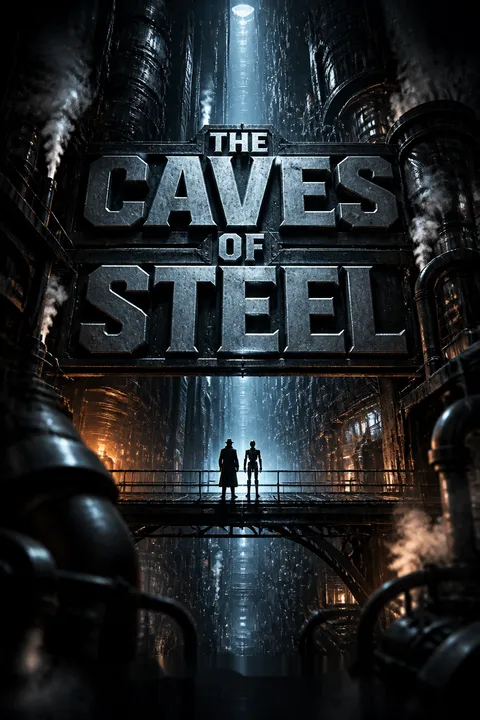
In a future New York, humanity lives in vast, enclosed Cities—steel caves housing millions, cut off from the open sky and nature. Detective Elijah "Lije" Baley, a plainclothes cop, navigates the rigid, hierarchical world of the City, where every privilege is rationed and robots are slowly replacing human labor. The City's efficiency is both its strength and its curse, breeding resentment, fear, and a longing for a lost, freer past. Baley's own life is shaped by these pressures: his father's declassification, his family's struggle, and his own uneasy place in a society on the brink of change. The City is a character itself—oppressive, protective, and deeply human in its contradictions.
Murder Behind the Barrier
Baley is summoned by his superior, Commissioner Enderby, and learns that a Spacer—one of the elite, genetically engineered humans from the Outer Worlds—has been murdered inside Spacetown, a domed enclave near the City. The Spacers, who wield immense political and technological power, suspect an Earthman is responsible. The murder threatens to ignite interplanetary conflict and could justify Spacer intervention on Earth. Baley is assigned to the case, but with a condition: he must work with a Spacer partner. The stakes are high—not just for Baley's career, but for the fragile peace between Earth and the Outer Worlds.
Robot Partner, Human Fears
Baley's new partner is not a human Spacer, but R. Daneel Olivaw—a humanoid robot so perfectly constructed he is indistinguishable from a man. Baley's initial revulsion and suspicion are palpable; robots are deeply resented on Earth, seen as threats to jobs and human dignity. Yet Daneel is calm, logical, and eerily competent. Their partnership is uneasy, marked by Baley's fear of being replaced and his struggle to see Daneel as anything but a machine. Together, they begin to investigate the murder, navigating the City's labyrinthine corridors and the even more tangled web of human emotions and prejudices.
Riot at the Shoe Counter
A routine stop at a shoe store turns into chaos when a crowd, incited by anti-robot sentiment, threatens to destroy the robot clerks. Baley and Daneel intervene; Daneel, wielding an (unloaded) blaster, quells the mob with a display of authority. The incident exposes the City's simmering tensions—fear of robots, economic insecurity, and the ease with which order can collapse. Baley is shaken by Daneel's effectiveness and by his own sense of helplessness. The event also marks the beginning of a rumor: a humanoid robot is loose in the City, working with the police.
Family Tensions Unveiled
Baley brings Daneel home, introducing him to his wife Jessie and son Bentley. The presence of the robot unsettles the family, especially Jessie, who senses something is amiss. The family's history—Jessie's longing for excitement, her discomfort with her name "Jezebel," and Baley's own insecurities—comes to the fore. Jessie's fears about the robot and the dangers of Baley's assignment strain their relationship. The City's pressures are mirrored in the home: privacy is scarce, status is fragile, and the threat of declassification looms over every decision.
The Spacer's Dilemma
Baley and Daneel visit Spacetown, where they meet Dr. Han Fastolfe, a Spacer leader. Fastolfe explains the Spacers' dilemma: their worlds are underpopulated, their lives long and comfortable, but stagnant. Earth, by contrast, is overpopulated and trapped in its Cities. The Spacers hope to "modernize" Earth by introducing robots, but resistance is fierce. Fastolfe reveals a deeper motive: to rekindle Earth's pioneering spirit and encourage emigration to new worlds. The murder of Dr. Sarton, the Spacer sociologist, threatens this fragile project. Baley is forced to confront the broader implications of his investigation.
Crossroads in Spacetown
In Spacetown, Baley makes a dramatic accusation: he claims that Daneel is not a robot, but Dr. Sarton in disguise, and that the murder is a Spacer plot to justify intervention on Earth. The Spacers calmly refute his theory, and Daneel reveals his true nature by exposing his robotic arm. Baley is humiliated, but the incident deepens his understanding of the Spacers' psychology and the complexity of the situation. The investigation seems to stall, and Baley's own position becomes precarious.
Suspicions and False Leads
Baley and Daneel pursue various leads: anti-robot agitators, known as Medievalists, who long for a return to Earth's "golden age"; the possibility of a secret organization orchestrating violence; and the role of the City's own police department. They interrogate suspects, including Francis Clousarr, a zealous Medievalist, but find little concrete evidence. The investigation is hampered by false leads, bureaucratic obstacles, and Baley's growing sense of being manipulated—by the Spacers, by his superiors, and perhaps even by Daneel.
Medievalists in the Shadows
Jessie confesses to Baley that she has been attending Medievalist meetings, drawn by a longing for meaning and rebellion against the City's conformity. The meetings are more social than subversive, but the organization's rhetoric is dangerous. Jessie's involvement puts Baley in a vulnerable position, both personally and professionally. The confession is a moment of raw honesty, exposing the psychological toll of life in the City and the ways in which even the most ordinary people are drawn into larger currents of fear and resistance.
The Trap Tightens
A robot, R. Sammy, is found destroyed in police headquarters, his positronic brain scrambled by an alpha-sprayer. The murder is a scandal, suggesting corruption or sabotage within the Department. Circumstantial evidence points to Baley: his wife's involvement with the Medievalists, his own access to the power plant where the weapon originated, and his proximity to R. Sammy. The real murderer is framing Baley, tightening the trap and threatening his career, his family, and his freedom.
Death of a Robot
As the investigation into R. Sammy's death intensifies, Baley realizes he is being set up. The destruction of the robot is not just an act of sabotage, but a calculated move to remove Baley from the Sarton case and discredit him. The pressure mounts: Baley faces suspension, public disgrace, and the possible declassification of his family. He is forced to confront the limits of justice in a world where truth is easily manipulated and the powerful protect their own interests.
Confessions and Revelations
In a tense confrontation, Baley pieces together the truth: Commissioner Enderby, a secret Medievalist, accidentally killed Dr. Sarton while attempting to destroy Daneel. Enderby's nearsightedness led him to mistake Sarton for the robot. He used R. Sammy to transport the murder weapon and later destroyed the robot to cover his tracks. The evidence—broken glasses, a hidden blaster, and the Commissioner's own psychological profile—confirms Baley's deductions. Enderby confesses, broken by guilt and the weight of his actions.
The Truth in the Details
Baley's success is not just a triumph of logic, but of empathy and understanding. He sees through the layers of deception by paying attention to the small details: the psychology of the suspects, the inconsistencies in their stories, and the subtle clues left behind. The case is solved not by brute force or technological prowess, but by the uniquely human ability to synthesize information, question assumptions, and see the world through another's eyes. The resolution is bittersweet—justice is served, but at a cost.
Justice, Mercy, and Forgiveness
As the dust settles, Baley reflects on the nature of justice. The Spacers are willing to forgive Enderby if he helps redirect the Medievalist movement toward peaceful colonization of new worlds. Baley, too, is moved by a sense of mercy—recognizing that true justice is not always about punishment, but about understanding, forgiveness, and the possibility of redemption. The story ends with a gesture of reconciliation: Daneel, the robot, quoting the words of Jesus, "Go, and sin no more," to the fallen Commissioner.
A New Dawn for Earth
The investigation's conclusion marks a turning point for Earth. The Spacers withdraw, leaving behind the seeds of a new movement: the possibility of emigration, the blending of human and robotic cultures, and the hope of a better future. Baley returns to his family, changed by his experiences and newly aware of the complexities of justice, the dangers of prejudice, and the enduring power of human connection. The City remains, but the steel shadows are pierced by the promise of a new dawn.
Analysis
A meditation on progress, prejudice, and the human conditionThe Caves of Steel is more than a detective story; it is a profound exploration of the tensions between tradition and progress, fear and hope, humanity and technology. Asimov uses the locked-room mystery as a lens to examine the psychological and social costs of rapid change: the resentment of those left behind, the dangers of fanaticism, and the difficulty of forging trust across divides. The partnership between Baley and Daneel is emblematic of the novel's central question: can humans and robots—emotion and logic, past and future—coexist and create something new? The answer is cautiously optimistic. Through empathy, understanding, and a willingness to question assumptions, the characters find a path forward. The novel's ultimate lesson is that justice is not just about punishment, but about mercy, forgiveness, and the possibility of redemption. In a world of steel shadows, it is the human capacity for change, connection, and hope that offers the promise of a new dawn.
Review Summary
The Caves of Steel is a classic sci-fi detective novel set in a dystopian future Earth. Readers praise Asimov's world-building, exploring themes of overpopulation, human-robot relations, and space colonization. The story follows detective Elijah Baley and his robot partner R. Daneel Olivaw as they investigate a murder. While some find the characters underdeveloped and the plot predictable, many appreciate the book's philosophical questions and social commentary. Despite its age, the novel remains relevant and thought-provoking for modern readers.
People Also Read








Characters
Elijah "Lije" Baley
Baley is a plainclothes detective, shaped by the City's rigid hierarchy and haunted by his father's declassification. He is intelligent, methodical, and deeply human—prone to doubt, fear, and flashes of empathy. His relationship with his wife Jessie is loving but strained by the pressures of City life and the secrets they both keep. Baley's journey is one of self-discovery: he must confront his own prejudices, learn to trust a robot partner, and navigate the moral ambiguities of justice. His greatest strength is his ability to see beyond the surface, to question assumptions, and to act with compassion even when the system demands otherwise.
R. Daneel Olivaw
Daneel is a humanoid robot, designed to be indistinguishable from a human Spacer. He is logical, calm, and unfailingly polite, but his presence unsettles those around him. Daneel's partnership with Baley is a study in contrasts: machine and man, logic and emotion, certainty and doubt. Over the course of the story, Daneel demonstrates not only intelligence but a growing understanding of human psychology, justice, and even mercy. He is both a symbol of the future and a mirror reflecting humanity's deepest fears and hopes.
Jessie Baley
Jessie is Baley's wife, a woman caught between the demands of City life and her own longing for meaning and excitement. Her involvement with the Medievalists is driven by a desire to feel special, to rebel against conformity, and to reclaim a sense of agency. Jessie's relationship with Baley is complex—marked by love, frustration, and mutual misunderstanding. Her confession is a moment of vulnerability, revealing the psychological toll of life in the City and the ways in which ordinary people are drawn into larger currents of resistance and fear.
Commissioner Julius Enderby
Enderby is the Commissioner of Police, a man who has risen through the ranks by being smooth, adaptable, and able to navigate the City's bureaucracy. Secretly a Medievalist, he is torn between his duties and his beliefs. His accidental killing of Dr. Sarton is the result of fear, prejudice, and a tragic mistake. Enderby's guilt and eventual confession are deeply human, exposing the dangers of fanaticism and the possibility of redemption through honesty and cooperation.
Dr. Han Fastolfe
Fastolfe is a leader among the Spacers, a man of intelligence, humor, and deep conviction. He believes in the necessity of change—both for Earth and the Outer Worlds—and is willing to take risks to achieve it. Fastolfe's conversations with Baley are philosophical, exploring the nature of progress, the dangers of stagnation, and the hope of a new synthesis between human and robotic cultures. He is both a mentor and a catalyst, pushing Baley to see beyond the immediate case to the larger issues at stake.
Francis Clousarr
Clousarr is a zymologist and a passionate Medievalist, deeply opposed to robots and the changes they represent. He is articulate, angry, and driven by a sense of loss and injustice. Clousarr's confrontations with Baley reveal the depth of anti-robot sentiment in the City and the psychological roots of resistance to change. He is both a suspect and a symbol—a reminder that the struggle over robots is ultimately a struggle over identity, dignity, and the meaning of progress.
R. Sammy
R. Sammy is a less advanced robot, used for menial tasks in the police department. His destruction is a turning point in the story, signaling the lengths to which the real murderer will go to cover his tracks and frame Baley. R. Sammy's fate is a stark reminder of the expendability of robots in a society that both depends on and resents them.
Bentley Baley
Bentley is Baley's teenage son, a product of the City but still open to new possibilities. His curiosity, intelligence, and resilience offer a glimpse of hope—a new generation that might bridge the gap between the old and the new, the human and the robotic. Bentley's relationship with his parents is loving but marked by the same tensions that shape the City as a whole.
Dr. Anthony Gerrigel
Gerrigel is a leading roboticist, called in to provide expert testimony on the nature of robots and the impossibility of a robot committing murder. His calm, methodical approach provides a counterpoint to the emotional turmoil of the investigation. Gerrigel's insights help Baley unravel the technical aspects of the case and underscore the limitations—and possibilities—of robotic intelligence.
The City
The City itself is a character—an environment that shapes every aspect of its inhabitants' lives. It is both protective and oppressive, efficient and dehumanizing. The City's rules, hierarchies, and routines are the backdrop against which the drama unfolds, and its pressures drive the characters to acts of courage, desperation, and rebellion. The City is the steel shadow that must be escaped if humanity is to find a new dawn.
Plot Devices
Locked-Room Mystery in a Futuristic World
The novel employs the structure of a locked-room mystery: a murder in an apparently inaccessible location, a limited pool of suspects, and a detective tasked with unraveling the truth. This familiar device is given new life by its futuristic setting—enclosed Cities, humanoid robots, and interplanetary politics. The investigation is complicated by layers of prejudice, technological limitations, and the psychological impact of life in the City. Foreshadowing is used skillfully: early hints about Enderby's glasses, Jessie's secret, and the nature of robots all pay off in the final revelation. The narrative structure alternates between action, introspection, and philosophical debate, allowing the reader to experience both the suspense of the case and the deeper questions it raises about justice, progress, and what it means to be human.
Robot, chronological order Series


About the Author
Other books by Isaac Asimov






Download PDF
Download EPUB
.epub digital book format is ideal for reading ebooks on phones, tablets, and e-readers.








































