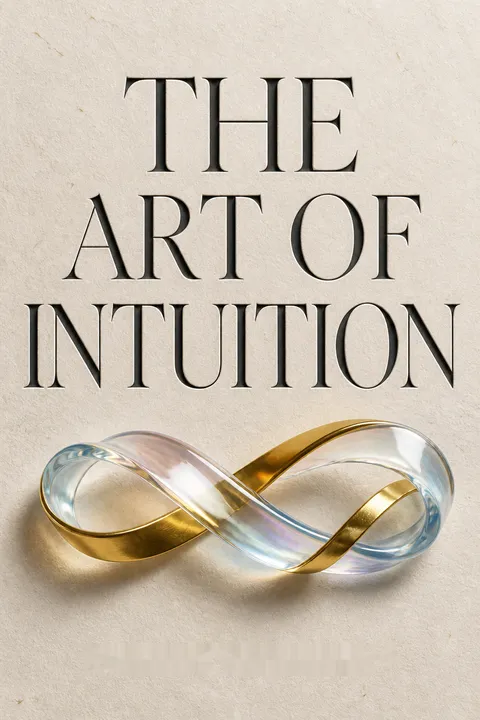

Key Takeaways
1. Intuition is a Natural, Trustworthy Inner Wisdom
By definition intuition involves information unavailable to the intellect, and it is always to be trusted.
Beyond intellect. Intuition is a swift, unreflective apprehension—a hunch, gut feeling, or premonition—that provides information inaccessible to our rational mind. Unlike intellectual judgments, which can be clouded by bias or incomplete data, intuition is consistently accurate, serving as an internal guide that warns of danger or points toward beneficial paths. It often manifests as a subtle nudge, a hesitation, or a sudden knowing that defies logical explanation.
Stories abound. The book shares numerous examples of intuition in action, from a CEO selling stock on a hunch to a woman canceling a cruise and saving her fiancé from a dangerous race, both of which averted disaster. These moments highlight intuition's protective nature, rooted in the Latin tueri, meaning "to guard, to protect." Even when intuition makes no immediate sense, acting on it is crucial, as its wisdom often becomes clear only in hindsight.
Listen and trust. While easily ignored or overridden by conscious reason, intuition is a fragile yet powerful force that speaks from our subconscious. It's distinct from fear or anxiety; true intuition never harms and always serves our highest good. Cultivating this inner voice requires quietude and trust, allowing us to respond instantly to its signals, whether they manifest as a physical sensation, a sudden insight, or a clear inner knowing.
2. Scientific Research Validates Psychic Phenomena
More than one thousand controlled studies of psi have been concluded with combined odds against chance of 10104 to 1.
Evidence abounds. Despite widespread skepticism, scientific research has consistently substantiated the reality of intuition, telepathy, clairvoyance, and precognition (collectively known as psi phenomena). Institutions like Duke University, Princeton, and Stanford have conducted hundreds of thousands of laboratory studies, yielding astronomical odds against chance for these occurrences. These studies often involve "forced-choice" tests or physiological measurements like skin conductance and heart rate.
Anticipating the future. Research shows that the human body can unconsciously anticipate future emotional events by several seconds, with changes in skin conductivity occurring before a violent image appears on a screen. This "presentiment" suggests a constant, unconscious scanning of the future, a survival skill that allows for pre-emptive responses. Even earthworms exhibit a one-second precognitive response, indicating this ability is not unique to complex organisms.
Skepticism's paradox. The scientific community's resistance to psi research is often rooted in a circular logic: phenomena aren't taken seriously until reported in "respectable" journals, which won't publish them until they're deemed "respectable." However, the sheer volume and statistical significance of the evidence challenge this stance, suggesting that our understanding of reality, particularly in quantum mechanics, may need to expand to accommodate these "nonlocal" connections.
3. Love and Interconnectedness Amplify Intuitive Experiences
We are hooked into life by the mystery of love, as we ourselves are love, our very atoms formed of love, and why should it be otherwise when our very thoughts would merge in love?
Ribbons of love. The book posits that intuition and psychic abilities are carried on "ribbons of love," suggesting a literal, energetic connection between individuals. This idea aligns with mystical traditions that proclaim "all is One" and modern quantum physics concepts like entanglement, where particles remain connected across vast distances. This profound interconnectedness allows for telepathic communication and deep empathetic knowing.
Empathetic resonance. The stronger our empathy and spiritual development, the more intuitive experiences we tend to have. This is evident in stories of mothers sensing their children's distress from afar, or individuals physically experiencing the pain of a loved one undergoing a heart attack. These powerful connections transcend physical distance, demonstrating that love acts as a conduit for information and shared experience.
Beyond the self. The energy of love is not just a personal feeling but a universal force that influences our perceptions and interactions. When we are filled with love, joy, or gratitude, our energy fields expand and shine, affecting those around us. This heightened state of being naturally opens us to intuitive insights, making us more receptive to the subtle whispers of the Divine and the interconnected web of existence.
4. Creativity and Inspiration Are Manifestations of Intuition
Is inspiration, is creativity itself, an aspect of intuition?
The Muse's whisper. Inspiration, much like intuition, often strikes when the mind is relaxed, receptive, and in a quiet state. Artists, writers, and scientists frequently report ideas "coming to them" in dreams, during meditation, or while engaged in repetitive, mindless tasks. This suggests that the unconscious mind, when unburdened by analytical thought, gains access to a deeper wellspring of knowledge and creative solutions.
Genius at work. Historical figures like Mozart, who heard entire symphonies "all at once," or Friedrich August Kekulé von Stradonitz, who discovered the benzene ring structure in a dream, exemplify intuition's role in groundbreaking creative and scientific breakthroughs. These moments of "bolt from the blue" are not random but often follow periods of intense, focused work, culminating in a sudden, effortless insight when the conscious mind lets go.
Cultivating the flow. To invite inspiration, one must cultivate a state of "no-mind" through practices like meditation, walking in nature, or engaging in hobbies that quiet the inner chatter. This receptive state allows the "Higher Self" or "Muse" to communicate, often through imagery, symbols, or even an "External Voice." The creative process, therefore, is a dance between diligent effort and humble surrender to intuitive guidance.
5. Animals Possess Profound Intuitive and Telepathic Abilities
The psychic abilities of animals are renowned, and if telepathy and precognition were standards of intelligence, they’d be off the Richter scale, so that we humans would be relegated to serving them as their slaves.
Beyond our senses. Animals demonstrate extraordinary intuitive and telepathic capabilities, often surpassing human perception. They can predict earthquakes, sense seizures in their owners, know when their humans are returning home from miles away, and even locate burial sites of deceased masters. These abilities highlight a deep, unspoken connection between animals and their environment, as well as with humans.
Empathy and knowing. Animals are highly attuned to human emotions, absorbing our anxieties, sadness, and joy. They act as natural healers, bringing us back to the present moment and offering unconditional love. Stories like Oscar the cat, who predicts patient deaths in a nursing home, or dogs traveling thousands of miles to find their way home, underscore their profound, inexplicable knowing that transcends conventional understanding.
Communicating in images. Animal communication often occurs through images and "knowings" rather than words. While humans may struggle to interpret these non-verbal messages, trained animal intuitives can bridge this gap, relaying animals' needs, fears, and even their past experiences. This suggests that animals operate on a level of consciousness deeply connected to the intuitive realm, offering us lessons in mercy, tolerance, and acceptance.
6. Our Energy Fields and Brainwaves Shape Our Perceptions
The heart appears to play a direct role in the perception of future events.
Auras and energy. All living things emit an electromagnetic aura or energy field, a "vital life force" that reflects our state of health and spiritual well-being. This radiance, depicted as halos in ancient art, can be perceived by sensitives and even measured by devices like the Gas Discharge Visualization (GDV) device. Our aura expands with love, joy, and mystical insight, and shrinks with illness, depression, or fear.
Brainwave symphony. Our state of consciousness is a fluid combination of four brainwave frequencies: beta (alertness), alpha (relaxed receptivity), theta (subconscious, creativity, intuition), and delta (deep sleep, spiritual longing, empathy). The "Awakened Mind" utilizes all four in harmony, granting access to heightened creativity, clarity, and intuitive gifts. Training can help individuals consciously access and balance these frequencies.
Heart-brain connection. Research suggests the heart may receive intuitive information before the brain, acting as a primary conduit to our "higher self." This information is then relayed to the brain, particularly the frontal cortex, where we become consciously aware of it. Practical exercises like "combing your aura" or "feeling an energy ball" can help individuals become more aware of and comfortable with these subtle energies, enhancing their intuitive sensitivity.
7. Consciousness Extends Beyond the Physical Body and Death
Something like eight million people have had a near-death experience (NDE).
Beyond the brain. The book delves into the profound question of consciousness and its fate after death, drawing on numerous accounts of Near-Death Experiences (NDEs). These experiences, where individuals are clinically dead (no brain or heart activity) yet report vivid, coherent experiences, challenge conventional scientific understanding of the mind. NDEs often involve encountering a great light, beautiful beings, or deceased relatives, and a review of one's life from a compassionate, non-judgmental perspective.
Mind-sight and awareness. Remarkable cases, such as Vicky Bright, blind from birth, who described surgical details during her NDE, or Pam Reynolds, who underwent "standstill" surgery with no brain activity yet recalled operating room conversations, suggest a "mind-sight" that operates independently of physical senses. These accounts imply that consciousness is not merely a product of the brain but a more fundamental aspect of existence, capable of transcending physical limitations.
Eternal identity. Those who return from NDEs often report retaining their personality and encountering loved ones who are "happy" and "young" on the "Other Side." This suggests that personal identity and awareness persist beyond physical death, offering comfort and a profound shift in perspective for the experiencer. The consistent themes across millions of NDEs point to an unwavering reality of survival after death, aligning with ancient spiritual wisdom.
8. Psychic Abilities Are Learnable Skills, Not Just Innate Gifts
CRV was not created for psychics. It was created for the nonpsychics, for the “ungifted.”
A skill to be honed. While some individuals are born with natural psychic gifts, the book emphasizes that these abilities are skills that can be learned and developed through practice, much like playing a musical instrument or mastering a craft. This perspective democratizes intuition, making it accessible to anyone willing to undertake the necessary discipline and training.
Controlled Remote Viewing (CRV). A prime example is Controlled Remote Viewing (CRV), a military-developed technique for accessing information remotely, which teaches a structured approach to tap into the subconscious mind. CRV uses ideograms and specific protocols to translate wordless, imagistic insights into conscious understanding, demonstrating that even "ungifted" individuals can learn to "view" distant targets with remarkable accuracy.
Tools and practice. Techniques like dowsing with a pendulum, automatic writing, and various energy exercises serve as tools to enhance intuitive perception. These practices, combined with mindfulness and meditation, train the mind to quiet its analytical chatter and become receptive to subtle information. Consistent practice, like any martial art, is key to honing these skills and integrating them into daily life, transforming them from rare occurrences into reliable guidance.
9. Spirit Communication is a Real and Often Gentle Phenomenon
I believe, however, that we have these gifts within ourselves. We are souls incarnated into physical bodies, and we come trailing clouds of glory from the other world (or worlds).
Beyond the veil. The book presents numerous personal accounts and historical examples of spirit communication, asserting that the soul lives on after death and can interact with the living. These interactions are often gentle, comforting, and sometimes humorous, challenging the dramatic, fear-inducing portrayals in popular culture. Spirits are described as happy, young, and eager to communicate, often through subtle signs or direct messages.
Mediumship and evidence. Mediums, who mediate between the visible and invisible worlds, can channel spirits or access information from the deceased. While skepticism is natural, verifiable instances, such as a medium relaying specific, unknown details about a deceased loved one or providing names and personal anecdotes, offer compelling evidence. These communications often bring peace and closure to the grieving, confirming the continuity of consciousness.
Subtle manifestations. Spirits often use technology, causing lights to flicker or music to play, or appear in symbolic forms like birds or butterflies. They can also influence thoughts, as in the case of a brother "knowing" where a lost document was hidden. These phenomena suggest that spirits, though discarnate, can exert subtle influences on our physical world and minds, acting as guides or offering reassurance from the "Other Side."
10. Ethical Practice and Spiritual Growth Are Paramount for Intuitive Development
Concentrate instead on what they point to: the psyche, the Soul, the Holy Spirit. Concentrate on the goodness that underlies the universe.
Purpose of intuition. The ultimate purpose of developing intuition and psychic abilities is not fortune-telling or personal gain, but spiritual growth and service to others. These "siddhis" or powers are natural by-products of spiritual awakening, intended to deepen our connection to the Divine and foster qualities like compassion, empathy, humility, and forgiveness. Focusing solely on the "glamorous" aspects can distract from this higher path.
Ethical conduct. Practicing intuition requires strict ethical guidelines: always seek permission before "looking into" someone, never use abilities for harm or manipulation, and maintain confidentiality. A true intuitive operates from a place of integrity, offering guidance that empowers clients rather than creating dependency. The client also has a responsibility to approach a reading with respect and an open mind, while trusting their own intuition to discern genuine guidance from potential fraud.
The path of humility. The journey of intuitive development is one of continuous learning and self-forgiveness. Mistakes are part of the process, serving as lessons to refine our understanding of how intuition speaks to us. Ultimately, it's about cultivating a "spiritually mature" self—less angry, less prideful, more patient, serene, and compassionate—and recognizing that our individual consciousness is part of a greater, interconnected, and loving universe.
Review Summary
The Art of Intuition receives mixed reviews, averaging 3.53 stars. Many readers expected practical guidance on developing intuition but found instead a collection of anecdotes about psychic phenomena and the author's personal experiences. Critics note the book becomes repetitive, lacks sufficient exercises, and diverges into topics like animal communication and mediumship. Skeptical readers found it unscientific. However, supporters appreciated the broad overview of intuitive experiences, elegant writing style, and fascinating stories, particularly those interested in spirituality and psychic abilities.
People Also Read






Download PDF
Download EPUB
.epub digital book format is ideal for reading ebooks on phones, tablets, and e-readers.








































