
Key Takeaways
1. The 17th Century: Crucible of Global Power and Apocalypse
What is euphemistically referred to as “modernity” is marked with the indelible stain of what might be termed the Three Horsemen of the Apocalypse: Slavery, White Supremacy, and Capitalism, with the bloody process of human bondage being the driving and animating force of this abject horror.
England's dramatic rise. The 17th century was a pivotal era that transformed England from a minor European power into a global superpower, a dominance later inherited by its "revolting spawn," the United States. This stunning ascent was not a tale of unblemished progress but was fundamentally rooted in a brutal trinity: slavery, white supremacy, and an emerging capitalism. These forces, far from being incidental, were the very engine of England's newfound wealth and influence.
Foundational crimes. Any explanation of this historical shift that overlooks the systematic enslavement of millions of Africans and Native Americans, and the accompanying ideology of white supremacy, is profoundly incomplete. These acts were not mere unfortunate side effects but the proximate causes of immense capital accumulation. The wealth generated from human bondage directly funded England's military expansion, technological advancements, and burgeoning industries, setting the stage for its global empire.
A dark inheritance. The United States, as London's successor, carried this torch of global dominance into the 21st century, perpetuating many of the same foundational crimes. The author argues that the framework for today's republic, with its inherent racial hierarchies and capitalist structures, was largely forged during this pivotal 17th century. This period laid the groundwork for a "modern" world built on exploitation and rationalized by a pernicious concept of race.
2. Mass Enslavement: The Engine of European Wealth
From the sixteenth through the nineteenth centuries nearly 13 million Africans were brutally snatched from their homelands, enslaved, and forced to toil for the greater good of European and Euro-American powers, London not least.
Unprecedented human bondage. The 17th century witnessed an explosion in the scale of human enslavement, far surpassing previous forms of servitude. Roughly 2 to 4 million Native Americans were enslaved and traded by European settlers, leading to catastrophic population declines, sometimes up to 90%, through warfare, famine, and disease. Simultaneously, Europeans enslaved some two million Africans during this century alone, with numbers accelerating dramatically after 1640.
Economic imperative. This mass enslavement was driven by the insatiable demand for labor to cultivate lucrative cash crops like sugar and tobacco in the Americas. Enslaved Africans, viewed as a "peculiar form of capital encased in labor," represented both the barbarism of emerging capitalism and its productive force. Their forced migration constituted two-thirds of the total migration into the Americas between 1600 and 1700, metaphorically and actually serving as currency to enrich England.
Underdevelopment and distortion. The slave trade had devastating, long-lasting impacts on Africa, depopulating communities of their healthiest members and severely wounding existing systems of agriculture, mining, and governance. This systemic cruelty simultaneously buoyed Western Europe, creating a stark seesaw effect where London's rise directly correlated with Africa's and the Americas' fall. The economic distortions and underdevelopment caused by this trade continue to reverberate today.
3. Inter-European Rivalry: A Bloody Ladder for England's Ascent
The point here is that the Dutch and Spanish were denuding each other in the first few decades of the seventeenth century, which also allowed England to rise.
Exploiting rivals' weaknesses. England's ascent was not solely due to its own strength but also its strategic exploitation of its European rivals' internal and external conflicts. Spain, once the dominant colonial power, was weakened by constant warfare, the Inquisition's anti-Semitism, and its disastrous encounters with the Dutch. This created openings for England to "leech parasitically onto Madrid's booming wealth" through piracy and direct conquest.
Dutch decline, English gain. The Netherlands, initially a formidable maritime and colonial power, also became a target. England opportunistically aided the Dutch against Spain in the late 16th century, only to "fatten a sheep for slaughter." Through a series of Anglo-Dutch wars (1652-1674), London systematically dismantled Dutch control over Atlantic trade routes and key colonial territories like Manhattan, absorbing their expertise and assets, particularly in the slave trade and sugar production.
Global chessboard. European powers were locked in a "regional crisis of production" and ceaseless conflict, which they often resolved by transferring militarism westward to the Americas and Africa. Events like the Thirty Years' War (1618-1648) and the decline of the Ottoman Empire (culminating in 1683) further diverted rivals' attention and resources, allowing England to consolidate its colonial gains and focus on expanding its slave-based economy.
4. The Rise of Merchants: Capitalism's Anti-Monarchist Architects
As scholar William Pettigrew has argued forcefully, the African Slave Trade rested at the heart of what is still held dear in capitalist societies: free trade, anti-monarchism, and a racially sharpened and class-based democracy.
Merchants challenge the Crown. A burgeoning merchant class in England, driven by the immense profits from colonial ventures and the slave trade, increasingly chafed under royal control and monopolies. This class played a pivotal role in the English Civil Wars (1640s-1650s), backing figures like Oliver Cromwell against the monarchy. Their desire to weaken the Crown's hold over the lucrative African Slave Trade was a significant driver of anti-monarchist sentiment.
"Free trade" in human lives. The merchants' push for "free trade" was, in this context, a demand for deregulation of the slave trade, allowing private traders to participate more widely and profitably. This economic victory over the monarchy, culminating in the "Glorious Revolution" of 1688, was presented as a triumph for "popular" politics and republicanism. However, this "bourgeois democracy" was deeply intertwined with racialized exploitation.
A blueprint for 1776. The weakening of the monarchy and the empowerment of merchants laid the ideological and economic groundwork for the American Revolution. The "Glorious Revolution" was a "Magna Carta for racialized bourgeois democracy," setting a precedent for colonists to later challenge London's authority when it seemed to impede their own expansion of land, slaves, and profit. The merchants' ethos of ruthless profit-seeking, even through piracy, became central to the emerging capitalist system.
5. The Invention of "Whiteness": A Tool for Colonial Control
Ultimately, this is a description of what “race” means, a pernicious concept that emerged forcefully, coincidentally enough, in the seventeenth century as colonialism was gaining traction.
A new identity for control. The 17th century saw the forceful emergence of "race," specifically "whiteness," as a pernicious concept designed to manage the inherent instability of settler colonialism. Initially, European settlements were diverse, including Catholics, Protestants, and Jews, often at odds. However, the overwhelming presence of enslaved Africans and hostile Indigenous populations necessitated a unifying identity among Europeans.
Bridging internal divides. "Whiteness" served as a powerful tool to overcome internal European class, ethnic, and religious conflicts. Poorer Europeans, often indentured servants or political dissidents, were granted privileges and elevated status over Africans and Native Americans. This "combat pay" or "racial solidarity" effectively drove a wedge between potential allies among the oppressed, ensuring that European settlers, regardless of their original status, would unite against the designated "racial other."
A persistent legacy. This "racializing rationalization of inhumanity" meant the denial of fundamental rights to millions, making Africans and Indigenous peoples permanent outsiders. The concept of "whiteness" became a "new kind of aristocracy," a cross-class coalition that solidified settler colonialism. This identity politics, forged in the crucible of slavery and dispossession, continues to resonate in contemporary society, shaping political and social dynamics, as seen in events like the 2016 US election.
6. The Caribbean's Centrality: A Violent Blueprint for Mainland Settler Colonialism
The main event was in the Caribbean. This would not change appreciably until the mid-eighteenth century, which suggested that the Royal Navy would be more prone to be concerned about challenges to Barbados, not Boston.
Crucible of sugar and slavery. The Caribbean islands, particularly Barbados and later Jamaica, were the primary engines of England's colonial wealth in the 17th century. The "sugar boom" transformed these islands into highly profitable, densely populated slave societies, demanding an ever-increasing influx of enslaved Africans. Barbados, for instance, saw its African population jump from 2,000 in the 1630s to over 50,000 by the 1660s.
A model for the mainland. The extreme racial ratios and constant threat of slave revolts in the Caribbean forced the rapid development of draconian slave codes and the hardening of racial hierarchies. These islands served as a violent blueprint for mainland colonies like South Carolina, which was effectively a "colony's colony" of Barbados. Settlers from the Caribbean, fleeing the dangers of overwhelming African majorities, brought their expertise in slave management and racialized social structures to the mainland.
The "Great Trek" and its consequences. The inherent instability of island settlements, coupled with the allure of vast, "empty" indigenous lands, spurred a "Great Trek" of European settlers from the Caribbean to the North American mainland. This migration, particularly to the American South, extended the shelf life of slavery and intensified the dispossession of Native Americans. The wealth generated from this expanded slave-based economy fueled a growing desire for independence from London, culminating in 1776.
7. Resistance and Rebellion: The Unyielding Fight Against Enslavement
Rebelliousness among those slated for enslavement in Africa and those held captive in the Americas was a factor that restrained the scope of the slave trade, thus restraining the unjust enrichment that characterized London and, ultimately, New York.
Constant defiance. Africans and Indigenous peoples did not passively accept their fate. From the moment of capture in Africa to their forced labor in the Americas, resistance was constant and varied. In Africa, European forts were targets of attack, and slave ships were notorious for engendering mutinies. In the Americas, Indigenous groups fiercely resisted land grabs, often allying with rival European powers or launching devastating wars like King Philip's War (1670s).
Slave revolts and their impact. Slave revolts were a perpetual threat, particularly in the Caribbean, where African populations often outnumbered Europeans. Events like the 1638 slave rebellion on Providence Island, the Maroons' decades-long insurgency in Jamaica, and the "Grand Conspiracy" in Barbados (1676) forced colonizers to implement increasingly brutal measures and to seek ways to divide and conquer the enslaved. These uprisings directly influenced colonial policy, including the forging of "whiteness."
Shaping colonial strategy. The persistent rebelliousness of Africans and Indigenous peoples profoundly shaped European colonial strategies. It led to the militarization of settler societies, the development of sophisticated surveillance systems, and the constant search for new labor sources or methods to control existing ones. The fear of a unified uprising, like the one that would eventually succeed in Haiti in 1791, was a constant undercurrent, driving settlers to make concessions to poorer Europeans and to expand westward.
8. The "Glorious Revolution" (1688): Liberty for Some, Apocalypse for Others
But the monarch and his retinue, as so often happens with a beleaguered ruling elite, suffered from a failure of imagination. It was readily contemplatable that the monarch could be downgraded to the status of figurehead and with the added wealth brought by the African Slave Trade and dispossession of the indigenous, the talents of smart men could then be bought to administer a state apparatus with the strength to build forts in Africa and a prepossessing Royal Navy.
A revolution for profit. The "Glorious Revolution" of 1688 in England, often celebrated as a triumph for liberty and parliamentary power, was, for Africans and Indigenous peoples, the dawning of an apocalypse. This event saw the deposing of King James II and a significant weakening of royal authority, particularly over the African Slave Trade. The rising merchant class, having long chafed under the Crown's monopoly (e.g., the Royal African Company), successfully lobbied for deregulation.
Deregulation and intensified enslavement. The deregulation of the slave trade after 1688 unleashed the "animal spirits" of freelance merchants, leading to a massive, exponential increase in the number of enslaved Africans transported to the Americas. This surge in forced labor fueled unprecedented wealth accumulation for England and its colonies, particularly in the mainland South, where reliance on enslaved African labor rapidly outpaced indentured European servitude.
Racial capitalism solidified. This "bourgeois revolution" was conceived in a "crass and crude act of staggering hypocrisy," where the rhetoric of "liberty" and "freedom" masked an intensified system of racialized exploitation. The shift from a Crown-controlled monopoly to a more "free market" slave trade solidified the foundations of racial capitalism, linking parliamentary power with systemic racism. This outcome further entrenched the "whiteness" identity, as poorer Europeans were increasingly incentivized to align with elites against the growing African and Indigenous populations.
9. The Enduring Legacy: Hypocrisy, Underdevelopment, and the Call for Reparations
For, other than Native America, Africa was the primary victim of the apocalypse unleashed with full fury in the seventeenth century.
A persistent historical amnesia. The narrative of "progress" and "bourgeois democracy" surrounding England's 17th-century rise and the subsequent formation of the United States often downplays or ignores the foundational role of slavery and dispossession. This "chutzpah and a minimum of self-awareness" has created a persistent historical amnesia, where these crimes are seen as anomalies rather than essential to the nation's founding.
The cost of "modernity." The "modern and advanced world" was built on immense suffering, leading to the underdevelopment of Africa and the lasting trauma of its diaspora, as well as the genocide and dispossession of Native Americans. The rationalization of these "bloody felonies" as necessary for the "advancement of the productive forces" or the "flowering of bourgeois liberties" is a profound hypocrisy that continues to impede true justice and equality.
The imperative for reparations. The author concludes by emphasizing that the immense damage inflicted over centuries, particularly on Africa, Africans, and Native Americans, demands repair. This mandates a "massive program of reparations" to address the ongoing economic, social, and psychological legacies of this apocalyptic period. The global landscape is changing, offering new opportunities to challenge the "hydra-headed monster" of white supremacy and capitalism that arose from the 17th century's brutal foundations.
Review Summary
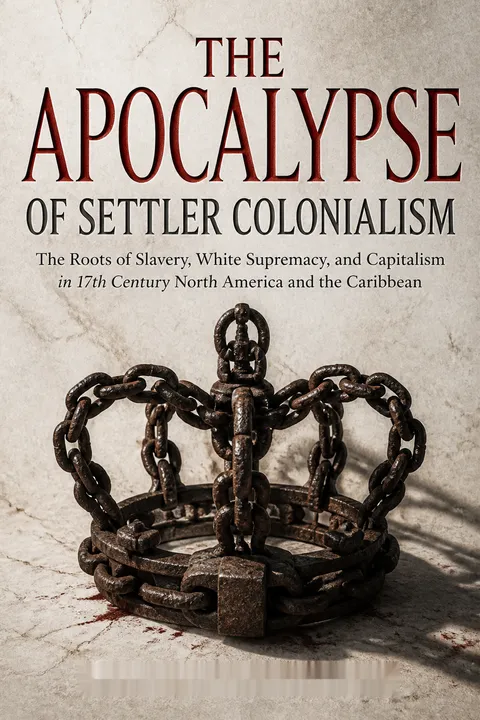
The Apocalypse of Settler Colonialism examines 17th-century history, arguing the Glorious Revolution of 1688 unleashed merchant-class control of the slave trade, accelerating capitalism, white supremacy, and indigenous genocide. Horne connects England, the Caribbean, and North America, showing how "whiteness" emerged as cross-class solidarity to suppress enslaved peoples. Reviewers praise his thorough research and compelling thesis linking slavery's expansion to capitalism's rise. However, many critique the dense, disorganized writing style, verbose language, and assumption of prior historical knowledge, making it challenging for general readers despite its important insights.
People Also Read








About the Author

Download PDF
Download EPUB
.epub digital book format is ideal for reading ebooks on phones, tablets, and e-readers.








































