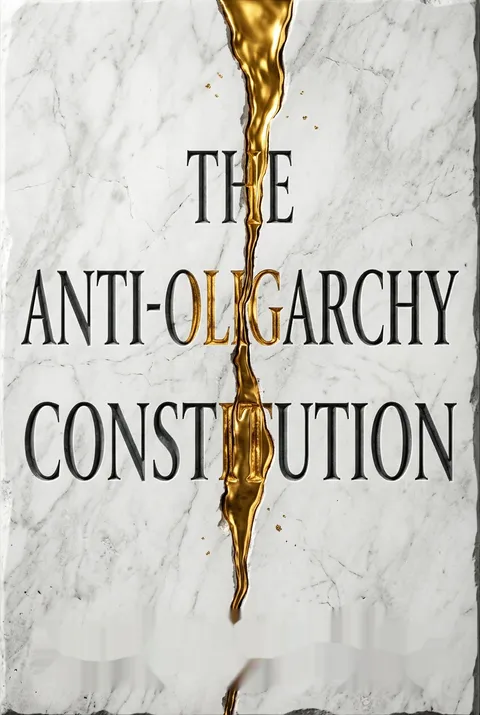

Key Takeaways
1. American Democracy's Enduring Economic Foundation
As long as political economy flourished, Americans of all political stripes viewed and argued about the Constitution through a political-economy lens and the political economy through a constitutional lens.
Inseparable spheres. For much of American history, politics and economics were seen as fundamentally intertwined, forming a "constitutional political economy." Thinkers from Adam Smith to Karl Marx understood that political decisions shaped market relations and wealth distribution, just as economic power influenced politics. This holistic view meant that debates about wages, prices, and wealth were inherently constitutional.
A lost perspective. The 20th century saw a shift, with economics emerging as a "scientific, technocratic" discipline, sidelining questions of wealth and power distribution. Liberals, in particular, embraced this technocratic approach, abandoning their historical tradition of political economy, while conservatives often retained it. This divergence led to a "Great Forgetting" of the Constitution's economic dimensions.
Constitutional claims as political substance. Historically, constitutional arguments were not conversation-stoppers enforced solely by courts, but rather "the substance of democratic constitutional politics." They were central to national debates about the relationship between the Constitution and the nation's economic life, reflecting a deep-seated belief that the nation's identity was "constituted and defined by law."
2. The Democracy-of-Opportunity Tradition's Core Principles
Arguments in the democracy-of-opportunity tradition hold, broadly, that we cannot keep our constitutional democracy—our “republican form of government”—without (1) restraints against oligarchy and (2) a political economy that sustains a robust middle class, open and broad enough to accommodate everyone.
Three essential strands. This tradition, named by Franklin Roosevelt, posits that a true constitutional democracy requires three interconnected elements:
- Anti-oligarchy: Preventing the concentration of excessive economic and political power in too few hands. This involves targeting corruption, empowering secondary associations like unions, and breaking up monopolies.
- Broad middle class: Ensuring a political economy that sustains a robust middle class, offering genuine opportunities for all to achieve material security and a dignified livelihood.
- Inclusion: Extending these opportunities and protections to all people, regardless of race, sex, or other invidious distinctions.
Affirmative obligations. Unlike a view of the Constitution as merely a set of limits, this tradition emphasizes the "affirmative obligations" of all government branches, especially the elected ones, to enact legislation that actively shapes the political economy. Courts, in this view, often play a crucial role by "get[ting] out of the way of such legislation."
Intertwined principles. The most compelling arguments within this tradition recognize that these three principles are inseparable. Historically, attempts to build a democracy of opportunity for white men only often led to anti-egalitarian politics that undermined the broader democratic project. Racial inclusion, particularly during Reconstruction, was seen as fundamentally linked to anti-oligarchy and the creation of a mass middle class.
3. The Early Republic's Anti-Oligarchy Roots
For the revolutionary generation, political liberty—the very heart of the Revolution—depended on economic equality.
Republican ideals. The American Revolution was fueled by anti-aristocratic, republican ideals that deemed it "a constitutional essential" to avoid European hierarchies and privilege. The new United States aimed for a society of "middling sorts"—citizens with enough independence to participate in self-governance, but not so much wealth as to form an aristocracy.
Material independence. This republican vision of liberty was not merely non-interference but "nondomination"—freedom from both private and public overlords. Such freedom required "material independence," meaning a broad distribution of resources. Early state constitutions reflected this by:
- Abolishing aristocratic laws like primogeniture and entail.
- Expanding suffrage rights for white males.
- Including provisions for public education and access to land.
Jefferson's vision. Thomas Jefferson, a key figure, advocated for policies like steep taxes on large landholdings and universal public education, viewing them as "essentially necessary" initial endowments. He famously replaced "property" with "the Pursuit of Happiness" in the Declaration of Independence, signifying that property rights were "subordinate to the inalienable individual right to the pursuit of happiness."
4. Antebellum Clashes Over Economic Design
"I deny … that it is either proper, or consistent with the object of our Government, to promote the growth of the country in wealth, without regard to the manner of its distribution."
Jacksonian constitutionalism. Andrew Jackson and his Democratic Party brought constitutional political economy to the forefront of partisan politics, defining "equal protection" as safeguarding the "many" against "class legislation" that privileged the "few." They vehemently opposed the national bank, corporate charters, and protective tariffs, viewing them as creating "inequalities of wealth and influence" that threatened republican institutions.
Whig "American System." Jackson's Whig opponents, including Henry Clay and Abraham Lincoln, also engaged in constitutional political economy, advocating for a robust national government to foster economic development. Their "American System" promoted protective tariffs, internal improvements (like canals and railroads), and a credit-based economy, arguing that these policies would create "ample as possible a supply of decent livelihoods for the laboring classes."
Affirmative legislative duties. Both parties believed that legislators, including the president, were the primary "expositors" of the Constitution, with "affirmative constitutional duties" to shape the nation's economic destiny. Whigs, in particular, argued that Article I's enumerated powers were "not only grants of power but trusts to be executed" and "duties to be discharged" to advance the "general welfare."
5. Reconstruction's Revolutionary Fusion of Inclusion and Opportunity
"The whole fabric of southern society must be changed … [i]f the South is ever to be made a safe republic.… How can republican institutions … exist in a mingled community of nabobs and serfs?"
Second Founding's promise. The Civil War and Reconstruction Amendments marked a "Second Founding," transforming America into a racially inclusive republic. Radical Republicans, like Thaddeus Stevens, understood that abolishing slavery required dismantling the "ruling and dominant class" of slaveholders and remaking the South's political economy. This meant intertwining anti-oligarchy, a broad middle class, and racial inclusion.
Congressional duties. Republicans asserted Congress's "affirmative constitutional duties" under the Thirteenth and Fourteenth Amendments and the Guarantee Clause to secure Black freedom. This included:
- Conferring basic civil rights (Civil Rights Act of 1866).
- Providing education (Freedmen's Bureau).
- Redistributing land (Southern Homestead Act, though limited).
- Enfranchising Black men (Fifteenth Amendment).
Women's rights and oligarchy. The women's rights movement, led by figures like Susan B. Anthony, also seized on Reconstruction's promise, arguing that the exclusion of women from suffrage constituted an "oligarchy of sex." They linked women's subordination in the household and economy to the broader anti-oligarchy principle, demanding equal rights and economic independence.
6. The Gilded Age's Class Struggle and Judicial Backlash
"There is an inevitable and irresistible conflict between the wage-system of labor and the republican system of government."
Corporate capitalism's crisis. The late 19th century saw the rise of corporate capitalism, creating a permanent class of wage earners and unprecedented concentrations of wealth. Labor activists and Populists argued that the "wage-system of labor" was incompatible with republican government, leading to "wage slavery" and threatening "the democratic social fabric."
Populist constitutionalism. The Populist movement, a farmer-labor alliance, developed a radical constitutional political economy. They demanded:
- Nationalization of railroads and public control over banking and currency.
- A graduated income tax to make "aggregated wealth bear its just proportion of taxation."
- Direct democracy (initiative, referendum, recall) to counter corporate capture of legislatures.
They viewed these reforms as essential to restore "the widest distribution among the people, not only of political power, but of the advantages of wealth, education, and social influence."
Judicial "Lochnerism." The Supreme Court, increasingly populated by corporate attorneys, responded with "Lochnerism," a laissez-faire constitutionalism that protected "freedom of contract" and private property against redistributive legislation. Decisions like In re Debs (1895) and Pollock v. Farmers' Loan & Trust Co. (1895) struck down labor protections and the federal income tax, effectively "magnifying" the judiciary's role as a bulwark against popular economic reforms.
7. The Progressive Era's Modernization of Democratic Governance
"How … can the wage-earners obtain an amount or a degree of economic independence analogous to that upon which the pioneer democrat could count?"
Progressive Democracy. Early 20th-century Progressives, like Herbert Croly and Theodore Roosevelt, modernized the democracy-of-opportunity tradition. They accepted the "inevitability" of big corporations but sought to tame their power through:
- "Industrial democracy": Empowering unions and giving workers a share of authority in industry.
- Administrative state: Building new government agencies to regulate corporations and manage public services.
- Progressive taxation: Advocating for income and inheritance taxes to curb "malefactors of great wealth."
Challenging judicial supremacy. Progressives, including Roosevelt, fiercely criticized the judiciary's "aristocracy of the robe" for thwarting democratic reforms. They argued that "the American people are fit for complete self-government" and should be the "final interpreters of the Constitution," advocating for structural reforms like the direct election of senators (17th Amendment) and popular referendums on judicial decisions.
Higher lawmaking. The era saw a burst of constitutional amendments:
- 16th Amendment (1913): Overturned Pollock, allowing federal income tax.
- 17th Amendment (1913): Mandated direct election of senators, curbing corporate influence in state legislatures.
- 19th Amendment (1920): Secured women's right to vote, completing Reconstruction's promise of inclusion for women.
These amendments reflected a self-conscious effort to reshape the political economy and restore popular sovereignty against oligarchic power.
8. The New Deal's "Economic Constitutional Order"
"If the average citizen is guaranteed equal opportunity in the polling place, he must have equal opportunity in the market place."
Confronting crisis. The Great Depression exposed the failures of laissez-faire, prompting Franklin D. Roosevelt to declare a "new despotism" of "economic royalists" threatening constitutional democracy. The New Deal aimed to save capitalism by establishing an "economic constitutional order" based on affirmative social and economic rights.
Affirmative rights and duties. Roosevelt articulated a "democracy of opportunity" that included:
- The right to a useful and remunerative job.
- The right to earn enough for a decent living.
- The right to organize unions and bargain collectively.
- The right to social insurance (Social Security Act).
These were framed as "inescapable obligations" of government, essential for "true individual freedom" and a bulwark against totalitarianism.
Constitutional showdown. The Supreme Court initially resisted, striking down key New Deal measures like the National Industrial Recovery Act (Schechter Poultry Corp., 1935) and the Railroad Retirement Act (Alton Railroad Co., 1935), citing federalism and liberty of contract. Roosevelt's "court-packing" plan, though politically controversial, ultimately led to a "switch in time," with the Court upholding the Wagner Act and Social Security Act in 1937.
9. Post-New Deal Counterrevolution and the "Great Forgetting"
"The constitutional revolution which once went by the name of the ‘New Deal’ … [government] has been converted into an instrument for the achievement of … economic security for ‘the common man’."
Conservative backlash. Despite the Court's "switch in time," a conservative coalition of Southern Democrats and anti-New Deal Republicans launched a "constitutional counterrevolution" from 1938 to 1947. They fought to repeal New Deal measures, block expansion of social programs, and curtail labor's power (e.g., Taft-Hartley Act, 1947), often invoking "states' rights" and "freedom of contract."
The "Great Forgetting." This period saw the eclipse of the democracy-of-opportunity tradition in mainstream liberal politics. Liberals shifted towards a "court-centered" constitutionalism focused on civil liberties and civil rights, largely abandoning economic issues as constitutional concerns. The rise of technocratic economics, emphasizing growth over distribution, further marginalized political economy.
Separation of strands. The three strands of the tradition—anti-oligarchy, broad middle class, and inclusion—were pulled apart. Racial inclusion, though advanced by the civil rights movement and the Warren Court, became disconnected from broader economic justice. This created a vulnerability, as race-conscious measures were later framed as "zero-sum games" fueling "populist white racial resentment."
10. Reclaiming Constitutional Political Economy Today
"The only question is whether the Constitution will come in on one side only, in the service of a deregulatory, anti-redistributive vision of constitutional political economy, or whether the democracy-of-opportunity tradition, too, will be heard."
Challenging inherited axioms. Modern liberals must abandon the outdated assumptions that constitutional law and economics are separate from politics. The current Supreme Court actively imposes a "neo-Lochnerian vision of political economy," using doctrines like the "weaponized First Amendment" to dismantle campaign finance regulations and weaken labor unions.
Constitutional arguments as a shield. Progressives must use constitutional political economy as a "shield" to defend legislation that does "essential constitutional work," such as:
- Campaign finance reform: Laws like Montana's Corrupt Practices Act, which limit corporate political spending, are constitutionally necessary to prevent oligarchy and preserve republican government.
- Labor law reform: Legislation like the PRO Act, which protects workers' collective action and organizing rights, is essential to build countervailing power against economic domination.
- Universal social insurance: Programs like Medicaid expansion are constitutionally weighty, addressing racial and economic precarity.
Reintegrating race and class. Addressing racial inequality requires structural reforms to the nation's political economy, not just antidiscrimination laws. This includes:
- Wealth taxes and inheritance taxes to disperse concentrated wealth.
- Public banking and credit systems to promote broad access to capital.
- Universal basic endowments (e.g., higher education without debt) to ensure economic participation for all.
Partisan constitutionalism. Winning these battles requires a political party committed to the democracy-of-opportunity tradition, willing to challenge a hostile judiciary and pursue structural reforms to the political system (e.g., Senate, Electoral College). The American people, as the ultimate arbiters, must judge whether the Court's constitutional politics aligns with the nation's democratic ideals.
People Also Read








Download PDF
Download EPUB
.epub digital book format is ideal for reading ebooks on phones, tablets, and e-readers.








































