
Key Takeaways
1. Emancipation Ignited a Revolution, Not Just Freedom
Begun to preserve the Union, the Civil War now portended a far-reaching transformation in Southern life and a redefinition of the place of blacks in American society and of the very meaning of freedom in the American republic.
A watershed moment. The Emancipation Proclamation on January 1, 1863, was more than a legal decree; it was a declaration of a social revolution. While initially a military strategy, it transformed the Civil War from a fight for Union preservation into a struggle for fundamental societal change, particularly for the over 3 million enslaved people. This act, celebrated widely in the North and among enslaved communities, signaled the irreversible end of plantation slavery and the beginning of a new, uncertain era.
Slaves as agents of change. The disintegration of slavery was already underway before the Proclamation, driven by the actions of the enslaved themselves. Thousands fled to Union lines, disrupting the plantation system and forcing the Union Army to confront the reality of abolition. Their determination to seize freedom propelled a reluctant white America towards a more radical stance, demonstrating that the enslaved were not passive victims but active participants in their liberation.
Black soldiers defined consequences. The large-scale enlistment of 180,000 black soldiers, authorized by the Proclamation, played a crucial role in winning the war and shaping its aftermath. Their service not only bolstered Union forces but also transformed the nation's treatment of black people, granting them unprecedented legal equality within the military and fostering a new sense of self-worth and a claim to equal citizenship. This military service became a powerful justification for their demands for political rights during Reconstruction.
2. The South's Internal Civil War Exposed Deep Divisions
Like a massive earthquake, the Civil War and the destruction of slavery permanently altered the landscape of Southern life, exposing and widening fault lines that had lain barely visible, just beneath the surface.
A fractured white society. The Civil War did not unite white Southerners; instead, it exacerbated long-standing class and regional divisions, particularly between the wealthy planter elite of the plantation belt and the yeoman farmers of the upcountry. While most initially rallied to the Confederacy, policies favoring planters, such as conscription exemptions for slaveholders, bred deep resentment among the non-slaveholding poor, leading to widespread desertion and outright resistance.
Upcountry Unionism emerged. In mountainous regions like East Tennessee and northern Alabama, where slavery was less prevalent, communities with strong local loyalties openly defied Confederate authority. These "inner civil wars" saw thousands join the Union Army and form secret Union societies, driven by a desire for local autonomy and a rejection of planter dominance. This disaffection shattered the political hegemony of the planter class and laid the groundwork for a new political consciousness among yeomen.
A legacy of bitterness. The war left the upcountry devastated and its Unionist population with bitter memories of persecution. This internal conflict bequeathed explosive political issues to Reconstruction, as these white Unionists, while committed to democratic change for themselves, often harbored deep animosity towards both former Confederates and, crucially, black freedmen, complicating the formation of a truly inclusive new order.
3. Northern Transformation Fueled Industrial Capitalism and Federal Power
The Civil War, observed Orestes Brownson, a New England social critic, forced the United States for the first time to confront the implications of its own nationality.
Economic boom and industrial growth. While the South faced devastation, the North experienced unprecedented prosperity during the Civil War. Wartime demand fueled industrial profits, railroad expansion, and mechanization, accelerating the shift towards an industrial economy. This era saw the rise of powerful entrepreneurs like Philip D. Armour and John D. Rockefeller, who would revolutionize American industry.
Expanded federal authority. The war necessitated an unprecedented expansion of federal power, leading to the creation of a national banking system, a paper currency, increased tariffs, and massive government spending on infrastructure like the transcontinental railroad. These policies, initially driven by wartime exigencies, permanently altered the conditions of capital accumulation and laid the groundwork for a more activist national state, embodying a new commitment to national economic development.
Social and political shifts. The war also transformed Northern society, fostering a heightened sense of national identity and purpose. Reformers, including women and black communities, saw the conflict as an opportunity to advance egalitarian ideals, leading to calls for civil rights and women's suffrage. However, this period also saw the rise of class tensions, as workers faced declining real wages, and racial anxieties, exemplified by the New York City draft riots, revealing the complex and sometimes contradictory nature of Northern "reconstruction."
4. Presidential Reconstruction: A Flawed Attempt at Restoration
"White men alone must manage the South," the President remarked to California Senator John Conness in 1865.
Johnson's lenient approach. Following Lincoln's assassination, Andrew Johnson, despite his anti-aristocratic rhetoric, pursued a Reconstruction policy that quickly alienated Radical Republicans. His plan offered broad amnesty to former Confederates, excluding only the wealthiest planters and high-ranking officials, who could then apply for individual pardons. This approach aimed to restore the Southern states to the Union swiftly, with minimal federal intervention in their internal affairs.
The rise of the Black Codes. Johnson's leniency allowed Southern state governments, dominated by former Whigs and ex-Confederates, to enact "Black Codes." These laws, while acknowledging the end of slavery, severely restricted black freedom, aiming to:
- Stabilize the black labor force through annual contracts and vagrancy laws.
- Limit economic options outside plantation labor.
- Reinstitute coercive labor discipline, often through apprenticeship laws for black minors.
- Exclude blacks from juries and public services.
A political miscalculation. Johnson's policies, particularly his rapid pardoning of wealthy Southerners and his tacit approval of the Black Codes, were seen by many Northerners as a betrayal of the Union's victory and a reassertion of the old order. His belief that black suffrage would lead to an alliance between freedmen and former masters, thereby undermining white yeomanry, fueled his racist stance. This approach, far from creating a new political order, solidified white Southern opposition to black rights and set the stage for a bitter confrontation with Congress.
5. Radical Reconstruction: A Bold Experiment in Interracial Democracy
"I believe in equality among citizens—equality in the broadest and most comprehensive democratic sense," declared Massachusetts Sen. Henry Wilson.
A new vision for the South. Driven by a moral commitment to racial justice and a belief in the expanded powers of the national state, Radical Republicans in Congress sought to fundamentally transform the South. They viewed the Civil War as a "golden moment" to establish a "perfect republic" where all citizens, regardless of race, enjoyed equal civil and political rights. This vision challenged the traditional notion of states' rights and aimed to dismantle the social and political structures inherited from slavery.
The Fourteenth Amendment as cornerstone. The Fourteenth Amendment, passed in 1866, became the central pillar of Radical Reconstruction. It defined national citizenship, guaranteed "privileges and immunities," ensured "due process of law," and promised "equal protection of the laws" to all persons. This amendment, while a compromise that implicitly allowed states to limit suffrage on non-racial grounds, fundamentally altered federal-state relations and provided a constitutional basis for federal intervention to protect civil rights.
Black suffrage and military rule. The Reconstruction Acts of 1867, passed over Johnson's veto, were the most radical legislative acts of the era. They divided the South into military districts, mandated new state constitutions, and, crucially, enfranchised black men. This unprecedented experiment in interracial democracy aimed to create a new political order where black votes, combined with loyal white support, would establish Republican governments and secure the gains of emancipation.
6. The Freedmen's Bureau: A Bridge to Free Labor, Yet Limited
"The law on the side of freedom," Frederick Douglass would later remark, "is of great advantage only where there is power to make that law respected."
A daunting mandate. The Freedmen's Bureau, established in 1865, was tasked with assisting the transition from slavery to free labor, a monumental undertaking. Its responsibilities included establishing schools, providing aid to the destitute, adjudicating disputes, and securing legal justice for freedmen. Operating with limited resources and manpower, its local agents often found themselves caught between the conflicting aspirations of former slaves and former masters.
The land question's betrayal. A key promise of the Bureau was to settle freedmen on abandoned and confiscated lands, particularly under Sherman's Field Order 15. However, President Johnson's rapid pardoning of former Confederates led to the restoration of these lands to their previous owners. This betrayal, exemplified by the poignant confrontation on Edisto Island, deeply disillusioned freedmen who believed land ownership was essential for true economic independence, forcing most back into labor contracts on white-owned plantations.
Ambiguities of "free labor." The Bureau's efforts to establish a "free labor" system were fraught with contradictions. While promoting voluntary labor and market incentives, it often coerced freedmen into signing annual contracts, which many viewed as a return to "slavery by another name." Despite its commitment to equal justice, the Bureau's temporary nature and reliance on state cooperation meant that its courts and medical programs were often inadequate, exposing the limits of federal intervention in a society deeply resistant to change.
7. Southern Republicanism: A Fragile Coalition Under Siege
"We must keep together, scallawags, carpetbaggers and niggers," declared a North Carolina Republican.
A diverse, yet vulnerable, alliance. Southern Republicanism, born from the ashes of war, was a coalition of black freedmen, Northern "carpetbaggers," and native white "scalawags." This alliance, unprecedented in American history, aimed to democratize the South and rebuild its economy. However, it faced immense challenges from a unified white Democratic opposition and internal divisions over policy, patronage, and racial priorities.
Blacks as the party's backbone. Black voters formed the overwhelming majority of the Republican party in the South, demonstrating remarkable political unity and enthusiasm. They eagerly participated in Union Leagues, mass meetings, and elections, viewing the Republican party as the champion of their newfound freedom and rights. Black leaders, many of them former slaves, rose to prominence in state legislatures and local offices, symbolizing the profound political revolution underway.
Internal conflicts and white resistance. Despite their shared goals, the Republican coalition was plagued by factionalism. Carpetbaggers, often educated and ambitious, sought to modernize the South's economy, while scalawags, a diverse group of former Whigs and upcountry Unionists, pursued their own economic and political agendas. These internal struggles, coupled with the persistent racism of many white Republicans and the relentless opposition of white Democrats, who used both political maneuvering and violence, weakened the party's ability to govern effectively and maintain its legitimacy.
8. The Ku Klux Klan: A Counter-Revolution of Terror
Its purposes were political, but political in the broadest sense, for it sought to affect power relations, both public and private, throughout Southern society.
A military force for white supremacy. The Ku Klux Klan and similar organizations emerged as a violent counter-revolution against Reconstruction. Far from a disorganized mob, the Klan acted as a paramilitary force, serving the interests of the Democratic party and the planter class. Its terror campaign aimed to:
- Destroy the Republican party's infrastructure by assassinating or driving out black and white leaders.
- Undermine Reconstruction governments.
- Reestablish control over the black labor force.
- Restore racial subordination in all aspects of Southern life.
Targeting black autonomy. Klan violence was directed not only at political figures but also at symbols of black autonomy, such as churches, schools, and economically successful freedmen. Black individuals were whipped for asserting their rights, disputing contracts, or simply for "impudence" towards whites. This systematic terror aimed to enforce a new racial hierarchy where black people remained subservient and dependent.
White complicity and federal impotence. The Klan's effectiveness was bolstered by the tacit approval or active participation of "respectable citizens" and the silence of prominent white Southerners. Local law enforcement often refused to act, and Republican governors, fearing all-out racial warfare, were reluctant to deploy black militias. While federal Enforcement Acts in 1870-71 temporarily suppressed the Klan in some areas, the widespread violence ultimately exposed the fragility of Reconstruction governments and the limits of federal power.
9. Northern Retreat and the Rise of Liberalism
"The Republican party was built up by its leaders," commented Tammany Hall's Peter B. Sweeney, who understood the nature of political obligation, "and they should have been allowed to administer the estate."
Shifting Northern priorities. As the 1870s progressed, Northern public opinion began to shift away from Reconstruction. The "vexed question of suffrage" for blacks, once a central tenet of Republicanism, was increasingly seen as settled by the Fifteenth Amendment. Northern attention turned to new issues:
- Economic concerns like currency, tariffs, and railroad regulation.
- Growing class conflict between labor and capital.
- Concerns about political corruption in both North and South.
The rise of Liberal Republicanism. A new intellectual and political movement, Liberal Republicanism, emerged, advocating "reform" through civil service, tariff reduction, and limited government. These "best men," often former Radicals, grew disillusioned with Grant's administration and the perceived failures of Reconstruction. They argued that federal intervention in the South was counterproductive, fostering corruption and hindering "local self-government" by the region's "natural leaders" (i.e., white elites).
Racial prejudice resurfaced. Liberal reformers, while often former abolitionists, increasingly echoed Democratic complaints about black "incapacity" for self-government. Works like James S. Pike's The Prostrate State depicted Reconstruction as a failure caused by "black barbarism." This resurgence of overt racism, coupled with a growing middle-class conservatism and a desire to move past the "bloody shirt" politics of the Civil War, undermined Northern support for continued federal protection of black rights.
10. The Depression of 1873: A Catalyst for Reconstruction's Demise
"The whole public are tired out with these annual autumnal outbreaks in the South … [and] are ready now to condemn any interference on the part of the Government."
Economic collapse and its ripple effects. The Panic of 1873 triggered a severe and prolonged economic depression, devastating both the North and the South. In the South, cotton prices plummeted, farmers faced widespread indebtedness, and the modest economic gains of Reconstruction were reversed. This economic disaster further eroded the credibility of Republican governments, which struggled to manage dwindling resources and rising demands for retrenchment.
Weakening Northern resolve. The depression shifted Northern political focus from Reconstruction to domestic economic issues. Voters, reacting to hard times, turned against the Republican party in the 1874 elections, leading to a Democratic takeover of the House of Representatives. This electoral setback, combined with growing class conflict and a hardening of conservative attitudes, made Northern Republicans increasingly reluctant to intervene in Southern affairs, viewing Reconstruction as a political liability.
"White line" politics and renewed violence. In the South, the depression fueled the rise of "white line" politics, as Democrats abandoned conciliatory rhetoric and openly campaigned on white supremacy, lower taxes, and control of black labor. This strategy, exemplified by the violent "Redemption" campaigns in Mississippi and Louisiana, aimed to destroy the Republican party and prevent black voting through intimidation and fraud, often with the tacit approval of a fatigued Northern public.
11. The Compromise of 1877: The Formal End of Reconstruction
"The whole South—every state in the South," lamented black Louisianan Henry Adams, "had got into the hands of the very men that held us as slaves."
The Centennial Election crisis. The Presidential election of 1876 resulted in a disputed outcome, with both Republican Rutherford B. Hayes and Democrat Samuel J. Tilden claiming victory. The constitutional ambiguity surrounding the counting of electoral votes led to a political crisis, with threats of renewed civil conflict. This deadlock provided the backdrop for a series of negotiations that would ultimately seal Reconstruction's fate.
The "Bargain of 1877." While the exact terms remain debated, the "Compromise of 1877" involved Southern Democrats agreeing to accept Hayes's presidency in exchange for the withdrawal of federal troops from the South and a promise of "home rule." This effectively meant the end of federal protection for black civil and political rights. Hayes, eager to avoid further national intervention and align his administration with "reform" elements, quickly ordered the removal of troops from Louisiana and South Carolina.
A decisive retreat. Hayes's actions marked the formal end of Reconstruction, confirming a broader shift in national policy away from protecting black rights. The Supreme Court, reflecting this change, further emasculated the postwar amendments, culminating in the 1883 ruling that declared the Civil Rights Act of 1875 unconstitutional. This retreat from the ideal of a powerful national state protecting citizens' fundamental rights left Southern blacks vulnerable to renewed oppression.
12. Redemption and the Birth of the "New South"
"When the bayonets shall depart … then look out for the reaction. Then the bottom rail will descend from the top of the fence."
Dismantling the Reconstruction state. With "home rule" restored, Southern "Redeemers" moved swiftly to dismantle the Reconstruction state. New constitutions severely restricted government scope and expenditures, slashing public services like education and welfare, and repudiating Reconstruction-era debts. This fiscal retrenchment disproportionately harmed black communities, who had benefited most from these new public responsibilities.
Erosion of black political power. Redeemers systematically curtailed black political rights through various means:
- Electoral fraud and gerrymandering.
- Poll taxes and literacy tests (later legalized).
- Transferring control of local offices from elected officials to state legislatures.
- Continued violence and intimidation, often by undisguised white paramilitary groups.
These actions effectively disenfranchised most black voters and eliminated black officeholding, long before the formal Jim Crow laws of the 1890s.
A new system of oppression. The "New South" that emerged was characterized by a peculiar hybrid economy and a repressive racial hierarchy. While some industrial development occurred, it was often controlled by Northern capital and relied on cheap white and black labor. New laws reinforced planter control over labor, criminalized petty theft (leading to the expansion of the convict lease system), and limited black economic options. Despite these harsh realities, black communities, through their autonomous institutions, continued to resist, keeping alive the aspirations for freedom and equality that Reconstruction had briefly promised.
Review Summary
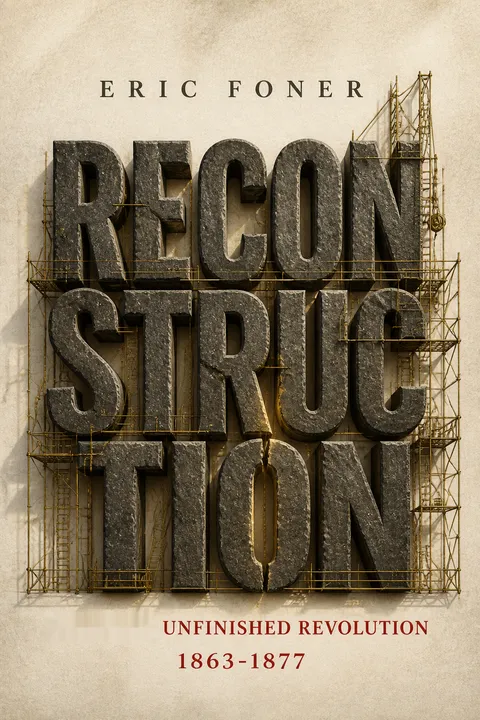
Reconstruction by Eric Foner receives overwhelmingly positive reviews (4.22/5) as the definitive scholarly work on America's Reconstruction era (1863-1877). Readers praise its comprehensive, meticulously researched examination of political, economic, and social dimensions of this transformative period. The book documents freedmen's aspirations, violent white resistance including the KKK, constitutional amendments, and Reconstruction's ultimate failure. While some find it dense and challenging—with suggestions to try Foner's shorter version—most consider it essential reading for understanding American race relations. Critics appreciate Foner's objectivity in revealing how both Northern apathy and Southern terrorism crushed hopes for racial equality, creating repercussions lasting into modern times.
People Also Read





About the Author

Download PDF
Download EPUB
.epub digital book format is ideal for reading ebooks on phones, tablets, and e-readers.








































