
Key Takeaways
1. The Universe is the Only True Word of God
THE WORD OF GOD IS THE CREATION WE BEHOLD: And it is in this word, which no human invention can counterfeit or alter, that God speaketh universally to man.
Divine scripture. Paine asserts that the true and uncorrupted word of God is not found in any written book, but in the vast, observable universe itself. This "creation-scripture" is universally accessible, speaking to all humanity without the need for translation, interpretation, or human intervention. It is an ever-existing original that cannot be forged, counterfeited, lost, altered, or suppressed.
Universal language. Unlike human languages, which are local, changeable, and prone to errors in translation and transcription, the language of the Creation is universal and immutable. It reveals God's attributes directly to every individual, making intermediaries like priests or sacred texts unnecessary.
- Power: Seen in the immensity of creation.
- Wisdom: Evident in the unchangeable order governing the universe.
- Munificence: Manifested in the earth's abundance, even for the unthankful.
Direct knowledge. To truly know God, one should not search printed scriptures, which are human artifacts, but rather the "scripture called the Creation." This direct contemplation of the universe allows man to discover God through reason, recognizing a first cause for all existence, a concept more difficult to disbelieve than to believe.
2. Organized Religions are Human Inventions for Power and Profit
All national institutions of churches, whether Jewish, Christian, or Turkish, appear to me no other than human inventions set up to terrify and enslave mankind, and monopolize power and profit.
Human constructs. Paine argues that all established churches are not divine institutions but rather human inventions designed to control and exploit people. These systems, regardless of their specific creed, serve to terrify and enslave mankind, while simultaneously monopolizing power and profit for their leaders. He explicitly states that his own mind is his own church.
Mental fidelity. True infidelity, according to Paine, is not believing or disbelieving, but rather professing to believe what one does not. This "mental lying" is a profound moral mischief, corrupting the mind and preparing individuals for other crimes, especially when one takes up the "trade of a priest for the sake of gain," beginning with perjury.
Church and state. The historical "adulterous connection of church and state" has suppressed free inquiry into religious principles through "pains and penalties." Paine predicted that a revolution in government would inevitably lead to a revolution in religion, exposing human inventions and priest-craft, allowing humanity to return to a pure belief in one God.
3. "Revelation" is Hearsay, Not Divine Truth
It is revelation to the first person only, and hearsay to every other; and consequently, they are not obliged to believe it.
Limited scope. Paine meticulously defines "revelation" as something communicated immediately from God to a specific person. Crucially, he argues that once this person relays the information to a second person, and so on, it ceases to be revelation for anyone beyond the first recipient. For all subsequent individuals, it is merely hearsay, and they are under no obligation to believe it.
No internal evidence. He applies this principle to foundational religious narratives, demonstrating their lack of verifiable evidence.
- Moses's Commandments: The Israelites were not obliged to believe Moses, as they had only his word. The commandments themselves contain "no internal evidence of divinity."
- Koran: The story of an angel bringing the Koran to Mahomet is "hearsay evidence."
- Virgin Birth: The account of Mary's conception and Joseph's angelic visitation is "hearsay upon hearsay," lacking stronger evidence than mere word.
Contradiction in terms. To call anything received secondhand, whether verbally or in writing, a "revelation" is a "contradiction in terms and ideas." Revelation is inherently limited to the initial, direct communication. Subsequent accounts are merely reports of what someone said was a revelation to them, and thus do not compel belief from others.
4. Christian Theology: A Fable of Absurdity and Contradiction
Putting aside every thing that might excite laughter by its absurdity, or detestation by its prophaneness, and confining ourselves merely to an examination of the parts, it is impossible to conceive a story more derogatory to the Almighty, more inconsistent with his wisdom, more contradictory to his power, than this story is.
Pagan origins. Paine contends that the Christian church's theory emerged from the "tail of the heathen mythology." The idea of a celestially begotten founder, a trinity of gods, and the canonization of saints are direct incorporations or reductions of earlier pagan beliefs and practices. He likens the Christian church, crowded with saints, to the ancient Pantheon.
Satan's triumph. The Christian narrative, particularly the story of Satan, Eve, and the apple, is presented as profoundly illogical and derogatory to God. It depicts Satan as having power equal to or greater than the Almighty, capable of liberating himself from a pit and defeating God's wisdom by stratagem, leading to the damnation of all mankind.
- Satan's power: Liberates himself, becomes omnipresent.
- God's predicament: Forced to surrender creation or capitulate for its redemption.
Inconsistent narrative. The story's inventors, to create a foundation for their system, were forced to deify Satan and then represent God as sacrificing himself due to Eve's apple. Paine finds this narrative utterly inconsistent with God's wisdom and power, suggesting that if the story were reversed (God compelling Satan to suffer), it would be less absurd.
5. Jesus Christ: A Moral Man, Not a Divine Sacrifice
He was a virtuous and an amiable man. The morality that he preached and practised was of the most benevolent kind; and though similar systems of morality had been preached by Confucius, and by some of the Greek philosophers, many years before; by the quakers since; and by many good men in all ages; it has not been exceeded by any.
Human, not divine. Paine distinguishes the historical Jesus from the theological construct of Christ. He acknowledges Jesus as a virtuous and amiable man who preached and practiced a benevolent morality, comparable to that of Confucius or Greek philosophers. However, he emphasizes that Jesus wrote nothing himself; the New Testament accounts are the work of others, written after his death.
No new religion. Jesus, born and living as a Jew, did not found a new religion. His primary message was the practice of moral virtues and belief in one God, with philanthropy as a central trait. Paine points out that Jesus's obscure parentage (born in a stable) and his need for Judas to betray his location suggest he was not widely known or publicly preaching at the time of his apprehension.
Crucifixion's intent. The idea that Christ "came on purpose to die" for the sins of the world is questioned. Paine argues that if death was the sentence for Adam's sin, any form of death would suffice, not specifically crucifixion. Furthermore, Jesus's concealment and apprehension suggest he did not intend to be crucified, contradicting the notion of a pre-ordained sacrifice.
6. The Doctrine of Redemption is Morally Flawed and Illogical
Moral justice cannot take the innocent for the guilty, even if the innocent would offer itself. To suppose justice to do this, is to destroy the principle of its existence, which is the thing itself.
Pecuniary vs. moral justice. Paine dissects the doctrine of redemption, arguing it is founded on a "pecuniary idea" rather than moral justice. He illustrates this with an analogy: a debt can be paid by another, but a crime cannot be atoned for by an innocent substitute. To allow an innocent person to suffer for the guilty destroys the very principle of justice, turning it into "indiscriminate revenge."
Quibbles and subterfuge. The Christian system, particularly through figures like St. Paul, employs "quibble, subterfuge and pun" to construct its theology. Paine cites the example of two Adams (one who sins and suffers by proxy, another who sins by proxy and suffers in fact) as an illustration of this intellectual dishonesty, which he believes instructs its followers in similar practices.
Fabricated for profit. Paine suggests that the entire theory of redemption was likely fabricated to justify "secondary and pecuniary redemptions" such as purgatory, pardons, and indulgences, which generate revenue for the church. He questions the church's credibility in asserting the genuineness of its books, given its history of fabricating doctrines and claiming miracles.
7. Mystery, Miracle, and Prophecy are Tools of Deception
Upon the whole, mystery, miracle, and prophecy, are appendages that belong to fabulous and not to true religion. They are the means by which so many Lo heres! and Lo theres! have been spread about the world, and religion been made into a trade.
Mystery: Fog of human invention. Paine argues that while existence itself is a mystery, the word "mystery" cannot apply to moral truth. He defines it as "a fog of human invention, that obscures truth and represents it in distortion." True religion, being a belief in God and the practice of moral truth, must be free from mystery, accessible to all understanding, and learned through reflection on God's works.
Miracle: Equivocal and improbable. Paine challenges the concept of miracles, stating that everything is a miracle in relation to human power, but nothing is a miracle to an almighty power. He points out that many seemingly miraculous events can be explained by natural laws or human art (e.g., lighter-than-air flight, electricity, resuscitation).
- Lack of criterion: No positive criterion exists to define a miracle.
- Degrading God: Supposing God performs "tricks to amuse and make the people stare."
- Less credible than a lie: A real miracle would be as suspect as a falsehood, as it relies on a reporter's credit. It's more probable a man tells a lie than nature goes out of its course.
Prophecy: Useless and misleading. Paine asserts that the original meaning of "prophet" (poet/musician) was changed, making modern prophecy a "creature of modern invention." Prophecies, often obscure poetic flights, are too vague to be reliable and serve no useful purpose even if real. They are easily manipulated by "sectaries, expounders, and commentators" to fit any circumstance, making God appear to "deal in this jesting manner with mankind."
8. Reason is Man's Divine Gift for Discovering God
It is only by the exercise of reason, that man can discover God. Take away that reason, and he would be incapable of understanding any thing; and, in this case, it would be just as consistent to read even the book called the Bible, to a horse as to a man.
The gift of reason. Paine champions reason as the paramount divine gift to humanity, essential for understanding God and the universe. He argues that without reason, man is incapable of comprehension, rendering religious texts as meaningless to him as they would be to an animal. To reject reason in matters of faith is to despise this choicest gift.
Deistical compositions. He identifies certain parts of the Bible, such as chapters in Job and the 19th Psalm, as "true deistical compositions" because they treat of the Deity through his works, referring only to the "book of Creation." These passages, by contemplating God's power and wisdom in the universe, align with his own deistic principles.
Understanding God's attributes. Reason allows man to answer fundamental questions about God:
- Existence: Yes, by observing that nothing makes itself, leading to the conclusion of a superior, eternally existing first cause.
- Perfection: No, because God's power and wisdom manifested in creation are incomprehensible, and this visible manifestation is likely a small display of an immense, multi-world creation.
This rational inquiry, he argues, is the only valid path to theological understanding.
9. The Vastness of the Universe Exposes Religious Narrowness
From whence then could arise the solitary and strange conceit that the Almighty, who had millions of worlds equally dependent on his protection, should quit the care of all the rest, and come to die in our world, because, they say, one man and one woman had eaten an apple.
Cosmic perspective. Paine uses astronomical knowledge to highlight the absurdity of Christian theology. He describes the immense scale of the solar system and the countless "fixed stars," each likely a sun with its own system of worlds. This vastness makes the Christian narrative, centered on a single, small earth and a singular act of redemption for an apple, appear "little and ridiculous."
Plurality of worlds. The belief in a plurality of worlds, familiar to the ancients and confirmed by scientific discovery, directly contradicts the Christian system's implicit assumption of Earth as the sole habitable creation. Paine argues that these two beliefs cannot coexist in the same mind, as the cosmic scale renders the idea of God abandoning millions of worlds to die for one apple on ours utterly inconceivable.
Benefits of multiple worlds. The Creator, in making a plurality of worlds, did so for the benefit of man. The revolutionary motions of these celestial bodies provide a universal "school of science," from which all scientific knowledge and mechanical arts are derived. Had all matter been blended into one globe, this crucial source of knowledge, essential for human comfort and felicity, would not exist.
10. Christianity Suppressed Science and True Learning
It is an inconsistency, scarcely possible to be credited, that any thing should exist under the name of a religion, that held it to be irreligious to study and contemplate the structure of the universe that God had made.
Age of ignorance. Paine asserts that the "age of ignorance commenced with the Christian system," leading to a long "interregnum of science." He argues that the church, fearing that scientific knowledge would expose the falsity of its doctrines, actively suppressed the study of science and persecuted its practitioners.
- Galileo: Sentenced to renounce his discoveries (telescope, heavenly motions) as "damnable heresy."
- Vigilius: Condemned to be burned for asserting the antipodes (Earth is a globe).
Redefining learning. The Christian system deliberately "cut learning down to a size less dangerous to their project" by restricting it to the "dead study of dead languages." True learning, Paine argues, consists not in knowing languages, but in knowing "things to which language gives names," as practiced by the ancient Greeks who focused on science and philosophy.
Principles of science. Scientific principles, such as those of trigonometry, astronomy, and geometry, are not human inventions but eternal and immutable truths discovered by man through studying the universe. These principles, like the laws governing heavenly bodies, have a divine origin. The church's opposition to science was a "fraud" to maintain its fabricated system against the undeniable evidence of God's works.
11. Deism: The Simple, Universal Religion of Nature
The true deist has but one Deity; and his religion consists in contemplating the power, wisdom, and benignity of the Deity in his works, and in endeavouring to imitate him in every thing moral, scientifical, and mechanical.
Pure and simple. Paine advocates for Deism as the true, universal religion, free from the "fabulous" appendages of mystery, miracle, and prophecy. A Deist believes in one God and finds religious duty in doing justice, loving mercy, and making fellow creatures happy. This simple creed avoids the complex, contradictory, and often cruel narratives of established churches.
Moral imitation. Deism encourages man to contemplate God's attributes in the creation and to imitate His moral goodness and beneficence towards all creatures. This means practicing kindness, avoiding persecution and revenge, and showing compassion to animals. It rejects the self-abasing humility often promoted by Christian systems, which Paine sees as ingratitude for the gift of reason.
Universal agreement. Paine observes that all nations and religions agree on one point: belief in a God. Their disagreements arise from the "redundancies annexed to that belief." Therefore, a future universal religion will not introduce anything new, but rather shed these redundancies, returning to the fundamental belief in God as revealed through His creation, as "man believed at first."
Review Summary
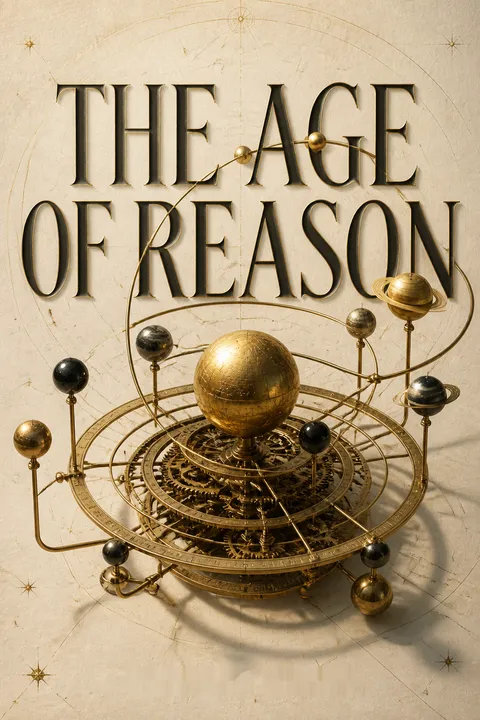
The Age of Reason by Thomas Paine is a deist critique of Christianity and the Bible, written in 1794-95. Paine systematically exposes contradictions and inconsistencies in biblical texts while arguing that God reveals himself through nature and reason, not scripture. Readers praise his rational analysis, courage, and wit, though his writing can be tedious when meticulously dissecting biblical passages. The book made Paine a social pariah despite his role in the American Revolution. Modern readers appreciate its historical significance and relevance to church-state separation debates.
People Also Read


About the Author
Download PDF
Download EPUB
.epub digital book format is ideal for reading ebooks on phones, tablets, and e-readers.








































