

Key Takeaways
Students fail not from low intelligence but from missing strategies
The comeback kids reveal the pattern. Miriam scored 37.5% on her first calculus exam, then 83% and 93%. Robert went from 42% to three consecutive 100%s in chemistry. An entire Advanced Placement physics class in rural Louisiana jumped from a 66.9% average to 95.6% after one strategy session. Nothing changed about these students' brains between the failing grade and the perfect one. They simply learned how to learn.
The premise flips the deficit model. McGuire, a chemistry professor of over four decades, argues that what students do in college matters more than who they are or which school they attend. The so-called slow students are not less capable. They are operating without an arsenal of learning tools that top students absorbed, often unconsciously, years earlier.
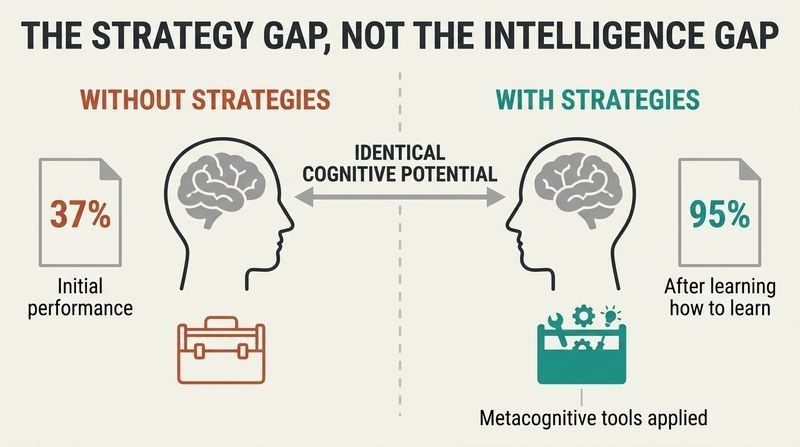
What's striking is how this reframes educational equity. If performance gaps reflect strategy gaps rather than fixed ability, then intervention becomes a matter of transmission, not selection. This aligns with Anders Ericsson's deliberate practice research and Carol Dweck's mindset work, both of which decouple achievement from innate talent. The caution worth naming: single-session transformations make compelling anecdotes but invite survivorship bias. The students who email back with success stories are self-selected. Rigorous controlled studies remain thin, as McGuire honestly concedes. Still, the mechanism is plausible and the downside of teaching strategies is essentially zero, which makes the wager asymmetric and worth taking.
Most students arrive never having needed to actually study
High school rewarded memorization, not learning. A national survey found nearly 59% of incoming freshmen spent fewer than six hours a week on homework in twelfth grade, yet almost 97% graduated with an A or B average. Over 72% believed their academic ability was above average. Many teachers spend the class before a test revealing the exact questions and answers, so students learn that reviewing given material the night before is all success requires.
Disengaged students are behaving rationally. McGuire stopped seeing bored, absent students as lazy and started seeing them as good scientists. They collected data in high school showing that minimal effort produced top grades, then logically applied that same strategy in college. Warnings that college is harder fall flat because students heard identical warnings before every prior transition that turned out easy.
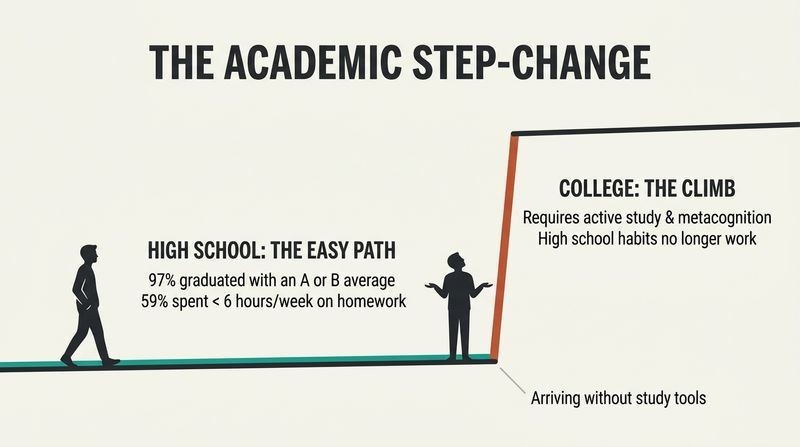
The good scientist reframe is genuinely humane and pedagogically useful. It replaces contempt with curiosity, which changes how an instructor engages a struggling student. The behavioral economics parallel is clear: people optimize against the incentive structure they actually face, not the one educators wish existed. There is a systemic indictment buried here too. High-stakes testing pressures teachers to feed answers, inadvertently training students out of independent learning. One nuance: not every disengaged student is a rational optimizer. Some face genuine barriers of trauma, poverty, or undiagnosed learning differences. The strategy fix is necessary but rarely sufficient on its own for that subset.
Think about your own thinking to teach yourself anything
Metacognition is the master key. Coined by psychologist John Flavell, it means being consciously aware of yourself as a problem solver: monitoring, planning, and controlling your mental processes, and accurately judging how deeply you have learned something. McGuire describes it as having a big brain outside your brain watching what your brain does. The crucial skill is asking, mid-study, am I actually understanding this or just recognizing it?
A vowel-counting exercise proves the point. McGuire has people count vowels in a list of fifteen phrases, then surprises them by asking them to recall the phrases. Average recall: about 20%, a failing grade. Then she reveals the list is secretly organized by number (dollar bill equals one, dice equals two, tricycle equals three). Given the goal and the organizing structure, recall jumps to roughly 80%. Same brains, better tools.
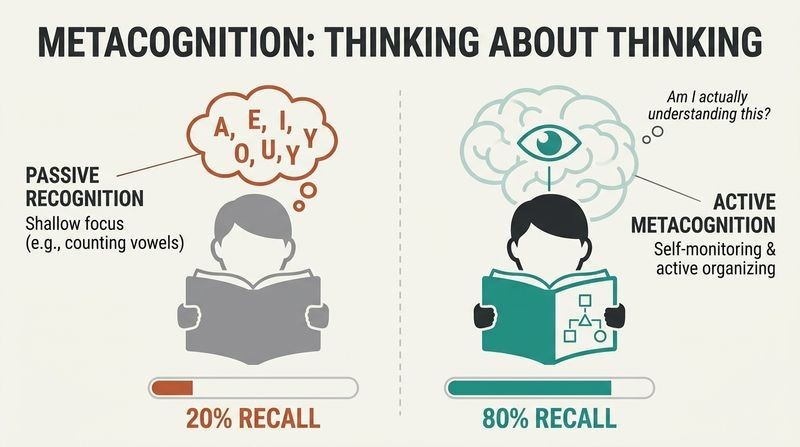
The vowel exercise elegantly isolates two variables that drive learning: knowing your actual goal and having a structure that connects new information to what you already know. Cognitive science supports both. Encoding specificity and the generation effect show that material tied to existing schemas and actively processed sticks far better than passively scanned text. What metacognition adds is the self-monitoring loop, closely related to what researchers call comprehension calibration. Students are notoriously overconfident, mistaking familiarity for mastery, which is why rereading feels productive but rarely is. The practical genius is making an invisible mental habit explicit and teachable rather than assuming students figure it out alone.
Climb Bloom's ladder: college demands analysis, not just memorizing
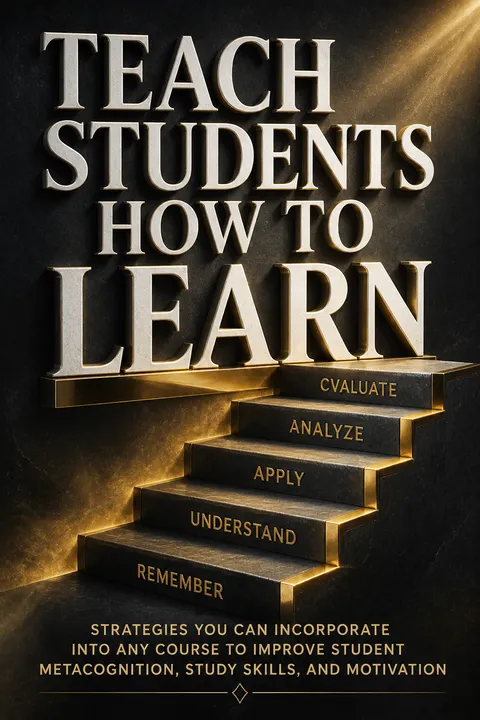
Bloom's Taxonomy names the leap students must make. It is a hierarchy of cognitive levels: remembering, understanding, applying, analyzing, evaluating, and creating. Most students earned high school A's operating at the bottom two rungs, memorizing and paraphrasing. College demands the top rungs. When McGuire teaches this to 250 chemistry students and asks where they had operated versus where they need to operate, the lightbulb goes on visibly.
Two questions prime the shift. First, what is the difference between studying and learning? Students volunteer that studying is renting information for the test, then falling behind on payments so it gets repossessed. Second, would you work harder to ace a test or to teach the material to the class? Nearly everyone says teach, because teaching forces you to anticipate questions and explain concepts multiple ways. That gap defines the target.
Bloom's is nearly seventy years old and ubiquitous in curriculum design, yet McGuire's insight is that it belongs in students' hands, not just instructors'. Giving learners the vocabulary to diagnose their own cognitive level is a quietly radical move. The teach-it-to-learn-it principle has robust empirical backing: the protege effect shows students who prepare to teach, or actually tutor, learn material more deeply than those studying for a test. Some cognitive scientists dispute Bloom's strict hierarchy, noting creation can precede mastery and levels intertwine. McGuire concedes this but keeps the pyramid because it makes vivid the dependency of higher thinking on foundational knowledge, which counters the everything-is-Googleable fallacy.
Cycle through preview, class, review, intense sessions, and self-assessment
The Study Cycle structures a whole learning routine. Five steps: preview the reading before class, attend class as an active participant, review notes soon after, run focused intense study sessions, and assess your mastery. Previewing takes about ten minutes and gives the brain a skeleton on which to hang the lecture. Reviewing right after class is like watching a movie a second time and noticing what you missed.
Intense study sessions break work into chunks. A session runs roughly 50 minutes: a few minutes setting specific goals, 30 to 50 minutes of active learning, a 10 to 15 minute break, then five minutes of review. Breaks matter neurologically because new neural connections need time to consolidate and tired brains make errors. Doing several sessions daily quietly builds 20 to 25 study hours a week, up from the typical five or six.
The Study Cycle repackages well-validated principles into a memorable routine. Previewing exploits the advance-organizer effect that David Ausubel documented in the 1960s. The intense session mirrors the Pomodoro technique and respects the roughly ten-minute attention ceiling John Medina popularized. The break-for-consolidation claim connects to memory research on synaptic stabilization and the spacing effect. What the framework does well is convert vague advice like study more into a concrete, schedulable behavior with built-in reward structure. The honest limitation is adherence. Students resist because it front-loads effort, and the payoff is delayed, which is precisely why McGuire pairs it with motivation strategies rather than presenting it in isolation.
Do homework like a test, never copying from worked examples
This single change turned around the most students. McGuire found that struggling STEM students almost universally do homework by flipping to a solved example and mimicking its steps. That produces finished assignments and zero learning. The fix: study the material first, then attempt each problem cold, checking only the final answer. If wrong, investigate why before peeking at the solution. Dana, a physics major on the verge of quitting after a 54, used this and scored 91, 97, and 90.
Mistakes made now are mistakes not made on the test. Students told McGuire that errors during homework are good: you learn from them, you find where your mind goes wrong, and you lose no points. Practicing problem-solving without a model trains the brain for exactly what it faces on exam day, when no example is available. She also urges starting with easy problems to build confidence before tackling harder ones.
This is arguably the book's most transferable tactic, and it rests on solid ground. The testing effect, documented by Roediger and Karpicke, shows retrieval practice dramatically outperforms restudying. Copying an example is restudying in disguise; solving cold is retrieval. There is also a desirable-difficulties dimension, Robert Bjork's term for how struggle that feels unproductive actually strengthens durable learning. The reframing of mistakes as diagnostic data rather than failure connects directly to growth mindset. One practical friction: online homework systems that offer instant hints and unlimited attempts quietly sabotage this, letting students complete assignments without the productive struggle that makes the practice valuable.
Grades reflect behavior you control, not intelligence you were born with
Mindset determines whether strategies get used. Drawing on Carol Dweck, McGuire distinguishes a fixed mindset (intelligence is a fixed hand of cards) from a growth mindset (you can grow your intelligence through effort). Students with fixed mindsets avoid challenges, quit easily, and read a bad grade as proof of permanent inadequacy, saying things like maybe I was high-school smart but not college smart. No strategy helps a student convinced the situation is hopeless.
Culture and labels manufacture fixed mindsets. A study of American versus Asian mothers found American mothers rated innate ability more important and effort less important, and their children absorbed the same belief. Classroom labels do it too: the blue group and green group of first grade calcify into lifelong self-concepts. When a teacher's note told students the critical feedback reflected high standards and belief in their potential, 80% revised their essays versus 39% given feedback alone.
Dweck's mindset construct has faced replication scrutiny, with some large studies finding small average effects. But the nuance matters: mindset interventions show the strongest benefit precisely for the population McGuire targets, lower-achieving and at-risk students facing academic threat. The essay-feedback study captures something powerful about attribution. When students believe criticism signals investment rather than judgment, they engage. This intersects with stereotype-threat research by Claude Steele, where fear of confirming a negative label depresses performance. The actionable core, attributing outcomes to controllable behavior rather than fixed traits, is the durable takeaway regardless of how the effect-size debates resolve. Belief is upstream of effort, and effort is upstream of strategy use.
Fear floods the brain with cortisol and blocks memory retrieval
Emotions are not separate from learning. The amygdala processes emotion; the hippocampus consolidates facts into long-term memory. Under stress, adrenal glands release cortisol, and because the hippocampus is dense with cortisol receptors, too much of it impairs the very memory-formation and retrieval that exams require. In plain terms: anxiety can lock up information a student genuinely knows.
Motivation runs on a cycle. When students succeed, they feel good, which motivates more effort, which produces more success. Three levers drive motivation: whether students value the goal, whether the environment feels supportive, and whether they believe they can succeed. One study found an instructor's attitude accounted for 27% of students' positive motivation and 32% of their negative motivation. A professor announcing look to your left and right, some of you will be gone, actively demoralizes; expressed belief that everyone can excel does the opposite.
The neurophysiology here is simplified but directionally sound, and useful precisely because it takes anxiety out of the realm of character weakness and into biology. Athletes and performers intuitively grasp that panic degrades performance; framing academic test anxiety the same way de-stigmatizes it. The Yerkes-Dodson curve adds nuance the summary omits: some arousal aids performance, and only excessive stress impairs it. The instructor-attitude statistics are worth dwelling on because they locate substantial power in something free and immediate, namely how a teacher frames expectations. Simple interventions like deep breathing and guided relaxation are low-cost, evidence-supported buffers, though they treat symptoms rather than the structural stressors of overloaded, underfunded student lives.
Assign learning strategies after the first bombed exam, not before
Timing is everything for buy-in. McGuire insists on delivering her 50-minute strategy session only after students receive their first test or quiz results. Present it on day one and students tune out, confident they will ace the course as always. Wait until reality delivers a splash of cold water and they become receptive to changing behavior. She also does not announce the session in advance, because students who did poorly would skip a class labeled study skills.
Language and framing carry the message. Students recoil at study skills, believing they already have them, but lean in at metacognitive learning strategies because it sounds new. McGuire opens sessions by connecting strategies to students' career goals, shows before-and-after miracle scores to build belief, and ends by extracting a written commitment to one specific strategy. If they do not start within 48 hours, she warns, they probably never will.
This is behavior-change design as much as pedagogy, and it echoes the transtheoretical model of change: people act only when they reach the contemplation stage, which the failing grade triggers. Selling a solution before the audience feels the problem wastes the message. The branding insight, swapping study skills for metacognitive learning strategies, is pure marketing psychology and slightly uncomfortable for that reason, but effective. The 48-hour commitment leverages implementation-intention research by Peter Gollwitzer, showing that specifying when and how you will act sharply increases follow-through. The subtle risk is manipulation creep. Still, using framing to get students to try genuinely beneficial behaviors is defensible influence, not deception.
Buy the textbook: lecture notes are the C T version of CAT
Notes are compressed; textbooks fill the gaps. McGuire flashes C T and asks what word you see: cat, cot, cut. If you know something well, missing pieces auto-complete in your mind. That is exactly why instructors reading their own sparse lecture notes see complete concepts while students see gibberish. The textbook, with its charts, diagrams, and worked problems, supplies the letters students' brains cannot fill in themselves.
Many students never learned to use a book. One student could not define entropy with the textbook sitting right in front of her; she did not know a textbook had an index or table of contents. McGuire pushes back hard against professors who tell students everything is in the notes, and offers doubters a personal check for the difference if the book proves useless after two weeks. She has never had to write one.
The C_T demonstration is a compact, memorable illustration of the curse of knowledge, the cognitive bias where experts cannot model what novices lack. It explains a common classroom mystery: students swear a test covered material never presented, while the instructor swears it was. Both are right, because expert and novice literally perceive different information from the same slides. The finding that some students arrive without knowing how to navigate a book is a sobering reminder that foundational academic literacies cannot be assumed. In an era of open educational resources and rising textbook costs, the prescription needs updating, but the underlying point about needing richer material than compressed notes holds.
Unprepared students can close the gap with specificity and high expectations
Preparation gaps are not destiny. McGuire tells of Charles, a math major who flunked out of Louisiana State twice, once while driving eight hours round-trip every weekend as his father died of cancer. Readmitted with strategy support, he earned a 4.0 that summer and graduated to become a math teacher. Minority-serving institutions like Xavier University routinely take students with modest test scores and send them to top graduate schools by meeting them where they are.
Six tactics work best in tandem for the underprepared. Set clear high expectations, interweave frequent testing with teaching, teach the basic vocabulary and skills they lack, deliver the metacognition session, make responsibility explicit, and stay personally connected. The through-line: challenge students hard while communicating unwavering faith they can meet the challenge. Scolding paralyzes; belief plus concrete tools mobilizes.
The Charles story guards against a real danger in strategy-focused pedagogy: treating learning technique as a cure-all while ignoring the material and emotional crises that derail students. His failures were entangled with grief and eight-hour drives, not just study habits. The institutional evidence from Xavier is compelling because it is systemic rather than anecdotal, pointing to programs like structured summer bridges and analytical-reasoning instruction. Sociologists of education would add that meeting students where they are must not slide into lowered expectations, a documented harm. McGuire threads this well by pairing high standards with high support, the combination that research on wise feedback and warm demander teaching consistently identifies as most effective for marginalized learners.
One 50-minute session can lift a whole class's average
Group interventions scale the miracle. At Louisiana State, chemistry students who attended a single strategy lecture averaged 81.5 in the course versus 72.6 for non-attendees. At East Tennessee State, a professor delivering his own version saw exam averages rise to the high 70s in the intervention semester versus barely 70 in prior years, a statistically significant jump. An engineering professor's class rose from a 65.7 average on exam two to 80.5 on exam three after the session.
The results are not McGuire's personal magic. Different professors, disciplines, and campuses reproduced the effect, which was her whole point in publishing. She is candid that these are not flawless double-blind studies, partly for ethical reasons: she refuses to withhold strategies from a control group when she has seen them determine whether a student reaches medical school. She invites others to run larger, more rigorous trials.
The scalability claim is the book's boldest and most consequential. If a single free session reliably moves class averages, the cost-benefit ratio for higher education is extraordinary. The evidence is suggestive rather than conclusive, and McGuire admirably flags the confounds: self-selection of attendees, non-random assignment, and modest sample sizes. Her ethical objection to control groups is principled but scientifically limiting, since it precludes the very designs that would convince skeptics. A middle path exists, such as waitlist or stepped-wedge designs that eventually give everyone the intervention while preserving comparison. The reproducibility across instructors is the strongest signal, because it argues the effect lives in the content, not the charisma.
Analysis
Teach Students How to Learn belongs to a practical pedagogy tradition, but its structure is unusual: part memoir, part how-to manual, part evidence brief, all organized around three M's, namely metacognition, mindset, and motivation. McGuire's central thesis is disarmingly simple and quietly subversive. The achievement gaps educators attribute to intelligence or preparation are largely gaps in learning strategy, and strategy is teachable in less time than most faculty imagine. This reframes the professor's job from gatekeeper to transmitter and relocates agency to students who previously believed themselves fixed in ability.
The book's intellectual center of gravity sits at the intersection of three well-established research programs: Flavell's metacognition, Dweck's mindset, and the testing effect from Roediger and Karpicke. McGuire's contribution is less theoretical than integrative and translational. She converts abstract cognitive science into concrete classroom moves, the Study Cycle, homework-as-assessment, the timing of interventions after the first failure, that ordinary instructors can deploy Monday morning. This translational work is genuinely valuable because the gap between what learning science knows and what classrooms practice remains vast. The evidentiary posture deserves scrutiny. McGuire is refreshingly honest that her data are associational, not causal, and that her refusal to withhold treatment from control groups precludes gold-standard trials. The dramatic before-and-after anecdotes are vulnerable to selection bias and regression to the mean, a point she half-acknowledges when noting she expected statistical regression from a student's improved score. Yet the multi-site, multi-instructor reproducibility is a meaningful signal, and the asymmetry of the wager, near-zero cost against potentially large benefit, makes adoption rational even under evidentiary uncertainty.
The deepest and most humane move is the good scientist reframe: disengaged students are not lazy but rationally optimizing against the incentives high school taught them. That single perceptual shift, from contempt to curiosity, may do more good than any specific technique in the book, because it changes how educators see the humans in front of them.
Review Summary
Teach Students How to Learn receives mostly positive reviews, with an average rating of 4.18/5. Readers appreciate the practical strategies for improving student metacognition and study skills. Many find the book engaging and valuable for both educators and students. Some criticisms include repetitiveness, dry writing style, and a focus on traditional teaching models. Overall, reviewers praise the book's emphasis on helping students develop effective learning strategies and its potential to improve academic performance.
People Also Read








Glossary
Metacognition
Thinking about your own thinkingA term coined by psychologist John Flavell meaning awareness and control of one's own thought processes. It includes monitoring, planning, and regulating how you think, and accurately judging how deeply you have learned something, distinguishing genuine understanding from mere familiarity. McGuire treats it as the master skill enabling students to teach themselves rather than depend on others.
The Study Cycle
Five-step recurring learning routineA learning system with five steps: preview material before class, attend class actively, review notes soon after, complete focused intense study sessions, and assess mastery. Based on Frank Christ's Learning Cycle and developed at Louisiana State's Center for Academic Success, it structures the full arc of engaging with course material rather than cramming.
Intense Study Session
Focused chunked study blockA study block of roughly 50 minutes with four parts: set specific goals, do active learning tasks for 30 to 50 minutes, take a 10 to 15 minute break, then review. Breaks allow neural consolidation. Doing several daily builds 20 to 25 study hours weekly. Also nicknamed the Power Hour.
Bloom's Taxonomy
Hierarchy of cognitive learning levelsA framework classifying thinking into ascending levels: remembering, understanding, applying, analyzing, evaluating, and creating (in the revised version). McGuire teaches it directly to students so they recognize that high school rewarded the lower levels while college demands the higher ones, giving them vocabulary to diagnose and elevate their own cognitive work.
Make-an-A versus teach-the-material mode
Two levels of study effortMcGuire's contrast between preparing merely to pass a test versus preparing as if you must teach the content to a class. Teaching mode forces anticipation of questions and multiple explanations, driving deeper mastery. Asking students which task they would work harder for exposes that they have been studying superficially.
Fixed versus growth mindset
Beliefs about whether intelligence changesFrom Carol Dweck: a fixed mindset holds intelligence as innate and unchangeable, causing people to avoid challenge and read failure as permanent. A growth mindset holds that intelligence expands through effort, encouraging persistence and treating errors as learning steps. McGuire argues mindset determines whether students bother to apply learning strategies at all.
Miracle portfolio
Collection of dramatic score turnaroundsMcGuire's term for a documented set of students' before-and-after exam scores showing rapid, dramatic improvement after learning metacognitive strategies. She shows these to new students to inspire belief that their first-test performance does not predict their ceiling, making them receptive to trying the strategies.
C_T demonstration
Why textbooks beat lecture notesAn exercise where McGuire shows the letters C_T and notes people instantly fill in cat, cot, or cut because they know the words. It illustrates that instructors mentally complete their sparse lecture notes while novice students cannot, proving students need the fuller textbook to supply the missing conceptual pieces.
FAQ
What's Teach Students How to Learn about?
- Focus on Learning Strategies: The book emphasizes teaching students effective learning strategies to enhance their metacognition, study skills, and motivation. It provides practical, research-based methods applicable across various disciplines.
- Three Key Ms: Saundra Yancy McGuire focuses on mindset, motivation, and metacognition, which are crucial for student success in higher education.
- Transformative Approach: McGuire shares her journey from a traditional instructor to an academic transformer, illustrating how teaching students how to learn can lead to significant improvements in their academic performance.
Why should I read Teach Students How to Learn?
- Practical Application: The book is filled with actionable strategies that educators can implement immediately to improve student learning outcomes.
- Research-Based Insights: Grounded in solid educational research, it is a credible resource for understanding how students learn and how to facilitate that process effectively.
- Empowerment for Educators: It empowers educators to take responsibility for student learning by providing them with the tools to teach students how to learn, rather than just delivering content.
What are the key takeaways of Teach Students How to Learn?
- Metacognition is Essential: Understanding metacognition—thinking about one’s own thinking—is crucial for students to become independent learners.
- Mindset Matters: The book discusses the importance of fostering a growth mindset in students, encouraging them to believe that their intelligence can be developed through effort and effective strategies.
- Practical Strategies: McGuire provides specific strategies for both students and instructors, including the study cycle, active reading techniques, and the importance of teaching material to others.
What are the best quotes from Teach Students How to Learn and what do they mean?
- “If you teach students how to learn...”: This quote encapsulates the book's core message that effective teaching involves equipping students with the skills to learn independently.
- “Your grades are not based on how smart you are...”: This emphasizes the importance of effort and strategy over innate ability, reinforcing the growth mindset concept.
- “Mistakes are good.”: This quote highlights the value of learning from errors, encouraging students to view mistakes as opportunities for growth rather than failures.
What is metacognition, and why is it important in Teach Students How to Learn?
- Definition of Metacognition: Metacognition refers to the awareness and understanding of one’s own thought processes, involving self-regulation and reflection on how one learns.
- Empowerment Through Awareness: By teaching metacognitive strategies, students learn to monitor their understanding and adjust their learning strategies accordingly.
- Connection to Learning: The book illustrates how metacognition helps students become proactive learners, enabling them to take control of their educational journey.
How does Teach Students How to Learn suggest improving student motivation?
- Understanding Motivation: The book defines motivation as the personal investment an individual has in reaching a desired outcome, emphasizing the need for students to find value in their learning goals.
- Creating a Supportive Environment: McGuire suggests that faculty can boost motivation by fostering a supportive classroom atmosphere where students feel encouraged and capable of succeeding.
- Strategies for Faculty: The book provides specific strategies for faculty to enhance student motivation, such as setting clear expectations and using engaging teaching methods.
What are the specific strategies for teaching metacognitive learning strategies in Teach Students How to Learn?
- Study Cycle: McGuire introduces the study cycle, which includes steps like previewing material, attending class, reviewing notes, and self-assessing understanding.
- Active Reading Techniques: Strategies for active reading include previewing texts, generating questions, and paraphrasing content to enhance comprehension and retention.
- Teaching to Others: One effective strategy is having students teach the material to peers, which reinforces their understanding and highlights gaps in their knowledge.
How can I apply the concepts from Teach Students How to Learn in my classroom?
- Implement Learning Strategies: Integrate the metacognitive strategies discussed in the book into your teaching practices, such as the study cycle and active reading techniques.
- Foster a Growth Mindset: Encourage students to adopt a growth mindset by sharing success stories and emphasizing that effort and strategy are key to academic success.
- Create a Supportive Environment: Establish a classroom culture that values mistakes as learning opportunities and promotes collaboration among students.
What role does mindset play in student success according to Teach Students How to Learn?
- Growth vs. Fixed Mindset: The book discusses Carol Dweck’s research on mindsets, explaining that students with a growth mindset are more likely to embrace challenges.
- Impact on Performance: A positive mindset can lead to increased motivation and better academic performance, as students believe in their ability to improve.
- Strategies for Change: McGuire provides strategies for educators to help students shift from a fixed mindset to a growth mindset, enhancing their learning outcomes.
What are some effective learning strategies mentioned in Teach Students How to Learn?
- Active Reading Techniques: The book suggests previewing material, developing questions before reading, and paraphrasing information to enhance comprehension.
- Homework Without Examples: Students are encouraged to attempt homework problems without looking at examples first, fostering problem-solving skills.
- Intense Study Sessions: The author advocates for structured study sessions that include breaks and focused goals, improving retention and understanding.
How does the author define metacognition in Teach Students How to Learn?
- Thinking About Thinking: Metacognition is described as the awareness and understanding of one’s own thought processes, involving self-regulation and reflection.
- Self-Assessment: The book emphasizes the importance of self-assessment in learning, encouraging students to evaluate their understanding.
- Impact on Learning: Developing metacognitive skills helps students become more effective learners, as they learn to identify what works best for them.
How does Teach Students How to Learn address the issue of educational equity?
- Equity in Learning: McGuire emphasizes that all students, regardless of their background, can succeed if they are taught how to learn effectively.
- Strategies for Underprepared Students: The book provides specific strategies for helping underprepared students develop the skills they need to thrive academically.
- Empowerment Through Education: By focusing on teaching students how to learn, educators can help bridge the gap in educational equity.
About the Author
Other books by Saundra Yancy McGuire

Download PDF
Download EPUB
.epub digital book format is ideal for reading ebooks on phones, tablets, and e-readers.








































