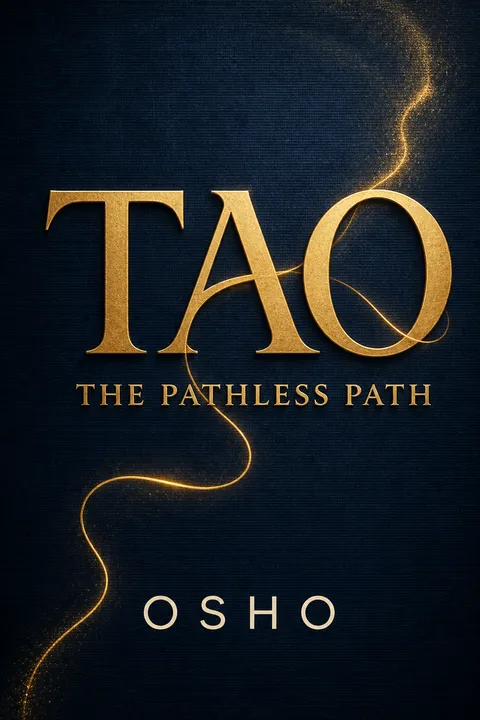
Key Takeaways
1. Tao is the ultimate synthesis of all dualities
Tao means transcendence – transcendence of all duality, transcendence of all polarity transcendence of all opposites.
Transcendence of opposites. Tao is the ultimate synthesis where all contradictions—man and woman, positive and negative, life and death—dissolve into a singular, harmonious whole. It is not a compromise between polarities, but a complete rise above them into a state of absolute stillness. When you stop choosing one side over the other, you enter a state of non-duality.
Beyond the mind. The human mind naturally functions through division, categorizing everything into neat, opposing boxes. To experience Tao, one must step out of this binary trap and realize that the opposites are merely two sides of the same coin. The mind cannot comprehend this synthesis because its very existence depends on division.
The unified field. When you transcend the polarity, you realize that everything is interconnected and part of the same cosmic energy.
- Day and night are not enemies, but two sides of the same cycle.
- Life and death are two breaths of the same existence.
- The observer and the observed merge into one.
2. The feminine principle (Yin) is the gateway to the transcendental
Nothing happens without the woman. The energy of the woman is the ladder of the lowest and of the highest, of the darkest valley and of the lightest peak.
The passive ladder. The feminine principle, or Yin, represents receptivity, passivity, and deep love. It acts as a bridge or a ladder; through it, one can descend into the darkest depths of the unconscious or ascend to the highest peaks of superconsciousness. The highest enters through the woman, just as the lowest does.
Aggression versus receptivity. The masculine energy (Yang) is aggressive, ambitious, and politically oriented, constantly trying to conquer and rape nature. In contrast, the feminine energy is religious, poetic, and artistic, playing with nature in deep harmony rather than trying to dominate it. The West has used male energy too much, losing its balance, while the East has lived through the moon principle.
The path of surrender. To reach the ultimate truth, one must first drop the aggressive masculine drive and move into the receptive feminine space.
- Science is born of masculine, aggressive energy.
- Art, poetry, and meditation are born of feminine, receptive energy.
- The ultimate sage becomes soft, round, and completely passive.
3. True transformation requires the utter destruction of the ego
I am not here to improve upon you; if the base remains wrong all improvement is going to lead you into more and more trouble.
Ego-decoration vs. death. Most seekers come to a Master looking for self-improvement, which is merely a way to decorate and strengthen the ego. True transformation, however, is a radical revolution that demands the complete death of the old self so that the new can be born. If the base remains wrong, all improvement is going to lead you into more and more trouble.
The Master's hammer. The Master functions as a sword or a thousand-pound sledgehammer, designed to shatter your illusions and behead your ego. This process is painful and arduous, but it is the only way to create a clean slate for the divine to enter. The Master is not here to console you, but to destroy you.
The leap of sannyas. Sannyas is not a reform program; it is a total jump into the unknown.
- Improvement keeps you continuous with your past.
- Transformation creates a sharp, absolute discontinuity.
- The ego seeks to accumulate; the soul seeks to empty itself.
4. Real knowledge is an inner awakening, not an accumulation of information
To be in reality a man has to get out of his mind, a man has to become a no-mind.
The weight of the past. Memory is a dead weight that constantly pulls us backward, preventing us from experiencing the fresh, living reality of the present moment. When your eyes are clouded by the past, you become blind to the immediate truth of what is happening right now. To be in reality, a man has to get out of his mind and become a no-mind.
The beauty of forgetfulness. To "lose your memory" in the Taoist sense means to drop the psychological past and become like a child again. It is not absent-mindedness, but a state of intense presence of mind where you respond to life like a clean mirror. When there is no memory, the mirror is simply clear, and the reflection is total.
The sweet taste of life. Even when surrounded by death and the ticking of time, the present moment offers the sweet taste of honey.
- The past is a dead memory; the future is a projected fantasy.
- No-mind allows you to respond authentically to unique situations.
- Forgetting the non-essential is the key to remembering your true self.
5. The fundamental rule of Tao is absolute non-interference (Wu-Wei)
The very idea that the world can be made better is the very root of all ego trips.
The trap of doing. The moment you try to improve, change, or reform the world, you bring your egoistic mind into play and create mischief. Tao is a state of total acceptance (Tathata), where things are left untouched, exactly as they are, without any judgment of right or wrong. The very idea that the world can be made better is the very root of all ego trips.
The madness of moralists. Moralists and do-gooders are the most dangerous people because they try to force their own rigid structures onto the spontaneous flow of life. True non-violence is not just refraining from physical harm, but completely dropping the desire to manipulate others. A man of real understanding is neutral, like the sun that shines on both the dunghill and the diamond.
Living in suchness. When you stop judging and comparing, the concepts of normal and abnormal completely disappear.
- The crowd's "normality" is actually a shared, collective sickness.
- Each individual is uniquely incomparable, like trees in a forest.
- Non-interference allows the natural rhythm of the universe to function.
6. To live in the present is to live in a state of non-seeking
To live in insecurity is to live the life of Tao... To live means to live dangerously; to live means to remain available to all possibilities.
The loss of control. Spontaneity means you are no longer the manager of your life; you have surrendered your control to the whole. This makes the future completely unpredictable and leaves you vulnerable, which is why the ego perceives spontaneity as a great danger. To live means to live dangerously and remain available to all possibilities.
The security of the grave. People who are too afraid of danger build a secure, comfortable grave of habits and rules around themselves. They feel protected, but they are actually dead to the dynamic, flowing river of life. A predictable life is mechanical and stagnant, while an unpredictable life is vibrant and pulsating.
The mirror of relationship. Relationship is the ultimate testing ground for spontaneity because it acts as a mirror to reveal your hidden ugliness and beauty.
- A predictable life is mechanical and stagnant.
- An unpredictable life is vibrant, pulsating, and alive.
- True silence is found in the very eye of the cyclone, not away from it.
7. Morality is a mechanical imposition, while religion is an organic growth
Morality is mechanical, religion is organic. Morality is put together from the outside, religion grows from the innermost core of your being.
The assembled life. Morality is like a machine; it is put together from the outside through social conditioning, rules, and commandments. It creates a split, hypocritical personality where you pretend to be good on the outside while boiling with repressed negativity on the inside. A moral man has to manage his honesty continuously because the dishonesty is still there, repressed.
The flowering of consciousness. Religion, or Tao, is like a tree; it grows naturally from your own inner center of awareness. A religious man does not follow a dead code of conduct or a fixed character; he simply responds to each moment out of his pure consciousness. He has no principles, only awareness.
The freedom of no-character. Having a fixed character means you are predictable and mechanical, whereas having consciousness means you are fluid and free.
- Morality is relative and comparative; religion is absolute and whole.
- The moral man lives at the minimum; the religious man lives at the optimum.
- A moral man has a conscience; a religious man has consciousness.
8. Authentic conflict is far superior to a false, compromised harmony
To compromise is to poison your being. Never compromise. It is better to die than to compromise.
The poison of compromise. Many people constantly give in and compromise their truth just to maintain a superficial, outer harmony. This false harmony is a slow poison that suffocates your soul and makes your entire life inauthentic and mechanical. To compromise is to poison your being; it is better to die than to compromise.
The beauty of authenticity. It is far better to have an open, honest conflict than to live a lie. When you are authentic—even in your anger or sadness—people can trust you because you are not wearing a mask. A positive relationship will face real problems and go through storms, but it will bring immense growth and maturity.
The path of no-compromise. True harmony is not something you can force; it is a natural by-product of being in harmony with your own nature.
- Giving in out of fear creates a deep, inner split.
- Authentic expression brings a solid, reliable backbone to your character.
- Outer harmony can only flower when your inner being is completely integrated.
9. The Master is an essential guide through the terrifying dark night of the soul
The Master is a must. If you can find one you are fortunate. Then he will interpret to you and the darkness will look like light...
The terror of emptiness. When you begin to drop your mind and enter the state of emptiness, you lose all your old reference points and identities. This transition is so sudden and terrifying that it feels like going completely mad or dying. The old is disappearing and the new is not yet recognized, which is why the blessing looks like a curse.
The silver cord. The Master acts as an invisible umbilical cord, holding your hand and nursing your soul while you are in the womb of transition. He helps you to see that this terrifying emptiness is actually a new, divine fullness. He interprets the inexpressible and shows you that which is beyond words.
The bridge to the beyond. Without a Master, the journey into the unknown is extremely hazardous, and you may easily get stuck in a state of perpetual disorientation.
- The Master interprets the inexpressible and guides you through the dark night.
- He helps you to see your "illness" as a great spiritual awakening.
- The Master is not a person but an open door, a pure absence.
10. True knowing is an inward return to the source, not an outward achievement
By learning, you know the world; by unlearning, you know yourself. By learning, you accumulate knowledge; by unlearning, you become a knower.
The inward arrow. Most people are focused on the target—the outer world, achievements, and information. True knowing, however, requires you to turn your attention one hundred and eighty degrees backward, away from the target and toward the archer. By learning, you know the world; by unlearning, you know yourself.
The art of unlearning. To become a sage, you must unlearn all your borrowed knowledge and become completely empty. It is only in this state of empty, relaxed passivity (Wu-Wei) that the arrow of life shoots itself without any effort on your part. You become a non-doer, allowing the whole to function through you.
Grasping the essence. A man of knowing ignores the superficial, accidental details of life and looks directly into the innermost, native impulse of reality.
- Knowledge is an aggressive, masculine pursuit of facts.
- Knowing is a passive, feminine surrender to the mystery of existence.
- The great sage raises no dust and leaves no tracks behind him.
Review Summary
Tao: The Pathless Path receives mostly positive reviews for its accessible exploration of Taoist philosophy. Readers appreciate Osho's unique perspective, challenging conventional thinking and encouraging self-discovery. The book is praised for its insights on meditation, mindfulness, and living authentically. Some find it repetitive or provocative, while others consider it life-changing. Critics note it may be difficult for beginners or those unfamiliar with Eastern philosophy. Overall, readers value the book's emphasis on personal growth, freedom, and finding one's own path in life.
People Also Read
FAQ
What's Tao: The Pathless Path about?
- Exploration of Tao: Osho delves into the concept of Tao, presenting it as a formless, nurturing essence that binds existence together without desires.
- Individual Transformation: The book emphasizes personal journeys to discover the Tao within oneself, highlighting the importance of individual change.
- Integration of Life: It discusses balancing masculine and feminine energies, movement and stillness, for a harmonious existence.
- Taoism Philosophy: Osho contrasts the natural flow of life with rigid religious structures, advocating for spontaneity and naturalness.
Why should I read Tao: The Pathless Path?
- Unique Perspective: Osho offers a fresh, practical take on spirituality, encouraging exploration beyond traditional religious dogmas.
- Encouragement of Self-Discovery: The book invites readers to engage in self-exploration and meditation for a deeper understanding of themselves.
- Timeless Wisdom: Osho's teachings draw from ancient wisdom, remaining relevant to contemporary issues and those seeking life's meaning.
- Engaging Style: His storytelling and humor make complex concepts accessible and entertaining.
What are the key takeaways of Tao: The Pathless Path?
- Embrace the Present: Osho stresses living in the present moment, letting go of past regrets and future anxieties.
- Balance of Opposites: The necessity of balancing masculine and feminine energies, and movement and stillness, is highlighted.
- Meditation as a Path: Meditation is presented as a state of being, urging direct life experiences rather than through thought.
- Embrace Imperfection: Perfection is an illusion; embracing imperfections is essential for personal growth.
What are the best quotes from Tao: The Pathless Path and what do they mean?
- "The Supreme Tao is formless...": Emphasizes that Tao is beyond form and definition, yet the source of all creation.
- "Sitting silently, doing nothing...": Illustrates the power of stillness and patience, suggesting natural growth comes from peace.
- "The man of meditation cannot be distracted.": Highlights the importance of awareness in meditation, allowing observation without attachment.
- "Renouncing knowledge is the greatest renunciation.": Suggests letting go of accumulated knowledge for spiritual growth and wisdom.
How does Osho define Tao in Tao: The Pathless Path?
- Ultimate Principle: Tao is described as the fundamental principle underlying all existence, nurturing and formless.
- Non-Dogmatic Approach: It transcends traditional religious structures, akin to nature itself, and cannot be worshipped.
- Harmony of Existence: Represents the intrinsic order of the universe, with understanding leading to enlightenment.
How can I meditate according to Osho's teachings in Tao: The Pathless Path?
- No-Mind State: Meditation involves entering a state of no-mind, setting aside thoughts and distractions for deeper connection.
- Awareness Over Concentration: Encourages gentle awareness of the present moment, observing thoughts without attachment.
- Embrace Stillness and Movement: Meditation can be practiced in both stillness and movement, finding a unique path to experiencing the Tao.
What role does love play in Tao: The Pathless Path?
- Foundation of Existence: Love is the essence of life, connecting individuals with themselves and others.
- Transcending Fear: Encourages loving without attachment or fear of loss, suggesting true love is liberating.
- Celebration of Life: Love is portrayed as a celebration, enriching life through joy and gratitude in relationships and experiences.
How does Osho address the concept of suffering in Tao: The Pathless Path?
- Inevitability of Suffering: Suffering is a natural part of life, transformable through awareness and understanding.
- Path to Enlightenment: Suffering can lead to deeper insights and personal growth, serving as a catalyst for transformation.
- Letting Go of Attachments: Emphasizes releasing attachments and expectations, finding peace amidst life's impermanence.
How does Osho differentiate between repression and discipline in Tao: The Pathless Path?
- Repression is Negative: Defined as an external imposition stifling individuality and creativity, leading to inner conflict.
- Discipline is Positive: Arises from inner awareness, encouraging growth and harmony within oneself.
- Freedom Through Discipline: True discipline leads to freedom, allowing authentic self-expression without societal constraints.
How does Osho differentiate between concentration and meditation in Tao: The Pathless Path?
- Concentration is Tension: Described as mental effort creating tension, focusing on a single object leading to distraction.
- Meditation is Relaxation: Involves being aware of everything without exclusion, arising from ease and openness.
- All-Inclusive Awareness: Encourages practicing awareness where nothing is excluded, enhancing the meditative experience.
What is the significance of spontaneity in Tao: The Pathless Path?
- Natural Flow of Life: Spontaneity is key to living in harmony with the Tao, leading to greater joy and fulfillment.
- Freedom from Conditioning: Requires breaking free from societal conditioning, embracing authentic selves and inner truth.
- Creativity and Joy: Leads to creativity and joy, allowing full engagement with the present moment and deeper life experiences.
What does Osho mean by "the state of no-mind" in Tao: The Pathless Path?
- Freedom from Thought: Refers to a condition where thoughts cease, experiencing pure awareness and essence of being.
- Connection to the Present: Fully present and connected to the moment, allowing deeper understanding of self and universe.
- Path to Enlightenment: Essential for spiritual awakening, accessing true nature and wisdom of the Tao.
About the Author
Other books by Osho
Download PDF
Download EPUB
.epub digital book format is ideal for reading ebooks on phones, tablets, and e-readers.








































