

Key Takeaways
Religion's war on sex made humanity more sexually obsessed, not less
Osho's most provocative claim. Animals have sex seasonally and move on. Humans are sexual around the clock — in thoughts, art, literature, advertising. Why? Because no other creature has been taught that sex is sinful. The result of millennia of religious condemnation hasn't been purity but perversion. Every nude magazine cover, every obscene novel, every sex-saturated film is evidence of a society tortured by what it was told to reject.
Osho argues that the so-called saints and moral preachers are the real "advertising agents for obscenity." By making sex forbidden, they made it irresistibly fascinating — the way stolen fruit always tastes sweeter than what's bought at the bazaar. Our songs, poems, paintings, and temple figures all revolve around the axis of sex precisely because we've been at war with it for ten thousand years.
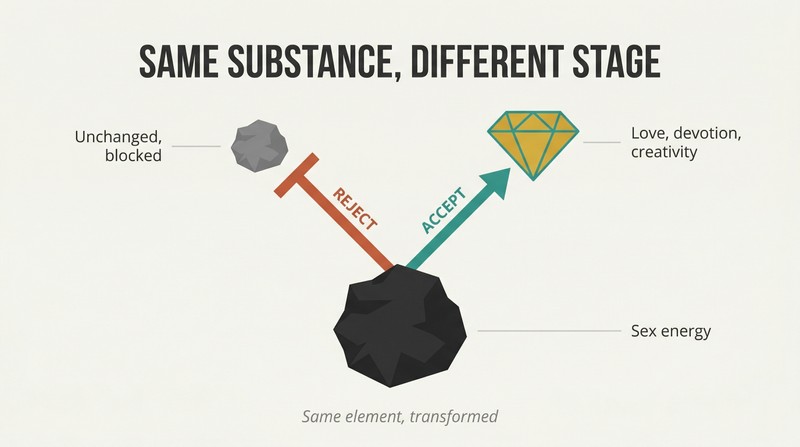
Sex energy is coal — accept it fully to let it become love's diamond
Coal and diamonds share identical elements — the only difference is transformation over time. Osho uses this as his central metaphor: sex energy and divine love are the same force at different stages. Despise coal and you'll never discover it can become a diamond. Despise sex and you block love's only source.
Sex is what Osho calls the "Gangotri" — the Himalayan origin point — of love's river. Every act of devotion, creativity, and tenderness is a flowering of this primal energy. The hostility toward sex doesn't just fail; it actively destroys the possibility of love. Acceptance is the path to deliverance. The flower's fragrance is nothing but the foul smell of manure, risen upward through the plant and transformed.
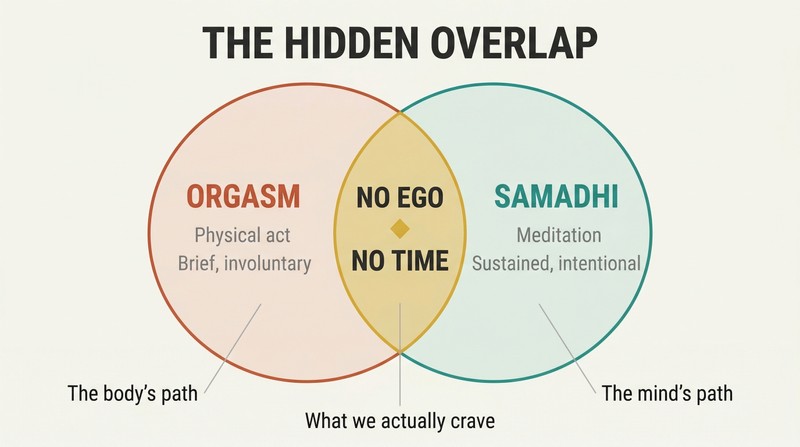
Orgasm's magnetic pull is a craving for egolessness and timelessness
Why does sex hold such power despite post-coital regret? Osho identifies two things that happen during orgasm: the ego temporarily dissolves, and time stops. For one instant, there is no "I" and no past or future — only pure present. These are precisely the states mystics describe in samadhi, the deepest meditation.
This overlap is no accident. Ancient meditators observed what happened in orgasm — a mind emptied of thought — and asked: could that emptiness be achieved without the physical act? From this insight, yoga, meditation, and prayer were born. The ecstasy we chase through sex is actually the ecstasy of self-transcendence, briefly accessed through the body. Understanding this transforms one's entire relationship with desire.
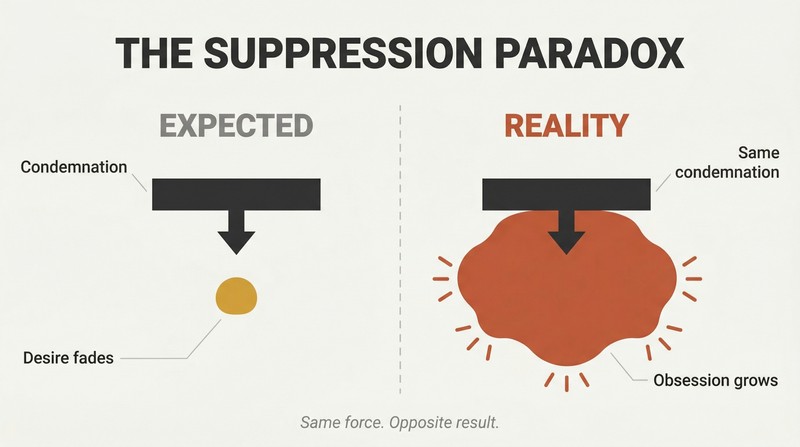
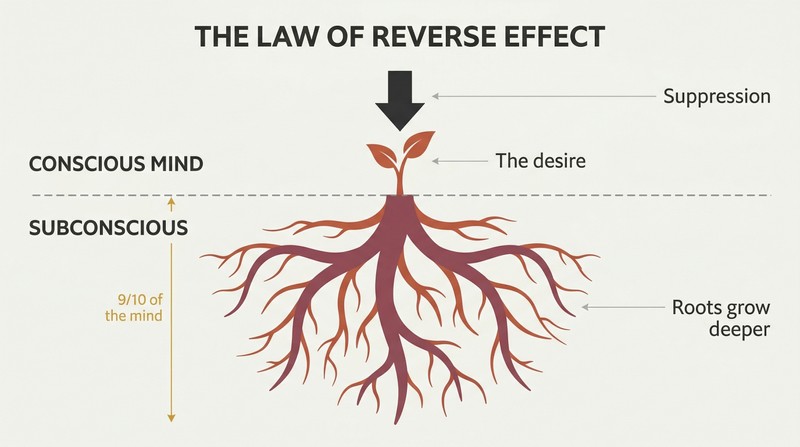
Suppressing a desire plants it deeper in your consciousness
Osho illustrates this with a parable. A farmer lends his finest clothes to a friend and resolves not to mention they're his. At the first house he blurts, "The clothes? They are mine!" At the second, overcorrecting: "The clothes are his and not mine!" At the third, despite swearing to God: "I won't say anything about them, because I have sworn not to say anything about the clothes!"
This is the psychology of every forced vow. A resolution occupies one-tenth of the mind while the remaining nine-tenths rage against it. Psychologist Coué called this the Law of Reverse-Effect: the mind is magnetically pulled toward whatever it tries hardest to avoid. Millennia of sexual suppression have produced not saints but neurotics.
Teach children meditation before puberty, not shame about bodies
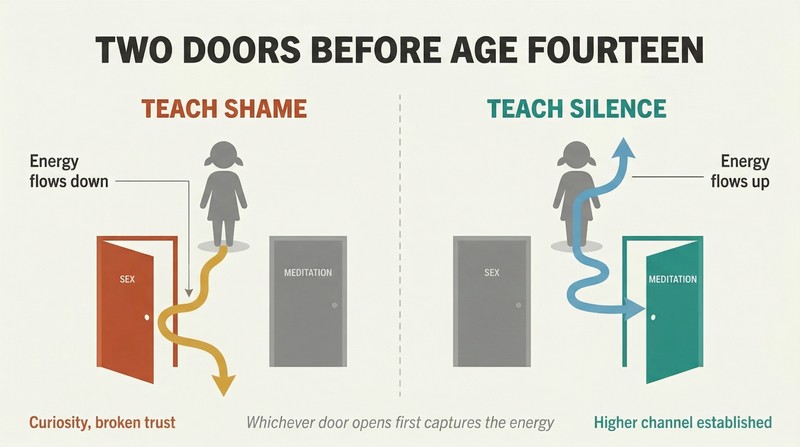
Before age fourteen, two doors remain closed: sex and meditation. Energy will flow through whichever opens first. If daily silence and stillness are practiced in childhood, the meditation door opens before sex arrives. When sexual energy later surges, it naturally flows through the higher channel already established.
Instead, we do the opposite — drumming "sex is sin" into children, which ironically knocks on sex's door by making them curious. Children quickly observe that their parents' night-lives contradict their daytime sermons. This discovery of hypocrisy shatters their trust, making future faith in anything nearly impossible. Every home should schedule a daily hour of silence, Osho argues. Drop a meal if you must, but the hour of silence is non-negotiable.
Slow breathing and third-eye focus transform fleeting sex into samadhi
Three concrete practices for transforming ordinary sex into a doorway for spiritual experience:
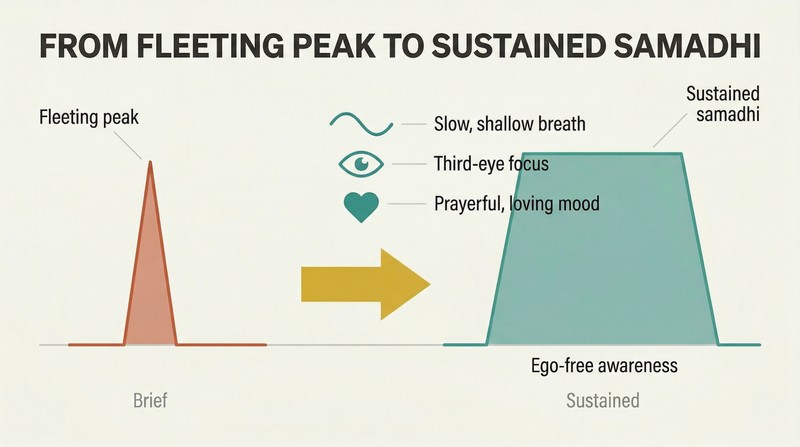
1. Breathe slowly and shallowly during intercourse — the calmer the breath, the longer the ego-free state extends
2. Focus awareness on the agnichakra — the point between the eyebrows — which deepens the meditative dimension
3. Approach sex only when cheerful, loving, and prayerful — never in anger, spite, or sadness
Osho makes the extraordinary claim that if coitus can be sustained for three hours through these methods, a single experience can free a person from sexual craving permanently. The point isn't duration for its own sake but depth: the longer egolessness and timelessness are sustained, the more firmly one is rooted in samadhi's transformative bliss.
The ego is an assembly with no core — dismantle it and love floods in
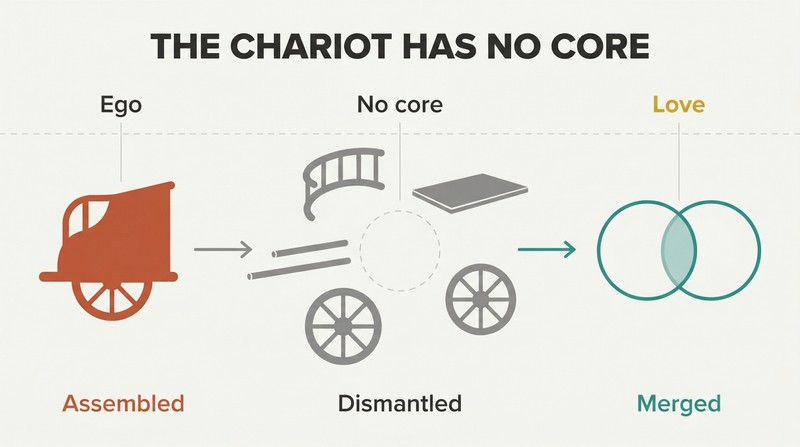
Osho tells the story of monk Nagsen visiting Emperor Malind. The emperor welcomes him, but Nagsen says no person called "Nagsen" exists. Confused, the emperor asks: "Then who accepted my invitation?" Nagsen points to the royal chariot and asks the emperor to remove its horses. "Are these the chariot?" No. Remove the poles. No. Part by part, everything is removed — and nothing that IS the chariot remains. It was only an assembly.
So it is with the self. Search for your "I" in head, heart, or hands — you won't find it. The ego is a phantom built from assembled parts. When two people dissolve their egos, two voids merge without barriers. Osho defines love as exactly this: the fusion of two emptied energies. When one merges with all existence, that is God.
Love is not a relationship — it's your nature overflowing to everything
A fakir in a tiny hut welcomes one soaking stranger, then two more, then even a donkey seeking shelter from the rain. Each time, the previous guests protest there's no room. Each time, the fakir makes space — "At the door of the rich, men are treated as animals, but this is the hut of a poor fakir and we are accustomed to treating even animals as human beings."
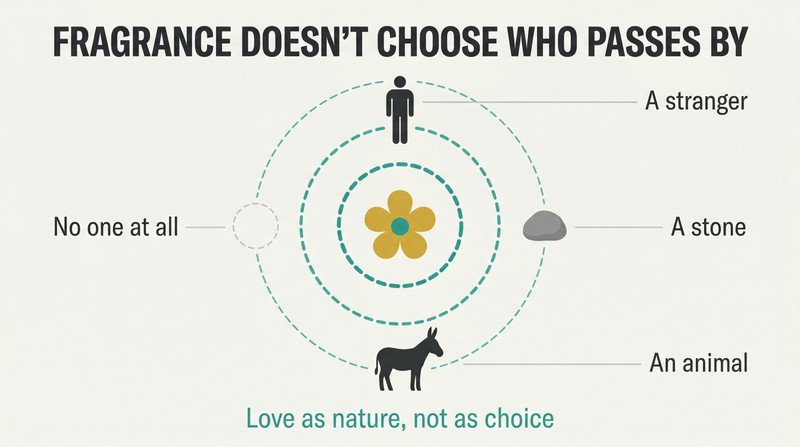
The mistake, Osho says, is attaching conditions to love. Telling a child "love your mother because she raised you" kills love by giving it a reason. A flower in the jungle spreads fragrance whether anyone passes or not. The goal isn't loving one person — it's cultivating a personality so saturated with love that it overflows to stones, strangers, and enemies alike.
Face sex with open eyes, like Khajuraho's temples, to transcend it
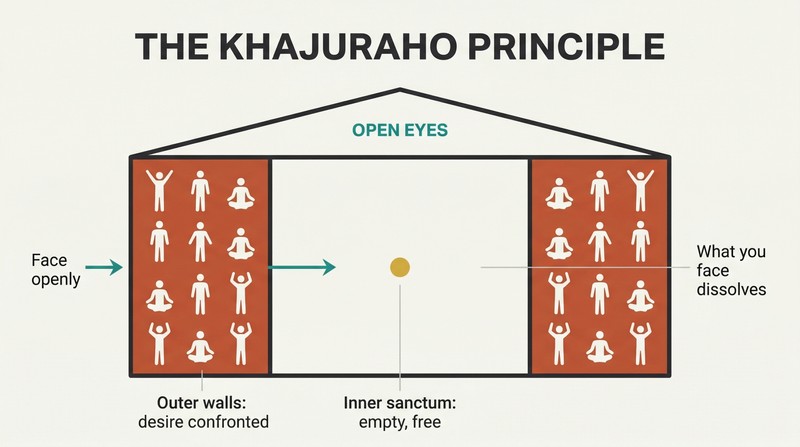
The famous temple at Khajuraho has explicit sexual sculptures covering its outer walls — but inside, there is no idol at all. Osho explains this architecture as a meditation tool: sex exists on the circumference of life. Aspirants were told to meditate on the erotic images until their minds were thoroughly free, then enter the empty inner sanctum. Only with open eyes could they eventually face God within.
The principle mirrors psychiatric practice. Osho describes a man obsessed with hitting his boss with a shoe. A psychiatrist prescribed hitting a photo of the boss five times each morning. Within two weeks, the obsession dissolved. Watching a fight satisfies the latent instinct to fight. Meditating openly on sex dissolves its hidden grip. Closing your eyes guarantees it follows you inside.
True celibacy blooms from profound sexual experience, not from denial
Brahmacharya — which Osho translates as "communion with God" — is sex's summit, not its opposite. A person who has had one truly profound, spiritually complete sexual experience, reaching full samadhi through union, is released from sex for life. The contentment is so total that craving simply ends, the way someone who discovers jewels stops collecting stones.
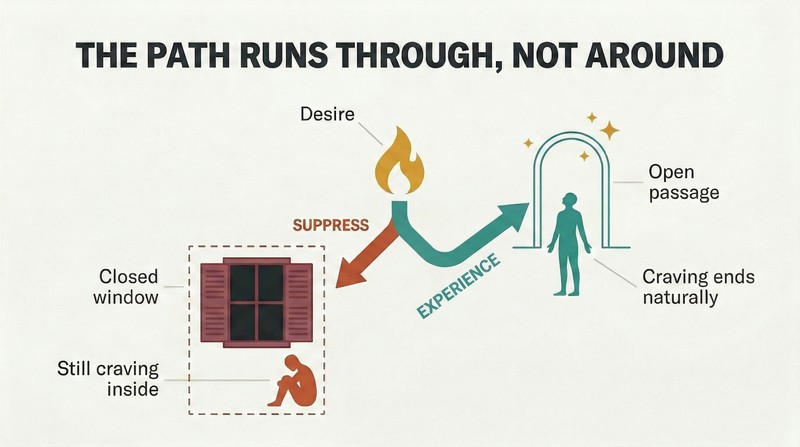
The self-styled celibate who forces abstinence without understanding sex remains imprisoned — he merely has a closed window instead of an open one. What he suppresses physically, he lives mentally, which Osho calls the greater perversion. If celibacy were achievable through willpower alone, ten thousand years of trying would have produced results by now. It hasn't. The path runs through sex, not around it.
Analysis
Osho's 1968 lectures remain one of the most deliberately provocative spiritual texts of the twentieth century — delivered in an India where publicly discussing sex was near-blasphemous. The central argument — that sexual energy is identical to spiritual energy, merely at a different refinement stage — predates Western popularizations of Tantric philosophy by decades and still challenges mainstream religious orthodoxy globally.
The work operates on two simultaneous levels. On the surface, it is a polemic against religious hypocrisy: Osho catalogues the neuroses, perversions, and violences resulting from sexual suppression with prosecutorial zeal. Beneath this, he offers a genuine phenomenology of sexual experience — arguing that orgasm's egolessness and timelessness are identical in kind (though not degree) to mystical states, and that this observation itself birthed meditative practice.
The weaknesses are real. Osho's empirical claims — ninety-eight percent of mental illness from sexual suppression, the three-hour coitus thesis — are stated with confidence but without evidence. His understanding of animal sexuality is simplified for rhetorical effect. His prescriptions for childhood nudity and early meditation would require enormous cultural context to evaluate responsibly.
Yet the core psychological insight holds up remarkably well. Ironic process theory, established by Daniel Wegner in 1987, confirms that thought suppression increases the frequency of suppressed thoughts — precisely the Law of Reverse-Effect Osho borrows from Coué. And the connection between meditative states and orgasm neuroscience has been explored seriously by researchers like Barry Komisaruk, whose fMRI studies show striking overlaps in brain activation patterns during both experiences.
What makes the book endure is its fundamental reframe: the spiritual journey doesn't begin by rejecting the body but by paying such exquisite attention to bodily experience that one transcends it. This is essentially the insight at the heart of all Tantric traditions, delivered with Osho's characteristic mix of parable, provocation, and plainspokenness — and with a courage that nearly got him shot for saying it aloud.
Review Summary
From Sex to Superconsciousness receives mixed reviews, with an overall positive reception. Readers praise Osho's unique perspective on sex, love, and spirituality, finding his ideas thought-provoking and transformative. Many appreciate his challenge to societal taboos and emphasis on embracing sexuality as a path to higher consciousness. Critics argue some ideas are repetitive or controversial. The book is seen as particularly relevant for those from conservative backgrounds. Several reviewers note the importance of approaching the content with an open mind and existing knowledge of sexuality.
People Also Read






Glossary
Brahmacharya
Celibacy as divine communionOsho redefines this traditional Hindu term beyond mere sexual abstinence. In his usage, brahmacharya means 'the charya (conduct) of Brahma (God)'—a state of communion with the divine that naturally emerges when sexual energy has been fully understood and transformed. It cannot be imposed through willpower; it evolves organically from profound inner experience of sex's spiritual dimension.
Samadhi
Superconsciousness beyond ego and timeA state of deep meditative absorption in which the ego dissolves completely and the sense of time ceases. Osho argues that orgasm provides a fleeting, involuntary glimpse of samadhi—egolessness and timelessness—and that meditation, yoga, and prayer were historically developed as methods to achieve this same state deliberately and sustainably, without the energy loss of sexual release.
Law of Reverse-Effect
Suppression intensifies the suppressed desireBorrowed from psychologist Émile Coué, this principle holds that the mind is magnetically drawn toward whatever it most strives to avoid. Osho applies it to explain why millennia of religious sexual suppression produced not purity but pervasive sexual obsession. Like a novice cyclist who fixates on a stone in the road and crashes into it, humanity crashed into sexuality by fixating on its avoidance.
Agnichakra
Energy center between the eyebrowsThe point between the eyes that Osho identifies as a focus for awareness during intercourse. Concentrating attention on this center during the sexual act is said to deepen and prolong the meditative state, extending the experience of egolessness and timelessness that characterizes the spiritual dimension of sex. It is one of three practical techniques Osho prescribes for transforming sex into samadhi.
Kama to Rama
Lust transformed into divine lightOsho's framework for understanding sexual energy as the starting point of a spiritual journey. 'Kama' (lust/desire) and 'Rama' (God/the divine) are not opposites but two ends of the same continuum. The journey from sex to superconsciousness—the book's title concept—is the progressive transformation of raw sexual energy into divine love through understanding, meditation, and acceptance rather than suppression.
Spiritual sex
Soul-level union transcending body and mindThe third and deepest level of sexual experience in Osho's three-tier framework. Physical sex involves only bodies (as in arranged marriages or prostitution). Psychological sex involves hearts and minds (as in love marriages). Spiritual sex involves the meeting of two souls—producing egolessness, timelessness, and a glimpse of samadhi. This level, Osho argues, has been understood neither in the repressive East nor the permissive West.
FAQ
What's "From Sex to Superconsciousness" about?
- Exploration of Sex and Spirituality: The book explores the relationship between sex and spirituality, suggesting that sex is the starting point of a journey towards higher consciousness.
- Transformation of Energy: Osho discusses how sexual energy can be transformed into spiritual energy, leading to a state of superconsciousness.
- Critique of Traditional Views: It challenges traditional religious and cultural views on sex, arguing that these views have suppressed the natural flow of love and energy in humans.
- Path to Enlightenment: The book proposes that understanding and transcending sex is essential for spiritual growth and enlightenment.
Why should I read "From Sex to Superconsciousness"?
- Unique Perspective: Osho offers a unique perspective on the connection between sexuality and spirituality, which can be enlightening for those interested in personal growth.
- Challenging Norms: The book challenges conventional beliefs about sex, encouraging readers to question societal norms and explore their own beliefs.
- Spiritual Growth: It provides insights into how one can transform sexual energy into spiritual energy, which can be beneficial for those on a spiritual path.
- Holistic Understanding: Reading the book can lead to a more holistic understanding of human nature and the potential for spiritual evolution.
What are the key takeaways of "From Sex to Superconsciousness"?
- Sex as a Starting Point: Sex is not just a physical act but the beginning of a journey towards love and superconsciousness.
- Transformation of Energy: Sexual energy, when understood and harnessed correctly, can be transformed into spiritual energy.
- Critique of Suppression: Suppressing sexual energy leads to societal and personal issues; understanding and embracing it can lead to liberation.
- Path to Enlightenment: The ultimate goal is to transcend sex and reach a state of superconsciousness, where one experiences egolessness and timelessness.
How does Osho define love in "From Sex to Superconsciousness"?
- Beyond Definition: Osho suggests that love is difficult to define but can be felt and experienced deeply.
- Misunderstood Concept: He argues that love has been misunderstood and misrepresented by religions and societies, leading to a lack of true love in human life.
- Love as Transformation: True love is seen as a transformation of sexual energy into a higher, more spiritual form of connection.
- Love and Superconsciousness: Love is a step towards reaching superconsciousness, where one transcends the ego and experiences unity with the universe.
What is the relationship between sex and spirituality according to Osho?
- Sex as a Foundation: Osho views sex as the foundational energy that can be transformed into spiritual energy.
- Path to Superconsciousness: By understanding and transcending sex, one can reach a state of superconsciousness, characterized by egolessness and timelessness.
- Critique of Suppression: Suppressing sexual energy is seen as detrimental to spiritual growth; instead, it should be embraced and transformed.
- Integration of Energies: The integration of sexual and spiritual energies leads to a more complete and enlightened human experience.
What are Osho's views on traditional religious teachings about sex?
- Criticism of Suppression: Osho criticizes traditional religious teachings for suppressing sexual energy, which he believes has led to societal and personal issues.
- False Morality: He argues that these teachings have created a false sense of morality that prevents true understanding and transformation of sexual energy.
- Barrier to Love: Traditional views are seen as barriers to experiencing true love and reaching higher states of consciousness.
- Need for Reevaluation: Osho calls for a reevaluation of these teachings to allow for a more open and transformative approach to sex and spirituality.
How does Osho suggest transforming sexual energy into spiritual energy?
- Meditation and Awareness: Osho emphasizes the importance of meditation and awareness in transforming sexual energy into spiritual energy.
- Understanding and Acceptance: Accepting and understanding one's sexual energy is the first step towards its transformation.
- Prolonged Experience: He suggests that prolonging the experience of sexual union can lead to deeper spiritual insights and transformation.
- Focus on Higher Goals: By focusing on higher spiritual goals, one can channel sexual energy towards achieving superconsciousness.
What role does meditation play in "From Sex to Superconsciousness"?
- Key to Transformation: Meditation is seen as a key practice for transforming sexual energy into spiritual energy.
- Path to Awareness: It helps in developing awareness and understanding of one's own energies and desires.
- Achieving Egolessness: Through meditation, one can achieve a state of egolessness, which is essential for reaching superconsciousness.
- Foundation for Growth: Meditation provides the foundation for spiritual growth and the transcendence of physical desires.
What are the stages of sex according to Osho?
- Physical Level: The first stage is purely physical, where the act of sex is seen as a mechanical routine.
- Psychological Level: The second stage involves a deeper connection, where sex is experienced on a psychological level.
- Spiritual Level: The final stage is spiritual, where sex becomes a means to experience unity with the universe and reach superconsciousness.
- Journey of Transformation: Each stage represents a step in the journey of transforming sexual energy into spiritual energy.
How does Osho address the concept of celibacy in "From Sex to Superconsciousness"?
- Celibacy as Transformation: Osho views celibacy not as suppression but as the transformation of sexual energy into spiritual energy.
- Result of Understanding: True celibacy is the result of understanding and transcending sexual desires, not merely abstaining from them.
- Path to Superconsciousness: Celibacy is seen as a natural outcome of reaching superconsciousness, where one experiences unity with the universe.
- Beyond Physical Abstinence: It goes beyond physical abstinence and involves a deep spiritual transformation and understanding.
What are the best quotes from "From Sex to Superconsciousness" and what do they mean?
- "Sex is the genesis of love." This quote highlights the idea that sex is the starting point of a journey towards love and higher consciousness.
- "Love is the transformation of sex energy." It suggests that true love is the result of transforming sexual energy into a higher spiritual form.
- "The journey to kama is also the journey to Rama." This emphasizes that the path of desire (kama) can lead to spiritual enlightenment (Rama) when understood and transcended.
- "Celibacy is the result of a serene and profound experience." This quote indicates that true celibacy comes from a deep understanding and transformation of sexual energy, not from mere abstinence.
About the Author
Other books by Osho








Download PDF
Download EPUB
.epub digital book format is ideal for reading ebooks on phones, tablets, and e-readers.








































