
Key Takeaways
1. From Cave Paintings to Plainsong: Music's Earliest Echoes
The Greeks knew this. They had their nine Muses, each shedding a light on one particular area of 'mousike' - that is the art of the Muse, covering not just music and dance but all areas of arts, science and, generally, learning.
Music's ancient origins. Our journey begins in the mists of time, some 13,500 years ago, with sketchy evidence of musical bows in French caves. Fast forward a few millennia, and the Egyptians and Sumerians were making their mark, laying claim to early harps and flutes. Imagine, if you will, a Sumerian harpist, serenading his bull-shaped soundboard, while the Great Sphinx was still a twinkle in a pharaoh's eye.
Early musical cultures. By 4000 BC, the musical map was taking shape, dominated by three major players:
- Egyptians: Pioneered harps and flutes, with their "bint" (rounded, bowed harp) and "aulos" (double-pipe).
- Sumerians/Babylonians: Developed elliptical harps with ornate soundboards, later expanding to six or seven strings. Hammurabi's era even saw the birth of the kettle drum and cymbals – imagine the "Rule Britannia" possibilities!
- Greeks: Elevated "mousike" (music, dance, poetry, learning) to a philosophical art, with Pythagoras even deriving our modern scale from a blacksmith's hammers.
Philosophical foundations. The Greeks, those clever clogs, believed music shaped morals and educated the soul. Figures like Terpander of Lesbos invented the seven-stringed lyre, while Plato and Aristotle debated music's ethical power and its role in education. Aristotle, bless him, even accepted instrumental music, believing it spoke directly to emotions, unhindered by words. A cathartic prescription for string quartets, perhaps?
2. The Medieval & Renaissance: Writing Music Down
Guido's method invented a series of words to go with the notes, or in the words of Queen Julie herself, 'One shalt commence at the very outset, indeed a goodly place wherein to begin. When one dost peruse, one surely inaugurates the process by means of the initial three symbols, ABC, when thou singest, thou leadest with "Do re mi"'. Er, etcetera.
From plainsong to notation. After a "bloody big gap" following the Greeks, Christianity's spread in the AD era brought music back into focus. Saints Augustine and Jerome saw the power of catchy hymns, but the lack of written music led to "incorrect or even deliberately false info." Enter Bishop Ambrose of Milan, who opened church singing to the people with "Ambrosian Chant," moving St. Augustine to tears.
Guido's game-changers. Around 1000 AD, Guido d'Arezzo, a Benedictine monk, revolutionized music with two enduring innovations:
- Tonic Solfa: A system of words (Ut, Re, Mi, Fa, Sol, La) for notes, laying the groundwork for "Do re mi."
- The Stave: The five-line system we still use today, ensuring musicians "need never get lost again."
These tools were crucial for preserving and disseminating music, moving beyond oral tradition.
Early polyphony and female voices. The medieval period also saw the rise of polyphony, with works like "Sumer is icumen in" (c. 1225) showcasing complex six-part rounds. This era also gave us Hildegard of Bingen, a remarkable abbess and composer who, despite the challenges of being a "female ANYTHING!", left behind numerous plainchants. Her story is a testament to early musical genius, even if her name wasn't "Hildegard of Basingstoke."
3. Baroque Brilliance: Opera, Orchestras, and the Big Two
What's the most amazing thing about the revolution that was opera, though, is that, despite being the biggest thing in vocal music in years, centuries even, it, more than any other innovation, led to a dramatic improvement in another, seemingly completely different, area, namely instrumental music.
Opera's dramatic debut. The Renaissance, a period of "rebirth" for Greek and Roman styles, saw the emergence of "dramma per musica" – plays through music. This led, quite inevitably, to opera. While Jacopo Peri's Dafne was technically the first, Claudio Monteverdi's L'Orfeo (1607) is often hailed as the first "real" opera, thanks to its surviving score and richer invention. The early days of opera also brought us the rather unfortunate, yet musically necessary, castrati.
Orchestral evolution. The accompanying orchestra in the opera pit, initially just for accompaniment, was increasingly called upon to play more dramatic and technically demanding music. This led to:
- New instruments: Flutes, oboes, bassoons, trumpets, and timpani became standard.
- Virtuoso players: Composers needed better musicians to execute their increasingly complex scores.
- Orchestra's independence: Eventually, the orchestra would leave the pit and take center stage, much to the Church's outrage, as instrumental music lacked "words" to praise God.
Bach and Handel: Baroque titans. Born in 1685, Johann Sebastian Bach and Georg Frideric Handel dominated the Baroque era, yet were "chalk and cheese."
- Bach: A homebody, deeply pious, focused on God's glory, producing "acres of superb music" like the St Matthew Passion and Brandenburg Concertos.
- Handel: A shrewd, travelling entrepreneur, opera-mad (he founded the Royal Academy of Music for it), known for hits like Water Music and Zadok the Priest.
Their contrasting lives and outputs perfectly illustrate the diverse brilliance of the Baroque.
4. The Classical Revolution: Form, Feeling, and Mozart's Magic
If Bach had done some showing off on this scale... well, it would have come out as a largely academic exercise... But with Mozart... you get a joyous, uplifting movement that sounds like… well, that sounds like freedom, in a way.
A new classical sound. By 1750, the "finicky, twiddly bits" of Baroque were on their way out, replaced by a more pared-down, elegant "classical" sound. This wasn't an overnight shift, but a gradual evolution, with composers seeking clarity and intricate forms. The symphony, born from the opera overture and sinfonia, became a central genre, with composers like explorers conquering a new musical pole.
Gluck's operatic realism. Christoph Willibald von Gluck, the man with the "mildly amusing middle name," championed realism in opera. He sought "less 'music for music's sake' and more 'this bit of music is meant to sound like this'," using the full orchestra for dramatic effects. His Orfeo ed Euridice (1762) brought "real humanity on stage, real truth," making opera a hit once again.
Haydn and Mozart: Classical giants. The twin thrones of music, vacated by Bach and Handel, were soon occupied by the younger frames of Haydn and Mozart.
- Haydn: The "insurance firm" composer, prolific and comfortable as Prince Esterhazy's resident, known for his 104 symphonies (including the Farewell Symphony).
- Mozart: The child prodigy, composing full symphonies at eight, whose music, like Exsultate, jubilate and Don Giovanni, possessed a joyous, improvisational freedom that transcended mere academic correctness. His piano concertos were his "party pieces," full of heart-rending tunes.
5. Beethoven: The Deaf Genius Who Redefined the Symphony
If you hear a Haydn symphony in concert, it's… orderly, it's… in place. If you hear a Mozart symphony even, it's still order. Genius, often, without doubt, but still order. Then you get something like Beethoven's Eroica - the 'heroic' symphony. It's… well, it's just not on the same playing field.
A miserable boyhood, a monumental talent. Ludwig van Beethoven, born in 1770, endured a harsh childhood under an alcoholic father. Despite this, his innate talent shone through, leading him to study with Haydn in Vienna. His early works, like the Three Piano Trios, hinted at the genius to come, but fate dealt him a cruel blow: the onset of deafness.
The revolutionary Eroica. By 1803, grappling with his impending deafness, Beethoven unleashed a "massive burst of creativity." His Third Symphony, the Eroica, was a game-changer, described as "the greatest single step made by a composer in the history of the symphony." It was:
- Epic and amazing: Far beyond the orderly symphonies of his predecessors.
- Boldly goes: "The Star Trek of symphonies," pushing boundaries.
- Politically charged: Initially dedicated to Napoleon, then famously rescinded when Bonaparte crowned himself Emperor.
This work marked a profound shift, injecting unprecedented drama and scale into the symphonic form.
A magnificent nine. Unlike Haydn's 104 or Mozart's 41, Beethoven composed only nine symphonies, but they were "truly greater works." His output, despite his personal hardships and "idiosyncratic state of self-absorption," included masterpieces like the Fifth Symphony ("De de de derrr"), the Emperor Concerto, and the Egmont Overture. His later works, like the Violin Concerto, showed a profound emotional depth, cementing his legacy as the bridge between the Classical and Romantic eras.
6. Romanticism's Grand Tapestry: Passion, Virtuosity, and National Pride
Because if you lift that phrase and graft it on to the world of music, well, what you have, more or less, is a viable definition of the word Romanticism.
Revolution and expression. The early 19th century was a time of immense change, politically and socially, with revolutions sweeping across Europe and America. This spirit of "heightened sense of worth, individual freedom and personal expression" found its perfect mirror in Romanticism. Music became inextricably linked with revolutionary life and art, reflecting a desire for emotional depth and personal narrative.
Pianist-composers and orchestral romantics. The era saw a surge in virtuoso performers and composers, particularly for the piano.
- Pianist-composers: Chopin, Schumann, and Liszt became "movers and shakers," creating highly expressive and technically demanding works that transformed the instrument.
- Orchestral romantics: Hector Berlioz, the "Arch-Romantic" and "bonkers" genius, became the standard-bearer for the romantic orchestra, pushing its sounds and capabilities to epic new levels with works like Symphonie Fantastique.
Nationalism's musical voice. As nations sought self-identity, composers began to infuse their music with the "sounds, smells, ideas and even tunes of their own country."
- Russia: Mikhail Glinka wrote the first truly Russian opera, A Life for the Tsar, incorporating folk songs and peasant stories.
- Bohemia: Bedřich Smetana, a patriot, developed Bohemia's musical voice with his epic cycle of tone poems, Má Vlast ("My Country"), including the famous Vltava.
This burgeoning nationalism added rich new colours to the romantic palette, paving the way for future generations.
7. Wagner vs. Verdi: Opera's Epic German-Italian Divide
Wagner wants the heights. Verdi wants the hits. Wagner deals with Gods on horseback. Verdi deals in bums on seats. Together, they are romantic opera in 1853.
Wagner's "music drama." Richard Wagner, a "one-off" and "unpleasant megalomaniac" (at 5'5"), sought to create a new, organic art form: "music drama." He rejected traditional opera's "stand and deliver" arias, opting for continuous music where plot and score were "inextricably linked." His innovations included:
- Leitmotivs: Short, recurring musical themes for characters, moods, or ideas.
- Chromaticism: Pushing harmonic boundaries, making it hard to discern a clear "key."
- Bayreuth Festspielhaus: His custom-built opera house, with a hidden orchestra and perfect acoustics, designed for total immersion.
Early works like The Flying Dutchman flopped, but Tannhäuser and the monumental Ring Cycle (four operas, 15 hours!) cemented his revolutionary status.
Verdi's Italian triumphs. Giuseppe Verdi, a "sprightly fifty-eight-year-old" and nationalist hero, was the undisputed king of Italian opera. His name, VERDI, even became an acronym for "Victor Emmanuel, King Of Italy." He was a master of "bel canto" (beautiful singing) and a crowd-pleaser, known for:
- Dramatic plots: Often with nationalist undertones, resonating with a unified Italy.
- Memorable arias: Like "La donna è mobile" from Rigoletto, which he famously kept secret until opening night to prevent theft.
- Spectacular productions: Aida, commissioned for the Cairo Opera House, was a grand spectacle, though Verdi himself refused to attend the premiere.
Verdi's operas, including Il Trovatore and La Traviata, were direct, emotional, and immensely popular, contrasting sharply with Wagner's intellectual ambitions.
8. Late Romantics & Modernism's Diverse Paths
Romantics one and all, yet as different as the day is long.
Brahms: The "Beethoven's Tenth" composer. Johannes Brahms, a "corpulent composer" with a "full-on white beard," was a "late developer" who felt the immense shadow of Beethoven. He delayed writing his first symphony, fearing it would be dubbed "Beethoven's Tenth." His First Piano Concerto (1858) and later symphonies, though initially met with mixed reactions, are now cornerstones of the repertoire, showcasing a "conservative romanticism" that valued classical forms within a romantic idiom.
Tchaikovsky: Melancholy and melody. Pyotr Ilyich Tchaikovsky, a "very sensitive Mr Tchaikovsky" plagued by neuroses (including the fear his head would fall off while conducting), was a master of lush, emotional melodies. His music, unlike the "Mighty Handful" of Russian nationalists, was deeply personal.
- Ballets: Swan Lake, The Nutcracker, and Sleeping Beauty are timeless.
- Symphonies: His Fifth Symphony (1888) and the "pessimistic" Sixth, Pathetique (1893), are emotional rollercoasters.
- Concertos: His Violin Concerto (1878) is a "test" for virtuosi, while his Piano Concerto No. 1 is universally beloved.
French impressionism and idiosyncrasy. Late 19th-century France offered a different flavour of romanticism, often influenced by visual arts.
- Debussy: Claude Debussy, "Thoroughly Modern Claude," sought to "soften the focus" of music, like a Monet painting, with works like Prélude à l'après-midi d'un faune and Clair de Lune.
- Ravel: Maurice Ravel, a "supreme orchestrator," created exquisite works like Daphnis and Chloe and the hypnotic Boléro, showcasing delicate textures and rhythmic drive.
- Satie: Erik Satie, the "bonkers" and "idiosyncratic" composer, delighted in absurd titles like Three Pieces in the Shape of a Pear, offering a whimsical counterpoint to the era's grandiosity.
9. The 20th Century's Musical Crossroads: Innovation and Audience Divide
The composers were becoming more and more intellectually stimulated by new methods - new methods that sounded, to the untrained audience's ear, like… well, like they were wrong. Music that wasn't right.
Mahler's symphonic zenith. Gustav Mahler, a "man of genius" and "Captain Sensible" conductor, pushed the symphony to its absolute limits. His Eighth Symphony, the "Symphony of a Thousand" (1907), with its colossal forces, was "the ultimate resting place of the symphony," a "GIGANTIC" work that left future symphonists wondering "where symphonies go to die."
Stravinsky's seismic shifts. Igor Stravinsky, "Russia's finest," was a revolutionary who "wrote out of his time." His early ballets for Diaghilev's Ballet Russes shocked audiences:
- Petrushka (1911): "Amazing, and it must have sounded so weird."
- The Rite of Spring (1913): Caused riots at its premiere, with "cataclysmic bars" that sounded like "the warning of the end of the world."
Stravinsky's music reflected the "giant leaps" of the early 20th century, from aircraft in war to cubist art.
The "modern music" problem. As composers like Arnold Schoenberg (S g) explored atonality and "twelve-tone" music, a chasm opened between creators and audience. Works like Alban Berg's opera Wozzeck (1925) were met with "utter disbelief" and labelled "chaos instead of music." This intellectual stimulation for composers often resulted in sounds that, to the public, were simply "wrong." Yet, amidst this, accessible masterpieces continued to emerge:
- Rachmaninov: His Second Piano Concerto (1901) was "100 per cent luwie, romantic gush," a "chocolate sauce" for the ears.
- Puccini: Master of "shameless" and "fab" opera, like Madame Butterfly (1904), tugging at heartstrings.
- Gershwin: Rhapsody in Blue (1924) successfully brought jazz into the classical concert hall.
The century continued to offer a "crazy different styles," from the "sledgehammer" of Bruckner to the "nut" of Tchaikovsky's Nutcracker, ensuring music remained a vibrant, if sometimes bewildering, landscape.
Review Summary
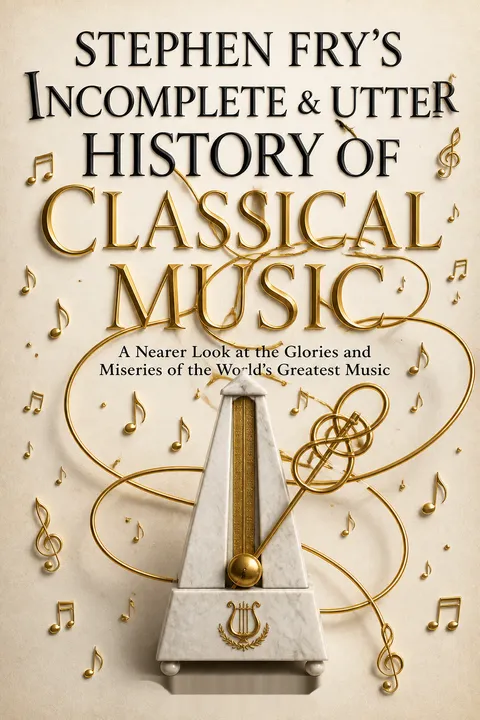
Stephen Fry's Incomplete and Utter History of Classical Music receives mixed reviews averaging 3.7/5 stars. Readers praise Fry's enthusiasm, humor, and accessible approach to making classical music relatable, with many appreciating the historical context and chronological structure. However, criticisms include inconsistent tone, excessive attempts at humor with tired jokes, bias toward Romantic composers while shortchanging 20th-century music, and stylistic quirks like varied fonts. Several reviewers note the book was actually dictated/written by Tim Lihoreau based on Fry's radio program, which some felt worked better in audio format than print.
People Also Read


About the Author
Other books by Stephen Fry



Download PDF
Download EPUB
.epub digital book format is ideal for reading ebooks on phones, tablets, and e-readers.








































