
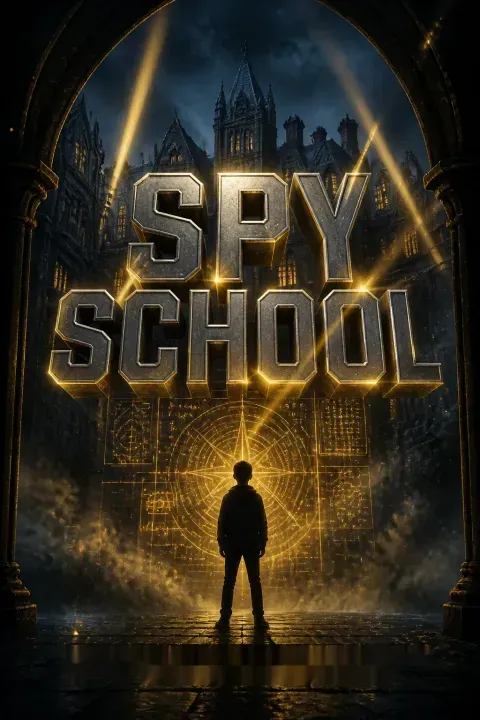


Plot Summary
Prologue
A classified CIA memo from the Director of Internal Investigations to the White House Director of Covert Affairs introduces the transcript that follows. The memo references 'Operation Creeping Badger' and states the enclosed pages come from 53 hours of debriefings with Benjamin Ripley,1 age 12, a first-year student at the Academy of Espionage.
The operation did not proceed as planned; an investigation has been launched to determine what went wrong, why it went wrong, and who should be terminated.
The documents are to be destroyed immediately after reading, per CIA Security Directive 163-12A. No weapons will be allowed at the review meeting. The bureaucratic framing establishes that everything following is testimony being scrutinized for institutional failure.
The memo frame accomplishes multiple structural functions simultaneously. It establishes stakes (something went catastrophically wrong), creates dramatic irony (disaster struck before Ben tells his story), and legitimizes the school's existence through bureaucratic authority. The tone of institutional self-protection, with its talk of determining who should be terminated, foreshadows the theme of organizational incompetence and scapegoating that runs throughout. The directive to destroy documents after reading, combined with the ban on weapons at the review meeting, creates an atmosphere of paranoid secrecy that mirrors the school's entire ethos. The reader understands from page one that Ben's story will expose institutional rot.
The Spy in the Living Room
Twelve-year-old Ben Ripley1 comes home to a stranger in a tuxedo on his couch. Alexander Hale4 works for the CIA, has a rakish chin scar, and recites Ben's1 secrets: 728 visits to the Agency website, perfect scores on hidden STIQ tests, Level 16 math, even his crush on Elizabeth Pasternak.
The CIA wants him at their Academy of Espionage, a secret school disguised as St. Smithen's Science Academy. A student flunked out, creating a mid-year opening. Ben1 must leave immediately and tell no one.
When Ben1 hesitates, Alexander4 challenges him to back out now. Desperate to become suave like his recruiter,4 Ben1 accepts. He lies to his parents, endures mockery from his best friend Mike,7 and within hours arrives at a gothic campus hidden behind high stone walls in Washington, DC.
Ben's recruitment weaponizes every insecurity a brilliant, socially invisible 12-year-old possesses. Alexander dangles the promise of transformation, from math nerd to debonair spy, with the precision of someone who has run this recruitment many times before. The 'sudden opening' is the first lie in what becomes a cascade of institutional deceptions: Ben is selected not for his abilities but for his expendability. His immediate acceptance, despite obvious red flags (the breaking and entering, the secrecy demands), reveals how desperately he wants to be chosen for something extraordinary. The scene establishes the core fantasy, that espionage is glamorous and meritocratic, which the rest of the book will systematically dismantle.
Bullets on Arrival
Alexander4 drives Ben1 onto the gothic campus. Something is wrong: no students are visible during sports period. Alexander4 shoves Ben1 from the car into a hail of gunfire. Ben1 sprints to a dormitory, bullets kicking up snow. Inside, a black-clad figure drops him to the floor.
It is a girl, maybe fourteen, with intense blue eyes and the scent of lilacs and gunpowder. Erica2 gives Ben1 a Taser and leads him through underground passages toward the administration building, pursued by armed men. In the library, Ben1 drops a heavy reference book from a balcony onto one pursuer's skull.
He reaches the principal's office, jams his Taser into the electronic keypad, and tumbles inside. The lights snap on. Administrators sit at a conference table, shaking their heads. It was all a test: the Survival and Combat Skills Assessment. The principal,9 a stocky man with a bad toupee, gives Ben1 a D-minus. Erica2 aced hers.
The SACSA exam is spy school's brutal pedagogy: trust nothing, expect betrayal at every turn. Ben's humiliation is engineered to establish institutional dominance over new students, yet the test also reveals his genuine improvisational skill (the book drop, the Taser keypad hack) that goes completely unrecognized by his evaluators. Erica's introduction establishes the asymmetrical dynamic that will drive the plot: she is everything the school values (competent, cold, self-sufficient) while Ben is everything it disdains, yet their eventual collaboration will prove more effective than the institution's formal methods. The principal's dismissiveness masks the real operation in which Ben is already entangled.
Pinwheel's Deadly Question
Before the attack, Ben1 endures his first hours at spy school. Chip Schacter,5 an older student, visits pretending friendship, then demands Ben1 hack the school mainframe using the cryptography scores in his file. Another boy, Murray Hill,3 electrocutes Chip5 with a rigged door handle and rescues Ben.1
In the mess hall, the slovenly, cynical Murray3 explains that spy school is awful, the food is weaponized to build poison immunity, and the smartest goal is a safe desk job. He seems like Ben's1 only genuine ally. That night at 1:30 AM, a man in black jams a gun up Ben's1 nose, demanding to know about 'Pinwheel.
'Ben1 has no idea what that is. When the gun rises toward his face, Ben1 swings his tennis racket, catching the man's wrist. The gun fires through the window. Ben1 keeps swinging until the intruder collapses, then vanishes before help arrives. Every camera along the route had been dismantled by someone who knew their locations.
The assassination attempt transforms the story from fish-out-of-water comedy to genuine thriller, while the mess hall scene plants the seeds of the eventual betrayal. Murray's performance of cynical laziness is so convincing that neither Ben nor the reader questions it. The attacker's professional knowledge of camera placement proves an inside job, yet the principal reflexively gaslights Ben rather than confronting the breach. Pinwheel functions as a MacGuffin, something everyone believes Ben knows that does not exist, revealing how intelligence agencies construct threats that become real through institutional response. Ben's unlikely victory with a tennis racket establishes his latent resourcefulness while highlighting his desperation.
The Box Confession
Ben1 is relocated to the Box, a reinforced cement holding cell in the sub-subbasement, supposedly for protection. At 5 AM, Erica2 materializes from the shadows inside the supposedly impenetrable room. She tells him the truth. His recruitment was a sham.
The school falsified his file to make him appear a cryptography prodigy who invented something called Pinwheel. It is all part of Operation Creeping Badger, a mole hunt. The previous top student, Joshua Hallal, was killed by an enemy operative with inside information. The administration needed fresh bait to draw the mole out again, so they created a fictional genius.
Ben's1 math skills and convenient location made him the ideal patsy. Erica2 wants to investigate together, unofficially. Ben,1 devastated but desperate to prove himself genuinely worthy, shakes her hand. It is the first warm thing that has happened to him at spy school.
This is the emotional nadir that becomes the foundation for Ben's genuine growth. Learning he was never chosen for his abilities but for his disposability strips away the fantasy that began his journey. Erica's offer is strategically motivated, she needs his position as the target, but it also represents the first authentic relationship Ben forms at the school, one based on shared knowledge rather than mutual deception. The revelation about Joshua Hallal's death raises the stakes from humiliation to mortality: students have died here, and the administration covered it up with euphemisms. Ben's decision to stay rather than flee marks his first step toward genuine agency.
Bomb Beneath the Snow
Three weeks pass. Zoe Zibbell,6 a first-year with enormous green eyes, dubs Ben1 'Smokescreen' and convinces classmates his failures were deliberate ruses. During a paintball war game, Ben1 spots Chip Schacter5 and Greg Hauser12 sneaking toward the perimeter.
He follows them to a stone toolshed where they vanish underground through a pneumatic elevator triggered by a swiveling trowel. In the vast tunnel network beneath campus, Ben1 tails them until they stop at a bomb: wires and yellowish putty nestled among pipes. He overhears the word 'Scorpio.' His phone vibrates with a text alert, giving him away.
Chip5 chases Ben.1 They tumble out through a secret panel into the main hall as the student body returns from the war game. The principal9 catches them fighting. In the commotion, Erica2 kneels beside Ben,1 pretending concern while slipping a transmitter into his ear.
The tunnel network literalizes the book's central metaphor: beneath the surface of ordinary school life runs a hidden infrastructure of secrets, threats, and abandoned Cold War history. Ben's incompetence (the vibrating phone) is balanced by genuine detective instincts. The war game provides ironic contrast: students play at combat while real explosives sit beneath their feet. Erica's swift exploitation of the chaos, pretending affection to plant a bug, demonstrates her operational ruthlessness and the theme that at spy school, even kindness is tactical. Chip's presence at the bomb suggests he is investigating rather than perpetrating, complicating the simple bully archetype.
Insulting the Principal
In the principal's9 office, Erica's2 voice whispers inside Ben's1 head through the transmitter. She needs him to force Principal Sidebottom9 to log into his computer so they can later access the mainframe. Following her instructions, Ben1 launches a campaign of calculated insults: mocking the principal's9 age, his breath, his obvious toupee.
Sidebottom9 grows apoplectic, his face reddening, his hairpiece shifting askew. Unable to expel Ben,1 who is essential to the mole hunt, he can only escalate punishment. In his fury, he logs into the computer to issue a probation order.
Ben1 watches him consult a dictionary on the shelf, where he keeps his passwords written, before typing. Erica2 confirms she has what she needs. Sidebottom9 sentences Ben1 back to the Box, vowing permanent misery. Chip Schacter,5 who witnessed the entire performance, offers a whispered compliment: Ben1 has serious guts.
Ben's transformation from passive victim to active provocateur represents his first exercise of power within the institution, even if he is being puppeted by Erica's remote direction. The scene is darkly comic: a boy deliberately antagonizing a man who could destroy him. Sidebottom's incompetence (passwords hidden in a dictionary, emotional fragility that a 12-year-old can exploit) embodies the academy's fundamental weakness. The institution projects authority while rotting from within, run by people promoted past their competence into positions they cannot handle. Chip's unexpected respect signals a shifting social dynamic: Ben earns status through defiance rather than conformity.
The Jackhammer Ruse
At 3 AM, Erica2 and Ben1 sneak through the tunnels to the principal's9 office, disabling 63 security cameras along the way. The door code is 12345678. Using the password from Sidebottom's9 dictionary, she accesses the CIA mainframe and retrieves the list of 13 people who received Ben's1 falsified file: the CIA director, five high-ranking officials, Alexander Hale,4 Principal Sidebottom,9 four professors, and RA Tina Cuevo.10
Then Erica2 executes her real plan. She sends a fake email from the principal's9 account announcing Ben1 has developed 'Jackhammer,' an ultimate code-breaking program far more dangerous than Pinwheel.
A classified presentation is scheduled for the following evening. The ruse forces the mole's hand: anyone who wants Jackhammer must strike before the presentation. By breakfast, the entire school knows about it. The CIA floods the campus with 52 agents. Alexander Hale4 arrives still wearing a dashiki from his previous assignment.
Erica's Jackhammer deception demonstrates her strategic genius and her willingness to increase Ben's danger for operational goals. She weaponizes the administration's own paranoia, using their systems against their enemy while keeping Ben partially in the dark. The list of 13 transforms the mole hunt from abstract threat to closed-room mystery: the traitor is one of these specific people. The speed at which Jackhammer leaks, everyone knows by breakfast, proves the mole's deep integration into the school's communication networks. Erica's methods are effective but ethically indistinguishable from the institution she criticizes; she is becoming what she despises, using people as tools for mission objectives.
Kidnapped from the Bunker
Ben1 is sequestered in the academy's most secure bunker, a steel-plated command center beneath the campus. Hours pass in tense boredom. At 7:30 PM, perimeter alarms trigger: a single intruder has breached the southwest wall. Alexander4 mobilizes every available agent.
Fifty operatives converge and capture the trespasser. It is Mike Brezinski,7 Ben's1 best friend from home, who claims Ben1 texted him instructions to come spring him for a party at Elizabeth Pasternak's. Ben1 never sent that text.
While the entire security force is occupied with Mike,7 three hooded men blow open the bunker's steel door with explosives, shoot sedation darts into the monitoring agents, and inject Ben1 with tranquilizer. He wakes in the back of a moving van, hooded and bound, his abductors listening to American sports radio. A Post-it note is stuck to his clothing, bearing only the number 70,200.
Mike's weaponization as an unwitting decoy is the mole's cruelest stroke, exploiting a genuine childhood friendship to engineer Ben's capture. The text message mystery becomes the crucial thread that will eventually unravel the entire conspiracy. The enemy's ability to breach the most secure location on campus, with intimate knowledge of its layout and security protocols, proves the mole's access extends to the highest levels. Ben's helplessness in the van, hooded and tossed like cargo, strips away any remaining pretense of the glamorous spy fantasy that drew him to the academy. The mysterious number on the Post-it note is exactly the kind of cryptic detail that either means nothing or everything.
Erica's Rescue
Something heavy lands on the van's roof. Through his hood, Ben1 hears a struggle: glass breaking, bodies thudding, the van swerving wildly. When the hood is removed, Erica Hale2 stands over him, camouflage paint and blood smeared across her face. She single-handedly took out three adult abductors while the van was moving, then shot out a pursuing vehicle.
She parks near the National Mall, cuts Ben's1 bonds, and finds the Post-it note with the number 70,200. Using a key from her grandfather, Erica2 leads Ben1 through a hidden entrance beneath a forgotten president's memorial into a tunnel connecting to the Washington Monument.
They climb 555 feet to the observation deck and watch enemy search teams give up below. During hours of waiting, Ben1 deduces the truth about Alexander Hale:4 he is a fraud, all surface and no substance. Erica2 confirms it, sharing stories of her father's4 catastrophic bumbling through helpless laughter.
The Washington Monument interlude is the book's emotional heart, the only moment of genuine human connection between two characters who have been performing for each other and everyone else. Physically elevated above the chaos, they achieve intimacy through shared laughter at institutional absurdity. Ben's deduction about Alexander demonstrates his growing perceptiveness, while Erica's willingness to share family secrets marks her first vulnerability since the story began. The scene reframes the entire narrative: spy school is not producing heroes; it is a broken system run by broken people, and the only trustworthy actors are those willing to see through the myths that sustain it.
The Text Message Trap
After escaping the monument, Erica2 and Ben1 sneak back to campus through an ATM tunnel entrance and find Professor Crandall.8 The doddering self-preservation instructor drops his senile act: he is sharp, cunning, and the only adult Erica2 trusts. Ben1 examines the Post-it: 70,200.
His mathematical mind converts it instantly. 70,200 seconds after midnight equals 7:30 PM, the exact moment Mike7 arrived. The enemy arranged Mike's7 intrusion deliberately. Later, after Ben1 endures nine hours of interrogation, Alexander4 springs him. While tailing Tina Cuevo10 as a suspect, Mike7 himself appears, having ditched school.
He shows Ben1 the text on his phone: infiltration instructions sent from Ben's1 number at 1:23 PM the previous day. Ben's1 time sense locks onto that moment. At 1:23 PM, Murray Hill3 had gone to get pie, swiping Ben's1 phone from his jacket. Murray3 is the mole.
The revelation sequence functions as a detective denouement where Ben's unique cognitive gift, perfect temporal awareness, becomes the key that unlocks the mystery. Murray's genius was hiding in plain sight, performing incompetence so convincingly that even Erica was fooled. The text message is the central clue that was always available but meaningless until Ben's mathematical cognition reframed it. Mike, the neglected friend Ben has been lying to for weeks, becomes the unwitting source of the crucial evidence that saves everyone. The scene validates the value of ordinary friendship over cultivated spycraft.
SPYDER's Offer
Ben1 follows his earpiece's tracking signal to the furnace room beneath the Hale Building. Erica2 lies unconscious, blood trickling from behind her ear. Murray Hill3 is calmly wiring an enormous C4 explosive beneath the conference room where American intelligence leadership has gathered.
He makes a pitch: join SPYDER, an international consortium that outsources chaos and mayhem for profit. The pay is excellent, tax-free. The CIA used Ben1 as disposable bait; SPYDER would value him. Ben1 pretends to accept, but Murray3 sees through it.
He sets the timer for five minutes, locks Ben1 and Erica2 inside, and flees. The timer uses Ben's1 own cheap alarm clock, the one that stops when pounded, ensuring investigators would find his clock in the debris and conclude Ben1 built the bomb himself.
Murray's recruitment pitch is the book's most sophisticated moral rhetoric because it contains uncomfortable truths. The CIA did use Ben as disposable bait. Governments do engage in morally ambiguous operations. SPYDER's critique of institutional hypocrisy is accurate even though its methods are monstrous. Murray embodies the dark mirror of spy school's teachings: when you train children to deceive and manipulate, some will inevitably turn those skills against the institution. The bomb's double function, as weapon and as frame job, reveals Murray's method: nothing is ever just what it seems, and every action serves multiple simultaneous purposes.
Ice from the Rooftop
With 90 seconds remaining and Erica2 unconscious, panic floods Ben.1 Then he remembers: the timer is his own clock, the cheap one that stops when pounded. He smacks it. The display freezes at 00:07. When Erica2 wakes, she disarms the remaining explosives and blasts the door. They pursue Murray,3 who has sabotaged the cameras.
Ben1 calls Zoe,6 who mobilizes the entire student body. Ben1 deduces Murray3 doubled back toward the front gate rather than heading for the wall. He spots Murray3 climbing from an oak tree and chases him across the quad. Murray3 opens fire. Ben,1 a terrible shot, aims instead at the ice-crusted roof of the Hale Building.
His bullets fracture the frozen sheet, sending massive icicles plummeting. The ice flattens Murray3 unconscious. Alexander Hale4 arrives, plants his foot on Murray's3 body, and takes full credit before the intelligence leadership. Erica2 puts her arm around Ben's1 shoulder.
The climax subverts heroic expectations with bittersweet realism. Ben's victory is genuine: he stops the bomb through specific, personal knowledge (his own broken clock's quirk), then defeats Murray through applied physics rather than marksmanship. But the credit, the recognition, the applause all flow to Alexander, who contributed nothing. Erica's arm around Ben's shoulder and her knowing look encapsulate the book's thesis: in bureaucracies, competence and credit are unrelated currencies. Ben has proven himself, but on terms that reveal the system's fundamental injustice. He belongs now, but belonging means accepting that the institution will always protect its narratives over its people.
Epilogue
A memo from the White House Director of Covert Affairs responds to the investigation. It acknowledges the shocking truth: the only person to uncover direct evidence of SPYDER was a first-year student who did not officially qualify for entry.
The director recommends Ben's1 acceptance be made official, granting him K-24 security status. But the memo also reveals the investigation continues: SPYDER must be neutralized. It mentions activating 'Operation Enduring Assault' and an agent code-named 'Klondike,' though it specifies Ben1 is not to be briefed on these yet.
Instead, he should be allowed to once again believe he is a normal student whose life is not in the slightest bit of danger. The cycle of protective deception that defined his recruitment begins anew.
The epilogue closes the frame while confirming that nothing fundamental has changed. The institution acknowledges Ben's value only to immediately begin manipulating him again with the same paternalistic logic: protect him by lying to him. The directive to let Ben believe his life is not in danger replicates the identical lie told during his recruitment, now in more bureaucratic language. The cycle is structural, not personal: the CIA cannot function without strategic deception, and Ben, having proven himself useful, will now be subjected to ever-larger deceptions. The epilogue's breezy sign-off ('My best to Betty and the kids') renders the manipulation even more chilling through its bureaucratic normalcy. The mention of 'Operation Enduring Assault' and 'Klondike' seeds sequel possibilities while reinforcing that Ben remains a pawn in a much larger game he does not yet understand.
Analysis
Spy School operates as a sustained critique of institutional culture disguised as a middle-grade thriller. The Academy of Espionage that Ben1 enters is not a meritocracy but a bureaucracy where competence and recognition are unrelated currencies. The most skilled person on campus, Erica,2 is a teenager whose insights are dismissed because she lacks institutional authority, while the most celebrated agent, Alexander Hale,4 is a hollow performer who has never accomplished anything independently. This inversion of value runs through every level of the story: the mole3 hides by appearing useless, the real detective work happens outside official channels, and the climactic victory is stolen by the person who contributed least. The book's psychological sophistication lies in its treatment of deception as both weapon and wound. Every character lies to Ben1 when he arrives, ostensibly to protect him or the mission, but these lies compound into genuine danger. The institution that trains children to detect deception is itself built on a foundation of it. Ben's1 emotional arc traces the painful process of learning that the people with the most impressive credentials are often the least trustworthy, while genuine competence may be found in those the system has labeled failures or dismissed as irrelevant.
Murray's3 betrayal is particularly resonant because it exploits the very skills spy school teaches. He weaponizes the institution's tendency to sort people into categories and hides in the category no one examines. His pitch to Ben1 contains uncomfortable truth: the CIA did use an untrained child as disposable bait. The moral distinction between SPYDER and the CIA is real but narrower than the school's propaganda suggests. The book ultimately argues that integrity is a personal choice made in defiance of institutional incentives, not a quality that institutions reliably produce or reward. Ben1 succeeds not because spy school trained him well, but because he learned to trust his own peculiar gifts and the ordinary friendships the institution taught him to devalue.
Review Summary
Spy School is a popular middle-grade spy novel with mixed reviews. Many readers enjoy its action, humor, and relatable characters, praising the plot twists and engaging storyline. Some compare it favorably to other spy series. However, criticism includes lack of diversity, unnecessary swearing, and unrealistic scenarios. The audiobook narrator received negative feedback. Despite these issues, many readers find it entertaining and look forward to continuing the series. Some parents express concern about age-appropriate content, while others appreciate its appeal to reluctant readers.
People Also Read





Characters
Ben Ripley
Math prodigy recruited as spy-in-trainingTwelve-year-old Ben Ripley possesses Level 16 math ability: he multiplies six-digit numbers instantly and always knows the exact time down to the second. Socially invisible at his public middle school, he has fantasized about becoming a spy for years, visiting the CIA website 728 times. When recruited to the Academy of Espionage, he believes his dreams have come true, only to discover he was selected as expendable bait for a mole hunt. Beneath his naivety lies genuine resourcefulness: he fights off an assassin with a tennis racket and uses mathematical reasoning to crack the conspiracy. His arc traces the painful growth from starry-eyed wannabe, what the school calls a 'Fleming' (someone who believes spy movies are real), to a young operative who understands that institutions value self-protective narratives over people.
Erica Hale
Ice-cold legacy spy and academy's top studentFourteen-year-old Erica Hale is descended from Revolutionary War spy Nathan Hale and already the academy's top student as a third-year. Cold, calculating, and seemingly self-sufficient, she sits alone at meals while tracking everything happening around her. She sneaks into supposedly impenetrable rooms, commandeers moving vehicles, and treats people as tools for operational goals, including Ben1, whom she uses as bait for her own investigation. Her emotional distance masks deep frustration: she knows her father Alexander4 is a fraud whose reputation is built on stolen credit, but exposing him would destroy her own career. She initially regards Ben1 as a useful pawn, planting transmitters in his ear and manufacturing lies to force the mole's3 hand. Over time, she develops grudging respect and then genuine trust, sharing family secrets she has never told anyone.
Murray Hill
Cynical underachiever who befriends BenThirteen-year-old Murray Hill should be a second-year but was held back after accidentally shooting off the principal's9 toupee during a combat simulation. Slouched, slovenly, and perpetually eating, he presents himself as the antidote to spy school ambition: he wants a safe desk job, not a dangerous field assignment. He rescues Ben1 from a bully on day one using a portable electrostatic generator, then explains how the school really works over spaghetti in the mess hall. His cynicism feels like honesty in an institution built on deception, and his laziness seems refreshing amid relentless competition. He makes his own peanut butter sandwiches because the cafeteria food is deliberately awful, wears mismatched socks, and offers Ben1 what seems like the only genuine friendship on campus.
Alexander Hale
Legendary CIA agent and Erica's fatherErica's2 father presents himself as the platonic ideal of a spy: tuxedo-clad, scarred, perpetually sipping Gatorade for electrolytes just in case he needs to leap into action. He claims to have survived ninja attacks in North Korea, protected Saudi royalty with a Swiss Army knife, and uncovered moles in Karachi. His recruitment of Ben1 is smooth and confident. In reality, he is a hollow performer whose entire reputation is constructed from stolen credit, exaggerated stories, and other people's accomplishments. His incompetence has caused diplomatic disasters and a near-nuclear incident, yet his skill at self-promotion keeps him celebrated. He genuinely believes his own mythology, which makes him both dangerous and strangely pitiable.
Chip Schacter
Handsome bully with unexpected depthAn older student with magazine-cover looks, Chip Schacter initially appears to be spy school's alpha predator: he threatens, coerces, and attempts to force Ben1 into hacking the mainframe on day one. Backed by two imposing enforcers, he seems like a straightforward antagonist. Yet he responds to displays of nerve; Ben's1 insults to the principal9 earn his whispered respect. He is later revealed to be conducting his own unauthorized investigation into the bomb plot. His bullying masks a more complicated relationship with the institution: he wants to excel but lacks the intellectual tools, so he resorts to force and finds himself in over his head.
Zoe Zibbell
Ben's most passionate defenderA thin, energetic first-year with enormous green eyes, Zoe Zibbell becomes Ben's1 most vocal supporter after his first day. She invents his nickname 'Smokescreen' and constructs an elaborate narrative in which his every failure is actually a calculated ruse: he did not lose to the ninjas, he faked it to deceive enemies. Her faith in Ben1 is based almost entirely on fiction, yet it provides him crucial social protection and confidence during his first weeks. She is the school's most enthusiastic gossip and rumor-monger, tracking everyone's relationships and secrets. Her crush on Ben1 motivates much of her behavior, though she channels it into legend-building rather than romance.
Mike Brezinski
Ben's neglected best friend from homeBen's1 best friend since first grade, a cool underachiever who mocked Ben's1 decision to attend 'loser science school.' When he inadvertently gets invited to parties at Elizabeth Pasternak's house, the tables turn: suddenly Ben1 is the one missing out. Mike's attempt to spring Ben1 from campus for a party makes him an unwitting pawn in the mole's3 scheme. His phone contains the text message that ultimately exposes the conspiracy. When he confronts Ben1 about being lied to and blown off, his hurt is genuine and deserved. Their friendship, neglected amid spy school drama, becomes the key to solving the entire mystery.
Professor Crandall
Senile instructor hiding sharp competenceThe academy's ancient self-preservation professor appears to be barely functional: he loses his train of thought mid-lecture, rambles about Cold War borscht, and has eyebrows that look tornado-struck. Students wear fake-eye glasses to sleep through his classes. In private, he is entirely different: sharp, cunning, and the only adult on campus Erica2 trusts. His entire classroom persona is an act, designed to make enemies underestimate him and to make colleagues speak freely around someone they assume is mentally gone. He keeps a loaded pistol under his racing form and bakes chocolate chip cookies with coconut flakes.
Principal Barnabus Sidebottom
Incompetent and petty academy headThe academy's principal is a former field agent who was captured so frequently he was promoted out of danger entirely. Stocky, perpetually food-stained, and deeply insecure about his obvious toupee, he wields his tiny authority with petulant fury. His complex password is taped inside his dictionary because he cannot remember it. His door code is 12345678. He placed Ben1 in the Box for safety, then forgot he had done so. Despite his incompetence, he is not malicious: he was placed in charge specifically because he will never question orders from above.
Tina Cuevo
Responsible RA caught in suspicionA sixth-year RA ranked third in her class, Tina responds to emergencies in bunny slippers with a gun in her pajama pocket. Her access to Ben's1 classified file and her tutoring of struggling students like Murray3 make her a convenient suspect when evidence is planted against her.
Warren Reeves
Camouflage expert trailing ZoeA first-year camouflage expert nicknamed 'Chameleon' who covers himself in moss, bark, and even snails. He follows Zoe6 everywhere and resents her attention to Ben1. His premature diversion during the war game gets him pelted with so many paintballs he turns blue for days.
Greg Hauser
Chip's muscle-bound enforcerOne of Chip's5 two imposing bodyguards, a slab of muscle with a crew cut who can crush steel spoons with his bare hand. Not intellectually gifted, but the CIA always has use for people who are big, mean, and follow orders without question.
Plot Devices
Pinwheel
Fake invention to bait moleA fictional cryptography breakthrough inserted into Ben's1 falsified recruitment file. The CIA invented Pinwheel as a 'hook,' a revolutionary secret worth stealing, to attract the enemy mole's3 attention. Ben1 is credited as its creator despite having no idea what it is. When the assassin demands information about Pinwheel, Ben's1 ignorance nearly gets him killed. The device reveals the CIA's circular logic: create a fiction, then treat responses to the fiction as actionable intelligence. Its nonexistence is the central irony of the first half of the book.
Jackhammer
Escalated fake to force mole's handAn even more dangerous fictional code-breaking program that Erica2 invents via a fake email from the principal's9 account. Where Pinwheel was supposedly an encryption tool, Jackhammer is described as a weapon: an ultimate code breaker that can demolish any security system. Its announcement triggers massive CIA security response and forces the mole3 to accelerate their timeline. Jackhammer demonstrates Erica's2 tactical brilliance and her willingness to increase Ben's1 danger for operational goals. Like Pinwheel, it is entirely imaginary, but the consequences it generates are devastatingly real.
Ben's Broken Clock
Defective timer becomes bomb's weaknessA cheap bedside clock in Ben's1 holding cell that malfunctions: it stops when pounded and starts again when pounded again. Ben1 discovers this quirk while bored on lockdown. The clock is stolen and used as the trigger for a massive C4 bomb beneath the Hale Building, intended to frame Ben1 by making investigators find his clock in the debris. Ben's1 specific, mundane knowledge of his own broken possession allows him to stop the timer with seven seconds remaining, when all his spy training had failed him.
STIQ Tests
Secret CIA screening in school examsStandardized Test Inserted Questions: the CIA's method for identifying potential espionage recruits without their knowledge. Hidden inside ordinary standardized tests taken by millions of American schoolchildren, these questions assess cryptography aptitude, perception, and logical reasoning. Ben1 has gotten every STIQ question right since third grade without ever knowing he was taking them. The program demonstrates the CIA's pervasive, invisible surveillance of ordinary citizens and provides the legitimate basis for Ben's1 recruitment, even though the specific role he was recruited for was fabricated.
Operation Creeping Badger
The mole hunt that frames everythingThe CIA's internal operation to identify an enemy agent within the Academy of Espionage. Named under the mistaken belief that badgers hunt moles (they do not), the operation planted Ben1 as bait: a fake cryptography prodigy whose supposed inventions would attract enemy attention. The operation's catastrophic failure, Ben1 is kidnapped and a bomb nearly destroys the school, triggers the internal investigation that frames the entire narrative. Its name embodies the institutional incompetence at the heart of the story: even the metaphor was wrong.
FAQ
Synopsis & Basic Details
What is Spy School about?
- Ordinary kid, spy recruit: Twelve-year-old Ben Ripley is recruited by the CIA and thrust into the Academy of Espionage, disguised as a science school.
- Unwitting pawn, dangerous game: Ben quickly discovers he's being used as bait to lure out a mole within the academy, forcing him to navigate a world of deception and danger.
- Friendship, loyalty, and survival: Ben must learn to trust his instincts, make new friends, and master espionage skills to survive and uncover the truth behind his recruitment.
Why should I read Spy School?
- Thrilling spy adventure: Spy School offers a fast-paced and engaging story filled with action, suspense, and unexpected twists, perfect for young readers who enjoy spy fiction.
- Relatable protagonist, coming-of-age: Ben Ripley's journey from an ordinary kid to a spy-in-training is relatable and inspiring, as he learns to embrace his strengths and overcome his weaknesses.
- Intriguing characters, complex relationships: The novel features a cast of memorable characters, including the brilliant Erica Hale and the deceptive Murray Hill, whose relationships add depth and complexity to the story.
What is the background of Spy School?
- Cold War echoes, modern threats: While not explicitly stated, the Academy's infrastructure and training methods hint at a Cold War legacy adapting to modern espionage challenges.
- CIA's clandestine operations: The story touches upon the CIA's history of covert operations and its use of deception and manipulation, raising questions about ethics and morality.
- Technological advancements, espionage tools: The novel incorporates elements of modern technology and espionage tools, such as surveillance cameras, encrypted communications, and advanced weaponry, reflecting the evolving nature of spycraft.
What are the most memorable quotes in Spy School?
- "And just like that, my life became interesting.": This opening line encapsulates Ben's sudden transformation from an ordinary kid to a spy recruit, setting the stage for the adventure ahead.
- "Welcome to spy school.": Erica's sardonic welcome to Ben after he barely survives a hail of gunfire highlights the dangerous and unpredictable nature of the academy.
- "There are no rules at spy school.": This statement, though misleading, underscores the unconventional and often morally ambiguous environment of the academy, where students are encouraged to think outside the box and bend the rules to achieve their goals.
What writing style, narrative choices, and literary techniques does Stuart Gibbs use?
- First-person narration, relatable voice: The story is told from Ben's perspective, using a humorous and self-deprecating tone that makes him a relatable and engaging protagonist.
- Fast-paced plot, cliffhanger endings: Gibbs employs a fast-paced plot with plenty of action, suspense, and cliffhanger endings to keep readers hooked and eager to turn the page.
- Humor, satire, and irony: The novel is filled with humor, satire, and irony, poking fun at spy movie tropes and highlighting the absurdity of certain situations.
Hidden Details & Subtle Connections
What are some minor details that add significant meaning?
- Alexander's lipstick smear: The detail of lipstick on Alexander Hale's neck hints at a more complex personal life and potentially questionable behavior, subtly undermining his image as a perfect spy.
- Hogarth's theory of fear-based urination: This seemingly humorous detail adds a layer of realism to the story, highlighting the psychological and physiological effects of fear on the characters.
- The Box's contents: The gingham comforter, dog-eared spy novels, and plastic houseplant in the Box, Ben's "safe" room, create a stark contrast between the intended security and the actual isolation and discomfort he experiences.
What are some subtle foreshadowing and callbacks?
- Alexander's tennis racket suggestion: Alexander's offhand suggestion that Ben bring his tennis racket foreshadows its later use as a weapon against the assassin, highlighting the importance of resourcefulness and improvisation.
- Murray's self-preservation exam: Murray's flunking his self-preservation exam by accidentally shooting off the principal's toupee foreshadows his later betrayal and his lack of genuine commitment to espionage.
- The mention of Joshua Hallal: The brief mention of Joshua Hallal, the student who supposedly died from a bee sting, foreshadows the deeper conspiracy and the enemy's willingness to eliminate threats within the academy.
What are some unexpected character connections?
- Erica's family history: The revelation that Erica is a descendant of Nathan Hale connects her to a long line of American spies, highlighting the legacy and tradition of espionage.
- Alexander and Erica's strained relationship: The subtle hints of tension and distance between Alexander and Erica suggest a more complex and troubled family dynamic than initially apparent.
- Murray's recruiter: The mention of Murray's recruiter, a successful desk jockey in the Paris bureau, reveals a hidden network of double agents and a larger conspiracy at play.
Who are the most significant supporting characters?
- Zoe Zayser: Zoe's unwavering belief in Ben's abilities, despite all evidence to the contrary, provides him with much-needed support and encouragement, helping him to embrace his role as a spy.
- Chip Schacter: Chip's initial antagonism toward Ben and his later attempts to manipulate him highlight the competitive and often ruthless nature of spy school, while his eventual assistance reveals a more complex and nuanced character.
- Professor Crandall: Despite his seemingly incompetent demeanor, Professor Crandall proves to be a valuable ally, offering guidance and support to Ben and Erica, and providing a link to the academy's past.
Psychological, Emotional, & Relational Analysis
What are some unspoken motivations of the characters?
- Ben's desire for acceptance: Ben's eagerness to impress Alexander and Erica stems from a deep-seated desire for acceptance and validation, driving him to take risks and push himself beyond his comfort zone.
- Erica's need for independence: Erica's aloofness and reluctance to rely on her father are rooted in a need to prove herself as a capable spy in her own right, independent of her family's legacy.
- Murray's disillusionment with espionage: Murray's betrayal is driven by a disillusionment with the spy world and a desire for financial gain, reflecting a cynical and pragmatic worldview.
What psychological complexities do the characters exhibit?
- Ben's imposter syndrome: Ben struggles with feelings of inadequacy and self-doubt, questioning his abilities and worthiness as a spy, despite his intelligence and courage.
- Erica's emotional repression: Erica's stoicism and emotional detachment mask a deep-seated vulnerability and a fear of intimacy, stemming from her upbringing and the pressures of her family's legacy.
- Murray's moral ambiguity: Murray's betrayal is not simply a matter of good versus evil, but rather a reflection of his moral ambiguity and his willingness to compromise his values for personal gain.
What are the major emotional turning points?
- Ben's realization of being bait: Ben's discovery that his recruitment was a sham and that he's being used as bait is a major emotional turning point, forcing him to confront the harsh realities of espionage and question his own worth.
- Erica's vulnerability with Ben: Erica's decision to confide in Ben about her father's flaws and her own insecurities marks a significant shift in their relationship, revealing a more vulnerable and human side to her.
- Ben's decision to trust Erica: Ben's decision to trust Erica, despite her aloofness and the risks involved, is a testament to his growing maturity and his ability to form meaningful connections in a world of deception.
How do relationship dynamics evolve?
- Ben and Erica's evolving partnership: Their relationship evolves from distant and distrustful to supportive and collaborative, as they learn to rely on each other's strengths and overcome their individual weaknesses.
- Ben and Alexander's shifting dynamic: Ben's initial admiration for Alexander is gradually replaced by disillusionment and disappointment, as he uncovers the truth about his mentor's flaws and self-promotion.
- Ben and Murray's shattered friendship: Ben's friendship with Murray is shattered by the revelation of his betrayal, highlighting the dangers of misplaced trust and the complexities of loyalty in the spy world.
Interpretation & Debate
Which parts of the story remain ambiguous or open-ended?
- The full extent of SPYDER's influence: The novel leaves the full extent of SPYDER's influence and reach within the intelligence community ambiguous, suggesting a larger and more complex conspiracy at play.
- The future of Ben and Erica's relationship: The novel hints at a potential romantic connection between Ben and Erica, but their relationship remains largely undefined, leaving room for future development.
- The long-term consequences of the mole hunt: The novel doesn't fully explore the long-term consequences of the mole hunt on the academy and the intelligence community, leaving readers to wonder about the lasting impact of the events.
What are some debatable, controversial scenes or moments in Spy School?
- The use of children as spies: The novel raises ethical questions about the use of children as spies, particularly in dangerous and life-threatening situations.
- The CIA's manipulation and deception: The CIA's willingness to manipulate and deceive its own recruits, as well as the public, raises questions about the morality of espionage and the ends justifying the means.
- Erica's methods and motivations: Erica's often ruthless and calculating methods, as well as her underlying motivations, can be seen as both admirable and questionable, sparking debate about her character and her role in the story.
Spy School Ending Explained: How It Ends & What It Means
- Murray's capture, SPYDER's threat: The ending sees Murray apprehended, but the larger threat of SPYDER remains, indicating that the fight against evil is far from over.
- Ben's official acceptance, a new beginning: Ben's official acceptance into the academy signifies his growth and transformation from an ordinary kid to a capable spy, ready to face the challenges ahead.
- Uncertain future, enduring bonds: The ending leaves the future uncertain, but it also emphasizes the importance of courage, friendship, and loyalty in a world of deception and danger, suggesting that Ben and Erica will continue to rely on each other as they navigate the complexities of espionage.
Spy School Series

About the Author

Download PDF
Download EPUB
.epub digital book format is ideal for reading ebooks on phones, tablets, and e-readers.








































