


Plot Summary
The Phone Call
Ruth2 is filming a video for her lifestyle brand, The Widow's Kitchen, when the antique wall phone shrieks. It is a Tuesday evening in June 2023 in Palisades, New York. The call comes from a trauma hospital in Río Piedras, San Juan.
Her twenty-two-year-old daughter Daisy3 has been struck by a car while riding her scooter through the gathering hurricane. The caller asks about Daisy3's medical history and insurance. Ruth2's body curls around the mouthpiece as she scrawls a phone number onto her own palm.
She hangs up and makes a sound foreign to her own ears, a mammal cry. After a moment, she remembers the camera still recording and walks across the room to stop it, her mascara smearing into mud beneath her eyes. Outside, the wind whips through the trees and travels south, toward where her daughter3 is.
The opening sequence operates as a primal disruption: the domestic sanctuary (exposed beams, tropical plants, lemon-cupcake scent) is invaded by catastrophe. Ruth's carefully curated online persona, built on documenting beauty after annihilation, is shattered by the real thing. The antique phone, chosen for aesthetic charm rather than function, becomes an instrument of terror. The detail that Ruth writes on her own hand, unable to find paper, signals the collapse of her orderly world into bodily immediacy. Her 'mammal sound' strips away the layers of performance and control, revealing the raw animal fear beneath. The wind traveling south connects mother and daughter across sixteen hundred miles.
A Racist Letter, A Wedding
In a powder-blue hotel in Santurce, Rafaela Acuña y Daubón1 prepares to become Mrs. Peter5 Brennan Jr. Her sister Dolores9 arrives in a panic, clutching a letter from Peter5's father in Missouri. The letter, written to Papamío,12 warns against the marriage, calling mixed-race unions unnatural and demanding proof that Rafaela1 carries no 'negro blood.'
Rafaela1 dismisses the letter, refusing to even refold it. She is certain her love for Peter5 transcends his family's bigotry. Dolores,9 unable to dissuade her sister, ultimately tucks the folded letter into her bra, where it pulses against her skin throughout the ceremony like a second heartbeat.
At the altar, Rafaela1 scans the pews for a different face, a pair of green eyes that might have diverted her onto another path entirely. But Candido4 is not there. She lets go of her father's12 arm.
This scene establishes the foundational secret that will ripple across three generations. Rafaela's willful blindness to the letter's warning is not naivety but a survival mechanism: she has already lost her family's wealth and status, and Peter represents stability and whiteness in a world that punishes her for being neither fully white nor fully acceptable. Her scanning the pews for Candido reveals the split in her heart that will define her life. Dolores's act of hiding the letter in her bra, against her skin, is an intimate act of protection that also becomes a form of burial. The letter will resurface decades later, unleashing truths no one was ready to face.
Papamío's Disgrace
When Rafaela1 is seventeen, her father Papamío,12 the municipal treasurer of San Juan, is accused of mismanaging a vast sum of public money. The scandal is instant and absolute. The governor offers only tepid defense.
The family must vacate their seven-bedroom house on Calle Américo Salas, sell the yellow Buick Roadmaster, and dismiss their servants, including Priti13 and her son Candido.4 Rafaela1 and Dolores9 are expelled from their elite school, Las Madres.
Papamío,12 hollowed with shame, tells Rafaela1 she must go to Trinidad to work as a secretary on a US Navy base while Dolores9 finishes her final year. Before she leaves, Candido4 kisses her in her parents' empty bedroom and tells her he might go to New York to find his father. She begs him not to go.
The family's financial collapse is a fall from Eden that shapes every subsequent choice. Papamío's disgrace is not merely about money but about the fragility of respectability for Puerto Rican families operating in colonial power structures. The scandal strips away the protective layers of wealth and status that had shielded the Acuña daughters from the island's racial and class hierarchies. Rafaela's exile to Trinidad is both punishment and necessity: at seventeen, she must earn money for her family while being severed from everyone she loves, including Candido. The kiss before departure marks the moment when childhood affection crystallizes into something that will never be fully acknowledged or consummated until decades later.
Candido's Green Eyes
Growing up in the big house on Calle Américo Salas, Rafaela1 and her sister Dolores9 considered Candido4 their friend first and their housekeeper Priti13's son second. When they were seven and nine, the three children played together in secret because Rafaela1 understood, without being told, that their fondness must be hidden from adults.
On Three Kings Day in 1953, Priti13 took them to a park where Doña Fela, the mayor of San Juan, had flown in snow from Vermont as a gift for the children.
Amid the shrieking crowd, Candido4 pulled Rafaela1 close, wrapped her hand in his, and plunged their fingers together into the clean, cold snow. Decades later, when a psychologist asked Rafaela1 to locate her happiest, safest memory, she returned to that moment: the bolt of feeling when Candido4 stood behind her, his small body a barrier around hers.
The childhood scenes establish the structural impossibility of Rafaela and Candido's love. They share a home but occupy different worlds within it: she is the daughter of privilege, he is the housekeeper's son whose labor makes that privilege possible. Their friendship thrives in hidden spaces (the pantry, behind potted palms) because both children have absorbed the rules of their society. The snow scene is the novel's central metaphor: a fleeting miracle of cold in the Caribbean heat, a gift that cannot last. Candido's green eyes, mentioned repeatedly, become the symbol of what is beautiful and unreachable. The class barrier between them is absolute, yet their emotional bond will prove more enduring than any marriage.
The Officer in Trinidad
In Trinidad, Rafaela1 endures leering sailors and tedious secretarial work. One day in the canteen, a red-haired private named Busby blocks her path and refuses to let her pass. Just as her tray begins to slide, a hand reaches across and steadies her milk glass.
Lieutenant Peter Brennan5 tells Busby to bug off, then carries Rafaela1's tray to her table and leaves without demanding conversation. Weeks later, she spots him at Sunday mass in Port of Spain.
He is the only man on base who treats her with genuine respect, and she is drawn to his dark hair, piercing blue eyes, and the surprising warmth of his Spanish when he finally speaks it. Over breakfast, he declares there is only one girl on the planet with whom he feels ready to fall. He opens his hand on his knee and waits for her to take it.
Peter's appeal to Rafaela is rooted in contrast: unlike every other man on the naval base, he does not treat her as a conquest. His restraint feels like respect, and his ability to speak Spanish signals a willingness to meet her in her own world. Yet the seeds of their future unhappiness are already present. Peter sees himself as her rescuer (from Busby, from Trinidad, from her family's reduced circumstances), a dynamic that will curdle into resentment when she fails to perform the grateful, domestic wife he expects. His declaration of readiness to fall suggests a love that is about his own transformation, not hers. The open hand on his knee is an invitation that will lead to decades of misunderstanding.
The Staff Locker Room
The Brennan family has been in St. Louis for two years. Peter5 announces he has joined the Short Hills Babylon Country Club and takes Rafaela,1 Benny,8 and Ruth2 to tour the grounds. At the clubhouse, the manager's welcome curdles the moment he sees Rafaela.1
He pulls Peter5 into a side room for a 'private' conversation that everyone can hear. The club, he explains, is for whites only. He demands documentation proving Rafaela1 is white. Peter5 offers a compromise: Rafaela1 may use the staff locker room instead of the women's locker room, as her own 'private dressing room.'
Peter5 accepts this. Ruth2 watches her mother's face go stony behind her sunglasses. In that moment, at nine years old, Ruth2 understands with absolute certainty that her parents' marriage cannot survive.
This scene is the crucible of Ruth's identity formation. She witnesses her mother being publicly degraded and her father accepting the terms of that degradation to avoid conflict. The 'staff locker room' compromise is the novel's most damning indictment of Peter: he loves Rafaela but cannot or will not defend her against the racism she faces daily. Ruth's childhood perception that her mother is 'like an oak tree' in her dignified silence belies the corrosive effect of these accumulated humiliations. The scene also marks Ruth's first conscious recognition of her own racial ambiguity as she studies her suntanned arm and wonders where she fits in a binary that excludes her. The sunglasses Rafaela never removes become armor against a world that refuses to see her fully.
Jíbara
In 1980, Benny8 befriends a new boy at school named Eddie, who has just arrived from Puerto Rico. Peter5 and Rafaela1 invite Eddie's family, the Morales y Reyes family, for coffee and cake. The evening goes well enough: baby Estela charms everyone, the parents make polite conversation.
But after the guests leave, Peter5 pushes Rafaela1 to befriend Consuelo, Eddie's mother. He insists they have so much in common. Rafaela1's long-suppressed fury erupts. She calls Consuelo a jíbara, declares the whole family would not have been fit to sweep her father's12 floors in San Juan.
A plate slams into the sink and chips. Peter5 retreats, muttering about how the mighty have fallen. Ruth2 and Benny8 sit frozen at the table, still eating cake. Rafaela1 hates herself immediately but hates Peter5 just a little bit more.
Rafaela's eruption is the novel's most uncomfortable moment because it reveals her as both victim and perpetrator of class and color prejudice. Her scorn for the Morales y Reyes family is not about them but about herself: she sees in their 'inexorable' manner, their mountain origins, everything she fears she has become in St. Louis. The word jíbara, deployed as a slur, exposes the hierarchies within Puerto Rican society that Rafaela has internalized. Her self-hatred is projected outward onto people who share her displacement. Peter's incomprehension of why she cannot simply 'make a friend' underscores the chasm between them: he sees shared nationality as sufficient bond, while she experiences her fellow Puerto Ricans as mirrors reflecting her own diminished status.
The Trust Fund Revealed
On November 16, 1981, Rafaela1's parents summon her and Peter5 to San Juan. In a lawyer's office in Hato Rey, Papamío12 reveals that on Rafaela1's first birthday, he locked a considerable sum into an irrevocable trust. The money survived the family's financial collapse because creditors could not touch it.
Now, after thirty-four years, the trust has matured into a substantial fortune. Peter,5 caught off guard and speaking limited Spanish, signs documents agreeing the money belongs to Rafaela1 alone. Rafaela1 stares at the staggering numbers on the page.
Her first thoughts are not of houses or freedom but of Candido,4 of sitting beside him at the dining room table as children, racing through math problems together. And just like that, she is rich again. And just like that, she can leave him.
The trust fund reveal functions as a deus ex machina that is also deeply earned: Rafaela has endured seventeen years of an increasingly hollow marriage, and this money is the key to her liberation. The scene in the lawyer's office reverses the power dynamics of the country club: here, Peter is the outsider, signing documents in a language he barely understands, while Rafaela's family controls the terms. The detail that her mind travels immediately to Candido, to childhood math problems with big sturdy numbers, reveals where her heart has always lived. The money does not create her desire for freedom, it enables an escape she has longed for since the day she boarded the ship to Trinidad. The repetition of 'just like that' underscores how swiftly a life can be remade.
The Affair's True Consequence
After Candido4 returns to San Juan from New York, he and Rafaela1 begin an affair that spans years. They meet on Friday afternoons when Rafaela1 tells her mother11 she has a luncheon or an appointment. She never uses the word affair in her own mind; Candido4 is pure, the love she has felt since childhood. When Peter5 announces in 1978 that the family is moving to St. Louis, Rafaela1 sees Candido4 one last time.
She presses her forehead to his and tells him she must be with her children. He says he is her family. She kisses his cheekbone and tastes salt. She does not know with certainty, but she suspects, that the child she carries, the daughter who will be born Ruth,2 is his. The suspicion she buries so deep she almost forgets it herself.
The affair is presented not as transgression but as the fulfillment of a love that social structures made impossible. Rafaela's refusal to call it an affair is psychologically significant: she compartmentalizes this relationship as existing outside the moral framework of her marriage because it predates and transcends it. Her choice to leave with Peter, despite her love for Candido, reflects the conservative logic of her era: children need legitimacy, and legitimacy requires marriage. The ambiguity about Ruth's paternity is deliberately maintained: Rafaela never confirms it even to herself, allowing both possibilities to coexist. This ambiguity becomes the generational inheritance that will only be resolved by twenty-first-century technology, when Daisy's DNA results force the truth into the open.
Lola's Apartment Discovery
In the summer of 1991, nineteen-year-old Ruth2 helps her mother1 clean out Titi Lola9's beachfront apartment in Luquillo after Lola9's sudden death from sepsis. While sorting through Lola9's desk, Ruth2 finds a folder of keepsakes containing a letter from her grandfather, Peter Brennan Sr., written to Papamío12 in April 1968.
The letter warns against Peter Jr.5's marriage to Rafaela,1 calls mixed-race children 'poor half-breed' offspring, and demands documentation that Rafaela1 is free of 'negro blood.'
Ruth2 reads it three times, her understanding of her family tilting on its axis. She decides not to show her mother,1 who is already shattered by grief. Instead, she waits until fall, when her father5 visits her at college, and confronts him alone in a hotel lobby.
The discovery of the letter is the hinge moment of the novel's second generation. Ruth's decision to protect her mother from the letter's cruelty is an act of filial care that also perpetuates a pattern of secrecy. By confronting only her father, Ruth seeks understanding from the man who, she now realizes, brought her mother into a world that would never fully accept her. The letter itself is a physical artifact of the racism that shaped every aspect of the family's life in St. Louis, and Ruth's childhood memories suddenly reorganize around this new knowledge. The country club, the birthday party, Grandpa Pete's occasional comments: all now reveal their true architecture. The letter also establishes the pattern of buried truths that Daisy's DNA test will eventually unearth.
Dad's Confession
In the quiet corner of a Radisson hotel lobby, Ruth2 places the letter on the orange table between them. Peter5 reads it, shame and horror spreading across his face. He admits he knew the letter existed but never read it.
Then, unexpectedly, he tells Ruth2 he will never love anyone the way he loved Rafaela,1 that she was his family, his everything, and making Ruth2 and Benny8 was the best thing he ever did. But the marriage could not withstand what Rafaela1 had to endure in St. Louis. He tried to keep her happy, to protect her, but people were cruel to her.
She curdled to their life. Then he says the words Ruth2 will never forget: 'I just didn't realize.' It is not an excuse but a truth, softly spoken. Ruth2 understands for the first time that her father was not oblivious to her mother's suffering; he was simply powerless to stop it.
Peter's confession is remarkable for what it does not do: it does not defend, minimize, or deflect. His admission that his love for Rafaela was the defining love of his life, even as he is now happily remarried, complicates the reader's understanding of his failures. He loved her deeply and still could not protect her. The phrase 'I just didn't realize' encapsulates a particular kind of privileged blindness: not the willful ignorance of a bigot but the structural inability of someone who has never experienced racial exclusion to fully comprehend its cumulative weight. This scene also models for Ruth the kind of honest reckoning with the past that she will need to practice with her own children decades later, when Daisy's DNA results force another generation of hidden truths into the open.
Two Men, Two Halves
At Wodsley College in New Jersey, twenty-year-old Ruth2 falls for two men simultaneously. Thomas Hayes,6 an Irish immigrant with a twinkling eye and a tucked-in T-shirt, makes her feel safe and known. Arthur Rodríguez,10 a Puerto Rican-Dominican classmate whose scent she memorized from two years of watching him across campus, makes her feel seen in a way no one ever has.
When Arthur10 calls her 'my girl' and kisses her in an elevator, Ruth2 is euphoric. But she cannot leave Thomas.6 Her brother Benny,8 calling from San Juan, suggests she feels torn because choosing between the two men feels like choosing between the two halves of herself: the Irish and the Puerto Rican.
Ruth2 eventually breaks it off with Arthur10 and marries Thomas,6 but the choice haunts her in ways she will not fully understand until decades later, when a DNA test on her children reveals truths she never knew she was hiding.
Ruth's love triangle literalizes the identity conflict that has defined her life since leaving Puerto Rico at age six. Arthur represents the belonging she has always craved: he recognizes her Puerto Ricanness without her having to explain it, offers community at the Boricua House, speaks to her in Spanish. Thomas represents the life she has actually built: sturdy, loving, grounded in her East Coast reality. Benny's insight that this is 'a grief-illusion,' that she is trying to fill the hole left by Lola's death, is partially correct but incomplete: the choice is also about what kind of future she wants to build. The irony, revealed only at the novel's climax, is that Ruth herself is fully Puerto Rican, not half-Irish as she always believed. She chose Thomas thinking she was bridging two cultures when in fact she was severing herself from the one that was already entirely hers.
The Widow at Thirty-Eight
Three days after her thirty-eighth birthday in 2009, Ruth2 receives a call from Thomas6's gym. He collapsed on the treadmill. By the time she reaches Nyack Hospital, he is dead of a brain aneurysm. In the disorienting aftermath, Ruth2 cannot bring herself to throw away the birthday flowers Thomas6 gave her, even as they rot and stink.
Her children grieve erratically: Vic14 sobbing beside the dishwasher, Charlie7 rending books from their spines, little Daisy3 frozen in the grocery store with a cereal box. Ruth2's mother, Rafaela,1 moves into Charlie7's old room.
Together, they begin documenting small domestic projects online, an Instagram meditation on absence called The Widow's Kitchen. Ruth2 photographs beauty amid devastation: a dimpled hand stealing a cookie, five aprons on hooks where six once hung. The project unexpectedly attracts a million followers and becomes her livelihood.
Thomas's sudden death is the second great loss of Ruth's adult life, after the loss of her first language and homeland in childhood. The Widow's Kitchen becomes both a genuine creative outlet and a coping mechanism that aestheticizes grief into something manageable. The empty sixth hook, Thomas's placeholder, is the brand's signature: absence made visible, loss transformed into beauty. But this transformation has a cost. Daisy will later accuse her mother of creating a fake reality, of refusing to acknowledge the mess and rage of actual grief. Ruth's carefully curated images become a metaphor for the family's broader pattern: presenting a beautiful surface while burying painful truths. The unresolved tension between the real and the performed will become central to Daisy's rebellion against her mother's expectations.
Daisy Builds Her Empire
After two attempts, Daisy3 finally makes a permanent move to San Juan. She finds her dream apartment, a time-capsule unit in Miramar with orange shag carpet, olive-green velvet sofa, and a daisy-shaped welcome mat that feels like fate. In exchange for managing her uncle Benny8's vacation rentals, she lives rent-free.
Over Thanksgiving break, her cousin Stefani15 helps clean out the previous tenant's closets, and they discover a trove of vintage clothing that inspires Daisy3's business vision. She writes a meticulous business plan on poster boards with glue sticks, names her shop The Double Down, and secures investors.
Her grandmother Rafaela1 surprises her by revealing Mamamía11's stored collection of designer clothing, Chanel bags, and Prada shoes, hidden for decades in Lola9's old apartment. This inventory becomes the foundation of Daisy3's luxury consignment business, a direct inheritance from the great-grandmother who was San Juan's secret tastemaker.
Daisy's entrepreneurial journey is a quiet repudiation of her mother's value system. Where Ruth built her career online, performing domestic perfection for followers, Daisy goes resolutely analog: rotary phones, paper business plans, handwritten price tags. Her deletion of all social media after her transformative thirteenth summer is an act of self-preservation that Ruth cannot understand. The discovery of Mamamía's collection closes a generational loop: the great-grandmother who rented couture to society ladies, the granddaughter who curates vintage treasures for a new generation. Daisy's shop succeeds not despite her rejection of the digital economy but because of the authentic, tactile experience it offers. The business becomes proof that Daisy's path, so fiercely opposed by Ruth, is not a rejection of her heritage but its fulfillment.
DNA and the Hurricane
In June 2023, Daisy3 receives the DNA test results she and Carlos7 had submitted months earlier as a birthday gift. She rips open the envelope on her couch in Miramar, expecting the predictable mix of Irish and Puerto Rican ancestry.
Instead, the results show she and Carlos7 are approximately fifty percent Puerto Rican, not the twenty-five percent that three Irish grandparents and one Puerto Rican grandmother should produce. Confused, she calls Carlos7 repeatedly, leaving breathless voicemails. Then the phone rings with a different caller: Brandon, an obnoxious tourist renting one of Benny8's apartments, fleeing the approaching hurricane without securing the balcony furniture.
Daisy,3 against all judgment, takes her scooter out into the gathering storm to close up the apartment. At a dark intersection, a car with its headlights off accelerates toward her. She cannot move. The impact sends her body flying against a fence.
The DNA results and the hurricane arrive simultaneously, linking personal revelation to natural catastrophe. Daisy's confusion about her ancestry mirrors the storm's chaos: both upend the expected order. Her decision to venture out during the hurricane is driven by the same impulse that led her to open the DNA results without waiting for Carlos: a restless need for answers, a refusal to let things sit unresolved. The driver's seizure (revealed later) makes the accident random yet strangely fitting: Daisy has been moving toward a collision with family secrets her whole life. The voicemails she leaves Carlos, unheard until he finds them during her coma, become time capsules of the moment before everything changed. The car with its lights off is the novel's central metaphor for the hidden truths that will soon be illuminated.
Rafaela's Bedside Revelation
After weeks in a coma, Daisy3 awakens to find her family gathered around her hospital bed. Carlos,7 who has been searching for the DNA results, finally finds them in Daisy3's backpack and confronts their mother.2 The results show Daisy3 and Carlos7 are half Puerto Rican, which makes no sense if their mother2 is half Irish, half Puerto Rican.
Ruth2 stares at the papers, bewildered. Then Rafaela,1 sitting in the corner eating sunflower seeds, performs a deliberate sigh and offers to explain. She tells the story of her lifelong love for Candido,4 her childhood friend and the housekeeper's son. She confesses that Ruth2 was conceived during her years-long affair with him, making Ruth2 fully Puerto Rican, not half.
Ruth2 is Candido4's daughter. The revelation reorganizes everything: Ruth2's lifelong identity confusion, her children's sense of heritage, the very structure of their family tree. Rafaela1 tells Ruth2 she made one big mistake in her life, and it was not her daughter.
This confession is the novel's emotional and structural climax, the moment when three generations of buried truth finally surface. Rafaela's calm delivery, complete with sunflower seeds, is a masterclass in earned revelation: she has lived with this knowledge for over fifty years, and its telling is less dramatic rupture than long-overdue release. The confession reframes Ruth's entire life story: her ambivalence about Puerto Rico, her inability to feel fully at home anywhere, even her college love triangle, all become legible as symptoms of an identity built on incomplete information. The line about making 'one big mistake' that 'was not you' is the absolution Ruth never knew she needed. The tragedy is not the affair but the decades of silence that followed, the inheritance of secrecy that shaped Ruth's own parenting.
The Second Crisis
Just as the family begins to absorb Rafaela1's revelation, Daisy3's machines shriek alarms. She coughs blood and collapses. A pulmonary embolism, a massive clot in her lung, has formed as a complication of her injuries.
The medical team rushes her into emergency surgery, an open embolectomy with a mortality rate of up to twenty-nine percent. The family huddles inside the faded linoleum rectangle where Daisy3's bed had been, pressing their heads together in prayer. Hours pass. When Daisy3 awakens in recovery, gasping but breathing, she tells her mother2 she dreamed of her father Thomas.6
She remembers things about him she had long forgotten: the scar dividing his eyebrow, his T-shirt tucked into his jeans. In the dream, he pulled back a curtain and revealed the whole family waiting. Her body was vapor, loose among them.
The embolism serves a dual narrative function: it raises the stakes to life-or-death just as the emotional truth has been fully exposed, and it forces the family to confront what they almost lost. The medical crisis strips away all pretense and performance. The family's huddled prayer in the empty bed-space, with its rubber marks and faded tile, is the novel's most honest image of communal love: no curated beauty, no careful framing, just bodies pressed together against extinction. Daisy's dream of Thomas is the novel's final refutation of the DNA anxiety: biological paternity does not determine fatherhood. Thomas, the man who raised her, who died when she was eight, is her father in every way that matters. The curtain he pulls back reveals the family whole, a vision of reunion that transcends blood.
Banyan Tree Wedding
In the months following Daisy3's recovery, the family remakes itself. Ruth2 sells the Palisades house to pay the astronomical medical bills (her insurance covers nothing in Puerto Rico) and moves permanently to San Juan, taking over some operations at The Double Down. Her Spanish returns haltingly.
Carlos7 and Vic14 rotate visits. Rafaela,1 at seventy-six, casually announces her engagement to Candido.4 She selects her own ring from Daisy3's vintage jewelry case: a ruby with diamond halo.
The wedding, originally planned as a simple courthouse affair, swells to 134 guests when Priti,13 Candido4's ninety-two-year-old mother, insists on one last party in San Juan. Under a banyan tree in the courtyard beside the Vanderbilt hotel, Candido4 waits in the evening light. Ruth,2 in a navy tuxedo-gown, walks her mother down the aisle. Rafaela,1 all in white, comes home.
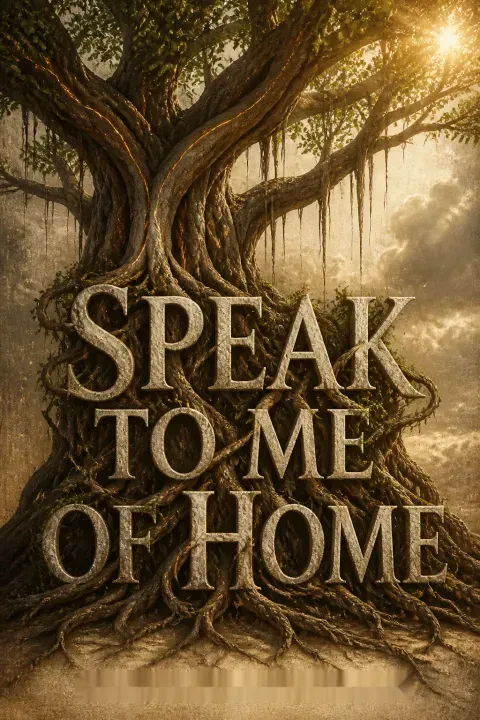
The wedding under the banyan tree is the novel's closing metaphor made literal. The banyan, described earlier in Ruth's bedside stories as a tree whose branches drop down, burrow into the earth, and become new roots, is the image of family as interconnected, self-renewing organism. Rafaela and Candido's marriage after fifty-five years apart is not a fairy-tale ending but a testament to patience and survival. The boomerang metaphor Ruth uses to describe her mother's life arc (out across oceans and decades, back to where she began) applies to the entire family: each generation has strayed and returned, each has lost and reclaimed some piece of home. The wedding registry containing only a Legend of Zelda video game, and Priti's insistence on one last party, affirm that joy and absurdity coexist with grief. The couple married beneath a tree that is its own family, its own history, providing everything it needs for itself.
Analysis
Speak to Me of Home is a novel about the stories families tell themselves to survive, and the cost of those stories when they become cages. Across three generations of women, Jeanine Cummins traces the inheritance of secrecy, the damage done by racial hierarchy, and the possibility of return even after decades of exile. The novel's title, spoken by Daisy3 in her coma as she listens to Ruth2's bedside stories, is both plea and prescription: identity is not discovered but narrated into existence, and home is wherever someone can speak it into being for you.
The book's structure, weaving between 1950s San Juan, 1970s St. Louis, 1990s New Jersey, and 2020s Puerto Rico, enacts its central argument: the past is never past. Rafaela1's decision to ignore a racist letter on her wedding day shapes Ruth2's childhood displacement. Ruth2's childhood displacement shapes her inability to give Daisy3 the cultural grounding Daisy3 craves. Daisy3's craving sends her to San Juan, where a DNA test and a hurricane force the whole buried architecture of the family into the light. The novel insists that what is hidden will eventually surface, and that the surfacing, however violent, is also liberation.
Cummins is particularly interested in the ways racial categories fail Caribbean people. Rafaela,1 whom St. Louis country club managers consider 'not white,' is also a snob who looks down on jíbaros from the mountains. Ruth,2 who checks 'white' on college applications at her mother1's insistence, is treated as Mexican by midwestern strangers. The novel refuses to resolve these contradictions into simple victimhood, instead showing how people internalize the hierarchies that oppress them and reproduce those hierarchies against their own interests. Rafaela1's cruelty toward the Morales y Reyes family is the novel's most uncomfortable moment, and Cummins does not offer absolution for it.
What the novel does offer is the possibility of repair. The final image, Rafaela1 and Candido4 marrying beneath a banyan tree whose branches drop down and become new roots, is a vision of family as self-renewing organism. The tree does not need to uproot itself to grow; it simply reaches down, again and again, into the soil where it already stands. Ruth2's return to San Juan, her halting recovery of Spanish, her work in Daisy3's shop, all suggest that home is not a place you leave and find again but a practice of attention you cultivate wherever you are. The novel's ultimate argument is that the stories we tell about ourselves become the homes we inhabit, and that the bravest act is to let the true story, however messy, finally be told.
Review Summary
People Also Read








Characters
Rafaela Acuña y Daubón Brennan
Matriarch, secret keeper, survivorBorn into wealth in San Juan, Rafaela loses her family's fortune at seventeen when her father Papamío12 is disgraced. Sent to Trinidad to work as a secretary, she marries Peter Brennan5, a white American naval officer, partly to escape her reduced circumstances and partly to evade her feelings for Candido4, the housekeeper's son she has loved since childhood. Her marriage to Peter5 is hollowed by his family's racism and his inability to protect her from the casual cruelties of life in St. Louis. She conducts a years-long affair with Candido4 after returning to San Juan, and her daughter Ruth2 is likely his child. Rafaela is vain, snobbish, and emotionally withholding, yet capable of tremendous loyalty and, in old age, radical honesty. After moving into a replica of her childhood home built by Ruth2, she reconnects with Candido4 through online video games. At seventy-six, she finally marries him.
Ruth Brennan Hayes
Daughter, widow, reluctant influencerBorn in San Juan in 1971, Ruth is six when her parents move the family to St. Louis, a relocation that strips her of her first language and her sense of belonging. She adapts more readily than her brother Benny8, making friends and losing her Spanish, but remains haunted by a feeling of never quite fitting anywhere. In college, she is torn between Thomas6, an Irish immigrant who makes her feel safe, and Arthur10, a Puerto Rican classmate who recognizes her in ways no one else does. She chooses Thomas6, and they have three children before his sudden death from a brain aneurysm when she is thirty-eight. Ruth channels her grief into The Widow's Kitchen, an Instagram project that becomes a lucrative career, but her curated presentation of beauty and resilience creates friction with her daughter Daisy3, who craves authenticity. The revelation that her biological father is Candido4, not Peter5, forces Ruth to reconsider her entire identity.
Daisy Hayes
Granddaughter, entrepreneur, truth-seekerThe youngest of Ruth2's three children, Daisy is eight when her father Thomas6 dies. She grows up feeling a powerful pull toward Puerto Rico that her mother2 cannot understand. At thirteen, a transformative summer in San Juan with her cousin Stefani15 teaches her to cook Puerto Rican food, awakens her to the liberation of a phone-free life, and plants the seed of her future. Defying Ruth2's fierce opposition, Daisy abandons college and moves permanently to San Juan, where she opens The Double Down, a vintage consignment shop. Her aesthetic is resolutely analog: rotary phones, paper business plans, handwritten price tags. She is pragmatic, stubborn, and deeply creative. A DNA test she takes with her brother Carlos7, intended as a lark, reveals family secrets that nearly kill her. After surviving a horrific scooter accident during a hurricane and a subsequent pulmonary embolism, she becomes the catalyst for her family's ultimate reconciliation.
Candido
Childhood love, hidden father, freight magnateThe son of Priti13, the Acuña family's housekeeper, Candido grows up in the same household as Rafaela1 but in a different world. His green eyes, honey-colored hair, and quiet grace make him beautiful and invisible in equal measure. He and Rafaela1 share a secret childhood friendship that deepens into love, but the class and racial hierarchies of Puerto Rican society make their relationship impossible. After the Acuña family's financial collapse, he moves to New York and later returns to San Juan, where he and Rafaela1 begin an affair that produces Ruth2. He eventually marries another woman and builds a successful freight company. Decades later, after both are widowed, he reconnects with Rafaela1 through online gaming and, when Daisy3 is hospitalized, mobilizes a private plane to bring Ruth2 and Rafaela1 to San Juan. At seventy-seven, he marries Rafaela1 under a banyan tree at the Vanderbilt.
Peter Brennan Jr.
Well-meaning husband, failed protectorA handsome naval officer from St. Louis with startling blue eyes and dark hair, Peter meets Rafaela1 in Trinidad and courts her with gentlemanly restraint. He speaks Spanish and seems to love her genuinely, but his inability to understand or defend her against the racism she faces in St. Louis corrodes their marriage. He accepts compromises like the staff locker room at the country club, believing he is keeping peace when he is actually forcing Rafaela1 to absorb humiliation. After the divorce, he remains a devoted father to Ruth2 and Benny8. In a crucial conversation with college-age Ruth2, he admits he 'just didn't realize' the toll that life in St. Louis took on Rafaela1, a confession of privileged blindness that is not quite an excuse. He legally signs away any claim to Rafaela1's inheritance, a gesture of decency that does not redeem his failures.
Thomas Hayes
Irish immigrant, devoted husband, absent fatherAn Irish immigrant from County Mayo, Thomas meets Ruth2 when he brings film to the photo lab where she works. He is older, steadier, and carries his own grief (his mother died when he was twelve, his father descended into alcoholism) with quiet dignity. His love for Ruth2 is uncomplicated and deep. He fathers Vic14, Daisy3, and Charlie7 (Carlos), and is the anchoring presence in their family until his sudden death from a brain aneurysm at thirty-eight. His death devastates Ruth2 and becomes the origin of The Widow's Kitchen. Though he is Irish, his children grow up disconnected from that heritage because Thomas's own family ties were severed by his mother's death. In Daisy3's near-death dream during the embolism surgery, Thomas appears as her father in every sense that matters, pulling back a curtain to reveal the family waiting.
Carlos Hayes-Acuña (Charlie)
Flamboyant youngest son, Broadway hopefulRuth2's youngest child, originally named Charlie, renames himself Carlos Hayes-Acuña in seventh grade, adding the Spanish name and the Acuña surname to the theater program for Beauty and the Beast. This act of self-definition confounds Ruth2, who lost the Acuña name involuntarily as a child. Carlos is a dancer and actor, flamboyant and witty, who embraces his Puerto Rican heritage with an enthusiasm Ruth2 finds bewildering. He buys the DNA test kits as a birthday gift for Daisy3, unwittingly setting in motion the revelations that will transform their family. During Daisy3's hospitalization, he is the one who finds the DNA results in her backpack and confronts their mother2, and he struggles most visibly with the emotional fallout, his usual irreverent humor failing him for the first time.
Benny Brennan
Older brother, steady anchor, property managerRuth2's older brother, Benny was nine when the family moved to St. Louis, and he never adjusted. He struggled with English, was held back a grade, and pined openly for Puerto Rico. After high school, he returned to San Juan permanently, where he became a mechanic, married a woman named Pamela, and raised four children. He serves as the family's anchor in Puerto Rico: managing properties, hosting visiting relatives, and being the first to reach Daisy3 after her accident. His return to the island is a model of intentional belonging that his sister Ruth2 never achieved. When Ruth2 calls him about Daisy3's accident during the hurricane, he does not hesitate: he leaves immediately, navigating closed roads and worsening conditions to be at his niece's bedside.
Dolores (Lola) Acuña
Beloved sister, keeper of the letter, catalyst of truthRafaela1's older sister by eighteen months, Lola is the pragmatic, earthy counterpart to Rafaela1's glamour. After her high school sweetheart dumps her following the family's financial collapse, she decides love is a treachery and becomes a math teacher and contented spinster. She builds a full, satisfying life of book clubs, card games, and cooking, proving that happiness does not require wealth or a husband. She is the one who keeps Peter Brennan Sr.'s racist letter, hiding it in her bra during Rafaela1's wedding and preserving it for decades. Her sudden death from sepsis in 1991 devastates Rafaela1 and prompts Ruth2's discovery of the letter in Lola's apartment. Through the letter, Lola becomes the unwitting agent of revelation, her preservation of the document ensuring that the family's secrets will eventually surface.
Arthur Rodríguez
College best friend, the path not takenA Puerto Rican-Dominican student at Wodsley College, Arthur is the object of Ruth2's silent obsession for two years before they finally meet at the photo lab where she works. He recognizes her Puerto Ricanness immediately, a recognition that undoes Ruth2 because no one outside her family has ever seen that part of her without explanation. Their intense friendship becomes a love affair that forces Ruth2 to choose between the belonging Arthur offers and the steady devotion of Thomas6. Arthur teaches Ruth2 to find community without hiding, but she ultimately chooses Thomas6. He reappears once, on bended knee with a ring, but Ruth2 refuses. His genetic absence from the family tree is the premise upon which the novel's climactic DNA revelation hinges.
Mamamía (María Teresa)
Elegant mother, secret entrepreneurRafaela1's mother, a stunning beauty from Mayagüez whose marriage to Papamío12 scandalized San Juan society because she was a morena marrying into an elite family. After the financial collapse, she becomes a secret stylist, renting couture to wealthy ladies who want to copy her impeccable taste. Her designer collection, stored for decades after her death, becomes the foundation inventory for Daisy3's vintage shop. She teaches her daughters, by example, that dignity survives disgrace.
Papamío (Rafael Acuña y Torres)
Disgraced patriarch, secret benefactorRafaela1's father, the municipal treasurer of San Juan whose career and reputation are destroyed by a financial scandal in 1964. The missing money is never fully explained; the novel leaves ambiguous whether he was corrupt, incompetent, or scapegoated. His greatest act of love is the irrevocable trust fund he establishes on Rafaela1's first birthday, which survives the family's bankruptcy and matures into a fortune on her thirty-fifth birthday, giving her the means to leave her unhappy marriage.
Priti
Housekeeper, second mother, Candido's fierce protectorCandido4's mother and the Acuña family's housekeeper, Priti raises her son in the downstairs bedroom of the big house while caring for Rafaela1 and Dolores9 with equal love and occasional sternness. After the family's collapse, she moves to Miami, marries a school principal, and teaches step aerobics. At ninety-two, she insists on attending Candido4 and Rafaela1's wedding, declaring she deserves one last party in San Juan.
Vic Hayes
Eldest son, practical caretakerRuth2's oldest child, emotionally reserved but reliably present. He drives family members between the hospital and Benny8's house during Daisy3's recovery, monitors his mother's eating, and provides the steady, unflappable presence that holds the family together during crisis. He is the sibling least invested in questions of identity and heritage, content to let Carlos7 and Daisy3 wrestle with those questions.
Stefani
Cousin, coconspirator, Daisy's other halfBenny8's daughter, Daisy3's age, who hosts Daisy3 during her transformative summer visits to San Juan. She helps Daisy3 clean out the previous tenant's vintage clothing, teaches her family recipes, and provides the sisterly companionship that grounds Daisy3's connection to the island. She goes to college in Florida but remains Daisy3's closest confidante, the one person who always believed in The Double Down.
Plot Devices
The Racist Letter
Buried evidence of family poisonWritten by Peter Brennan Sr. to Papamío12 in April 1968, the letter warns against Peter Jr.5's marriage to Rafaela1, calling mixed-race children 'poor half-breed offspring' and demanding documentation of Rafaela1's racial purity. Dolores9 hides the letter in her bra during the wedding ceremony and preserves it for twenty-three years. Ruth2 discovers it in 1991 while cleaning out Lola9's apartment after her death and confronts her father. The letter functions as physical proof of the racism that shaped the family's life in St. Louis, explaining Rafaela1's depression, Peter5's inadequacy, and Ruth2's lifelong confusion about her identity. It also establishes the pattern of buried documents and hidden truths that culminates with the DNA test results.
The Secret Trust Fund
Financial liberation, escape hatchOn Rafaela1's first birthday, Papamío12 locks a substantial sum into an irrevocable trust that survives the family's financial collapse in 1964. The trust matures on Rafaela1's thirty-fifth birthday in 1981, providing her with enough money to achieve financial independence from Peter5. The trust's legal structure, which Peter5 unknowingly signs away any claim to, ensures the money belongs to Rafaela1 alone. This device enables Rafaela1's divorce and her second act as an independent woman, but it also creates a tension: her freedom is purchased by the very wealth and privilege that separated her from Candido4 in childhood. The trust fund is a gift that liberates and implicates simultaneously.
The DNA Test Kits
Truth catalyst, generational unmaskerCarlos7 buys two DNA test kits as a birthday gift for Daisy3, intending them as a lighthearted exploration of their heritage. Daisy3, who hates email, requests results by postal mail, creating a delay that ensures the results arrive just as the hurricane approaches San Juan. The results show Daisy3 and Carlos7 are approximately fifty percent Puerto Rican rather than the expected twenty-five percent, a discrepancy that makes no sense given their known family history. This discrepancy forces Rafaela1's confession about her affair with Candido4 and Ruth2's true paternity. The physical paper results become a MacGuffin that Carlos7 searches for during Daisy3's coma, and their eventual discovery precipitates the novel's climactic confrontation and revelation.
The Hurricane
Crisis catalyst, forced reunionAn unusually early June hurricane strikes San Juan, grounding all commercial flights and preventing Ruth2 and Rafaela1 from reaching Daisy3 after her accident. The storm creates the conditions for Daisy3's accident (she ventures out to secure a tourist's balcony furniture) and then traps her family in New York, forcing them to rely on Benny8 and, crucially, Candido4, whose freight company plane becomes their only means of reaching San Juan. The hurricane thus becomes the mechanism that reunites Candido4 and Rafaela1 after decades apart, setting the stage for their eventual marriage. The storm's violence mirrors the emotional cataclysm about to hit the family: hidden truths, like floodwaters, will overwhelm every barrier.
Mamamía's Designer Collection
Inheritance, entrepreneurial foundationAfter Mamamía11's death, her collection of vintage designer clothing and accessories (Chanel, Dior, Gucci, Prada) is stored in Lola9's apartment closet for decades. When Rafaela1 reveals this trove to Daisy3, it becomes the inventory that launches The Double Down from a quirky vintage shop into a luxury consignment destination. The collection represents a direct line of female entrepreneurship: Mamamía11 was San Juan's secret tastemaker, renting couture to society ladies; Rafaela1 preserved the collection; Daisy3 transforms it into a business. The clothes function as a physical inheritance that bypasses Ruth2 entirely, connecting Daisy3 directly to her great-grandmother's legacy and providing the material validation of Daisy3's chosen path that Ruth2's emotional support could not.

Download PDF
Download EPUB
.epub digital book format is ideal for reading ebooks on phones, tablets, and e-readers.








































