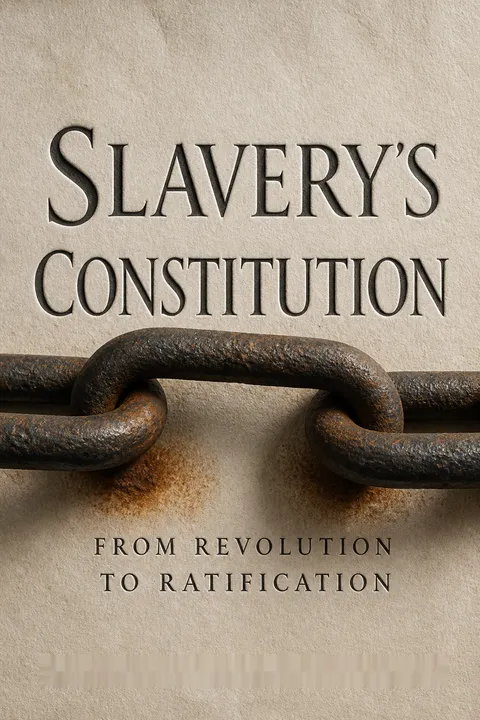

Key Takeaways
1. Slavery's Pervasive Presence in the Constitution
Of its eighty-four clauses, six are directly concerned with slaves and their owners.
Hidden in plain sight. The U.S. Constitution, famously silent on the word "slavery," is nonetheless deeply imbued with its presence. Six clauses directly address slaves and their owners, while five others carry significant implications for the institution, debated extensively by the framers. This pervasive influence, far exceeding that in the weaker Articles of Confederation, demonstrates that the Constitution was fundamentally shaped by the existence of human bondage.
Foundational protections. The document's structure, from representation to taxation and security, was designed to sustain slavery. Clauses like the three-fifths rule, the militia's role in suppressing "insurrections," and the prohibition of export taxes all served to protect slaveholders' interests. The framers, in their quest to "grow their government," inadvertently or intentionally created fundamental laws that entrenched human bondage within the new national framework.
A constitutional matter. Slavery was not merely a moral or economic issue; it was a constitutional one, defining sovereignty over individuals and property. The Constitution, by seeking to govern, inevitably sought to govern slavery, making it an unavoidable element in debates over federalism, democracy, and national identity. The framers' solutions—silence, compromise, and artful design—were not absences but deliberate choices with profound meanings, understood and debated by contemporaries.
2. The Three-Fifths Clause: Power, Not Personhood
Africans and their descendants were not being defined as three-fifths of a person, as is sometimes said, for that would have implied that the men among them deserved three-fifths of a vote, when they had none, or had three-fifths of a person’s rights before the law, when they had much less than that, usually.
A calculus of power. The infamous three-fifths clause (Article I, Section 2) did not diminish the humanity of enslaved people but rather amplified the political power and wealth of their owners. By counting three-fifths of the enslaved population for both congressional representation and direct taxation, the clause acknowledged slaves as a source of economic and political leverage for the states that held them. This meant that states with larger enslaved populations gained disproportionate influence in the House of Representatives.
Taxation and representation. This formula directly linked the number of representatives a state received to its potential tax burden, a contentious issue during the Confederation era. While slaveholders might pay more in direct taxes, the increased representation granted them greater power to influence federal tax policy, potentially regulating or even eliminating the very taxes they would pay. This created a system where "taxation with representation and slavery were joined at the hip."
A source of wealth. The clause implicitly recognized enslaved people as a significant form of property and a driver of wealth, particularly in the agricultural South. Any power granted to the House of Representatives, such as originating revenue bills, would thus benefit slaveholding states. This mechanism ensured that the federal government, from its inception, favored those who owned people, making slavery a central, rather than peripheral, element of the new American order.
3. The Mansfieldian Moment: Imperial Crisis and Slavery
The modern constitutional politics of slavery began in 1772 when black resistance, white British criticisms of slavery, and the imperial crisis converged in a profoundly important court case.
British hypocrisy exposed. The British Empire, while proclaiming "Britons never will be slaves," increasingly faced accusations of hypocrisy regarding its vast slave system. As colonists protested perceived political "enslavement" by Parliament, critics in Britain and America highlighted the actual bondage of Africans. This tension escalated, particularly after the Seven Years' War, when Britain sought greater control over its colonies, including their economies, which were heavily reliant on slave labor.
Somerset v. Steuart. The pivotal 1772 case of James Somerset, a runaway slave in London, brought this crisis to a head. Lord Mansfield, Chief Justice of the King's Bench, ruled that Somerset could not be forcibly removed from England and sold, as no positive parliamentary law sanctioned slavery on English soil. This decision, though narrowly applied, sent shockwaves through the slaveholding colonies, demonstrating that parliamentary sovereignty could threaten their property rights and local laws.
Slavery as a constitutional fulcrum. The "Mansfieldian moment" revealed that fundamental constitutional questions—like parliamentary authority versus colonial autonomy—could no longer be separated from the politics of slavery. For American slaveholders, British constitutionalism, as interpreted by Mansfield, became a direct threat. This forced them to consider how a new, independent government might protect their "peculiar institution," laying the groundwork for the intense debates over slavery at the Constitutional Convention.
4. Revolutionary Hypocrisy and Southern Secession Threats
If it is debated whether the slaves are their property, there is an end of the confederation . . . Freemen cannot be got to work in our Colonies; it is not in the ability or inclination of freemen to do the work that the negroes do.
Liberty for some. The American Revolution, fought under the banner of liberty and equality, presented a stark contradiction with the widespread practice of slavery. While figures like Thomas Jefferson privately condemned slavery, the public discourse often blamed Britain for imposing the institution, even as colonists themselves profited immensely from it. This hypocrisy was weaponized by British critics and, more powerfully, by enslaved people who sought freedom by aligning with the Crown, as seen in Lord Dunmore's Proclamation.
Threats of disunion. During the debates over the Articles of Confederation in 1776, the question of counting slaves for taxation immediately exposed deep sectional divisions. Southern delegates, particularly from South Carolina, explicitly threatened to withdraw from any union that challenged their right to property in slaves. Thomas Lynch's ultimatum underscored that for these states, the very existence of the confederation hinged on the unquestioned acceptance of slavery.
A fragile unity. The early compromises, such as the three-fifths clause for taxation in 1783, were born out of this necessity to maintain a fragile unity among the states. The revolutionaries, having emancipated themselves from British rule, found themselves unable to resolve the question of slavery collectively. Instead, they preserved local autonomy over the institution, allowing contradictory trends—emancipation in the North, entrenchment in the South—to continue, setting the stage for future national conflict.
5. The Great Compromises: Forging a Proslavery Union
The security the South[er]n States want is that their negroes, may not be taken from them, which some gentlemen within or without doors, have a very good mind to do.
A union of interests. The Constitutional Convention of 1787 was marked by a series of "great compromises" that explicitly protected and enabled slavery, ensuring the participation of southern states in the new federal union. These deals, often brokered behind closed doors, were not merely about abstract principles but about the tangible economic and political interests tied to slavery. The Connecticut Compromise, for instance, linked proportional representation in the House (with the three-fifths clause) to equal representation in the Senate, effectively tying the democratic branch to southern slaveholding interests.
Economic and political concessions. The Committee on Detail, heavily influenced by southern delegates, drafted clauses that further solidified slavery's position. These included banning federal taxes on exports (benefiting slave-produced goods) and prohibiting Congress from banning the international slave trade until 1808. These concessions were a direct response to southern threats of disunion, as articulated by Pierce Butler, who openly stated the South's demand for security against emancipation.
The Northwest Ordinance's role. The simultaneous passage of the Northwest Ordinance in 1787, which banned slavery in the territories north of the Ohio River but included a fugitive slave clause, served as a crucial "compromise of 1787." This territorial line-drawing implicitly protected slavery in the Southwest and demonstrated a willingness to make sectional deals. These interlocking provisions, though often couched in euphemism, ensured that slavery was not merely tolerated but actively safeguarded within the new constitutional framework.
6. Euphemism and Silence: Masks of the Law
The words are dark and ambiguous; such as no plain man of common sense would have used, [and] are evidently chosen to conceal from Europe, that in this enlightened country, the practice of slavery has its advocates among men in the highest stations.
Deliberate ambiguity. The framers of the Constitution consciously avoided using the word "slavery," opting instead for euphemisms like "such Persons," "bound to Service or Labour," and "domestic violence" (later "insurrections"). This deliberate ambiguity, as noted by antifederalist critics, served to obscure the institution's pervasive role in the document and manage the moral discomfort of creating a republic founded on both liberty and bondage. It was a strategic choice to present a unified front, particularly to a European audience.
Containing the debate. This "silence" was not an absence but a mechanism to contain the volatile issue of slavery within the bounds of political discourse. By not explicitly theorizing slavery as right or wrong, the Constitution allowed for different interpretations and future outcomes, while simultaneously enacting mechanisms that empowered slaveholders. This approach, which the author calls "the Madisonian moment," transformed deep disagreements into a structure that managed doubts and conflicts about nationhood and slavery itself.
A political virtue. Benjamin Franklin, in his closing remarks at the Convention, justified this approach, urging delegates to project unanimity and sacrifice individual objections for the "public good." This emphasis on the appearance of consensus, even over contentious issues like slavery, became a political virtue. The "masks of the law" allowed the founders to nationalize and constitutionalize slavery without feeling personally implicated, effectively depoliticizing the issue in mainstream national debate for decades to come.
7. Antifederalist Critique: Slavery as a Constitutional Flaw
Will it not be said, that the greatest Sticklers for Liberty, are its worst Enemies?
A betrayal of principles. Opponents of the Constitution, the Antifederalists, quickly identified the slavery compromises as fundamental flaws, arguing they betrayed the Revolution's ideals and undermined republican government. They saw the three-fifths clause, the protected slave trade, and the fugitive slave clause not as isolated concessions but as integral to a document they viewed as aristocratic, undemocratic, and potentially deceitful. For them, the Constitution's dealings with slavery typified its tightly interwoven problems.
Slavery and political corruption. Antifederalists like Samuel Bryan ("Centinel") and Melancton Smith ("Federal Farmer") argued that the Constitution's protections for slavery would corrupt representation, give "unreasonable weight" to the South, and encourage the slave trade. They questioned the moral integrity of leaders who, having fought for their own liberty, now sanctioned the enslavement of others. Benjamin Gale, a Connecticut antifederalist, denounced the Constitution as a "perfect system of slavery" that would reduce common people to "vassalage."
A challenge to federalism. These critics also challenged the Federalists' selective federalism, pointing out the hypocrisy of allowing slavery to escape national oversight while centralizing power in other areas. They argued that a government with expansive powers could not avoid governing slavery, and its ambiguities posed an unlimited threat to state sovereignty and individual liberties. The Antifederalists' doomed struggle against the Constitution, however, ensured that antislavery became a persistent, if marginalized, tradition of American dissent.
8. Federalist Defense: Compromise, Blame, and False Promises
The regulation complained of was one result of the spirit of accommodation, which governed the Convention; and without this indulgence, no union could possibly have been formed.
Justifying the deals. Federalists, facing intense criticism, developed a multi-pronged strategy to defend the Constitution's slavery clauses. They celebrated the spirit of compromise as essential for union, arguing that without concessions to southern interests, no national government could have been formed. Alexander Hamilton, in the New York ratification convention, explicitly explained the compromises as necessary indulgences for the "Southern States" due to their "staples" and economic importance.
Blame and false hope. Federalists often deflected blame onto the Deep South, portraying their demands for slavery's protection as unavoidable "necessary evils." Simultaneously, they exaggerated the Constitution's antislavery implications, particularly regarding the slave trade. Figures like James Wilson and Noah Webster claimed that the 1808 end date for the slave trade would mark the beginning of slavery's eventual demise, a "mortal wound" that would lead to gradual emancipation.
Madison's nuanced defense. James Madison, in The Federalist Papers, skillfully navigated these treacherous waters. He presented the slave trade clause as a "great point gained in favor of humanity" and defended the three-fifths clause by ventriloquizing a "southern brethren" who argued for slaves as both persons and property. Madison's arguments, while intellectually sophisticated, served to rationalize slavery's place within the constitutional framework, portraying it as a balanced, if imperfect, reflection of existing state laws and economic realities.
9. Slavery's Enduring Legacy: From Constitution to Civil War
In this sense, slavery did not itself cause the Civil War. Slavery’s Constitution did.
A nationalized institution. The compromises and silences embedded in the Constitution did not resolve the issue of slavery but rather nationalized it, making it central to American politics for decades to come. The framers' artful design, intended to manage doubts and conflicts, instead created a framework where slavery became inextricably linked to every major political, economic, and social issue. This constitutionalization of slavery ensured its survival and expansion, rather than its gradual demise.
Fueling sectional conflict. The Constitution's provisions, from representation to federal power over insurrections and the fugitive slave clause, empowered slaveholders and deepened sectional divides. What began as a series of pragmatic deals evolved into a volatile political system where "the act of talking publicly about slavery" became a threat to the union itself. Subsequent compromises, like the Missouri Compromise and the Compromise of 1850, merely postponed an inevitable reckoning.
The ultimate reckoning. By the mid-19th century, the constitutional politics of slavery had become politics itself. The clarity that antislavery politicians eventually achieved, articulating a vision of a nation fundamentally at odds with slavery, directly challenged the Constitution's carefully constructed ambiguities. When the Confederacy formed, its constitution explicitly protected slavery, mirroring the 1787 document but removing its euphemisms. The Civil War, therefore, was not just a conflict over slavery, but a battle over the very meaning and structure of "Slavery's Constitution."
Review Summary
Slavery's Constitution receives mixed reviews (3.69/5) on Goodreads. Many readers acknowledge Waldstreicher's argument that the Constitution was "nominally neutral but operationally pro-slavery," with six clauses directly addressing slavery without naming it. Critics find the book repetitive, poorly written, and difficult to follow. Some dispute the premise that slavery dominated the founding, arguing the Constitution was neutral or that other issues were equally important. Supporters praise its concise examination of how slavery shaped ratification debates and gave Southern states disproportionate power through the three-fifths compromise and Electoral College.
People Also Read


Download PDF
Download EPUB
.epub digital book format is ideal for reading ebooks on phones, tablets, and e-readers.








































