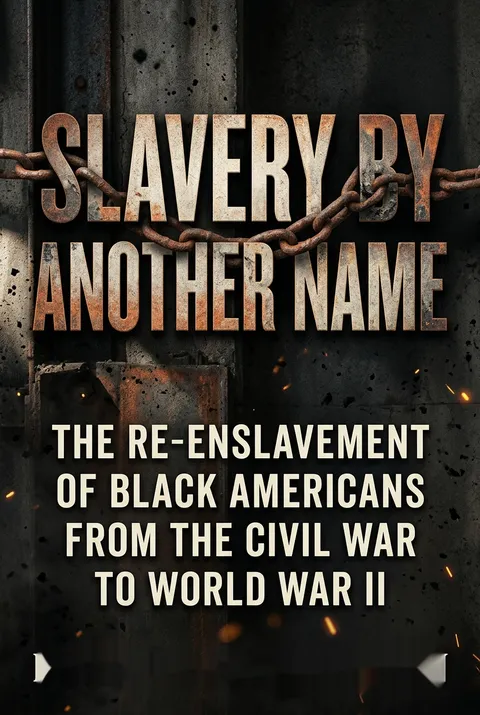

Key Takeaways
1. The Illusion of Post-Civil War Freedom
The long controversy over the black man seems to have reached a finality.
Shattered hopes. The end of the Civil War brought a brief, exhilarating period of freedom for Black Americans, symbolized by events like Henry and Mary Cottinham's wedding in 1868. However, this hope was quickly dashed by a virulent white insurgency determined to reverse the gains of emancipation. Despite constitutional amendments granting citizenship and voting rights, a new social order emerged that systematically stripped Black Americans of their newfound liberties.
White resistance. White southerners, devastated by war and the loss of slave labor, viewed Black freedom not as an extension of liberty but as a violation of their own. They organized vigilante groups like the Ku Klux Klan, intimidated Union agents, and waged propaganda campaigns to blame freed slaves for the region's chaos. This widespread animosity laid the groundwork for decades of repression, ensuring that the promise of equality remained largely unfulfilled.
A new paradox. The post-Civil War South presented a profound paradox: a society that had fought to preserve slavery now struggled to manage a free Black population it deemed essential yet inferior. The initial years saw attempts to coerce former slaves into "lifetime contracts" or onerous year-to-year agreements that mirrored antebellum bondage, setting a precedent for the systemic re-enslavement that would follow.
2. Industrial Slavery: A Precedent for Post-Emancipation Exploitation
The South’s highly evolved system of seizing, breeding, wholesaling, and retailing slaves was invaluable in the final years before the Civil War, as slavery proved in industrial settings to be more flexible and dynamic than even most slave owners could have otherwise believed.
Antebellum origins. Even before the Civil War, a brutal form of industrial slavery flourished in the South, particularly in mines, ironworks, and railroad construction. Unlike agrarian slavery, which sometimes had paternalistic undertones, industrial slavery treated Black laborers as expendable assets, valued solely for their brute strength and productivity. This model, focused on maximizing output with minimal care, proved highly "effective" and resilient.
Wartime expansion. During the Civil War, the Confederacy aggressively expanded industrial slavery to support its war effort. Thousands of slaves, including Green Cottenham's grandfather Scipio, were forcibly impressed into mines and foundries to produce iron, coal, and armaments. This wartime experience demonstrated to Southern industrialists like John T. Milner that Black labor, when marshaled and coerced, could be the engine of complex industrial enterprises.
A blueprint for the future. The practices of leasing slaves from owners, consuming their labor, and accepting high mortality rates in industrial settings provided a chilling blueprint for post-emancipation exploitation. These industrialists, raised in the traditions of bondage, quickly adapted their methods to the new legal landscape, seeing in the "management" of Black laborers the key to rebuilding the South's economy and fending off Northern influence.
3. Convict Leasing: A System of State-Sanctioned Re-enslavement
Forcing convicts to work as part of punishment for an ostensible crime was clearly legal too; the Thirteenth Amendment to the Constitution, adopted in 1865 to formally abolish slavery, specifically permitted involuntary servitude as a punishment for “duly convicted” criminals.
Legal loophole. The Thirteenth Amendment, while abolishing slavery, contained a critical loophole: it permitted involuntary servitude as punishment for a crime. Southern states swiftly exploited this, enacting "Black Codes" and later "Jim Crow" laws that criminalized routine Black behaviors. These laws, though ostensibly race-neutral, were enforced almost exclusively against Black men, creating a vast pool of "criminals."
Profitable enterprise. Beginning in the late 1860s, Southern states and counties began leasing these Black prisoners to private companies—mines, lumber camps, farms, and factories. This system was incredibly lucrative, generating millions in revenue for cash-strapped governments and providing cheap, captive labor for burgeoning industries. Sheriffs and judges, whose salaries often depended on fees from arrests and convictions, were incentivized to incarcerate as many Black men as possible.
Dehumanizing conditions. The convict leasing system replicated the worst aspects of slavery, often exceeding its brutality. Prisoners faced squalid living conditions, inadequate food, and rampant disease. They were subjected to relentless physical abuse, including severe whippings and torture, for failing to meet impossible work quotas. High mortality rates were common, with companies facing no financial penalty for the deaths of these expendable laborers.
4. Debt Peonage: Binding Black Laborers to the Land
The black men who confessed judgment avoided being sold into the slave mines, but traded that fate for onerous labor contracts closer to home or working under men they had at least elementary knowledge of—their present landlord, or often with the same farm families under whom they or their slave forebears had worked in antebellum times.
A new form of bondage. Beyond the formal convict lease system, debt peonage emerged as another pervasive form of neo-slavery. White farmers and landowners would advance money or supplies to Black tenants at the start of a crop season. If the Black laborer fell behind on payments, the landowner would swear out a criminal warrant, accusing them of fraud or contract violation.
"Confessing judgment." Faced with certain conviction by a white judge, Black laborers were coerced into "confessing judgment." This archaic legal concept allowed the white landowner to pay the alleged fine and costs on the Black man's behalf, in return for a signed contract binding the laborer to work without compensation until the "debt" was repaid. These contracts often included provisions for indefinite extensions due to new charges or "expenses."
Indefinite servitude. The system created a cycle of perpetual indebtedness. Black workers, like John Davis, found themselves trapped on farms, unable to leave until all debts were paid—a condition often impossible to achieve. They were subject to imprisonment, shackles, and the lash, effectively returning them to a state of uncompensated servitude on the very lands they had worked as free men, or even as slaves.
5. Unspeakable Brutality and Dehumanization in Labor Camps
“Day after day we looked Death in the face & was afraid to speak.”
A reign of terror. Life in the forced labor camps and mines was a nightmare of human suffering. Prisoners, like Green Cottenham at Slope No. 12, endured grueling labor from before dawn until late night, often in pitch-black, poorly ventilated tunnels filled with toxic gases and contaminated water. They were constantly under the threat of violence for failing to meet impossible quotas.
Methods of torture. Guards, often vulgar and inebriated, employed sadistic punishments:
- Whipping: Frequent lashings with thick leather straps, often until skin peeled from backs.
- "Come-a-longs": Steel bracelets twisted arms into knots.
- "The chains": Prisoners hung by handcuffs for hours.
- "Pick shackles": Sharpened pick heads riveted to ankles, making escape impossible and causing severe infections.
- "Water cure": Stripping men naked and plunging them headfirst into barrels of water until near-drowning.
Dehumanization and death. Sexual abuse was rampant, with younger men and boys often forced into "gal-boy" roles. Homicides were common, and bodies of the dead were often dumped in shallow graves or incinerated in coke ovens. The sheer brutality and dehumanization in these camps, where men were "degraded to a plane lower than the brutes," ensured compliance through terror and extinguished any hope of resistance.
6. Federal Government's Failed Crusade Against Neo-Slavery
“The South … is in the hands of unfriendly white men… It has been left to the Federal Government, under that administration of President Roosevelt, to expose this iniquity …and stretch out the long arm of the Nation to punish and prevent it.”
Roosevelt's intervention. In 1903, President Theodore Roosevelt, driven by a mix of progressive ideals and political ambition, launched an unprecedented federal investigation into peonage in the South. Sparked by reports from U.S. District Court Judge Thomas G. Jones and U.S. Attorney Warren S. Reese Jr., the inquiry exposed widespread slavery in Alabama, particularly in Tallapoosa County. This marked a rare moment of federal willingness to challenge Southern racial practices.
Southern defiance. The federal efforts were met with fierce resistance and outrage from white Southerners, who viewed it as an unconstitutional intrusion into state affairs. Politicians like J. Thomas Heflin denounced federal agents as "nigger lovers" and rallied support for the accused slaveholders. Despite overwhelming evidence of guilt, juries often deadlocked or acquitted white defendants, demonstrating the deep-seated racial bias of the Southern legal system.
A hollow victory. While some prominent slaveholders like John W. Pace pleaded guilty, their sentences were often lenient or suspended, and they continued to operate their enterprises. The Supreme Court's subsequent rulings further weakened federal jurisdiction over peonage, effectively ceding control back to the states. This federal retreat, coupled with the pervasive intimidation of Black witnesses, ensured that the "crusade" ultimately failed to dismantle the systemic nature of neo-slavery.
7. The Pervasive Ideology of White Supremacy
“The character of a Negro and knows that there is no punishment in the world that can take the place of the lash with him. He must be controlled that way.”
Justifying oppression. The re-enslavement of Black Americans was underpinned by a pervasive and evolving ideology of white supremacy. This ideology, articulated by politicians, scientists, and popular culture, asserted the inherent inferiority of Black people and justified their subjugation. It claimed that Black individuals were naturally prone to criminality, idleness, and immorality, thus requiring strict control and physical punishment.
"Scientific" racism. New interpretations of Darwinian evolution were twisted to provide a "scientific" rationale for racial hierarchy. Anthropologists and physicians published studies purporting to show Black physical and intellectual inferiority, even comparing Black features to barnyard animals. This "science" was used to argue that Black people were incapable of self-governance or full citizenship and that a "mild form of slavery" was their natural state.
Cultural reinforcement. Popular culture, through best-selling novels like Thomas Dixon Jr.'s The Leopard's Spots and later films like The Birth of a Nation, romanticized the antebellum South and demonized Black political participation. These narratives, widely embraced by white Americans in both the North and South, cemented a revised history where the Civil War had sufficiently addressed slavery, and any remaining Black grievances were due to their own inherent flaws, not systemic oppression.
8. Major Corporations Profited from Forced Labor
“This great corporation has probably done more toward the industrial development of the South than any other agency.”
Industrial engine. Major industrial corporations, both Southern and Northern-owned, were central to the perpetuation of neo-slavery. Companies like Tennessee Coal, Iron & Railroad (TCI), Sloss-Sheffield Iron and Steel, and Chattahoochee Brick Company aggressively acquired thousands of Black forced laborers. These companies, often lauded as engines of the "New South," relied on this cheap, captive workforce to fuel their booming production of coal, iron, steel, and building materials.
Economic incentives. Forced labor provided an ideal solution to labor shortages and a powerful weapon against unionization efforts by free workers. Convicts, unable to strike or demand higher wages, ensured continuous operation and suppressed labor costs. Executives like Erskine Ramsey of TCI privately acknowledged the "very remunerative" nature of convict operations, even as they publicly complained about the quality of convict labor.
Corporate complicity. The acquisition of TCI by U.S. Steel in 1907, one of the largest financial transactions of its time, brought the nation's largest corporation into direct ownership of slave mines. Despite claims from U.S. Steel chairman Elbert H. Gary that he ordered an end to the practice, the company continued to lease thousands of Black prisoners for years, citing the "certainty of a supply of coal" during labor disputes. This demonstrated a deep corporate entanglement with and reliance on the system.
9. The End of Neo-Slavery: A Response to Global Forces
“In the United States one cannot sell himself as a peon or slave—the law is fixed and established to protect the weak-minded, the poor, the miserable.”
A slow decline. The formal state-sanctioned convict leasing system began to decline in some Southern states in the early 20th century, often due to political scandals, changing economic conditions, or public outcry over extreme brutality. However, this did not mean the end of forced labor. Instead, it often shifted to county-level chain gangs or informal debt peonage, which continued unabated.
World War II's catalyst. The true turning point came with World War II. As the U.S. mobilized for a global conflict against fascist ideologies, the stark contradiction of widespread slavery at home became an international embarrassment and a propaganda vulnerability. President Franklin D. Roosevelt and Attorney General Francis Biddle recognized that the nation could not credibly fight for freedom abroad while tolerating involuntary servitude at home.
Federal re-engagement. In 1941, Biddle issued a directive explicitly repudiating the long-standing federal policy of ignoring peonage complaints. He ordered federal prosecutors to aggressively pursue cases of "involuntary servitude and slavery," leveraging existing statutes like the Slave Kidnapping Act. This renewed federal commitment, driven by wartime imperatives and international scrutiny, finally began to dismantle the entrenched system of neo-slavery.
10. The Enduring Legacy of a Forgotten Past
As painful as it may be to plow the past, among the ephemera left behind by generations crushed in the wheels of American white supremacy are telling explanations for the fissures that still thread our society.
A hidden history. The long persistence of American neo-slavery, extending well into the mid-20th century, remains largely ignored in mainstream historical narratives. This omission distorts our understanding of the past, creating a mythology that glosses over the brutal realities faced by Black Americans for generations after the Civil War. The stories of individuals like Green Cottenham, who died enslaved in 1908, highlight the shocking recency of this oppression.
Profound impact. The legacy of neo-slavery profoundly shaped American society, particularly for Black communities:
- Mistrust of institutions: Generations of false arrests, sham trials, and systemic injustice fostered a deep and enduring mistrust of the legal and governmental systems.
- Economic disparities: The forced labor system systematically denied Black Americans the opportunity to accumulate wealth, land, and education, contributing directly to persistent economic inequality.
- Social trauma: The constant threat of re-enslavement, violence, and dehumanization left deep psychological scars on individuals and communities, impacting family structures and social mobility for decades.
Confronting the truth. Acknowledging this "Age of Neoslavery" is crucial for understanding contemporary racial disparities and fostering genuine reconciliation. Corporations that profited from forced labor, and families whose wealth was built on it, often remain unaware or unwilling to confront this past. However, as some institutions like Wachovia Bank have shown, a frank reckoning with this history, though painful, can lead to deeper understanding, trust, and a more just path forward.
Review Summary
Slavery by Another Name reveals how forced labor continued in the American South for decades after the Civil War through convict leasing systems. Reviewers praise Blackmon's meticulous research documenting how African Americans were arrested on false charges like vagrancy, then sold to corporations and forced into brutal labor conditions worse than antebellum slavery. The book exposes widespread participation by major companies, government officials, and the justice system. Readers found it eye-opening, emotionally difficult, and essential reading, though some criticized repetitive writing. Most emphasized it fills crucial gaps in American history education.
People Also Read


Download PDF
Download EPUB
.epub digital book format is ideal for reading ebooks on phones, tablets, and e-readers.








































