

Key Takeaways
Build a complete behavioral profile of anyone in six minutes
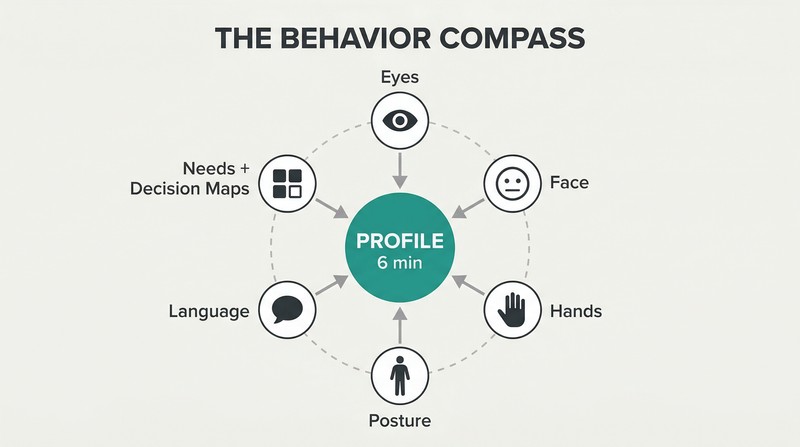
The 6MX is a layered system. Developed by Chase Hughes over 20 years for military intelligence, it combines observation of unconscious body signals — eyes, face, hands, posture — with language analysis and two profiling frameworks (the Human Needs Map and the Decision Map) to decode someone's hidden fears, decision patterns, and social drives within a single conversation.
The operational tool is the Behavior Compass, a circular profiling form where you jot abbreviations for each element as you observe them. For training, Hughes designed the Quadrant — a post-it-note-sized grid limiting focus to four behaviors at a time. The core principle throughout: never read a single gesture in isolation. You're tracking changes from someone's baseline behavior and identifying the conversational context that triggered each shift.
See the hurt child behind every adult's mask
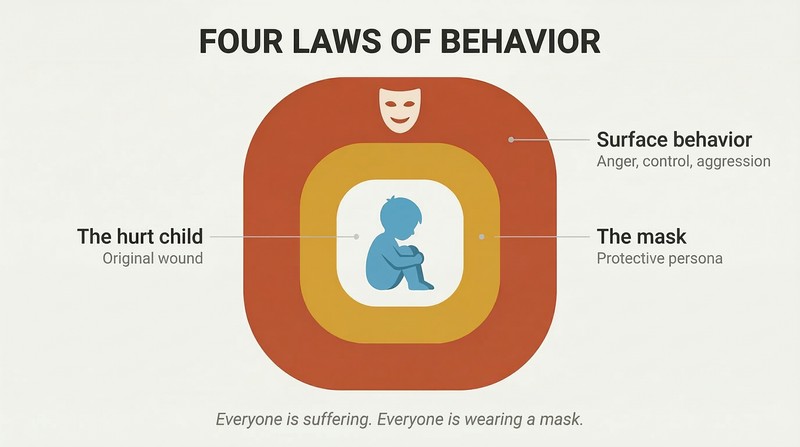
Hughes built 6MX on Four Laws of Behavior:
1. Everyone is suffering and insecure
2. Everyone is wearing a mask
3. Everyone pretends not to wear a mask
4. Everyone is a product of childhood suffering and reward
He reframes the road-rage driver who cuts you off — not as an asshole, but as a little boy who was once hurt and promised himself, "I will never be hurt again." The person who corrects everything you say? A child whose parents made her feel stupid. The highest lens is viewing people as "Reasons" — seeing all behavior as the product of pain and childhood experiences. This eliminates judgment, just as you wouldn't blame a bee for stinging. It also makes reading people dramatically easier, because empathy opens doors that analysis alone cannot.
Track blink rate to detect stress and interest instantly
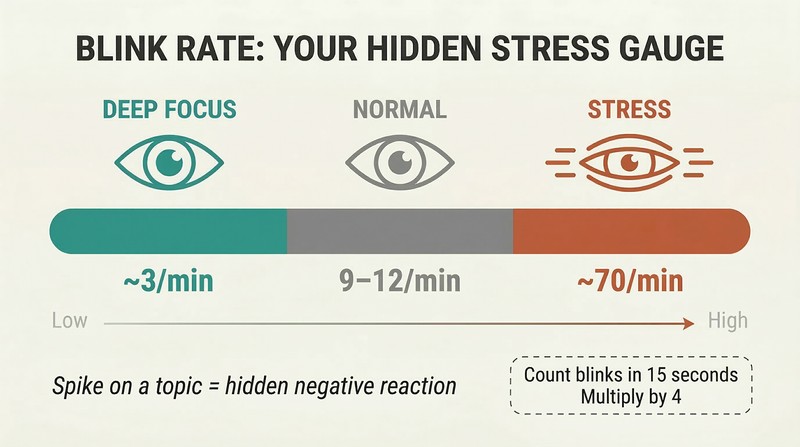
Normal blink rate runs 9 – 12 per minute. Under stress, it spikes to 70. During deep focus, it drops to 3. Count blinks in a 15-second window and multiply by four — this rough estimate instantly reveals whether someone is engaged or distressed. If blink rate spikes when you mention contract terms, that topic is causing a hidden negative reaction.
Eyes reveal even more. Gestural Hemispheric Tendency tracks which direction someone looks when recalling positive versus negative memories — then you move to their positive side when closing a deal. Eye Home establishes their default gaze direction for memory retrieval; deviations during specific questions flag potential fabrication. Shutter speed — how fast eyelids open and close — measures fear: faster closure means greater fear.
Lips and fingers broadcast objections people never say aloud
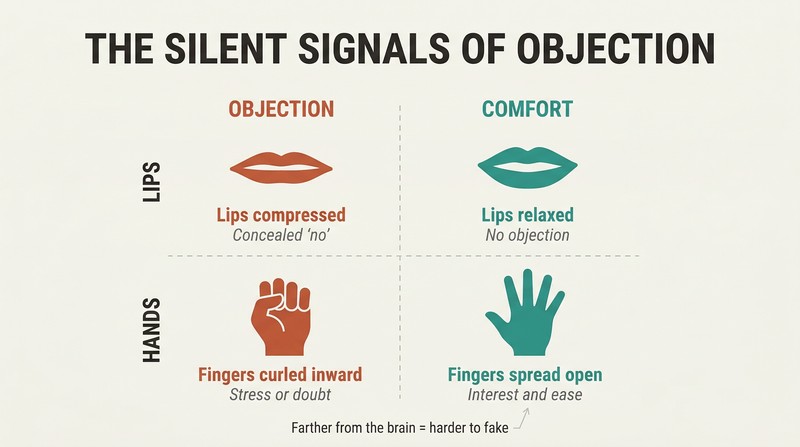
Lip compression — lips squeezing shut — is one of humanity's earliest "no" signals, rooted in infant breastfeeding refusal. When an adult says "That sounds great" while their lips compress, you've spotted a concealed objection that could kill a deal later. Object insertion — placing a pen or fingertip past the teeth — signals a need for reassurance about whatever was just discussed.
Fingers are equally revealing. Digital flexion (fingers curling inward) signals disagreement, stress, or doubt. Digital extension (fingers relaxing outward) signals comfort and interest. Since hands are far from the brain, they're nearly impossible to consciously control. Spotting extension when you name your price means the number is favorable. Spotting flexion when you mention a warranty pinpoints exactly where the objection hides.
No single behavior proves lying — cluster multiple stress signals
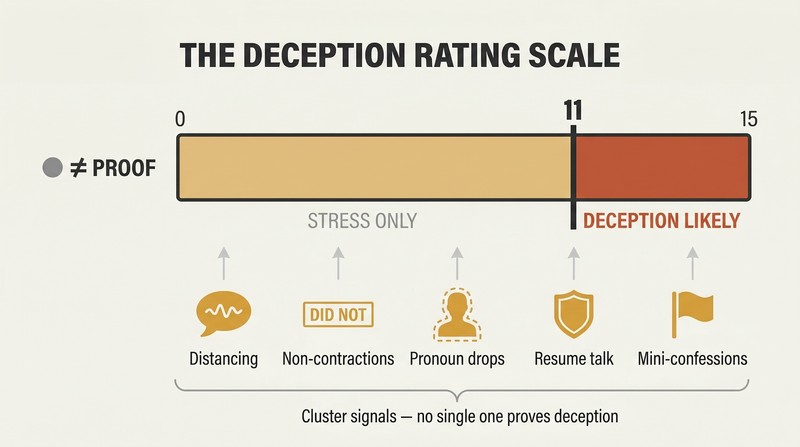
Even polygraphs only measure stress, which is why they're inadmissible in court. Hughes created the Deception Rating Scale: if stress signals tally above 11 points during a question-and-answer exchange, deception is highly likely. This is the antidote to the Attribution Error — assigning one meaning to one gesture without context.
Key verbal stress markers to cluster:
1. Psychological distancing — softening harsh words ("hurt" instead of "kill") and dropping victims' names
2. Non-contractions — "I did not" instead of "I didn't," mimicking technical-manual language
3. Pronoun absence — deceptive statements contain fewer pronouns than truthful speech
4. Resume statements — listing personal virtues instead of directly answering the question
5. Mini-confessions — confessing to smaller offenses to appear honest and derail questioning
Extract secrets with statements, not questions
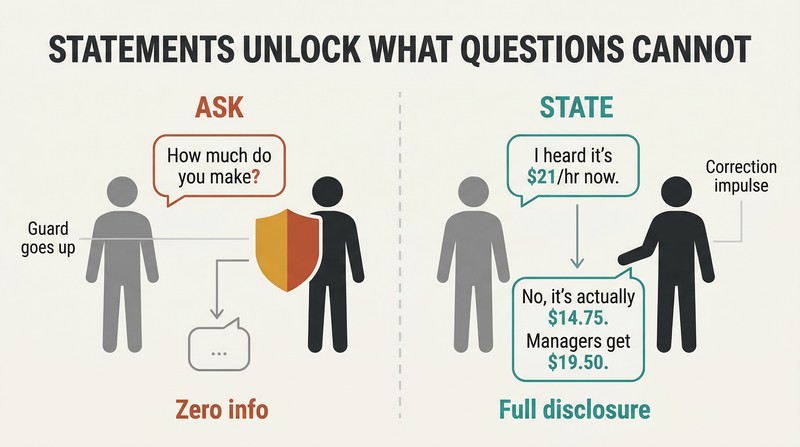
Elicitation is the intelligence art of obtaining information without direct questions. Hughes demonstrates by telling a grocery store employee, "I just read you all got bumped up to $21 an hour." She corrects him: "What? No. We only make $14.75 here unless you're a manager. Managers make like $19.50." Income obtained voluntarily — zero offense given — by triggering the human need to correct the record.
Nine techniques include provocative statements ("I bet that's exhausting"), citations (stating false info to trigger corrections), disbelief ("There's no way you're profitable"), naïveté (feigning ignorance about someone's expertise), and bracketing (offering a number range to elicit the real figure). The Hourglass Method buries sensitive gathering in a conversation's middle, exploiting our tendency to remember beginnings and endings more vividly than middles.
Map someone's social need to reveal their deepest fear
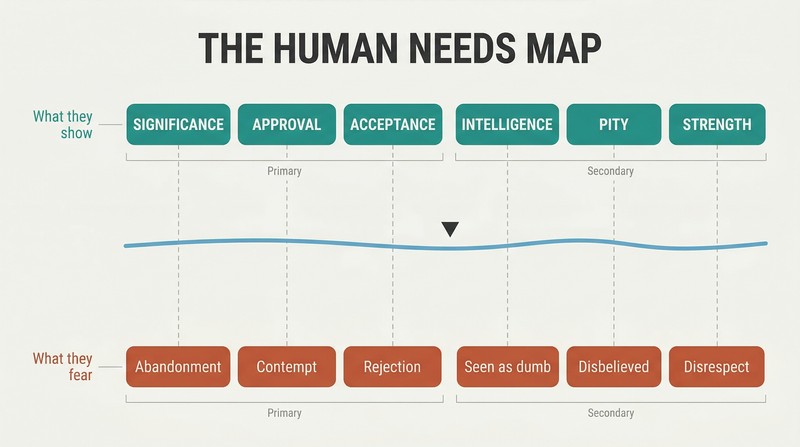
The Human Needs Map identifies six social drives — three primary (Significance, Approval, Acceptance) and three secondary (Intelligence, Pity, Strength). Each represents an unconscious question: the Significance person asks "Do others view me as impactful?"; the Pity person asks "Do others realize how bad I've had it?"
Each need maps directly to hidden fears:
1. Significance — fears abandonment and being ignored
2. Approval — fears dismissal and contempt
3. Acceptance — fears gossip and peer rejection
4. Intelligence — fears being seen as dumb
5. Pity — fears being disbelieved or disregarded
6. Strength — fears disrespect and being challenged
Hughes argues these needs operate like chemical addictions. Neuropeptides flood the body when a social need is met, and over time, cellular receptor sites rebuild to demand more of that specific chemical — the secret fifth law of behavior.
Six decision filters explain every purchase, partner, and confession
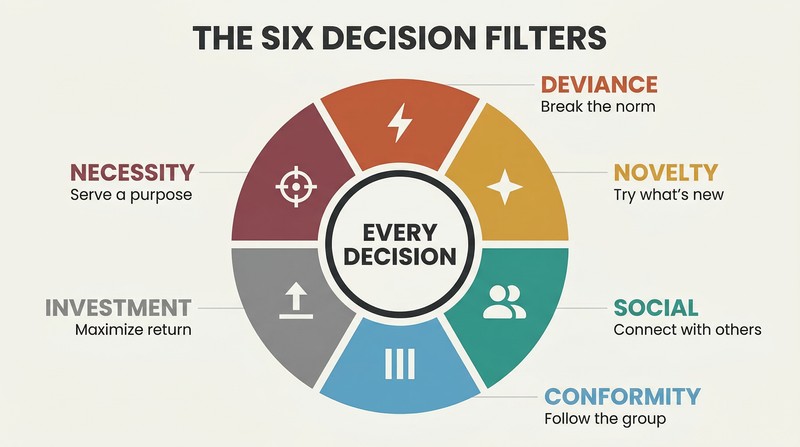
The Decision Map identifies six styles filtering every choice: Deviance (will this break norms?), Novelty (is this noticeably new?), Social (will people connect with me?), Conformity (are my peers doing this?), Investment (what's my return?), and Necessity (does this serve a specific purpose?). Adjacent styles bleed into each other.
A cell phone case test makes it vivid. The Deviance buyer grabs the cat-shaped case. Novelty picks a transparent case to showcase their brand-new phone. Conformity picks whatever everyone else has. Necessity picks the cheapest option. When paired with the Human Needs Map, these two frameworks decode both what someone fears and how they decide. In interrogations lasting five-plus hours, Hughes observed confessions came within minutes once interrogators accidentally matched the suspect's decision style.
Mirror their sensory words, pronouns, and adjectives to persuade
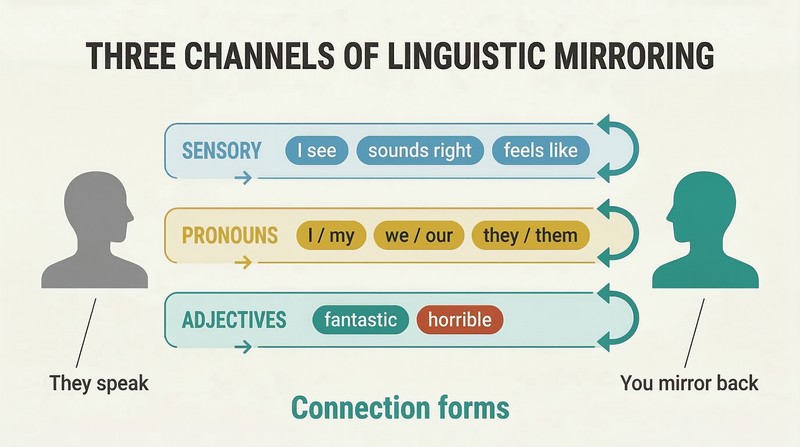
Linguistic harvesting tracks three speech patterns. First, sensory preference: visual people say "I see what you mean," auditory people say "that sounds right," kinesthetic people say "something doesn't feel right." Matching their sensory vocabulary makes your message resonate dramatically more.
Second, pronoun identification: Self-focused users emphasize "I" and "my"; Team-focused users say "we" and "our"; Others-focused users highlight people they've met. Frame your pitch accordingly. Third, adjective tracking: catalog which words someone pairs with things they like ("fantastic," "brilliant") versus dislike ("horrible," "outdated"). When closing, deploy their positive adjectives to describe your offering and their negative adjectives to describe the competition or consequences of inaction.
Lead someone's body first and their mind will follow
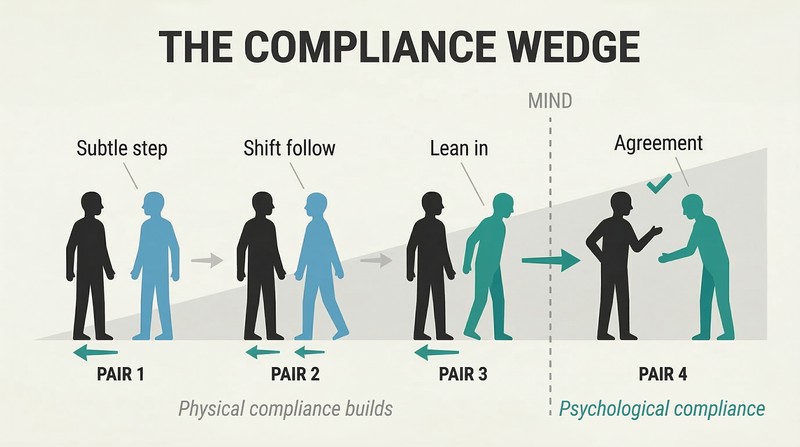
Hughes teaches the compliance wedge. At conversation's start, take a small sideways step as you shake hands — forcing the other person to subtly adjust their facing direction. They followed unconsciously. A minute later, shift again. Then step back to create a "social vacuum" they fill by stepping forward. Each micro-adjustment deepens a nonverbal pattern of following that transfers to psychological compliance.
Agreement prep is the closer. Never ask for a major commitment while someone's back touches the chair. If they're leaned back, hand them a pen, slide a document across the table — anything requiring them to lean forward. Once their posture mimics decision-making engagement, you close. The principle is biological: sitting upright makes confidence easier; slouching makes it harder. Bodies prime minds before words ever arrive.
Analysis
Hughes' 6MX represents an ambitious synthesis of behavioral science tradecraft for civilian use. Its intellectual ancestry is traceable — Eckman's facial coding, Navarro's nonverbal intelligence, NLP's sensory preference model from Satir and Perls, Maslow's hierarchy, and Rotter's locus of control. Hughes' contribution is integration: layering these disparate tools into a single profiling workflow executable within a six-minute conversation.
The system's greatest intellectual contribution is its insistence on context over catalog. Unlike most body language books compiling gesture dictionaries ('crossed arms means defensive'), Hughes repeatedly warns against the Attribution Error — assigning one meaning to one gesture. A lip compression means nothing without knowing the sentence that preceded it. This principle, while unremarkable in academic kinesics, is radical in popular body language literature, which thrives on simple gesture-to-meaning mappings.
The empirical foundation deserves honest scrutiny. The Human Needs Map and Decision Map are field-tested frameworks, not peer-reviewed models. The neuropeptide addiction analogy — while pedagogically compelling — oversimplifies receptor neurobiology. Social drives and substance addiction share some dopaminergic pathways, but claiming receptor sites rebuild to match someone's dominant social need stretches molecular biology well beyond current evidence.
The elicitation chapter may be the book's highest-value content, drawing directly from HUMINT methodology with concrete, reproducible conversational scripts. The grocery store salary example is pedagogically brilliant — memorable, testable, and immediately applicable.
What's most compelling is Hughes' implicit argument about expertise. By insisting skill beats knowledge and offering a 25-week progressive training plan, he applies deliberate practice theory to social cognition. The Quadrant method — limiting focus to four behaviors at a time — is sound instructional design regardless of whether every behavioral claim survives laboratory scrutiny. The system's lasting value may lie less in the precision of each indicator and more in the attentional discipline it cultivates: the habit of watching people carefully, noting context, and always asking what changed and why.
Review Summary
Six-Minute X-Ray receives mixed reviews, with praise for its concise, practical approach to behavior profiling and body language analysis. Many find it insightful and applicable to various fields. Critics note poor writing quality, lack of scientific references, and repetitive content. Some view it as overly simplistic or manipulative. Positive reviewers appreciate the actionable techniques and training plan, while others see it as a sales pitch for further courses. Overall, readers value the potential impact but debate its presentation and credibility.
People Also Read







Glossary
6MX (Six-Minute X-Ray)
rapid behavior profiling systemA rapid behavior profiling system developed by Chase Hughes for military intelligence, combining observation of unconscious body signals, language analysis, and two profiling frameworks (the Human Needs Map and Decision Map) to decode someone's hidden fears, decision patterns, and social drives within six minutes of conversation.
Behavioral Table of Elements (BTE)
comprehensive behavior reference chartA single-page reference chart organizing all identified human behaviors in a grid format resembling the Periodic Table of Elements. Developed by Hughes for analyzing overseas interrogations, it categorizes behaviors by body region, stress/deception rating, cultural prevalence, and gender propensity. Used in FBI training and hundreds of police departments worldwide.
Human Needs Map
six core social drivesA profiling framework identifying six social needs—three primary (Significance, Approval, Acceptance) and three secondary (Intelligence, Pity, Strength). Each need represents an unconscious question someone asks in social settings and maps to specific hidden fears that drive behavior and decision-making. Hughes argues these needs operate like chemical addictions through neuropeptide receptor dynamics.
Decision Map
six decision-style filtersA framework of six interrelated decision styles—Deviance, Novelty, Social, Conformity, Investment, and Necessity—each associated with a filtering question that governs how a person evaluates choices. Adjacent styles influence each other, and most people exhibit two of the six categories. Applicable to purchases, relationships, and interrogation confessions alike.
Behavior Compass
circular behavioral profiling formA circular form used to record a complete behavioral profile during conversation. Contains abbreviations for all 6MX elements—Decision Map location, handedness, sensory preference, pronoun usage, locus of control, Human Needs Map needs, and a central Quadrant for real-time behavioral observations. With practice, a full Behavior Compass can be completed mentally during a six-minute conversation.
The Quadrant
four-slot training focus toolA post-it-note-sized grid divided into four sections, each containing one behavioral indicator to observe during conversation. Designed to prevent cognitive overwhelm by limiting focus to four behaviors at a time. As proficiency develops, mastered behaviors rotate out and new ones rotate in, progressively building toward full Behavior Compass capability.
Gestural Hemispheric Tendency (GHT)
positive/negative memory body sideThe tendency for a person to consistently look and gesture in one direction when recalling positive information and the opposite direction for negative information. Once identified within the first 60 seconds of conversation, a communicator can physically position themselves on the person's positive side when presenting favorable ideas to leverage unconscious associations.
Digital Flexion
stress-indicating finger curlingThe unconscious curling of fingers inward toward the palm, indicating disagreement, doubt, stress, or fear. Its opposite, Digital Extension (fingers relaxing outward), signals comfort, agreement, and focus. Both are highly reliable behavioral indicators because hands are far from the brain and extremely difficult to consciously control during conversation.
Hourglass Method
sandwich sensitive info gatheringAn elicitation structure that buries sensitive information-gathering in the middle of a conversation, flanked by general topics on either side. Exploits the Primacy Effect (tendency to remember beginnings) and Recency Effect (tendency to remember endings) so the person is less likely to recall volunteering sensitive information.
Deception Rating Scale (DRS)
stress-behavior scoring systemA numerical scoring system rating behavioral indicators on a 1–4 scale of stress and deception likelihood. If a person's combined verbal and nonverbal stress behaviors tally above 11 points during a question-and-answer period, deception is considered highly likely. Designed to prevent the Attribution Error of assigning meaning to any single gesture.
Compliance Wedge
escalating nonverbal following techniqueA technique where small physical movements at the start of a conversation establish a pattern of unconscious following. Each successive movement is slightly larger, gradually building nonverbal compliance that transfers to psychological compliance. Begins with micro-adjustments like stepping sideways during a handshake, then escalates to creating spatial vacuums the other person fills.
Linguistic Harvesting
tracking speech pattern preferencesThe 6MX term for systematically identifying three language patterns in someone's speech: sensory preference words (visual, auditory, or kinesthetic), pronoun usage (Self, Team, or Others), and positive versus negative adjective choices. These patterns are then mirrored back to the person to create deeper resonance and more persuasive communication.
FAQ
What's "Six-Minute X-Ray: Rapid Behavior Profiling" by Chase Hughes about?
- Behavior Profiling System: The book introduces the Six-Minute X-Ray (6MX) system, a rapid behavior profiling method designed to reveal hidden aspects of human behavior in under six minutes.
- Origins and Purpose: Developed by Chase Hughes, the system was initially created for intelligence operations to read human behavior effectively and is now accessible for personal and professional use.
- Comprehensive Guide: It covers various techniques for understanding nonverbal cues, psychological needs, and decision-making processes to gain insights into people's hidden fears, desires, and motivations.
- Practical Applications: The book is intended for anyone looking to improve their ability to read people, whether in sales, interrogation, or everyday interactions.
Why should I read "Six-Minute X-Ray: Rapid Behavior Profiling"?
- Gain an Edge: The book offers tools to gain a significant advantage in understanding and influencing others, which can be beneficial in personal and professional settings.
- Unique System: It presents a unique, structured approach to behavior profiling that is not commonly found in other body language or psychology books.
- Real-World Applications: The techniques can be applied in various scenarios, from sales and negotiations to personal relationships and self-improvement.
- Expert Insights: Written by a leading expert in behavior analysis, the book provides insights backed by years of research and practical experience.
What are the key takeaways of "Six-Minute X-Ray: Rapid Behavior Profiling"?
- Behavioral Profiling: Learn to identify and interpret nonverbal cues and psychological patterns to understand others better.
- Human Needs Map: Discover how to identify people's social needs and fears, which drive their behavior and decision-making.
- Decision Map: Understand the six decision styles that influence how people make choices, from buying products to forming relationships.
- Practical Techniques: Gain practical skills in elicitation, sensory preference identification, and pronoun usage to enhance communication and persuasion.
How does the Six-Minute X-Ray system work?
- Rapid Profiling: The system is designed to quickly assess and interpret human behavior within six minutes, using a structured approach.
- Behavioral Elements: It involves observing nonverbal cues, such as blink rate, lip compression, and body language, to gather insights.
- Psychological Maps: The system uses tools like the Human Needs Map and Decision Map to understand underlying motivations and decision-making processes.
- Practical Application: Techniques are provided for real-world scenarios, allowing users to apply the system in various contexts, from sales to personal interactions.
What is the Human Needs Map in "Six-Minute X-Ray"?
- Social Needs Identification: The Human Needs Map is a tool to identify the primary and secondary social needs of individuals, such as significance, approval, and acceptance.
- Behavioral Indicators: It helps in recognizing behavioral patterns that reveal these needs, providing insights into a person's motivations and fears.
- Influence and Persuasion: Understanding these needs allows for more effective communication and influence, as it reveals what drives a person's behavior.
- Practical Use: The map is used to tailor interactions and communication strategies to align with the identified needs, enhancing rapport and compliance.
What is the Decision Map in "Six-Minute X-Ray"?
- Decision-Making Styles: The Decision Map outlines six decision styles—Deviance, Novelty, Social, Conformity, Investment, and Necessity—that influence how people make choices.
- Behavioral Insights: It provides a framework for understanding the questions people unconsciously ask themselves when making decisions.
- Application in Interactions: By identifying a person's decision style, one can tailor communication and persuasion strategies to align with their decision-making process.
- Enhanced Understanding: The map offers a deeper understanding of the factors that drive decisions, from purchasing behavior to personal relationships.
How can I apply the techniques from "Six-Minute X-Ray" in real life?
- Sales and Negotiations: Use the profiling techniques to understand clients' needs and decision styles, allowing for tailored pitches and increased sales success.
- Personal Relationships: Improve communication and empathy by recognizing the social needs and fears of friends and family.
- Professional Development: Enhance leadership and team dynamics by understanding the motivations and decision-making processes of colleagues.
- Self-Improvement: Reflect on your own behavior and decision-making style to improve personal growth and self-awareness.
What are the best quotes from "Six-Minute X-Ray" and what do they mean?
- "We rise by lifting others." This quote emphasizes the importance of understanding and supporting others to achieve personal and collective growth.
- "Focus is currency." It highlights the value of attention and concentration in a world filled with distractions, crucial for effective communication and influence.
- "Everyone is suffering and insecure." This insight encourages empathy and understanding, recognizing that everyone has hidden struggles and vulnerabilities.
- "Knowing is the enemy of learning." It suggests that being open to new information and perspectives is essential for continuous growth and improvement.
What is the significance of the Behavioral Table of Elements in "Six-Minute X-Ray"?
- Structured Analysis: The Behavioral Table of Elements provides a systematic approach to analyzing human behavior, similar to the periodic table in chemistry.
- Comprehensive Tool: It categorizes various nonverbal cues and behaviors, offering a detailed framework for behavior profiling.
- Practical Application: The table is used to identify clusters of behaviors that indicate stress, deception, or agreement, enhancing the accuracy of profiling.
- Universal Use: It is applicable in diverse settings, from interrogations to everyday interactions, providing a versatile tool for understanding human behavior.
How does "Six-Minute X-Ray" address deception detection?
- Stress Indicators: The book emphasizes that there are no direct indicators of deception, only signs of stress and discomfort that may suggest lying.
- Behavioral Clusters: It teaches how to identify clusters of behaviors, such as hesitancy, rising pitch, and non-answers, that increase the likelihood of deception.
- Contextual Analysis: Understanding the context of behaviors is crucial, as stress indicators can also arise from other factors, not just deception.
- Practical Techniques: The book provides practical methods for identifying stress and potential deception in various scenarios, from sales to interrogations.
What is the role of elicitation in "Six-Minute X-Ray"?
- Information Gathering: Elicitation is a technique for obtaining information without direct questioning, making it feel more natural and less intrusive.
- Conversational Skills: It involves using statements and subtle prompts to encourage others to share information voluntarily.
- Building Rapport: Elicitation helps create a connection and trust, as people feel more comfortable sharing information in a conversational setting.
- Versatile Application: The techniques can be used in various contexts, from casual conversations to professional settings, enhancing communication and understanding.
How does "Six-Minute X-Ray" suggest improving communication through sensory preference identification?
- Sensory Words: The book teaches how to identify whether someone prefers visual, auditory, or kinesthetic language, based on the words they use.
- Tailored Communication: By matching your language to their sensory preference, you can enhance understanding and rapport.
- Practical Examples: It provides examples of sensory words and how to use them effectively in conversations to resonate with others.
- Enhanced Persuasion: Understanding sensory preferences allows for more persuasive communication, as it aligns with how individuals process information.
About the Author
Other books by Chase Hughes
Download PDF
Download EPUB
.epub digital book format is ideal for reading ebooks on phones, tablets, and e-readers.








































